

 |
市場調查報告書
商品編碼
2154890
東協紡織製造業:市佔率分析、產業趨勢與統計及成長預測(2026-2031年)ASEAN Textile Manufacturing - Market Share Analysis, Industry Trends & Statistics, Growth Forecasts (2026 - 2031) |
||||||

※ 本網頁內容可能與最新版本有所差異。詳細情況請與我們聯繫。
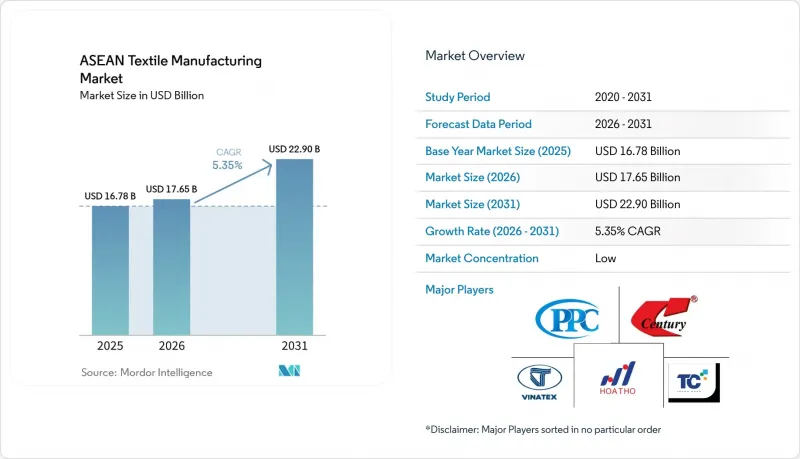
據 Mordor Intelligence 稱,2025 年東協紡織品製造市場價值 167.8 億美元,預計到 2031 年將達到 229 億美元,而 2026 年為 176.5 億美元,預測期(2026-2031 年)複合年成長率為 5.35%。
東協紡織品製造業市場趨勢與洞察
出口和採購來源多元化以及近岸外包
自2024年以來,全球服裝和紡織品買家調整了採購計劃,使得東協紡織品製造市場成為重要的生產中心。越南在美國服裝進口中所佔佔有率從2024年的18.9%上升至2025年的21.1%。 2025年前九個月,柬埔寨紡織品、服裝、鞋類和旅行用品的出口較去年同期成長16.6%。越南、泰國和柬埔寨的製造商正在提升紡紗、織造和染色能力,以確保先前留在中國的更多生產佔有率。長期來看,能夠在符合原產地認證規則的地點供應紡織品、紗線和布料的生產商可能更具優勢。緬甸的人事費用仍然較低,但政治不穩定限制了以認證為導向的買家所要求的正規產能擴張。越南2025年的工業生產指數成長了9.2%,顯示訂單增加正在支撐製造業產出和訂單積壓。
自由貿易協定原產地規則、本地採購和數位化生產
《東協紡織工業成長協定》(ATIGA)、《區域全面經濟夥伴關係協定》(RCEP)和雙邊協定中的原產地規則影響著東協紡織品製造業市場的投資決策和貿易單據的編制。 ATIGA的紡織品原產地規則要求滿足「紗線前驅」標準之一或區域增加值達到40%才能享受優惠關稅。 2025年ATIGA修正案將優惠進入範圍擴大到458個稅號,並引入了電子版D表原產地證書。 RCEP允許製造商在15個參與經濟區內累積合格的投入品,從而拓寬了合格生產商的採購基礎。這個框架正在刺激越南和馬來西亞新的紡紗和織造項目,因為經認證的上游工程生產能力確保了關稅准入,而過境模式則無法提供這種准入。雖然數位印花和小批量生產系統提供了更大的柔軟性,但其優勢因業務、資金籌措和客戶需求而異。因此,在東協紡織品製造業市場,能夠結合本地原料採購、電子合規系統和快速生產調度的工廠具有優勢。
對棉花進口的依賴以及紡織品價格的波動
由於國內棉花產量有限,東協紡織製造業市場仍容易受到全球棉花和紡織品價格波動的影響。越南在2025/26銷售年度進口了760萬包棉花(每包480英鎊),其中美國、巴西和澳洲在2025年8月至2026年2月期間供應了86%的進口量。雖然棉花價格下跌會降低投入成本,但紗線價差收窄也可能擠壓紡紗廠的利潤空間。越南紡織業協會(Vinatex)指出,100%依賴棉花進口和90-95%依賴紡織品進口是其主要脆弱性因素。由於購買力下降和進口減少,印尼2025/26銷售年度的棉花消費量預計將下降5%,至185萬包。此外,儘管新的再生纖維專案取得了進展,但紡織廢棄物收集系統的不完善限制了可靠的循環原料的供應。印尼棉紗進口的保障措施保護了紡紗廠,但增加了下游紡織和針織企業的成本。
細分市場分析
至2025年,通用合成纖維將佔東協紡織品製造業市場銷售額的49.5%。聚酯纖維、尼龍、聚丙烯、腈綸和氨綸等纖維非常適合該地區成熟的聚合物、紡紗和加撚工藝,因此能夠支援大規模生產。合成纖維佔全球紡織品產量的67.4%,其中聚酯纖維佔57.2%。天然纖維仍然很重要,但棉花嚴重依賴進口,而絲綢和羊毛等動物纖維則主要用於泰國和越南等更專業的領域。粘膠纖維、Lyocell纖維、莫代爾纖維和醋酸纖維等人造纖維素纖維正逐漸成為品牌商替代原生聚酯纖維和傳統種植棉花的選擇。
在東協紡織品製造市場,特種纖維和高性能纖維預計將在2026年至2031年間以8.2%的複合年成長率成長。芳香聚醯胺、超高分子量聚乙烯(UHMWPE)、工業長絲和碳纖維增強材料廣泛應用於運輸、國防、防護和工業領域。該領域的發展依賴於技術規範、穩定的性能以及與工業買家的緊密合作。 Indorama Ventures於2025年成立的再生PET合資企業,展現了區域紡織品製造商如何尋求從再生紡織品中創造價值。隨著歐洲對聚酯產品中再生材料含量的要求日益嚴格,經認證的回收過程可能比僅使用原生樹脂的生產方式更受青睞。這種轉變可能會促使企業選擇那些能夠檢驗原料來源和生產品質的供應商。
至2025年,紡織品製造業將佔東協紡織品製造業市場的43.5%。越南、印尼、泰國和馬來西亞均已建立紡織品、針織品和不織布的生產系統。 2025年,越南擁有121家紡紗廠,預計產能相當於1,040萬錠。其中包括46家外資工廠和75家本地工廠。紡織品生產集中在越南北部以及爪哇中部和西部地區,而馬來西亞和泰國則具備高性能針織物的生產能力。不織布可用於生產醫用紡織品、地工織物、過濾器和個人防護設備(PPE),但需要大量的資本投資。
在東協紡織品製造市場,紡織品整理和表面處理預計到2031年將以7.7%的複合年成長率成長。預處理、漂白、染色、印花、塗層和其他表面處理工程在決定織物是否滿足客戶的化學品、水和碳排放要求方面發揮越來越重要的作用。根據Epson和IDC提供的數據,與傳統的網版印刷相比,數位印刷可減少90%的用水量。即使在需求波動時期,該製程也能滿足小批量訂單和快速設計變更的需求。印尼修訂後的廢水標準要求大型濕加工企業在2027年底前投資以達到合規要求。雖然該領域的成長反映了對認證整理材料需求的增加,但由於更嚴格的環境法規,預計資本需求也將增加。
其他好處:
- Excel格式的市場預測(ME)表
- 3個月的分析師支持
目錄
第1章:引言
- 研究假設和市場定義
- 調查範圍
第2章:調查方法
第3章執行摘要
第4章 市場狀況
- 市場概覽
- 市場促進因素
- 出口和採購來源多元化以及近岸外包
- 自由貿易協定原產地規則與區域供應鏈本地化
- 醫療、交通運輸和工業應用領域對技術紡織品的需求。
- 品牌對可追溯且環保的材料有需求。
- 數位化生產和小批量客製化
- 擴大再生纖維的生產能力
- 市場限制因素
- 棉花進口依賴性和纖維價格波動
- 能源、水和合規成本不斷上漲
- 中小企業自動化技能差距和資金籌措。
- 紡織廢棄物收集不足,再生原料供應可靠性低。
- 價值供應鏈分析
- 監理情勢
- 技術展望
- 智慧製造、自動化與人工智慧應用分析
- 數位紡織印花
- 人工智慧驅動的需求和生產計畫
- 纖維到纖維的回收利用
- 東協紡織品生產、消費與貿易的分析與思考
- 主要紡織品生產國製造成本競爭力分析
- 東協供應鏈多元化分析
- 原料供應狀況及纖維價格趨勢分析
- 投資趨勢、產能擴充與製造地搬遷
- 對永續和循環紡織製造的深入了解
- 評估貿易政策和地緣政治事件對市場的影響
第5章 市場規模與成長預測
- 按成分
- 天然纖維
- 植物來源纖維
- 棉布
- 其他(黃麻、亞麻、大麻、苧麻、柯爾麻)
- 動物性纖維(羊毛、絲綢和其他動物纖維)
- 植物來源纖維
- 人造纖維素纖維(黏膠/人造絲、Lyocell纖維、莫代爾纖維、醋酸纖維)
- 通用合成纖維(聚酯纖維、尼龍/聚醯胺纖維、聚丙烯纖維、腈綸纖維、彈性纖維)
- 特殊纖維及高性能纖維(芳香聚醯胺、超高分子量聚乙烯等)
- 天然纖維
- 按製造程序和產品類型
- 生產線和縫紉線
- 織物製造
- 織物
- 編織和鉤編
- 不織布和毛氈的生產
- 其他紡織品製造程序
- 紡織品整理與表面處理(預處理、漂白、染色、印花等)
- 按最終用途行業分類
- 服裝與時尚
- 家用紡織品
- 技術及工業紡織品
- 交通運輸與出行
- 醫療衛生
- 工業加工和過濾
- 用於建築和地基工程的不織布
- 保護/安全
- 包裝
- 其他技術應用—農業等。
- 按企業規模
- 大規模有組織的製造商
- 微型、小規模和中型企業(MSMEs)以及非正規部門
- 按地區
- 越南
- 印尼
- 泰國
- 馬來西亞
- 柬埔寨
- 緬甸
- 菲律賓
- 其他東南亞國協-新加坡、寮國人民民主共和國、汶萊
第6章 競爭情勢
- 市場集中度
- 策略趨勢
- 市佔率分析
- 公司簡介
- Vietnam National Textile and Garment Group
- Thanh Cong Textile Garment Investment Trading Joint Stock Company
- Phong Phu Corporation JSC
- Hoa Tho Textile-Garment Joint Stock Corporation
- Century Synthetic Fiber Corporation
- PT Asia Pacific Fibers Tbk
- PT Sri Rejeki Isman Tbk
- PT Indo-Rama Synthetics Tbk
- Duniatex
- PT Tifico Fiber Indonesia Tbk
- PT Elegant Textile Industry
- PT Indo Liberty Textiles
- PT Sunrise Bumi Textiles
- Ramatex Textiles Industrial Sdn Bhd
- Penfabric Sdn Berhad
- Toray Industries Malaysia Sdn Bhd
- Aditya Birla Yarns
- Indo Thai Synthetics Co. Ltd
- Jong Stit Group
- Innotech Textile(M)Sdn. Bhd.
第7章 市場機會與未來展望
According to Mordor Intelligence, the ASEAN textile manufacturing market size was valued at USD 16.78 billion in 2025 and is estimated to grow from USD 17.65 billion in 2026 to reach USD 22.90 billion by 2031, at a CAGR of 5.35% during the forecast period (2026-2031).
ASEAN Textile Manufacturing Market Trends and Insights
Export-Sourcing Diversification and Nearshoring
Global apparel and textile buyers have changed their sourcing plans since 2024, and the ASEAN textile manufacturing market has become a major destination for the resulting production. Vietnam's share of United States apparel imports rose to 21.1% in 2025 from 18.9% in 2024. Cambodia's textile, garment, footwear, and travel goods exports rose 16.6% year over year in the first 9 months of 2025. Manufacturers in Vietnam, Thailand, and Cambodia are adding spinning, weaving, and dyeing capacity to retain more production that had previously remained in China. The lasting advantage is likely to favor producers that can supply fiber, yarn, and fabric within a certified, rules-of-origin-compliant location. Myanmar retains low labor costs, but political instability limits the formal capacity expansion certification-focused buyers seek. Vietnam's industrial production index rose 9.2% in 2025, showing that order growth has supported manufacturing output as well as bookings.
FTA Rules of Origin, Regional Localization, and Digital Production
Rules of origin under ATIGA, RCEP, and bilateral agreements affect investment decisions and trade documentation in the ASEAN textile manufacturing market. ATIGA textile rules require either a yarn-forward standard or 40% regional value content for preferential tariff eligibility. The 2025 ATIGA revision expanded preferential access across 458 tariff lines and introduced electronic Form D origin certification. RCEP lets manufacturers cumulate qualifying inputs across 15 participating economies, which broadens the sourcing base available to an eligible producer. This framework encourages new spinning and weaving projects in Vietnam and Malaysia because certified upstream capacity can support tariff access that a transshipment model cannot offer. Digital printing and small-batch systems add flexibility, although their benefits depend on operators, funding, and customer demand. The ASEAN textile manufacturing market therefore rewards plants that combine local input sourcing, electronic compliance systems, and responsive production scheduling.
Cotton Import Dependence and Fiber-Price Volatility
The ASEAN textile manufacturing market remains exposed to global cotton and fiber-price movements because domestic cotton production is limited. Vietnam imported 7.6 million 480-pound bales of cotton in marketing year 2025/26, and the United States, Brazil, and Australia supplied 86% of the volume between August 2025 and February 2026. Lower cotton prices can reduce input costs, but narrow yarn spreads can also compress spinner margins. Vinatex has identified 100% cotton import dependence and 90% to 95% fiber import dependence as key vulnerabilities. Indonesia's cotton consumption is forecast to decline 5% to 1.85 million bales in marketing year 2025/26 as weaker purchasing power constrains imports. Weak textile-waste collection also restricts reliable circular feedstock, despite new recycled-fiber projects. Indonesia's safeguards on imported cotton yarn can protect spinners while raising costs for downstream weavers and knitters.
Other drivers and restraints analyzed in the detailed report include:
- Technical Textile Demand from Medical, Mobility, and Industrial Uses
- Brand Demand for Traceable and Lower-Impact Materials
- Energy, Water, and Compliance Cost Inflation
For complete list of drivers and restraints, kindly check the Table Of Contents.
Segment Analysis
Commodity synthetics accounted for 49.5% of the ASEAN textile manufacturing market revenue in 2025. Polyester, nylon, polypropylene, acrylic, and elastane support large-volume production because they fit established regional polymer, spinning, and texturing operations. Synthetic fibers accounted for 67.4% of global fiber production, and polyester represented 57.2% of global output. Natural fibers remain important, but cotton is imported, and animal fibers such as silk and wool serve more specialized activities in Thailand and Vietnam. Artificial cellulosic fibers such as viscose, lyocell, modal, and acetate offer brands an alternative to virgin polyester and conventionally grown cotton.
Specialty and high-performance fibers are forecast to grow at an 8.2% CAGR from 2026 to 2031 within the ASEAN textile manufacturing market. Aramid, UHMWPE, technical filaments, and carbon-fiber-reinforced materials are used in transport, defense, protection, and industrial applications. The segment relies on technical specifications, consistent performance, and close engagement with industrial buyers. Indorama Ventures' 2025 recycled PET joint venture shows how a regional fiber producer is pursuing value from recovered textiles. Expected recycled-content requirements for polyester products supplied to Europe may favor certified recycled processing over virgin-resin-only production. This change can move purchasing decisions toward suppliers that can verify material origin and process quality.
Fabric manufacturing accounted for 43.5% of the ASEAN textile manufacturing market size in 2025. Weaving, knitting, and nonwoven production are established across Vietnam, Indonesia, Thailand, and Malaysia. Vietnam had an estimated 10.4 million spindle equivalents across 121 spinning mills in 2025, including 46 foreign-invested mills and 75 domestic mills. Weaving is concentrated in northern Vietnam and the Central and West Java belt, while Malaysia and Thailand have capabilities in knit performance fabrics. Nonwovens support medical textiles, geotextiles, filtration, and personal protective equipment, but they require substantial capital investment.
Textile finishing and surface treatment are forecast to grow at a 7.7% CAGR through 2031 in the ASEAN textile manufacturing market. Pretreatment, bleaching, dyeing, printing, coating, and other finishing steps increasingly determine whether fabric meets customer chemical, water, and carbon requirements. Digital printing can use 90% less water than conventional screen printing, according to the supplied Epson and IDC material. This process also supports smaller orders and faster design changes when demand is uneven. Indonesia's updated wastewater standards will require major wet-processing facilities to invest in compliance by late 2027. The segment's growth reflects higher demand for certified finished inputs, although the added environmental controls will raise capital needs.
Complete Report Scope:
- By Raw Material
- Natural Fibers
- Plant-Based Fibers
- Cotton
- Others (Jute, Flax, Hemp, Ramie, Coir)
- Animal-Based Fibers (Wool, Silk, and Other Animal Fibers)
- Plant-Based Fibers
- Man-Made Cellulosic Fibers (Viscose/Rayon, Lyocell, Modal, and Acetate)
- Commodity Synthetics (Polyester, Nylon/Polyamide, Polypropylene, Acrylic, and Elastane)
- Specialty and High-Performance Fibers (Aramid, UHMWPE, etc.)
- Natural Fibers
- By Manufacturing Process and Product Type
- Yarn and Thread Manufacturing
- Fabric Manufacturing
- Weaving
- Knitting and Crocheting
- Nonwoven and Felt Manufacturing
- Other Fabric-Formation Processes
- Textile Finishing and Surface Treatment (Pretreatment, Bleaching, Dyeing, Printing, etc.)
- By End Use Industry
- Apparel and Fashion
- Home and Household Textiles
- Technical and Industrial Textiles
- Transportation and Mobility
- Medical and Hygiene
- Industrial Processing and Filtration
- Construction and Geotextiles
- Protective and Safety
- Packaging
- Other Technical Applications - Agriculture, etc.
- By Enterprise Scale
- Large Organized Manufacturers
- Micro, Small, and Medium Enterprises (MSMEs) and the unorganized sector
- By Geography
- Vietnam
- Indonesia
- Thailand
- Malaysia
- Cambodia
- Myanmar
- Philippines
- Rest of ASEAN Countries - Singapore, Lao PDR and Brunei
List of Companies Covered in this Report:
- Vietnam National Textile and Garment Group
- Thanh Cong Textile Garment Investment Trading Joint Stock Company
- Phong Phu Corporation JSC
- Hoa Tho Textile - Garment Joint Stock Corporation
- Century Synthetic Fiber Corporation
- PT Asia Pacific Fibers Tbk
- PT Sri Rejeki Isman Tbk
- PT Indo-Rama Synthetics Tbk
- Duniatex
- PT Tifico Fiber Indonesia Tbk
- PT Elegant Textile Industry
- PT Indo Liberty Textiles
- PT Sunrise Bumi Textiles
- Ramatex Textiles Industrial Sdn Bhd
- Penfabric Sdn Berhad
- Toray Industries Malaysia Sdn Bhd
- Aditya Birla Yarns
- Indo Thai Synthetics Co. Ltd
- Jong Stit Group
- Innotech Textile (M) Sdn. Bhd.
Additional Benefits:
- The market estimate (ME) sheet in Excel format
- 3 months of analyst support
TABLE OF CONTENTS
1 Introduction
- 1.1 Study Assumptions and Market Definition
- 1.2 Scope of the Study
2 Research Methodology
3 Executive Summary
4 Market Landscape
- 4.1 Market Overview
- 4.2 Market Drivers
- 4.2.1 Export-Sourcing Diversification and Nearshoring
- 4.2.2 FTA Rules of Origin and Regional Supply-Chain Localization
- 4.2.3 Technical Textile Demand from Medical, Mobility, and Industrial Uses
- 4.2.4 Brand Demand for Traceable and Lower-Impact Materials
- 4.2.5 Digital Production and Small-Batch Customization
- 4.2.6 Regenerated and Recycled Fiber Capacity Expansion
- 4.3 Market Restraints
- 4.3.1 Cotton Import Dependence and Fiber-Price Volatility
- 4.3.2 Energy, Water, and Compliance Cost Inflation
- 4.3.3 Uneven Automation Skills and SME Financing Constraints
- 4.3.4 Weak Textile-Waste Collection and Circular Feedstock Reliability
- 4.4 Value / Supply-Chain Analysis
- 4.5 Regulatory Landscape
- 4.6 Technological Outlook
- 4.6.1 Analysis of Smart Manufacturing, Automation, and AI Adoption
- 4.6.2 Digital Textile Printing
- 4.6.3 AI-Enabled Demand and Production Planning
- 4.6.4 Fiber-to-Fiber Recycling
- 4.7 Insights on ASEAN Textile Production, Consumption, and Trade Analysis
- 4.8 Insights on Manufacturing Cost Competitiveness Across Major Textile-Producing Countries
- 4.9 Analysis of ASEAN Supply Chain Diversification
- 4.10 Insights on Raw Material Availability and Fiber Price Trends
- 4.11 Investments, Capacity Expansion, and Manufacturing Relocation Activities
- 4.12 Insights on Sustainable and Circular Textile Manufacturing
- 4.13 Impact Assessment of Trade Policies and Geopolitical Events on the Market
5 Market Size and Growth Forecasts
- 5.1 By Raw Material
- 5.1.1 Natural Fibers
- 5.1.1.1 Plant-Based Fibers
- 5.1.1.1.1 Cotton
- 5.1.1.1.2 Others (Jute, Flax, Hemp, Ramie, Coir)
- 5.1.1.2 Animal-Based Fibers (Wool, Silk, and Other Animal Fibers)
- 5.1.1.1 Plant-Based Fibers
- 5.1.2 Man-Made Cellulosic Fibers (Viscose/Rayon, Lyocell, Modal, and Acetate)
- 5.1.3 Commodity Synthetics (Polyester, Nylon/Polyamide, Polypropylene, Acrylic, and Elastane)
- 5.1.4 Specialty and High-Performance Fibers (Aramid, UHMWPE, etc.)
- 5.1.1 Natural Fibers
- 5.2 By Manufacturing Process and Product Type
- 5.2.1 Yarn and Thread Manufacturing
- 5.2.2 Fabric Manufacturing
- 5.2.2.1 Weaving
- 5.2.2.2 Knitting and Crocheting
- 5.2.2.3 Nonwoven and Felt Manufacturing
- 5.2.2.4 Other Fabric-Formation Processes
- 5.2.3 Textile Finishing and Surface Treatment (Pretreatment, Bleaching, Dyeing, Printing, etc.)
- 5.3 By End Use Industry
- 5.3.1 Apparel and Fashion
- 5.3.2 Home and Household Textiles
- 5.3.3 Technical and Industrial Textiles
- 5.3.3.1 Transportation and Mobility
- 5.3.3.2 Medical and Hygiene
- 5.3.3.3 Industrial Processing and Filtration
- 5.3.3.4 Construction and Geotextiles
- 5.3.3.5 Protective and Safety
- 5.3.3.6 Packaging
- 5.3.3.7 Other Technical Applications - Agriculture, etc.
- 5.4 By Enterprise Scale
- 5.4.1 Large Organized Manufacturers
- 5.4.2 Micro, Small, and Medium Enterprises (MSMEs) and the unorganized sector
- 5.5 By Geography
- 5.5.1 Vietnam
- 5.5.2 Indonesia
- 5.5.3 Thailand
- 5.5.4 Malaysia
- 5.5.5 Cambodia
- 5.5.6 Myanmar
- 5.5.7 Philippines
- 5.5.8 Rest of ASEAN Countries - Singapore, Lao PDR and Brunei
6 Competitive Landscape
- 6.1 Market Concentration
- 6.2 Strategic Moves
- 6.3 Market Share Analysis
- 6.4 Company Profiles (Includes Global Level Overview, Market Level Overview, Core Segments, Financials as available, Strategic Information, Products and Services, Recent Developments)
- 6.4.1 Vietnam National Textile and Garment Group
- 6.4.2 Thanh Cong Textile Garment Investment Trading Joint Stock Company
- 6.4.3 Phong Phu Corporation JSC
- 6.4.4 Hoa Tho Textile - Garment Joint Stock Corporation
- 6.4.5 Century Synthetic Fiber Corporation
- 6.4.6 PT Asia Pacific Fibers Tbk
- 6.4.7 PT Sri Rejeki Isman Tbk
- 6.4.8 PT Indo-Rama Synthetics Tbk
- 6.4.9 Duniatex
- 6.4.10 PT Tifico Fiber Indonesia Tbk
- 6.4.11 PT Elegant Textile Industry
- 6.4.12 PT Indo Liberty Textiles
- 6.4.13 PT Sunrise Bumi Textiles
- 6.4.14 Ramatex Textiles Industrial Sdn Bhd
- 6.4.15 Penfabric Sdn Berhad
- 6.4.16 Toray Industries Malaysia Sdn Bhd
- 6.4.17 Aditya Birla Yarns
- 6.4.18 Indo Thai Synthetics Co. Ltd
- 6.4.19 Jong Stit Group
- 6.4.20 Innotech Textile (M) Sdn. Bhd.
7 Market Opportunities & Future Outlook
- 7.1 White-Space and Unmet-Need Assessment

 2026-2030年全球紡織品檢測設備市場
 紡織品市場報告:趨勢、預測和競爭分析(至2035年)
 有機家用紡織品市場預測至2034年-按產品類型、材料、分銷管道、價格範圍、應用和地區分類的全球分析
 海洋塑膠纖維市場規模、佔有率和趨勢分析報告:按塑膠原料、聚合物類型、纖維形態、最終用途、地區和細分市場預測(2026-2033 年)
 越南紡織製造業:市場佔有率分析、產業趨勢與統計及成長預測(2026-2031年)絲線:市場佔有率分析、產業趨勢與統計、成長預測(2026-2031)歐洲紡織品市場:市場佔有率分析、產業趨勢與統計、成長預測(2026-2031年)泰國紡織品市場:市場佔有率分析、產業趨勢與統計及成長預測(2026-2031)印尼紡織製造業:市場佔有率分析、產業趨勢與統計及成長預測(2026-2031年)義大利紡織製造業:市場佔有率分析、產業趨勢與統計、成長預測(2026-2031)