


 |
市場調查報告書
商品編碼
2113462
義大利紡織製造業:市場佔有率分析、產業趨勢與統計、成長預測(2026-2031)Italy Textile Manufacturing - Market Share Analysis, Industry Trends & Statistics, Growth Forecasts (2026 - 2031) |
||||||

※ 本網頁內容可能與最新版本有所差異。詳細情況請與我們聯繫。
據 Mordor Intelligence 稱,2025 年義大利紡織品製造業市場價值為 303.2 億美元,預計到 2031 年將達到 366.4 億美元,而 2026 年為 313 億美元,預測期(2026-2031 年)的複合年成長率為 3.22%。
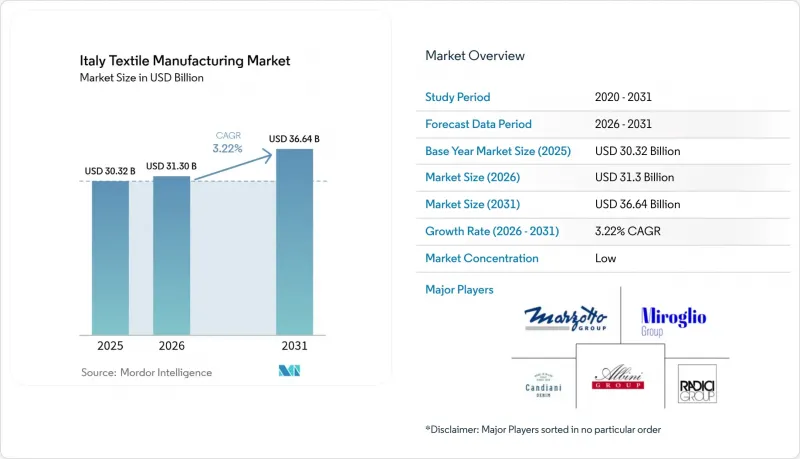
本報告按應用領域(時尚服飾、工業及技術紡織品等)、原料(天然纖維、合成纖維、再生纖維等)、生產流程及技術(機織織物、針織織物、不織布等)以及地區(西北、東北、中部和南部/島嶼)進行分類。市場預測以美元計價。
義大利紡織品製造業市場趨勢與洞察
工業和功能性纖維產能快速擴張
技術紡織品已佔義大利國內產量的22%,銷售額超過40億美元,使義大利成為全球第四大生產國。受衝突導致的需求成長的推動,義大利防護織物出口占全球市場佔有率的6.5%,這主要得益於對軍事和緊急服務的出口成長。併購活動正在加速義大利紡織業的成長。 Quadrivio的「工業4.0基金」收購了聚丙烯紡粘技術專家SoftNW公司。該公司年收入達3,600萬美元,其中90%出口到德國以及中東歐國家。在「MY-FI Horizon」計畫下,汽車原始設備製造商正在試驗使用菌絲複合材料製造儀表板和座椅靠背,同時,過濾材料也符合歐盟室內空氣品質指令的要求。隨著ISO 14001認證成為強制性要求,義大利加工商正在爭取長期契約,在這些合約中,合規性和性能優先於價格,這進一步擴大了他們相對於低工資競爭對手的優勢。
出口主導高品質羊毛和絲綢布料市場復甦
正裝市場的選擇性復甦正為比耶拉的毛紡廠和科莫的絲綢加工廠帶來訂單回流。儘管經濟成長放緩,雷達公司2024年的銷售額仍達到8,300萬美元,而2025年初的帳單顯示,由於庫存水準最佳化,北美市場的需求更加穩定。市值3.98億美元的馬佐托集團利用覆蓋歐洲和北非的從精煉到後整理的全整合供應鏈,確保產品品質和準時交付。一些知名品牌正透過將記錄紡織品來源、加工化學品和碳足跡的區塊鏈2D碼標籤與工匠的專業知識相結合,來滿足「數位產品護照」的要求。與Spiber合作開發的「Brewed Protein™」混紡布料,展示了一種將生物技術纖維融入精紡布料而不影響懸垂性的方法,鞏固了其在高階市場的地位,而亞洲紡紗廠一直難以複製這一優勢。即使全球奢侈品消費恢復正常,原產地和可追溯性的持續差異化預計將使平均出口售價 (ASP) 保持強勁。
能源和天然氣價格飆升正在影響染色和整理行業的利潤率。
預計2024年天然氣和電力成本將年比飆升28%,這將對未透過汽電共生或購電協議(PPA)進行對沖的中小型企業(SME)帶來沉重負擔。染色和整理生產線佔紡織業溫室氣體(GHG)排放量的一半以上,預計其息稅折舊攤銷前利潤(EBITDA)將下降至多300個基點,威尼托地區的員工休假率將上升91%。機械供應商報告稱,2024年上半年產能運轉率將停滯在61%,預計隨著電力期貨價格趨於穩定,產能利用率僅會略有上升。耗水量龐大的廢水處理產業本已面臨更嚴格的排放限制,如今更是加劇了能源成本負擔。雖然像Marchi & Fildi這樣的大型企業已透過熱回收和薄膜過濾提高了效率,但如果補貼延遲發放,規模小規模的整理企業則面臨退出市場的風險。短期緩解措施取決於對電網脫碳的津貼以及工業 5.0 的快速普及。
細分市場分析
到2025年,時尚服裝業將佔義大利紡織品製造業市場佔有率的48.35%,再次鞏固了義大利作為奢侈品生產中心的傳統地位。儘管2024年銷售額成長乏力,LVMH集團的銷售額較上年下降了16億美元,但該行業憑藉精湛的工藝和可追溯性認證,依然保持了其定價權。工業和技術紡織品正在推動成長,預計到2031年,其複合年成長率將達到4.66%,這主要得益於汽車製造商對輕質複合材料的需求以及國防機構對防護裝備的採購。新興的跨界產品,例如用於汽車內飾的菌絲生物皮革,正在模糊傳統界限,使時尚製造商能夠在不放棄其核心競爭優勢的前提下,將業務拓展到技術細分市場。
用於航太的高強度芳香聚醯胺和超高分子量聚乙烯(UHMWPE)織物、用於暖通空調(HVAC)維修的過濾以及用於醫療用途的一次性不織布產品,其目標市場正從高級時裝領域拓展至更廣泛的領域。隸屬於MY-FI聯盟的新創公司已與大眾汽車和Stellantis等公司建立了合作關係,這表明工業紡織品如何利用義大利設計理念來獲得高利潤合約。儘管大眾服飾市場正受到亞洲進口產品的壓力,但對奢侈品和客製化產品的需求依然強勁,自由裁量權支出的復甦將為這兩大支柱產業提供充足的成長空間。
其他好處:
- Excel格式的市場預測(ME)表
- 3個月的分析師支持
目錄
第1章:引言
- 研究假設和市場定義
- 調查範圍
第2章:調查方法
第3章執行摘要
第4章 市場狀況
- 市場概覽
- 市場促進因素
- 高品質羊毛和絲綢布料出口主導經濟復甦
- 技術紡織品和工業紡織品產能快速擴張
- 為「國家復甦和韌性計畫」提供資金,以建立循環光纖樞紐
- 菌絲體和生物衍生纖維(MY-FI、SMARTWASTE)的試驗計畫正接近商業規模。
- 歐盟綠色新政和生態設計法規正在加速設備現代化。
- 引進數位相容的紡織機械(工業4.0稅額扣抵)
- 市場限制因素
- 能源和天然氣價格上漲正在影響染色和整理產業的利潤率。
- 儘管徵收了關稅,但來自亞洲的低價進口商品仍然帶來了競爭壓力。
- 環境工程師短缺和勞動力老化
- 北部地區加強了飲水限制。
- 價值供應鏈分析
- 監理情勢
- 技術展望
- 產業吸引力—五力分析
- 新進入者的威脅
- 買方的議價能力
- 供應商的議價能力
- 替代品的威脅
- 競爭公司之間的競爭
第5章 市場規模與成長預測
- 透過使用
- 時尚與服裝
- 工業和技術用紡織品
- 家用及家用紡織品
- 用於醫療保健領域的紡織品
- 汽車和運輸紡織品
- 其他(防護和運動紡織品等)
- 按成分
- 天然纖維
- 棉布
- 羊毛
- 絲綢
- 合成纖維
- 聚酯纖維
- 尼龍
- 人造絲/粘膠纖維
- 丙烯酸纖維
- 聚丙烯
- 再生纖維
- 其他(特殊高性能纖維(芳香聚醯胺、碳纖維、超高分子量聚乙烯))
- 天然纖維
- 按工藝/技術
- 織物
- 針織
- 不織布
- 紡絲成網(紡粘/熔噴)
- 乾式突襲水力纏繞
- 濕法成網法
- 針刺機
- 3D編織織物和間隔織物
- 按地區
- 西北地區(Lombardia、Piemonte、Liguria、奧斯塔)
- 東北部(威尼托、特倫蒂諾-上阿迪傑、Friuli-Venezia Giulia、Emilia-Romagna)
- 中部(托斯卡納、馬爾凱、翁布里亞、拉齊奧)
- 南部地區和島嶼(Campania、普利亞、西西里、撒丁島等)
第6章 競爭情勢
- 市場集中度
- 策略趨勢
- 市佔率分析
- 公司簡介
- Marzotto Group
- Albini Group
- Miroglio Group
- RadiciGroup
- Candiani Denim
- Ratti SpA
- Carvico SpA
- Eurojersey SpA
- Pontetorto SpA
- Beste SpA
- Limonta SpA
- Sitip SpA
- Sinterama SpA
- Tessitura Monti SpA
- Gruppo Piacenza 1733
- Para Group
- Canclini 1925 SpA
- Noyfil SpA
- Manifattura Italiana Cucirini
- Gruppo Tessile Maglieria Benetton(manufacturing arm)
第7章 市場機會與未來展望
According to Mordor Intelligence, the Italy textile manufacturing market size was valued at USD 30.32 billion in 2025 and estimated to grow from USD 31.3 billion in 2026 to reach USD 36.64 billion by 2031, at a CAGR of 3.22% during the forecast period (2026-2031).
This report is Segmented by Application (Fashion & Apparel, Industrial/Technical Textiles, and More), by Raw Material (Natural Fibers, Synthetic Fibers, Recycled Fibers, and More), by Process/Technology (Woven, Knitted, Non-Woven, and More), and by Geography (North-West, North-East, Central and South & Islands). The Market Forecasts are Provided in Terms of Value (USD).
Italy Textile Manufacturing Market Trends and Insights
Rapid Scale-Up Of Technical/Industrial Textiles Capacity
Technical textiles already form 22% of domestic output and exceed USD 4 billion in turnover, placing Italy fourth worldwide. Protective fabric exports capture 6.5% global share as conflict-driven demand lifts shipments for military and emergency services. Growth is redoubled through M&A; Quadrivio's Industry 4.0 Fund took over Soft N.W., a polypropylene spunbond specialist earning USD 36 million with 90% exports to Germany and CEE. Automotive OEMs are piloting mycelium composites for dashboards and seat backs under the MY-FI Horizon program, while filtration media fit into EU indoor-air directives. With ISO 14001 credentials now table stakes, Italian converters are winning long-cycle contracts where compliance and performance trump unit cost, extending their lead over low-wage rivals.
Export-Led Rebound In Premium Wool & Silk Fabrics
Selective recovery in formalwear is reviving order books for Biella's wool mills and Como's silk converters. Reda held USD 83 million in sales in 2024 despite a slowdown, and early-2025 invoices signal steadier North American demand as inventory rightsizing concludes. Marzotto Group, with a USD 398 million turnover, is leveraging fully integrated scouring-to-finishing chains across Europe and North Africa to protect quality and lead times. Heritage houses are complementing artisanal expertise with blockchain QR tags that document fiber origin, processing chemicals, and carbon footprint, thus meeting Digital Product Passport rules. Brewed Protein(TM) blends created with Spiber showcase how biotech fibers can be inserted into worsted lines without compromising drape, anchoring a premium tier that Asian mills struggle to replicate. Sustained differentiation on provenance and traceability is expected to keep export ASPs resilient even as global luxury consumption normalizes.
Surging Energy & Gas Prices Impacting Dyeing/Finishing Margins
Gas and electricity costs spiked 28% year-on-year in 2024, throttling SMEs that lack cogeneration or PPA hedges. Dyeing and finishing lines, responsible for over half of textile GHG emissions, saw EBITDA compress by up to 300 bps, prompting 91% more redundancy hours in Veneto. Machinery suppliers report capacity utilization stuck at 61% in H1 2024, with only a modest rise forecast as power futures ease. Water-intensive effluent treatment, already facing stricter discharge caps, magnifies the energy hit. Larger players like Marchi & Fildi captured efficiency gains via heat-recovery and membrane filtration, but micro-finishers risk exit if subsidies lag. Short-term relief hinges on grid decarbonization grants and faster Industry 5.0 rollout.
Other drivers and restraints analyzed in the detailed report include:
- EU Green Deal & Ecodesign Regulations Accelerating Re-Tooling
- National Recovery & Resilience Plan Funds For Circular Textile Hubs
- Competitive Pressure From Low-Cost Asian Imports Despite Tariffs
For complete list of drivers and restraints, kindly check the Table Of Contents.
Segment Analysis
Fashion & Apparel held 48.35% of Italy's textile manufacturing market share in 2025, underscoring the country's heritage as a luxury production hub. Sales suffered in 2024 as LVMH flagged USD 1.6 billion lower revenues year-over-year, yet the segment retained pricing power via artisanal quality and certified traceability. Industrial/Technical Textiles is the sprinter, poised to log a 4.66% CAGR through 2031 as automakers crave lightweight composites and defense agencies requisition protective gear. Emerging cross-overs like mycelium-based bio-leathers for car interiors blur classical boundaries, enabling fashion mills to pivot into technical niches without abandoning core competencies.
High-strength aramid and UHMWPE fabrics for aerospace, filtration felts for HVAC retrofits, and non-woven medical disposables are expanding addressable markets beyond couture. Startups under the MY-FI consortium collaborate with Volkswagen and Stellantis, demonstrating how industrial textiles piggy-back on Italy's design ethos to win high-margin contracts. Although mass-market apparel is squeezed by Asian imports, luxury and made-to-measure demand remains sticky, offering runway for dual-track growth once discretionary spending cycles recover.
Complete Report Scope:
- By Application
- Fashion & Apparel
- Industrial/Technical Textiles
- Household & Home Textiles
- Medical & Healthcare Textiles
- Automotive & Transport Textiles
- Others (Protective, Sports Textiles, etc.)
- By Raw Material
- Natural Fibers
- Cotton
- Wool
- Silk
- Synthetic Fibers
- Polyester
- Nylon
- Rayon / Viscose
- Acrylic
- Polypropylene
- Recycled Fibers
- Others (Speciality High-Performance Fibers (Aramid, Carbon, UHMWPE))
- Natural Fibers
- By Process / Technology
- Woven
- Knitted
- Non-woven
- Spunlaid (Spunbond / Melt-blown)
- Dry-laid Hydro-entangled
- Wet-Laid
- Needle-punched
- 3-D Weaving & Spacer Fabrics
- By Geography
- North-West (Lombardy, Piedmont, Liguria, Aosta)
- North-East (Veneto, Trentino-AA, Friuli-VG, Emilia-Romagna)
- Central (Tuscany, Marche, Umbria, Lazio)
- South & Islands (Campania, Apulia, Sicily, Sardinia, Others)
List of Companies Covered in this Report:
- Marzotto Group
- Albini Group
- Miroglio Group
- RadiciGroup
- Candiani Denim
- Ratti S.p.A.
- Carvico S.p.A.
- Eurojersey S.p.A.
- Pontetorto S.p.A.
- Beste S.p.A.
- Limonta S.p.A.
- Sitip S.p.A.
- Sinterama S.p.A.
- Tessitura Monti S.p.A.
- Gruppo Piacenza 1733
- Para Group
- Canclini 1925 S.p.A.
- Noyfil S.p.A.
- Manifattura Italiana Cucirini
- Gruppo Tessile Maglieria Benetton (manufacturing arm)
Additional Benefits:
- The market estimate (ME) sheet in Excel format
- 3 months of analyst support
TABLE OF CONTENTS
1 Introduction
- 1.1 Study Assumptions & Market Definition
- 1.2 Scope of the Study
2 Research Methodology
3 Executive Summary
4 Market Landscape
- 4.1 Market Overview
- 4.2 Market Drivers
- 4.2.1 Export-led rebound in premium wool & silk fabrics
- 4.2.2 Rapid scale-up of technical/industrial textiles capacity
- 4.2.3 National Recovery & Resilience Plan funds for circular textile hubs
- 4.2.4 Mycelium & bio-based fibre pilots (MY-FI, SMARTWASTE) reaching commercial scale
- 4.2.5 EU Green Deal & Ecodesign regulations accelerating re-tooling
- 4.2.6 Digital-ready textile machinery adoption (Industry 4.0 tax credits)
- 4.3 Market Restraints
- 4.3.1 Surging energy & gas prices impacting dyeing/finishing margins
- 4.3.2 Competitive pressure from low-cost Asian imports despite tariffs
- 4.3.3 Shortage of green-skilled technicians & ageing workforce
- 4.3.4 Increasing water-abstraction limits in northern districts
- 4.4 Value / Supply-Chain Analysis
- 4.5 Regulatory Landscape
- 4.6 Technological Outlook
- 4.7 Industry Attractiveness - Porter's Five Forces
- 4.7.1 Threat of New Entrants
- 4.7.2 Bargaining Power of Buyers
- 4.7.3 Bargaining Power of Suppliers
- 4.7.4 Threat of Substitutes
- 4.7.5 Intensity of Competitive Rivalry
5 Market Size & Growth Forecasts(Values, In USD Billion)
- 5.1 By Application
- 5.1.1 Fashion & Apparel
- 5.1.2 Industrial/Technical Textiles
- 5.1.3 Household & Home Textiles
- 5.1.4 Medical & Healthcare Textiles
- 5.1.5 Automotive & Transport Textiles
- 5.1.6 Others (Protective, Sports Textiles, etc.)
- 5.2 By Raw Material
- 5.2.1 Natural Fibers
- 5.2.1.1 Cotton
- 5.2.1.2 Wool
- 5.2.1.3 Silk
- 5.2.2 Synthetic Fibers
- 5.2.2.1 Polyester
- 5.2.2.2 Nylon
- 5.2.2.3 Rayon / Viscose
- 5.2.2.4 Acrylic
- 5.2.2.5 Polypropylene
- 5.2.3 Recycled Fibers
- 5.2.4 Others (Speciality High-Performance Fibers (Aramid, Carbon, UHMWPE))
- 5.2.1 Natural Fibers
- 5.3 By Process / Technology
- 5.3.1 Woven
- 5.3.2 Knitted
- 5.3.3 Non-woven
- 5.3.3.1 Spunlaid (Spunbond / Melt-blown)
- 5.3.3.2 Dry-laid Hydro-entangled
- 5.3.3.3 Wet-Laid
- 5.3.3.4 Needle-punched
- 5.3.4 3-D Weaving & Spacer Fabrics
- 5.4 By Geography
- 5.4.1 North-West (Lombardy, Piedmont, Liguria, Aosta)
- 5.4.2 North-East (Veneto, Trentino-AA, Friuli-VG, Emilia-Romagna)
- 5.4.3 Central (Tuscany, Marche, Umbria, Lazio)
- 5.4.4 South & Islands (Campania, Apulia, Sicily, Sardinia, Others)
6 Competitive Landscape
- 6.1 Market Concentration
- 6.2 Strategic Moves
- 6.3 Market Share Analysis
- 6.4 Company Profiles (includes Global level Overview, Market level overview, Core Segments, Financials as available, Strategic Information, Products & Services, and Recent Developments)
- 6.4.1 Marzotto Group
- 6.4.2 Albini Group
- 6.4.3 Miroglio Group
- 6.4.4 RadiciGroup
- 6.4.5 Candiani Denim
- 6.4.6 Ratti S.p.A.
- 6.4.7 Carvico S.p.A.
- 6.4.8 Eurojersey S.p.A.
- 6.4.9 Pontetorto S.p.A.
- 6.4.10 Beste S.p.A.
- 6.4.11 Limonta S.p.A.
- 6.4.12 Sitip S.p.A.
- 6.4.13 Sinterama S.p.A.
- 6.4.14 Tessitura Monti S.p.A.
- 6.4.15 Gruppo Piacenza 1733
- 6.4.16 Para Group
- 6.4.17 Canclini 1925 S.p.A.
- 6.4.18 Noyfil S.p.A.
- 6.4.19 Manifattura Italiana Cucirini
- 6.4.20 Gruppo Tessile Maglieria Benetton (manufacturing arm)
7 Market Opportunities & Future Outlook
- 7.1 White-space & Unmet-Need Assessment

 有機家用紡織品市場預測至2034年-按產品類型、材料、分銷管道、價格範圍、應用和地區分類的全球分析
 絲線:市場佔有率分析、產業趨勢與統計、成長預測(2026-2031)歐洲紡織品市場:市場佔有率分析、產業趨勢與統計、成長預測(2026-2031年)泰國紡織品市場:市場佔有率分析、產業趨勢與統計及成長預測(2026-2031)印尼紡織製造業:市場佔有率分析、產業趨勢與統計及成長預測(2026-2031年)馬來西亞紡織製造業:市場佔有率分析、產業趨勢與統計及成長預測(2026-2031)技術紡織材料市場預測至2034年—按纖維類型、材料、功能、應用、產業和地區分類的全球分析
 防護紡織品市場:2026-2032年全球市場預測(按織物類型、產品、製造流程、最終用途和分銷管道分類)動物源纖維市場:2026-2032 年全球市場按形態、混合成分、表面處理、分銷管道和應用進行預測。印尼紡織品:市場佔有率分析、產業趨勢與統計、成長預測(2026-2031)