


 |
市場調查報告書
商品編碼
2121965
印尼紡織製造業:市場佔有率分析、產業趨勢與統計及成長預測(2026-2031年)Indonesia Textile Manufacturing - Market Share Analysis, Industry Trends & Statistics, Growth Forecasts (2026 - 2031) |
||||||

※ 本網頁內容可能與最新版本有所差異。詳細情況請與我們聯繫。
根據 Mordor Intelligence 估計,到 2026 年,印尼紡織品製造業市場價值將達到 418.5 億美元,高於 2025 年的 401.5 億美元,預計到 2031 年將達到 515.2 億美元。
預計從 2026 年到 2031 年,其複合年成長率將達到 4.24%。
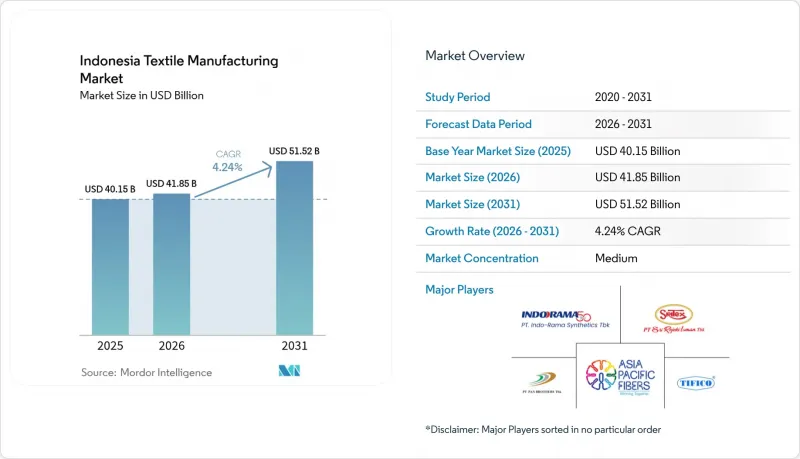
本報告按製造程序(織布、針織、紡紗等)、紡織品(布料、紗線、纖維等)、材質(天然纖維(棉、絲等))、應用領域(服裝、家用紡織品等)和地區(爪哇島、蘇門答臘島等)進行細分。報告提供了上述所有細分市場的規模和預測(以美元計)。
印尼紡織製造業市場趨勢與洞察
美國和歐盟品牌將運動服訂單轉移到爪哇島的叢集,這種趨勢日益成長。
亞洲傳統生產地人事費用不斷上漲,以及對更快補貨的需求,正促使西方品牌將目光轉向爪哇島的大型工廠。年產能達1.17億件服裝的Pan Brothers公司已獲得更多功能性針織服裝訂單,凸顯了印尼市場的顯著成長。島上工業園區內紗線、布料和縫紉部門的集中佈局,縮短了前置作業時間,降低了處理成本。然而,美國可能提高關稅的不確定性,仍是生產商擔憂的問題。
伊斯蘭時尚出口的快速成長正在推動高附加價值服裝的生產。
憑藉其文化親和性和設計能力,印尼正為不斷成長的全球「穆斯林時尚」市場供應產品,該市場預計到2023年將達到3,610億美元。參加紐約時裝週提升了印尼本土品牌的國際知名度,使其能夠設定更高的價格。高附加價值產品線有助於加強客戶關係,並需要先進的裝飾技術,這促使紡織廠投資於專用機械和熟練工匠的培訓。
非法低價進口商品正在侵蝕中小型紡織品製造商的利潤率。
非法進口商品以低於本地價格的價格出售,導致工廠倒閉和裁員,迫使各國政府收緊進口許可並加強檢查。儘管徵收了200%的保障性關稅,但執法不力使得假冒仿冒品布料得以通過港口,阻礙了當地紡織產業叢集收回成本。新的Permenperin 5/2024號法規旨在透過明確文件要求和連接海關資料庫來堵住這些漏洞。
細分市場分析
2025年,紡織業在印尼紡織品製造業市場中佔據36.92%的佔有率。這主要得益於西爪哇產業叢集中梭織機和劍桿織布機的產能。其主要產品為襯衫布料和丹寧布料,這些產品持續支撐著穩定的出口量。同時,受功能性服裝和休閒需求激增的推動,針織服飾業預計到2031年將維持4.93%的複合年成長率。生產商正在採用能夠處理小批量生產和功能性混紡紗線的圓形針織機,以適應線上零售商青睞的短交貨週期模式。
針織服裝產業的成長也反映出東南亞運動服飾品牌為快速補貨而增加的訂單。爪哇島的製造商正利用其內部的染色和印花設備交貨成品服飾,這比僅提供布料的供應商更具附加價值。中期來看,無縫結構等先進針織技術可望透過提高生產效率和減少生產後廢棄物,進一步增強印尼在舒適型服裝領域的競爭力。
到2025年,服裝將佔印尼紡織品製造業市場佔有率的59.5%,這充分體現了該國先進的縫紉技術和豐富的勞動力資源。生產商正從裁剪、縫紉和後整理等傳統工序轉向提供全套服務,包括為品牌客戶提供設計提案、商品行銷和合規文件等。功能性和工業用紡織品產業是成長最快的領域,預計年複合成長率將達到4.89%,這主要得益於基礎設施投資和汽車OEM生產的在地化。
印尼在服飾業的持續主導地位也得益於其「端莊服飾」這一細分市場。在這一市場,各大品牌將傳統圖案與現代輪廓融合,以滿足出口市場的需求。那些自主管理布料生產和染色等上游工程的一體化企業,在確保產品品質符合品牌審核標準的同時,正努力提高利潤率。同時,那些僅生產布料的製造商則透過將更多生產轉向防護衣、過濾器和汽車零件,來降低對時尚潮流的依賴。
其他好處:
- Excel格式的市場預測(ME)表
- 3個月的分析師支持
目錄
第1章:引言
- 研究假設和市場定義
- 調查範圍
第2章:調查方法
第3章執行摘要
第4章 市場狀況
- 市場概覽
- 市場促進因素
- 政府的「印尼製造4.0」計畫正在加速紡織業的自動化進程。
- 美國和歐盟品牌正擴大將運動服訂單給爪哇島的叢集。
- 伊斯蘭時尚的出口繁榮正在推動高附加價值服飾的生產。
- 電子商務推動了Z世代消費者對國內服飾需求的激增。
- 在高度依賴棉花的情況下,出現了一股以合成纖維取代進口棉花的潮流。
- 為中爪哇省環保印染廠維修的投資者提供稅收優惠。
- 市場限制因素
- 非法低價進口商品正在擠壓中小紡織品製造商的利潤空間。
- 長期存在的港口和鐵路瓶頸推高了島際物流成本。
- PLN 電價波動給能源密集型紡織業帶來了壓力。
- 西爪哇勞動力短缺導致當地工資高於越南。
- 價值供應鏈分析
- 對監管和政府主導措施的展望
- 技術趨勢-為工業4.0和數位轉型做好準備
- 產業吸引力—五力分析
- 新進入者的威脅
- 買方的議價能力
- 供應商的議價能力
- 替代品的威脅
- 競爭公司之間的競爭
- 近期全球動盪對印尼紡織業的影響
- 永續發展和循環經濟的發展趨勢
第5章 市場規模與成長預測
- 依工藝類型
- 旋轉
- 織物
- 針織
- 精加工
- 其他工藝(不織布)
- 依纖維類型
- 纖維
- 線
- 材料
- 服飾
- 其他紡織品
- 材料類型
- 天然纖維(棉、絲等)
- 合成纖維(聚酯纖維、尼龍等)
- 其他(再生纖維、特種纖維)
- 透過使用
- 服飾
- 家用紡織品
- 技術/工業紡織品
- 其他用途
- 按地區(印尼)
- 爪哇島
- 蘇門答臘
- 其他(加里曼丹、蘇拉威西、峇裡島等)
第6章 競爭情勢
- 市場集中度
- 策略趨勢
- 市佔率分析
- 公司簡介
- PT Asia Pacific Fibres Tbk
- Indo-Rama Synthetics Tbk
- PT Sri Rejeki Isman Tbk(Sritex)
- PT Tifico Fiber Indonesia Tbk
- PT Pan Brothers Tbk
- PT Ever Shine Tex Tbk
- PT Trisula Textile Industries Tbk
- PT Century Textile Industry Tbk(Toray)
- PT Polychem Indonesia Tbk
- PT Argo Pantes Tbk
- Duniatex Group
- PT Kahatex
- PT Apac Inti Corpora
- PT Eratex Djaja Tbk
- PT Ateja Tritunggal
- PT Sinar Para Taruna
- PT Kewalram Indonesia
- PT Pura Group(Textile Div.)
- PT Multi Garmenjaya
- PT Delami Garment Industries
第7章 市場機會與未來展望
According to Mordor Intelligence, the Indonesia textile manufacturing market size market size in 2026 is estimated at USD 41.85 billion, growing from 2025 value of USD 40.15 billion with 2031 projections showing USD 51.52 billion, growing at 4.24% CAGR over 2026-2031.
This report is Segmented by Process Type (Weaving, Knitting, Spinning, and More), by Textile Type (Fabric, Yarn, Fiber, and More), by Material Type (Natural Fibers (Cotton, Silk Etc. ), and More), by Application (Apparel, Home Textiles, and More), and by Region (Java, Sumatra and More). The Report Offers Market Size and Forecasts in Value (USD) for all the Above Segments.
Indonesia Textile Manufacturing Market Trends and Insights
Rising Near-Shoring of Activewear Orders from US & EU Brands to Java Clusters
Labor cost escalation in legacy Asian hubs and the need for faster replenishment bring Western labels to Java's large-scale plants. Pan Brothers, with annual capacity of 117 million pieces, has secured incremental contracts for performance knitwear, underscoring the pivot toward Indonesia. Close proximity among yarn, fabric, and garment units inside the island's industrial estates compresses lead times and lowers handling expenses. Nevertheless, uncertainty over potential US tariff hikes remains a watchpoint for producers.
Boom in Muslim Fashion Exports Driving Value-Added Garment Production
Indonesia leverages cultural affinity and design talent to supply the expanding global modest-fashion segment, estimated at USD 361 billion in 2023. Showcases at New York Fashion Week have raised international visibility, allowing local brands to command higher price points. Value-added lines create stickier customer relationships and require advanced embellishment techniques, prompting mills to invest in specialty machinery and skilled artisans.
Illegal Low-Priced Imports Eroding SME Weaving Margins
Unlawful inflows undercut local price points and have triggered factory closures and layoffs, pushing the government to tighten import permits and step up inspections. Even with 200% safeguard tariffs, weak enforcement lets counterfeit and sub-standard fabrics slip through ports, leaving community-based weaving clusters unable to recover overheads. The new Permenperin 5/2024 regulation aims to close loopholes by clarifying documentation requirements and synchronizing customs databases.
Other drivers and restraints analyzed in the detailed report include:
- Government "Making Indonesia 4.0" Incentives Accelerating Textile Automation
- Surge in E-Commerce-Led Domestic Apparel Demand Among Gen-Z Consumers
- Chronic Port & Rail Bottlenecks Inflating Inter-Island Logistics Cost
For complete list of drivers and restraints, kindly check the Table Of Contents.
Segment Analysis
Weaving retained a 36.92% share of the Indonesia textile manufacturing market in 2025, anchored by entrenched shuttle and rapier loom capacity across West Java clusters. Output caters mainly to shirtings and denim, segments that still support steady export volumes. Knitting, however, posts a 4.93% CAGR through 2031 as performance apparel and athleisure lines surge. Producers deploy circular knitting machines capable of smaller lot sizes and functional yarn blends, aligning with the short-run model favored by online retailers.
Knitting's growth also reflects rising orders from sportswear labels seeking quick replenishment out of Southeast Asia. Java-based makers leverage co-located dye-houses and print shops to deliver fully packaged garments, capturing greater value than fabric-only suppliers. In the medium term, advanced knitting techniques such as seamless construction are expected to lift productivity and reduce post-production waste, reinforcing Indonesia's competitiveness in comfort apparel.
Garments represented 59.5% of the Indonesia textile manufacturing market share in 2025, testifying to the country's deep sewing expertise and abundant workforce. Producers have moved beyond cut-make-trim to full-package services, offering design input, merchandising, and compliance documentation to brand customers. The fastest expansion occurs in technical and industrial textiles at 4.89% CAGR, reflecting infrastructure spending and automotive OEM localization.
Continued garment leadership also stems from Indonesia's modest-wear niche, where brands merge traditional motifs with modern silhouettes for export markets. Integrated players that control upstream fabric and dyeing steps capture improved margins and ensure quality alignment with brand audits. Meanwhile, fabric-only producers channel more output into protective wear, filtration, and automotive components, reducing reliance on fashion cycles.
Complete Report Scope:
- By Process Type
- Spinning
- Weaving
- Knitting
- Finishing
- Other Processes (non-woven)
- By Textile Type
- Fiber
- Yarn
- Fabric
- Garments
- Other Textiles
- By Material Type
- Natural Fibers (Cotton, Silk etc.)
- Synthetic Fibers (Polyester, Nylon etc.)
- Others (Regenerated & Recycled Fibers, Speciality Fibers)
- By Application
- Apparel
- Home Textiles
- Technical/Industrial Textiles
- Other Applications
- By Region (Indonesia)
- Java
- Sumatra
- Others (Kalimantan, Sulawesi, Bali, etc.)
List of Companies Covered in this Report:
- PT Asia Pacific Fibres Tbk
- Indo-Rama Synthetics Tbk
- PT Sri Rejeki Isman Tbk (Sritex)
- PT Tifico Fiber Indonesia Tbk
- PT Pan Brothers Tbk
- PT Ever Shine Tex Tbk
- PT Trisula Textile Industries Tbk
- PT Century Textile Industry Tbk (Toray)
- PT Polychem Indonesia Tbk
- PT Argo Pantes Tbk
- Duniatex Group
- PT Kahatex
- PT Apac Inti Corpora
- PT Eratex Djaja Tbk
- PT Ateja Tritunggal
- PT Sinar Para Taruna
- PT Kewalram Indonesia
- PT Pura Group (Textile Div.)
- PT Multi Garmenjaya
- PT Delami Garment Industries
Additional Benefits:
- The market estimate (ME) sheet in Excel format
- 3 months of analyst support
TABLE OF CONTENTS
1 Introduction
- 1.1 Study Assumptions & Market Definition
- 1.2 Scope of the Study
2 Research Methodology
3 Executive Summary
4 Market Landscape
- 4.1 Market Overview
- 4.2 Market Drivers
- 4.2.1 Government "Making Indonesia 4.0" incentives accelerating textile automation
- 4.2.2 Rising near-shoring of activewear orders from US & EU brands to Java clusters
- 4.2.3 Boom in Muslim fashion exports driving value-added garment production
- 4.2.4 Surge in e-commerce-led domestic apparel demand among Gen-Z consumers
- 4.2.5 Import-substitution push for man-made fibers amid high cotton dependency
- 4.2.6 Investor tax breaks for green dye-house upgrades in Central Java
- 4.3 Market Restraints
- 4.3.1 Illegal low-priced imports eroding SME weaving margins
- 4.3.2 Chronic port & rail bottlenecks inflating inter-island logistics cost
- 4.3.3 Volatile PLN electricity tariffs squeezing energy-intensive spinning
- 4.3.4 Tight labour pool in West Java driving wage inflation vs. Vietnam
- 4.4 Value / Supply-Chain Analysis
- 4.5 Regulatory & Government-Initiative Outlook
- 4.6 Technological Outlook - Industry 4.0 & Digital Transformation Readiness
- 4.7 Industry Attractiveness - Porter's Five Forces
- 4.7.1 Threat of New Entrants
- 4.7.2 Bargaining Power of Buyers
- 4.7.3 Bargaining Power of Suppliers
- 4.7.4 Threat of Substitutes
- 4.7.5 Intensity of Competitive Rivalry
- 4.8 Impact of Recent Global Disruptions on the Indonesia Textile Manufacturing Industry
- 4.9 Sustainability & Circular Economy Trends
5 Market Size & Growth Forecasts (Value, In USD Billion)
- 5.1 By Process Type
- 5.1.1 Spinning
- 5.1.2 Weaving
- 5.1.3 Knitting
- 5.1.4 Finishing
- 5.1.5 Other Processes (non-woven)
- 5.2 By Textile Type
- 5.2.1 Fiber
- 5.2.2 Yarn
- 5.2.3 Fabric
- 5.2.4 Garments
- 5.2.5 Other Textiles
- 5.3 By Material Type
- 5.3.1 Natural Fibers (Cotton, Silk etc.)
- 5.3.2 Synthetic Fibers (Polyester, Nylon etc.)
- 5.3.3 Others (Regenerated & Recycled Fibers, Speciality Fibers)
- 5.4 By Application
- 5.4.1 Apparel
- 5.4.2 Home Textiles
- 5.4.3 Technical/Industrial Textiles
- 5.4.4 Other Applications
- 5.5 By Region (Indonesia)
- 5.5.1 Java
- 5.5.2 Sumatra
- 5.5.3 Others (Kalimantan, Sulawesi, Bali, etc.)
6 Competitive Landscape
- 6.1 Market Concentration
- 6.2 Strategic Moves
- 6.3 Market Share Analysis
- 6.4 Company Profiles {(includes Global level Overview, Market level overview, Core Segments, Financials as available, Strategic Information, Products & Services, and Recent Developments)}
- 6.4.1 PT Asia Pacific Fibres Tbk
- 6.4.2 Indo-Rama Synthetics Tbk
- 6.4.3 PT Sri Rejeki Isman Tbk (Sritex)
- 6.4.4 PT Tifico Fiber Indonesia Tbk
- 6.4.5 PT Pan Brothers Tbk
- 6.4.6 PT Ever Shine Tex Tbk
- 6.4.7 PT Trisula Textile Industries Tbk
- 6.4.8 PT Century Textile Industry Tbk (Toray)
- 6.4.9 PT Polychem Indonesia Tbk
- 6.4.10 PT Argo Pantes Tbk
- 6.4.11 Duniatex Group
- 6.4.12 PT Kahatex
- 6.4.13 PT Apac Inti Corpora
- 6.4.14 PT Eratex Djaja Tbk
- 6.4.15 PT Ateja Tritunggal
- 6.4.16 PT Sinar Para Taruna
- 6.4.17 PT Kewalram Indonesia
- 6.4.18 PT Pura Group (Textile Div.)
- 6.4.19 PT Multi Garmenjaya
- 6.4.20 PT Delami Garment Industries
7 Market Opportunities & Future Outlook
- 7.1 White-Space & Unmet-Need Assessment

 有機家用紡織品市場預測至2034年-按產品類型、材料、分銷管道、價格範圍、應用和地區分類的全球分析
 絲線:市場佔有率分析、產業趨勢與統計、成長預測(2026-2031)歐洲紡織品市場:市場佔有率分析、產業趨勢與統計、成長預測(2026-2031年)泰國紡織品市場:市場佔有率分析、產業趨勢與統計及成長預測(2026-2031)義大利紡織製造業:市場佔有率分析、產業趨勢與統計、成長預測(2026-2031)馬來西亞紡織製造業:市場佔有率分析、產業趨勢與統計及成長預測(2026-2031)技術紡織材料市場預測至2034年—按纖維類型、材料、功能、應用、產業和地區分類的全球分析
 防護紡織品市場:2026-2032年全球市場預測(按織物類型、產品、製造流程、最終用途和分銷管道分類)動物源纖維市場:2026-2032 年全球市場按形態、混合成分、表面處理、分銷管道和應用進行預測。印尼紡織品:市場佔有率分析、產業趨勢與統計、成長預測(2026-2031)