


 |
市場調查報告書
商品編碼
2123101
歐洲紡織品市場:市場佔有率分析、產業趨勢與統計、成長預測(2026-2031年)Europe Textile - Market Share Analysis, Industry Trends & Statistics, Growth Forecasts (2026 - 2031) |
||||||

※ 本網頁內容可能與最新版本有所差異。詳細情況請與我們聯繫。
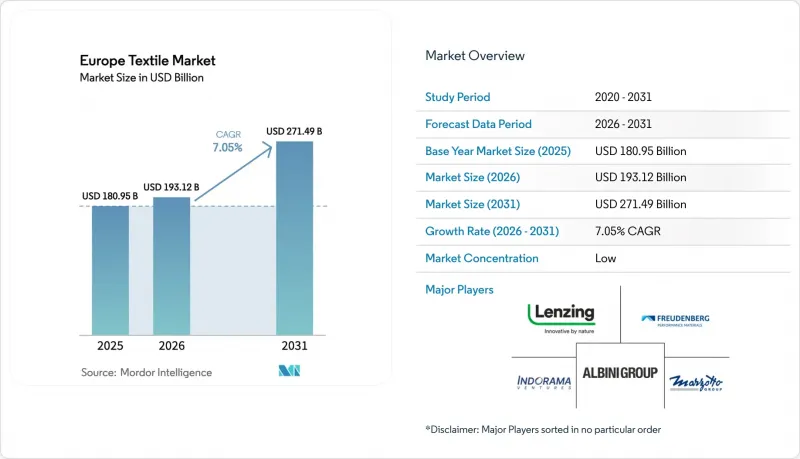
根據 Mordor Intelligence 預測,歐洲紡織品市場規模將從 2025 年的 1809.5 億美元和 2026 年的 1931.2 億美元成長到 2031 年的 2714.9 億美元,2026 年至 2031 年的年複合成長率(CAGR)為 7.05%。
本報告按應用領域(時尚服飾、工業技術及其他)、原料(天然纖維、合成纖維及其他)、加工方法(機織物、針織物、不織布和間隔織物)以及地區(英國、德國、法國、義大利、西班牙、比荷盧經濟聯盟、北歐國家及其他歐洲國家)進行細分。市場預測以美元計價。
歐洲紡織品市場的趨勢與洞察
從 2025 年起,歐盟 27 國將強制實施紡織品廢棄物分類收集。
自2025年1月起,所有市政當局均須設立紡織品專用回收點,預計每年將有約500萬噸衣物被送往歐洲各地的分揀中心。法國和荷蘭等領先國家透過路邊回收箱和與社會企業的合作,實現了超過60%的回收率。這項法規凸顯了一個挑戰:截至2025年中期,歐洲的自動化分類生產線不到50條,促使投資人投資8.7億美元在波蘭、西班牙和葡萄牙新建廠。目前,生產商正面臨生態調節費的負擔,這促使他們設計採用單一材料、可拆卸裝飾的服裝。中期來看,這項回收義務可望增加再生纖維的供應,並為循環供應鏈合約奠定基礎。
高性能技術紡織品在交通運輸和基礎設施領域的成長
到2025年,電動車製造商將每輛車的技術紡織品用量增加到12公斤以上,以碳纖維複合材料取代電池機殼中的鋼材以減輕重量。歐盟成員國已撥款1300億美元用於鐵路和公路的維修,推動了對地工織物的需求,這些地工織物可以穩定土壤並減少瀝青厚度。醫院強制要求使用符合ISO 16604標準的可清洗屏障織物,刺激了阻燃和抗菌材料的採購。 2024年,混合間隔物和複合結構的專利申請量增加了18%,顯示研發領域將迎來新的投資。這一長期成長要素正在推動對超高分子量聚乙烯和芳香聚醯胺長絲的投資,與通用聚酯相比,它們的利潤率高出3到5倍。
能源和原料價格的波動給利潤率低的生產商帶來了壓力。
天然氣價格在2024年初達到每兆瓦時130美元的峰值,隨後在2025年底暴跌至每兆瓦時43美元,這給印染廠帶來了巨大衝擊,因為能源成本有時可占到這些工廠運營成本的70%。原油價格每桶變動10美元,聚合物價格就會波動8%,棉花期貨價格則在每磅75美元至95美元之間波動。缺乏避險工具的中小型企業利潤率大幅縮水,迫使波蘭和羅馬尼亞的企業出售資產。除了強大的夥伴關係關係外,能夠分擔風險的成本加成合約仍然十分罕見。因此,價格波動正在威脅產能,並加速產業重組。
細分市場分析
2025年,時尚服飾領域佔據歐洲紡織品市場的大部分佔有率,佔市場總規模的56.06%。受電動車內裝、醫用防護布料和地工織物加固材料的推動,技術紡織品領域成為成長最快的細分市場,預計到2031年將維持6.15%的複合年成長率。 2025年,德國汽車製造商每輛車使用超過12公斤的技術紡織品來減輕電池平台的重量(高於2020年的9公斤)。隨著醫院強制要求使用符合ISO 16604標準的外科用覆蓋巾,醫用紡織品的合約量也隨之成長。防護工作服受益於更嚴格的阻燃法規,運動服則採用導電線來收集生物識別資料。同時,2024年智慧紡織品相關專利數量增加了18%。
當奢華時尚品牌將重心轉向直銷網站和線下活動時,中階服飾業正面臨超高速競爭對手的嚴峻挑戰,這些競爭對手幾乎每兩天就會推出新款。這種兩極化促使紡織企業平衡基礎服裝訂單和高利潤率技術紡織品訂單。區域生產結構也正在進行重組。義大利繼續保持其作為高檔襯衫布料訂單中心的地位,而德國和法國則在為汽車和航太產業的合作夥伴公司研發技術紡織品方面處於主導。在整個預測期內,歐洲紡織品市場將依靠工業需求來抵消服裝需求放緩的影響。
其他好處:
- Excel格式的市場預測(ME)表
- 三個月的分析師支持
目錄
第1章:引言
- 研究假設和市場定義
- 調查範圍
第2章:調查方法
第3章執行摘要
第4章 市場狀況
- 市場概覽
- 市場促進因素
- 時尚週期快速變化和快時尚的興起
- 從 2025 年起,歐盟 27 個成員國將強制實施紡織品廢棄物分類收集。
- 電子商務和社群電商平台正在縮短從設計到商店的前置作業時間。
- 高性能技術紡織品在交通運輸和基礎設施領域的成長
- 歐盟的「數位產品護照」協助建構資料豐富的循環經營模式
- 由於歐洲亞麻、大麻和羊毛是低碳環保、本地採購的纖維,市場需求激增。
- 市場限制因素
- 能源和原料價格的波動給利潤率低的生產商帶來了壓力。
- 引進最先進的回收和分類設備需要大量的資金投入。
- 染色、整理和先進紡織品製造領域技術純熟勞工短缺。
- 中小企業基礎設施的碎片化使得它們難以遵守新的歐盟實質審查法規。
- 價值供應鏈分析
- 監理展望
- 技術展望
- 產業吸引力—五力分析
- 買方的議價能力
- 供應商的議價能力
- 新進入者的威脅
- 替代品的威脅
- 競爭公司之間的競爭
- 地緣政治對紡織品市場的影響
第5章 市場規模與成長預測
- 透過使用
- 時尚與服裝
- 工業和技術用紡織品
- 家用及家用紡織品
- 醫療和保健纖維
- 汽車和運輸紡織品
- 其他(防護和運動紡織品等)
- 按成分
- 天然纖維
- 棉布
- 羊毛
- 絲綢
- 合成纖維
- 聚酯纖維
- 尼龍
- 人造絲/粘膠纖維
- 丙烯酸纖維
- 聚丙烯
- 再生纖維
- 其他(特殊高性能纖維(芳香聚醯胺、碳纖維、超高分子量聚乙烯))
- 天然纖維
- 按工藝/技術
- 織物
- 針織
- 不織布
- 紡絲成網(紡粘/熔噴)
- 乾式突襲水力纏繞
- 濕法成網
- 針刺機
- 3D編織織物和間隔織物
- 按地區
- 英國
- 德國
- 法國
- 義大利
- 西班牙
- 比荷盧經濟聯盟(比利時、荷蘭、盧森堡)
- 北歐國家(丹麥、芬蘭、冰島、挪威、瑞典)
- 其他歐洲國家
第6章 競爭情勢
- 市場集中度
- 策略趨勢
- 市佔率分析
- 公司簡介
- Lenzing AG
- Freudenberg Performance Materials
- Indorama Ventures(M&G Fibras Europe)
- Albini Group
- Marzotto Group
- Klopman International
- Schoeller Textil AG
- Borgers SE & Co. KG
- Ahlstrom-Munksjo
- Beaulieu Technical Textiles
- Don & Low Ltd
- ITV Denkendorf Produktservice
- Holland & Sherry
- Gebruder Otto
- TWE Group
- PFNonwovens Czech sro
- HUESKER Synthetic GmbH
- Tirotex Textile Company
- Baltex
- Statex Produktions GmbH
第7章 市場機會與未來展望
According to Mordor Intelligence, the Europe textile market size is projected to expand from USD 180.95 billion in 2025 and USD 193.12 billion in 2026 to USD 271.49 billion by 2031, registering a CAGR of 7.05% between 2026 to 2031.
This report is Segmented by Application (Fashion & Apparel, Industrial/Technical, and More), by Raw Material (Natural Fibers, Synthetic Fibers, and More), by Process (Woven, Knitted, Non-Woven, 3-D Weaving & Spacer Fabrics), and by Geography (United Kingdom, Germany, France, Italy, Spain, BENELUX, NORDICS, Rest of Europe). Market Forecasts are Provided in Value (USD).
Europe Textile Market Trends and Insights
Mandatory Separate Collection of Textile Waste Across EU-27 from 2025
From January 2025, all municipalities were required to install dedicated textile-collection points, redirecting roughly 5 million tonnes of garments per year into European sorting hubs. Early movers such as France and the Netherlands achieved collection rates above 60% by pairing curbside bins with social-enterprise partners. The regulation exposed a shortfall: Europe had fewer than 50 automated sorting lines in mid-2025, so investors committed USD 870 million to new plants in Poland, Spain, and Portugal. Producers now face eco-modulation fees, pushing them to design mono-material garments with detachable trims. Over the medium term, the collection mandate is expected to lift recycled-fiber availability and underpin circular supply contracts.
Growth of High-Performance Technical Textiles for Mobility and Infrastructure
Electric-vehicle makers increased technical-textile content to more than 12 kg per car in 2025, replacing steel in battery enclosures with carbon-fiber composites for weight savings. EU states earmarked USD 130 billion for rail and highway upgrades, lifting demand for geotextiles that stabilize soil and reduce asphalt thickness. Hospitals mandated washable barrier fabrics that meet ISO 16604, driving purchases of flame-retardant and antimicrobial materials. Patent filings for hybrid spacer-composite architectures rose 18% in 2024, signaling fresh R&D spend. The long-term driver pulls investment toward ultra-high-molecular-weight polyethylene and aramid filaments that earn margins three to five times those of commodity polyester.
Volatile Energy and Raw-Material Prices Squeezing Low-Margin Producers
Natural-gas costs peaked at USD 130 per MWh in early 2024 before sliding to USD 43 in late 2025, unsettling dyehouses where energy can reach 70% of operating costs. Crude swings of USD 10 per barrel drove 8% moves in polymer prices, while cotton futures oscillated between USD 75 and USD 95 per pound. SMEs without hedging tools saw margins evaporate, prompting asset sales in Poland and Romania. Cost-plus contracts that share risk remain rare outside deep partnerships. Price instability, therefore, threatens capacity and fuels consolidation.
Other drivers and restraints analyzed in the detailed report include:
- Rapid Changes in Fashion Cycles and Rise of Fast Fashion
- EU Digital Product Passport Enabling Data-Rich Circular Business Models
- High Capex Requirement for State-of-the-Art Recycling and Sorting Capacity
For complete list of drivers and restraints, kindly check the Table Of Contents.
Segment Analysis
In 2025, the fashion and apparel segment represented a significant majority of the overall Europe textile market, accounting for 56.06% of the total market size. The fastest-growing technical segment is forecast to clock a 6.15% CAGR through 2031, buoyed by electric-vehicle interiors, medical barrier fabrics, and geotextile reinforcement. German automakers used more than 12 kg of technical textiles per vehicle in 2025, up from 9 kg in 2020, to lighten battery platforms. Hospitals mandated ISO 16604-compliant drapes, expanding medical-textile contracts. Protective workwear profits from stricter flame-retardant rules, and sportswear integrates conductive yarns that capture biometric data, backed by 18% growth in smart-textile patents in 2024.
Premium fashion labels pivot to direct-to-consumer sites and store events, yet mid-market apparel grapples with ultra-fast competitors that post styles every two days. This bifurcation encourages mills to balance staple apparel orders with high-margin technical contracts. Regional production also realigns: Italy continues to anchor luxury shirting, while Germany and France lead technical-fabric R&D for automotive and aerospace partners. Over the forecast horizon, the Europe textile market will rely on industrial demand to offset slower apparel volumes.
Complete Report Scope:
- By Application
- Fashion & Apparel
- Industrial/Technical Textiles
- Household & Home Textiles
- Medical & Healthcare Textiles
- Automotive & Transport Textiles
- Others (Protective, Sports Textiles, etc.)
- By Raw Material
- Natural Fibers
- Cotton
- Wool
- Silk
- Synthetic Fibers
- Polyester
- Nylon
- Rayon / Viscose
- Acrylic
- Polypropylene
- Recycled Fibers
- Others (Speciality High-Performance Fibers (Aramid, Carbon, UHMWPE))
- Natural Fibers
- By Process / Technology
- Woven
- Knitted
- Non-woven
- Spunlaid (Spunbond / Melt-blown)
- Dry-laid Hydro-entangled
- Wet-Laid
- Needle-punched
- 3-D Weaving & Spacer Fabrics
- By Geography
- United Kingdom
- Germany
- France
- Italy
- Spain
- BENELUX (Belgium, Netherlands, and Luxembourg)
- NORDICS (Denmark, Finland, Iceland, Norway, and Sweden)
- Rest of Europe
List of Companies Covered in this Report:
- Lenzing AG
- Freudenberg Performance Materials
- Indorama Ventures (M&G Fibras Europe)
- Albini Group
- Marzotto Group
- Klopman International
- Schoeller Textil AG
- Borgers SE & Co. KG
- Ahlstrom-Munksjo
- Beaulieu Technical Textiles
- Don & Low Ltd
- ITV Denkendorf Produktservice
- Holland & Sherry
- Gebruder Otto
- TWE Group
- PFNonwovens Czech s.r.o
- HUESKER Synthetic GmbH
- Tirotex Textile Company
- Baltex
- Statex Produktions GmbH
Additional Benefits:
- The market estimate (ME) sheet in Excel format
- 3 months of analyst support
TABLE OF CONTENTS
1 Introduction
- 1.1 Study Assumptions & Market Definition
- 1.2 Scope of the Study
2 Research Methodology
3 Executive Summary
4 Market Landscape
- 4.1 Market Overview
- 4.2 Market Drivers
- 4.2.1 Rapid changes in fashion cycles & rise of fast fashion
- 4.2.2 Mandatory separate collection of textile waste across EU-27 from 2025
- 4.2.3 E-commerce & social-commerce platforms shortening design-to-shelf lead-times
- 4.2.4 Growth of high-performance technical textiles for mobility & infrastructure
- 4.2.5 EU "Digital Product Passport" enabling data-rich circular business models
- 4.2.6 Demand surge for Europe-grown flax, hemp & wool as low-carbon local fibres
- 4.3 Market Restraints
- 4.3.1 Volatile energy & raw-material prices squeezing low-margin producers
- 4.3.2 High capex requirement for state-of-the-art recycling & sorting capacity
- 4.3.3 Skilled-labour shortages in dyeing / finishing & advanced weaving
- 4.3.4 Fragmented SME base complicating compliance with new EU due-diligence rules
- 4.4 Value / Supply-Chain Analysis
- 4.5 Regulatory Outlook
- 4.6 Technological Outlook
- 4.7 Industry Attractiveness - Porter's Five Forces
- 4.7.1 Bargaining Power of Buyers
- 4.7.2 Bargaining Power of Suppliers
- 4.7.3 Threat of New Entrants
- 4.7.4 Threat of Substitutes
- 4.7.5 Competitive Rivalry
- 4.8 Impact of Geopolitics on Textile Market
5 Market Size & Growth Forecasts (Value, In USD Billion)
- 5.1 By Application
- 5.1.1 Fashion & Apparel
- 5.1.2 Industrial/Technical Textiles
- 5.1.3 Household & Home Textiles
- 5.1.4 Medical & Healthcare Textiles
- 5.1.5 Automotive & Transport Textiles
- 5.1.6 Others (Protective, Sports Textiles, etc.)
- 5.2 By Raw Material
- 5.2.1 Natural Fibers
- 5.2.1.1 Cotton
- 5.2.1.2 Wool
- 5.2.1.3 Silk
- 5.2.2 Synthetic Fibers
- 5.2.2.1 Polyester
- 5.2.2.2 Nylon
- 5.2.2.3 Rayon / Viscose
- 5.2.2.4 Acrylic
- 5.2.2.5 Polypropylene
- 5.2.3 Recycled Fibers
- 5.2.4 Others (Speciality High-Performance Fibers (Aramid, Carbon, UHMWPE))
- 5.2.1 Natural Fibers
- 5.3 By Process / Technology
- 5.3.1 Woven
- 5.3.2 Knitted
- 5.3.3 Non-woven
- 5.3.3.1 Spunlaid (Spunbond / Melt-blown)
- 5.3.3.2 Dry-laid Hydro-entangled
- 5.3.3.3 Wet-Laid
- 5.3.3.4 Needle-punched
- 5.3.4 3-D Weaving & Spacer Fabrics
- 5.4 By Geography
- 5.4.1 United Kingdom
- 5.4.2 Germany
- 5.4.3 France
- 5.4.4 Italy
- 5.4.5 Spain
- 5.4.6 BENELUX (Belgium, Netherlands, and Luxembourg)
- 5.4.7 NORDICS (Denmark, Finland, Iceland, Norway, and Sweden)
- 5.4.8 Rest of Europe
6 Competitive Landscape
- 6.1 Market Concentration
- 6.2 Strategic Moves
- 6.3 Market Share Analysis
- 6.4 Company Profiles {(includes Global level Overview, Market level overview, Core Segments, Financials as available, Strategic Information, Products & Services, and Recent Developments)}
- 6.4.1 Lenzing AG
- 6.4.2 Freudenberg Performance Materials
- 6.4.3 Indorama Ventures (M&G Fibras Europe)
- 6.4.4 Albini Group
- 6.4.5 Marzotto Group
- 6.4.6 Klopman International
- 6.4.7 Schoeller Textil AG
- 6.4.8 Borgers SE & Co. KG
- 6.4.9 Ahlstrom-Munksjo
- 6.4.10 Beaulieu Technical Textiles
- 6.4.11 Don & Low Ltd
- 6.4.12 ITV Denkendorf Produktservice
- 6.4.13 Holland & Sherry
- 6.4.14 Gebruder Otto
- 6.4.15 TWE Group
- 6.4.16 PFNonwovens Czech s.r.o
- 6.4.17 HUESKER Synthetic GmbH
- 6.4.18 Tirotex Textile Company
- 6.4.19 Baltex
- 6.4.20 Statex Produktions GmbH
7 Market Opportunities & Future Outlook
- 7.1 White-space & Unmet-Need Assessment

 有機家用紡織品市場預測至2034年-按產品類型、材料、分銷管道、價格範圍、應用和地區分類的全球分析
 絲線:市場佔有率分析、產業趨勢與統計、成長預測(2026-2031)泰國紡織品市場:市場佔有率分析、產業趨勢與統計及成長預測(2026-2031)印尼紡織製造業:市場佔有率分析、產業趨勢與統計及成長預測(2026-2031年)義大利紡織製造業:市場佔有率分析、產業趨勢與統計、成長預測(2026-2031)馬來西亞紡織製造業:市場佔有率分析、產業趨勢與統計及成長預測(2026-2031)技術紡織材料市場預測至2034年—按纖維類型、材料、功能、應用、產業和地區分類的全球分析
 防護紡織品市場:2026-2032年全球市場預測(按織物類型、產品、製造流程、最終用途和分銷管道分類)動物源纖維市場:2026-2032 年全球市場按形態、混合成分、表面處理、分銷管道和應用進行預測。印尼紡織品:市場佔有率分析、產業趨勢與統計、成長預測(2026-2031)