


 |
市場調查報告書
商品編碼
2154439
越南紡織製造業:市場佔有率分析、產業趨勢與統計及成長預測(2026-2031年)Vietnam Textile Manufacturing - Market Share Analysis, Industry Trends & Statistics, Growth Forecasts (2026 - 2031) |
||||||

※ 本網頁內容可能與最新版本有所差異。詳細情況請與我們聯繫。
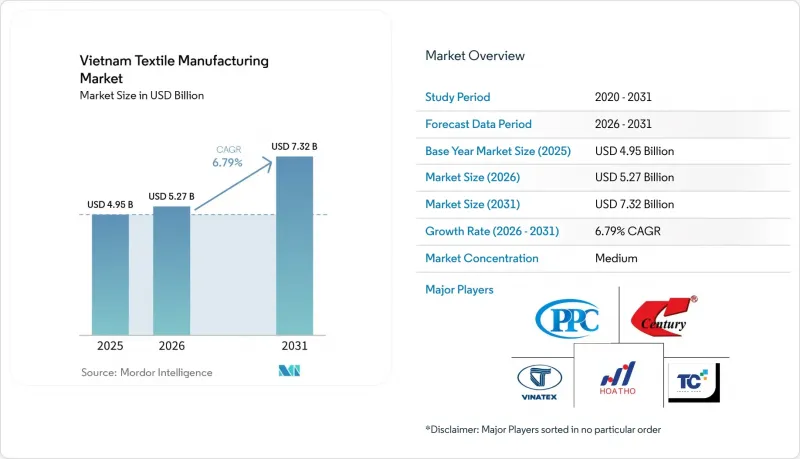
據 Mordor Intelligence 稱,越南紡織品製造業市場規模預計將從 2025 年的 49.5 億美元擴大到 2026 年的 52.7 億美元,到 2031 年達到 73.2 億美元,2026 年至 2031 年的複合年成長率為 6.79%。
越南紡織製造業市場趨勢與洞察
供應鏈多元化,擺脫以中國為中心的採購模式
鑑於關稅緊張局勢和先前供應鏈中斷暴露了以中國為中心的供應鏈風險,全球服裝和家用紡織品買家正持續擴大在越南的採購活動。越南在美國服飾進口中所佔佔有率從2024年的18.9%上升至2025年的21.1%,而中國供應商在美國和日本進口中所佔佔有率則有所下降。買家正將產品開發、品質審核和供應商管理等業務轉移到更靠近其在越南生產基地的地區。這提高了越南紡織品製造市場製造商的期望,因為合作關係不再局限於簡單的「裁剪、縫紉和整理」訂單。 2025年前七個月,越南對中東的出口額達7億美元,2024年則為10億美元。訂單的成長雖然支撐了紡紗和針織運轉率,但也給符合原產地規則的織物染色和整理產能帶來了額外壓力。
透過新一代自由貿易協定市場進入
越南已簽署17項自由貿易協定,為60多個出口市場提供差異化的關稅准入。其中,《歐洲-越南自由貿易協定》(EVFTA)允許使用原產於越南或EVFTA涵蓋範圍內的布料製成的符合條件的紡織品和針織品免稅進口到歐盟。這項規定將鼓勵對紡織品、針織品和濕加工布料的投資,這些產業與服裝相比仍處於低度開發狀態。 《全面與進步跨太平洋夥伴關係協定》(CPTPP)的「紗線優先」要求更重視紡紗以及成員經濟體內部紡織品、布料和服飾的融合。 2025年前九個月,越南對歐洲和美洲的紡織品和服飾出口較去年同期成長10.8%,而對同一地區的紡織原料和紗線出口較去年同期成長13.3%。如果生產商能夠使用本地採購或符合條件的原料來滿足這些原產地要求,越南的紡織製造業市場將從中受益最多。
對進口布料、棉花、纖維、化學品和染料的依賴
對進口原料的依賴仍然是限制越南國內價值創造的最頑固因素。越南100%依賴進口棉花,年消費量達40萬噸,國內供應量不到3000噸。此外,越南高達95%的合成纖維也依賴進口。國內布料產量僅能滿足25%至30%的市場需求,迫使製造商依賴進口原料和輔料。預計到2025年,越南將進口171萬噸棉花(價值28.8億美元),其中美國供應量佔45.6%。 2024年,越南進口布料規模將達到110億美元,其中中國佔原料和輔助材料採購量的59%。這些依賴性限制了越南在原料不符合「紗線前驅」規則的情況下享受《全面與進步跨太平洋夥伴關係協定》(CPTPP)優惠待遇的能力。
細分市場分析
預計到2025年,通用合成纖維將佔市場佔有率的49.5%,這主要得益於大眾市場服裝和功能性服裝的出口需求。此類別的主要材料包括聚酯纖維、尼龍、聚丙烯、腈綸和氨綸。聚酯短纖維和聚酯長絲仍然是國內生產設施中最常用的原料。合成纖維的整合被視為減少進口流失、確保越南上游工程更高附加價值的優先事項。粘膠纖維、Lyocell纖維、莫代爾纖維和醋酸纖維等人造纖維素纖維正吸引尋求可生物分解的傳統合成纖維替代品的買家。對於能夠確保可追溯性並證明其採購符合UFLPA標準的供應商而言,天然棉纖維也是一個選擇。
預計到2031年,特種纖維和高性能纖維的複合年成長率將達到8.2%,成為成長最快的原料類別。其需求主要來自交通運輸、防護工具、醫療設備、建築和地工織物等領域。這凸顯了技術標準和可控加工流程對於進入越南紡織製造業的供應商的重要性。東麗在越南的聚酯和尼龍特種織物業務,體現了在外國直接投資(FDI)驅動下,越南正在建立一個更先進的原料基地。基於ISO 9001的流程管理以及對國際品質系統的遵守,在特殊纖維的採購中日益重要。這些要求使大規模認證製造商比小規模加工商更具優勢。此類別為生產高附加價值產品打開了大門,但其發展取決於穩定的品質和客戶的認可。
2025年,布料製造仍是越南紡織製造業的主要環節,佔越南紡織市場規模的43.5%。截至2025年,越南運作121家紡紗廠(含棉紗廠),總紡錠產能達1,040萬錠。這些紡紗廠為布料生產提供原料,並支撐著越南的服飾出口系統。儘管紗線和縫紉線產量保持高位,但由於全球價格下跌,棉紗出口價格在2025年下降了5%,而出口量卻增加了8%。預處理、漂白、染色和印花等後表面處理工程受到歐洲環境法規的嚴格監管。數位紡織印花技術因其能夠減少這些工序中的水和化學品用量而日益受到重視。
預計到2031年,不織布和毛氈的生產將以9.8%的複合年成長率成長,成為製造業加工產業中成長最快的產業。醫療衛生、工業過濾、地工織物和汽車內裝是推動此需求的主要因素。後疫情時代的需求凸顯了衛生和醫療應用領域的商業性潛力,促使企業加強對紡粘和熔噴生產線的投資。 2026年1月,YKK在位於同奈省農澤市的工廠啟動了三期工程,投資8,360萬美元,用於擴大輔料生產並開發先進產品。該項目旨在支持服裝生產相關的零件和輔料生態系統,並體現了企業對更廣泛的中游產業鏈的信心,這些產業鏈將支持技術布料和不織布布的應用。可靠的設備、嚴格的品管以及專業的買家管道是該行業擴張的關鍵。
其他好處:
- Excel格式的市場預測(ME)表
- 3個月的分析師支持
目錄
第1章:引言
- 研究假設和市場定義
- 調查範圍
第2章:調查方法
第3章執行摘要
第4章 市場狀況
- 市場概覽
- 越南主要的紡織品製造生態系統
- 製造地和產業叢集
- 本地增值和導入依賴
- 市場成熟度與產業生命週期
- 市場促進因素
- 獲得新一代自由貿易協定的機會
- 供應鏈多元化,擺脫以中國為中心的採購模式
- 全球買家採購環保、可追溯的紡織品。
- 擴大再生纖維和循環加工能力
- 工業數位化和流程自動化
- 市場限制因素
- 對進口布料、棉花、纖維、化學品和染料的依賴
- 濕式加工和碳減排相關的合規成本很高。
- 技術純熟勞工短缺和勞動市場波動
- 關稅、原產地規則和地緣政治風險
- 價值供應鏈分析
- 監理情勢
- 技術展望
- 智慧製造、自動化與人工智慧應用分析
- 數位紡織印花
- 人工智慧驅動的需求和生產計畫
- 纖維到纖維的回收利用
- 東協紡織品生產、消費與貿易的分析與思考
- 主要紡織品生產國製造成本競爭力分析
- 越南供應鏈多元化分析
- 原料供應狀況及纖維價格趨勢分析
- 投資趨勢、產能擴充與製造地搬遷
- 對永續和循環紡織製造的深入了解
- 評估貿易政策和地緣政治事件對市場的影響
第5章 市場規模與成長預測
- 按成分
- 天然纖維
- 植物來源纖維
- 棉布
- 其他材質(黃麻、亞麻、大麻、苧麻、椰子纖維)
- 動物性纖維(羊毛、絲綢和其他動物纖維)
- 植物來源纖維
- 人造纖維素纖維(黏膠/人造絲、Lyocell纖維、莫代爾纖維、醋酸纖維)
- 通用合成纖維(聚酯纖維、尼龍/聚醯胺纖維、聚丙烯纖維、腈綸纖維、彈性纖維)
- 特殊纖維及高性能纖維(芳香聚醯胺、超高分子量聚乙烯等)
- 天然纖維
- 按製造程序和產品類型
- 線材和縫紉線的生產
- 織物製造
- 織物
- 編織和鉤編
- 不織布和毛氈的生產
- 其他紡織品製造程序
- 紡織品整理與表面處理(預處理、漂白、染色、印花等)
- 按最終用途行業分類
- 服裝與時尚
- 家用紡織品
- 技術及工業紡織品
- 交通運輸與出行
- 醫療衛生
- 工業加工和過濾
- 用於建築和地基工程的不織布
- 保護/安全
- 包裝
- 其他技術應用—農業等。
- 按企業規模
- 大規模有組織的製造商
- 微型、小規模和中型企業(MSMEs)以及非正規部門
第6章 競爭情勢
- 市場集中度
- 策略趨勢
- 市佔率分析
- 公司簡介
- Vietnam National Textile and Garment Group(Vinatex)
- Thanh Cong
- Century Synthetic Fiber Corporation
- Phong Phu Corporation
- Hoa Tho Textile
- Viet Thang Corporation
- Nam Dinh Textile Garment Corporation
- Phu Bai Spinning Mill Joint Stock Company
- Duc Quan Investment and Development Joint Stock Company
- Nha Trang Textile & Garment Joint Stock Company
- Dong Phuong Knitting Company Limited
- Sagotex Textile Joint Stock Company
- Viet Phat Import Export Trading Investment Joint Stock Company
- Tien Phong Textile Joint Stock Company
- Duy Tan Textile and Garment Joint Stock Company
- Maxport Limited Vietnam
- Luen Thai Holdings Limited
- Texhong Vietnam
- Hyosung Vietnam Co., Ltd.
- Toray Industries Vietnam Co., Ltd.
- Far Eastern Polytex(Vietnam)Ltd.
第7章 市場機會與未來展望
According to Mordor Intelligence, the Vietnam textile manufacturing market size is expected to increase from USD 4.95 billion in 2025 to USD 5.27 billion in 2026 and reach USD 7.32 billion by 2031, growing at a CAGR of 6.79% over 2026-2031.
Vietnam Textile Manufacturing Market Trends and Insights
Supply-Chain Diversification Away from China-Centric Sourcing
Global apparel and home-textile buyers have continued to place more sourcing activity in Vietnam after tariff tensions and earlier supply disruptions exposed the risk of China-centered supply chains. Vietnam's share of United States garment imports rose to 21.1% in 2025 from 18.9% in 2024, while Chinese suppliers lost share in United States and Japanese import baskets. Buyers are moving product development, quality auditing, and supplier-management work closer to Vietnamese production facilities. This raises expectations for manufacturers in the Vietnam textile manufacturing market because the relationship extends beyond basic cut-make-trim orders. Exports to the Middle East reached USD 700 million in the first 7 months of 2025 after generating USD 1 billion in 2024. Higher order flows support spinning and knitting utilization, but they also place added pressure on dyeing and finishing capacity needed for origin-compliant fabric.
New-Generation Free Trade Agreement Access
Vietnam has 17 free trade agreements that provide differentiated tariff access to more than 60 export markets. The EVFTA allows qualifying woven and knitted products made from Vietnam-originating or EVFTA-originating fabric to enter the European Union tariff-free. This rule favors investment in weaving, knitting, and wet processing, which are still underdeveloped relative to garment assembly. CPTPP yarn-forward requirements place more emphasis on spinning and on links between fiber, fabric, and garments within member economies. Textile and garment exports to the Europe-America region increased 10.8% year over year in the first 9 months of 2025, while textile fiber and yarn exports to that corridor increased 13.3%. The Vietnam textile manufacturing market benefits most when producers can meet these origin requirements with local or qualifying inputs.
Imported Fabric, Cotton, Fiber, Chemicals, and Dyes Dependence
Dependence on imported raw materials remains the most persistent constraint on domestic value addition. Vietnam imported 100% of its cotton, consuming 400,000 tons annually against a domestic supply of less than 3,000 tons, and imported up to 95% of its synthetic fibers. Domestic fabric production covered only 25% to 30% of market needs, leaving manufacturers dependent on imported materials and accessories. Vietnam imported 1.71 million tons of cotton valued at USD 2.88 billion in 2025, and the United States supplied 45.6% of the import volume. Imported fabric had reached USD 11 billion in 2024, while China accounted for 59% of raw material and accessory sourcing. These dependencies limit the Vietnam textile manufacturing market's ability to use CPTPP preferences when input materials do not qualify under yarn-forward rules.
Other drivers and restraints analyzed in the detailed report include:
- Green and Traceable Textile Procurement by Global Buyers
- Rising FDI Inflows and Industrial Zone Expansion
- Tariff, Rules of Origin, and Geopolitical Exposure
For complete list of drivers and restraints, kindly check the Table Of Contents.
Segment Analysis
Commodity synthetics held 49.5% market value in 2025, supported by demand from mass-market apparel and performance-wear exports. Polyester, nylon, polypropylene, acrylic, and elastane are the principal materials in this category. Polyester staple fiber and polyester filament yarn remain the highest-volume inputs for the domestic production base. identified synthetic-fiber integration as a priority for reducing import leakage and retaining more upstream value in Vietnam. Artificial cellulosic fibers such as viscose, lyocell, modal, and acetate are gaining interest from buyers seeking biodegradable alternatives to conventional synthetics. Natural cotton-based fibers also provide an option for suppliers that can demonstrate traceable, UFLPA-compliant sourcing.
Specialty and high-performance fibers are forecast to record an 8.2% CAGR through 2031, making them the fastest-growing raw-material category. Demand comes from transportation, protective equipment, medical devices, construction, and geotextile applications. This raises the importance of technical standards and controlled processing for suppliers entering the Vietnam textile manufacturing industry. Toray's Vietnam operations in polyester and nylon specialty fabrics show the FDI-led development of a more advanced raw-material base. ISO 9001 process management and international quality-system compliance are increasingly relevant to specialty-fiber procurement. These requirements favor larger certified manufacturers over fragmented processors. The category offers a path to higher-value output, but its development depends on consistent quality and customer qualification.
Fabric manufacturing held 43.5% of the Vietnam textile manufacturing market size in 2025 and remained the leading process segment. The country had 121 operating cotton-yarn-containing spinning mills with 10.4 million spindle-equivalents in calendar year 2025. This spinning base supplies fabric production that feeds the country's garment export system. Yarn and thread manufacturing remains high volume, but cotton-yarn export unit values declined 5% in calendar year 2025 as global prices softened, even though export volumes rose 8%. Finishing activities such as pretreatment, bleaching, dyeing, and printing face the closest scrutiny from European environmental requirements. Digital textile printing is gaining relevance because it can lower water and chemical use in these activities.
Nonwoven and felt manufacturing is projected to grow at a 9.8% CAGR through 2031, the highest rate among process categories. Medical hygiene, industrial filtration, geotextiles, and automotive interiors support this demand. Investment in spunbond and meltblown lines has increased after post-pandemic demand confirmed the commercial depth of hygiene and medical applications. YKK began Phase 3 of its Nhon Trach facility in Dong Nai in January 2026, committing USD 83.6 million to expand accessories production and advanced product development. The project supports the components and accessories ecosystem around apparel production. It also reflects confidence in the broader mid-stream base that supports technical fabrics and nonwoven applications. Expansion in this category depends on reliable equipment, quality control, and access to specialized buyers.
Complete Report Scope:
- By Raw Material
- Natural Fibers
- Plant-Based Fibers
- Cotton
- Others (jute, flax, hemp, ramie, coir)
- Animal-Based Fibers (wool, silk and other animal fibers)
- Plant-Based Fibers
- Man-Made Cellulosic Fibers (viscose/rayon, lyocell, modal and acetate)
- Commodity Synthetics (polyester, nylon/polyamide, polypropylene, acrylic and elastane)
- Specialty and High-Performance Fibers (aramid, UHMWPE, etc.)
- Natural Fibers
- By Manufacturing Process and Product Type
- Yarn and Thread Manufacturing
- Fabric Manufacturing
- Weaving
- Knitting and Crocheting
- Nonwoven and Felt Manufacturing
- Other Fabric-Formation Processes
- Textile Finishing and Surface Treatment (Pretreatment, Bleaching, Dyeing, Printing, etc.)
- By End Use Industry
- Apparel and Fashion
- Home and Household Textiles
- Technical and Industrial Textiles
- Transportation and Mobility
- Medical and Hygiene
- Industrial Processing and Filtration
- Construction and Geotextiles
- Protective and Safety
- Packaging
- Other Technical Applications - Agriculture, etc.
- By Enterprise Scale
- Large Organized Manufacturers
- Micro, Small, and Medium Enterprises (MSMEs) and the unorganized sector
List of Companies Covered in this Report:
- Vietnam National Textile and Garment Group (Vinatex)
- Thanh Cong
- Century Synthetic Fiber Corporation
- Phong Phu Corporation
- Hoa Tho Textile
- Viet Thang Corporation
- Nam Dinh Textile Garment Corporation
- Phu Bai Spinning Mill Joint Stock Company
- Duc Quan Investment and Development Joint Stock Company
- Nha Trang Textile & Garment Joint Stock Company
- Dong Phuong Knitting Company Limited
- Sagotex Textile Joint Stock Company
- Viet Phat Import Export Trading Investment Joint Stock Company
- Tien Phong Textile Joint Stock Company
- Duy Tan Textile and Garment Joint Stock Company
- Maxport Limited Vietnam
- Luen Thai Holdings Limited
- Texhong Vietnam
- Hyosung Vietnam Co., Ltd.
- Toray Industries Vietnam Co., Ltd.
- Far Eastern Polytex (Vietnam) Ltd.
Additional Benefits:
- The market estimate (ME) sheet in Excel format
- 3 months of analyst support
TABLE OF CONTENTS
1 Introduction
- 1.1 Study Assumptions and Market Definition
- 1.2 Scope of the Study
2 Research Methodology
3 Executive Summary
4 Market Landscape
- 4.1 Market Overview
- 4.1.1 Vietnam Primary Textile Manufacturing Ecosystem
- 4.1.2 Manufacturing Footprint and Industrial Clusters
- 4.1.3 Local Value Addition and Import Dependence
- 4.1.4 Market Maturity and Industry Life Cycle
- 4.2 Market Drivers
- 4.2.1 New-Generation Free Trade Agreement Access
- 4.2.2 Supply-Chain Diversification Away From China-Centric Sourcing
- 4.2.3 Green and Traceable Textile Procurement by Global Buyers
- 4.2.4 Recycled Fiber and Circular Processing Capacity Expansion
- 4.2.5 Industrial Digitalization and Process Automation
- 4.3 Market Restraints
- 4.3.1 Imported Fabric, Cotton, Fiber, Chemicals and Dyes Dependence
- 4.3.2 High Compliance Cost for Wet Processing and Carbon Reduction
- 4.3.3 Skilled-Labor Shortage and Workforce Volatility
- 4.3.4 Tariff, Rules-of-Origin and Geopolitical Exposure
- 4.4 Value / Supply-Chain Analysis
- 4.5 Regulatory Landscape
- 4.6 Technological Outlook
- 4.6.1 Analysis of Smart Manufacturing, Automation, and AI Adoption
- 4.6.2 Digital Textile Printing
- 4.6.3 AI-Enabled Demand and Production Planning
- 4.6.4 Fiber-to-Fiber Recycling
- 4.7 Insights on ASEAN Textile Production, Consumption, and Trade Analysis
- 4.8 Insights on Manufacturing Cost Competitiveness Across Major Textile-Producing Countries
- 4.9 Analysis of Vietnam Supply Chain Diversification
- 4.10 Insights on Raw Material Availability and Fiber Price Trends
- 4.11 Investments, Capacity Expansion, and Manufacturing Relocation Activities
- 4.12 Insights on Sustainable and Circular Textile Manufacturing
- 4.13 Impact Assessment of Trade Policies and Geopolitical Events on the Market
5 Market Size & Growth Forecasts
- 5.1 By Raw Material
- 5.1.1 Natural Fibers
- 5.1.1.1 Plant-Based Fibers
- 5.1.1.1.1 Cotton
- 5.1.1.1.2 Others (jute, flax, hemp, ramie, coir)
- 5.1.1.2 Animal-Based Fibers (wool, silk and other animal fibers)
- 5.1.1.1 Plant-Based Fibers
- 5.1.2 Man-Made Cellulosic Fibers (viscose/rayon, lyocell, modal and acetate)
- 5.1.3 Commodity Synthetics (polyester, nylon/polyamide, polypropylene, acrylic and elastane)
- 5.1.4 Specialty and High-Performance Fibers (aramid, UHMWPE, etc.)
- 5.1.1 Natural Fibers
- 5.2 By Manufacturing Process and Product Type
- 5.2.1 Yarn and Thread Manufacturing
- 5.2.2 Fabric Manufacturing
- 5.2.2.1 Weaving
- 5.2.2.2 Knitting and Crocheting
- 5.2.2.3 Nonwoven and Felt Manufacturing
- 5.2.2.4 Other Fabric-Formation Processes
- 5.2.3 Textile Finishing and Surface Treatment (Pretreatment, Bleaching, Dyeing, Printing, etc.)
- 5.3 By End Use Industry
- 5.3.1 Apparel and Fashion
- 5.3.2 Home and Household Textiles
- 5.3.3 Technical and Industrial Textiles
- 5.3.3.1 Transportation and Mobility
- 5.3.3.2 Medical and Hygiene
- 5.3.3.3 Industrial Processing and Filtration
- 5.3.3.4 Construction and Geotextiles
- 5.3.3.5 Protective and Safety
- 5.3.3.6 Packaging
- 5.3.3.7 Other Technical Applications - Agriculture, etc.
- 5.4 By Enterprise Scale
- 5.4.1 Large Organized Manufacturers
- 5.4.2 Micro, Small, and Medium Enterprises (MSMEs) and the unorganized sector
6 Competitive Landscape
- 6.1 Market Concentration
- 6.2 Strategic Moves
- 6.3 Market Share Analysis
- 6.4 Company Profiles (includes Global Level Overview, Market Level Overview, Core Segments, Financials as available, Strategic Information, Products and Services, Recent Developments)
- 6.4.1 Vietnam National Textile and Garment Group (Vinatex)
- 6.4.2 Thanh Cong
- 6.4.3 Century Synthetic Fiber Corporation
- 6.4.4 Phong Phu Corporation
- 6.4.5 Hoa Tho Textile
- 6.4.6 Viet Thang Corporation
- 6.4.7 Nam Dinh Textile Garment Corporation
- 6.4.8 Phu Bai Spinning Mill Joint Stock Company
- 6.4.9 Duc Quan Investment and Development Joint Stock Company
- 6.4.10 Nha Trang Textile & Garment Joint Stock Company
- 6.4.11 Dong Phuong Knitting Company Limited
- 6.4.12 Sagotex Textile Joint Stock Company
- 6.4.13 Viet Phat Import Export Trading Investment Joint Stock Company
- 6.4.14 Tien Phong Textile Joint Stock Company
- 6.4.15 Duy Tan Textile and Garment Joint Stock Company
- 6.4.16 Maxport Limited Vietnam
- 6.4.17 Luen Thai Holdings Limited
- 6.4.18 Texhong Vietnam
- 6.4.19 Hyosung Vietnam Co., Ltd.
- 6.4.20 Toray Industries Vietnam Co., Ltd.
- 6.4.21 Far Eastern Polytex (Vietnam) Ltd.
7 Market Opportunities & Future Outlook
- 7.1 White-Space and Unmet-Need Assessment

 2026-2030年全球紡織品檢測設備市場
 紡織品市場報告:趨勢、預測和競爭分析(至2035年)
 有機家用紡織品市場預測至2034年-按產品類型、材料、分銷管道、價格範圍、應用和地區分類的全球分析
 東協紡織製造業:市佔率分析、產業趨勢與統計及成長預測(2026-2031年)
 海洋塑膠纖維市場規模、佔有率和趨勢分析報告:按塑膠原料、聚合物類型、纖維形態、最終用途、地區和細分市場預測(2026-2033 年)絲線:市場佔有率分析、產業趨勢與統計、成長預測(2026-2031)歐洲紡織品市場:市場佔有率分析、產業趨勢與統計、成長預測(2026-2031年)泰國紡織品市場:市場佔有率分析、產業趨勢與統計及成長預測(2026-2031)印尼紡織製造業:市場佔有率分析、產業趨勢與統計及成長預測(2026-2031年)義大利紡織製造業:市場佔有率分析、產業趨勢與統計、成長預測(2026-2031)