


 |
市場調查報告書
商品編碼
2114409
泰國紡織品市場:市場佔有率分析、產業趨勢與統計及成長預測(2026-2031)Thailand Textile - Market Share Analysis, Industry Trends & Statistics, Growth Forecasts (2026 - 2031) |
||||||

※ 本網頁內容可能與最新版本有所差異。詳細情況請與我們聯繫。
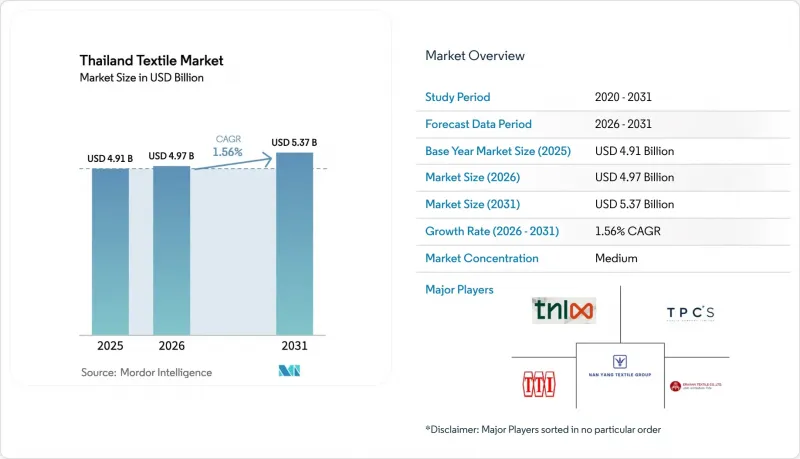
根據 Mordor Intelligence 預測,泰國紡織品市場規模將從 2025 年的 49.1 億美元成長到 2026 年的 49.7 億美元,然後在 2031 年達到 53.7 億美元,2026 年至 2031 年的複合年成長率為 1.56%。
本報告按應用領域(時尚服飾、工業科技、家居、醫療保健、汽車交通運輸及其他)、原料(天然纖維、合成纖維、再生纖維及其他)和加工/技術(機織物、針織物、不織布、3D機織物和間隔織物)進行分類。市場預測以美元計價。
泰國紡織品市場趨勢與洞察
受國內旅遊業的推動,服裝市場正在復甦。
預計到2025年,旅遊消費將恢復到2019年水準的88%,休閒服裝和度假裝的銷售額將成長22%。為此,水門和乍都乍的批發商正在採購規模小規模、種類更豐富的布料,這提高了泰國中部紡紗廠的運轉率。該地區舉辦的購物節也開闢了新的銷售管道,繞過了經銷商,實現了即時銷售。旅遊局的電子錢包宣傳活動持續促進本地服飾的銷售,使工廠累積訂單穩定到2026年。因此,儘管出口方面面臨一些不利因素,但持續不斷的遊客湧入支撐了短期布料需求。
政府(投資委員會)對機械設備現代化改造的激勵措施
「智慧永續紡織品」計畫為先進織布機、數位印花機和水處理系統提供八年免稅期和50%的進口關稅減免。已核准的47個項目(總額達3.43億美元)旨在到2025年底將每米織物的能耗降低30%。光是Indorama公司的熔融紡絲設備升級就降低了15%的能源強度,這顯示大規模紡紗廠的節能效果立竿見影。另一方面,由於抵押品不足,中小企業仍然難以參與聯合投資,這加劇了泰國紡織市場的生產力差距。中期來看,資本密集度的提高可望抑制人事費用的上漲壓力。
人事費用上升和技術純熟勞工短缺
2025年,泰國最低工資將提高至每日11.50美元,與2023年相比,人事費用將增加21%。年輕工人持續流失到電子和汽車組裝產業,導致紡織業出現2.3萬個職缺。儘管自動化減輕了紡紗和織造工序的負擔,但染色和最終檢驗仍然是勞動密集環節。預計到2025年,參加業界支持的職業培訓計畫的人數僅為1800人,遠低於每年穩定勞動市場所需的5,000名新學員。除非人力資源發展體係得到擴展,否則不斷上漲的最低工資將對泰國紡織市場的成本競爭力構成壓力。
細分市場分析
2025年,受旅遊業推動的休閒服飾需求以及電商平台對快速響應訂單的訂單支撐,時尚服裝業在泰國紡織品市場中仍將佔據62.67%的佔有率。工業和技術紡織品佔銷售額的18%,預計將以1.95%的複合年成長率實現最高成長,這主要得益於東部經濟走廊對安全氣囊、醫用不織布和地工織物的需求。從2027年起,由於來自中國和越南的低價進口產品擠壓利潤空間,服裝銷售量成長預計將趨於平緩,但國內紡紗製造商仍將依賴這一領域來擴大規模並提高營運資金周轉率。
製造商正重新分配運作時間,用於生產規格導向型布料,這些布料的平均售價比普通布料高出25%,同時保留小批量服裝生產線以確保現金流。一家獲得ISO 13485認證的不織布製造商已開始向泰國和東南亞國協的醫院供應產品,這表明符合標準有助於獲得高價合約。東洋紡和Indorama合資生產安全氣囊尼龍紗線,體現了汽車產業叢集如何推動在地採購,並實現準時交付。在預測期內,工業應用預計將推動泰國紡織品市場規模成長至約10億美元,抵消大眾市場服飾的商品化趨勢。
其他好處:
- Excel格式的市場預測(ME)表
- 3個月的分析師支持
目錄
第1章:引言
- 研究假設和市場定義
- 調查範圍
第2章:調查方法
第3章執行摘要
第4章 市場狀況
- 市場概覽
- 市場促進因素
- 受國內旅遊業的推動,服裝市場正在復甦。
- 政府投資委員會對機械現代化給予優惠待遇
- 電子商務主導的快速反應供應鏈
- 本地合成纖維和黏膠纖維的生產能力
- 泰國汽車和醫療產業叢集對技術紡織品的需求。
- 引入基於區塊鏈的ESG合規可追溯性(媒體報告不足)
- 市場限制因素
- 人事費用上升和技術純熟勞工短缺
- 從中國和越南進口廉價服裝產品
- 不良債務率上升(瞞報)導致對中小企業的貸款收緊。
- 印染廢水用水壓力管理條例(報告不足)
- 價值供應鏈分析
- 監理展望
- 技術展望
- 產業吸引力—五力分析
- 買方的議價能力
- 供應商的議價能力
- 新進入者的威脅
- 替代品的威脅
- 競爭公司之間的競爭
- 地緣政治對紡織品市場的影響
第5章 市場規模與成長預測
- 透過使用
- 時尚與服裝
- 工業和技術用紡織品
- 家用及家用紡織品
- 醫療和保健纖維
- 汽車和運輸紡織品
- 其他(防護和運動紡織品等)
- 按成分
- 天然纖維
- 棉布
- 羊毛
- 絲綢
- 合成纖維
- 聚酯纖維
- 尼龍
- 人造絲/粘膠纖維
- 丙烯酸纖維
- 聚丙烯
- 再生纖維
- 其他(特殊高性能纖維(芳香聚醯胺、碳纖維、超高分子量聚乙烯))
- 天然纖維
- 按工藝/技術
- 織物
- 針織
- 不織布
- 紡絲成網(紡粘/熔噴)
- 乾式突襲水力纏繞
- 濕法成網
- 針刺機
- 3D編織織物和間隔織物
第6章 競爭情勢
- 市場集中度
- 策略趨勢
- 市佔率分析
- 公司簡介
- Thanulux PCL
- Textile Prestige PCL
- Nan Yang Textile Group
- Thai Textile Industry PCL
- Erawan Textile Co Ltd
- Luckytex(Thailand)PCL
- High-Tech Apparel Co Ltd
- Hong Seng Knitting Co Ltd
- Thai Toray Textile Mills PCL
- Thai Acrylic Fibre Co Ltd
- Thai Rayon PCL
- Toray Textiles(Thailand)PCL
- Indorama Polyester Industries PCL
- Kangwal Textile Co Ltd
- Indo Thai Synthetics Co Ltd
- Wacoal(Thailand)PCL
- PASAYA(Tara Textile Co Ltd)
- Perma Corporation Co Ltd
- Sahapattanapibul Textile Unit
- Empire Textile Co Ltd
第7章 市場機會與未來展望
According to Mordor Intelligence, the Thailand textile market size is expected to grow from USD 4.91 billion in 2025 to USD 4.97 billion in 2026 and is forecast to reach USD 5.37 billion by 2031 at 1.56% CAGR over 2026-2031.
This report is Segmented by Application (Fashion & Apparel, Industrial/Technical, Household & Home, Medical & Healthcare, Automotive & Transport, and Others), by Raw Material (Natural Fibers, Synthetic Fibers, Recycled Fibers, and Others), and by Process/Technology (Woven, Knitted, Non-Woven, and 3-D Weaving & Spacer Fabrics). Market Forecasts are Provided in Terms of Value (USD).
Thailand Textile Market Trends and Insights
Domestic Tourism-Led Apparel Rebound
Tourist spending rebounded to 88% of 2019 levels in 2025, driving a 22% jump in casual-wear and resort apparel sales. Pratunam and Chatuchak wholesalers responded by sourcing smaller, more varied fabric lots, which lifted mill utilization rates in central Thailand. Regional shopping festivals added new outlets for immediate sales, bypassing traditional distributors. E-wallet campaigns by the Tourism Authority continue to spur purchases of locally made garments, keeping factory order books steady into 2026. The sustained flow of visitors is thus anchoring near-term fabric demand despite export headwinds..
Government BOI Incentives for Machinery Modernization
The Smart & Sustainable Textile scheme grants eight-year tax holidays and 50% import-duty waivers on advanced looms, digital printers, and water-treatment systems. Forty-seven approved projects totaling USD 343 million aimed to trim energy use by up to 30% per meter of cloth by end-2025. Indorama's melt-spinning upgrades alone cut its energy intensity by 15%, underscoring the immediate payoff for large mills. SMEs lacking collateral still struggle to co-invest, widening the productivity gap within the Thailand textile market. Over the medium term, higher capital intensity is expected to contain labor-cost pressures.
Rising Labor Costs and Skilled-Labor Shortages
Minimum wages increased to USD 11.50 per day in 2025, lifting total labor expenses by 21% versus 2023. Younger workers continue to migrate into electronics and automotive assembly, leaving 23,000 textile vacancies unfilled. Automation eases pressure in spinning and weaving, yet dyeing and final inspection remain human-intensive. Enrollment in industry-backed vocational programs reached only 1,800 students in 2025, well below the 5,000 annual entrants needed to stabilize the workforce. Unless training pipelines expand, rising wage floors will squeeze the Thailand textile market's cost competitiveness.
Other drivers and restraints analyzed in the detailed report include:
- E-Commerce-Driven Quick-Response Supply Chains
- Local Availability of Synthetic & Viscose Fiber Capacity
- Cheaper Apparel Imports from China & Vietnam
For complete list of drivers and restraints, kindly check the Table Of Contents.
Segment Analysis
Fashion and apparel retained a 62.67% Thailand textile market share in 2025, anchored by tourism-driven casual wear demand and quick-response orders from e-commerce platforms. Industrial and technical textiles captured 18% of revenue and are forecast to post the fastest 1.95% CAGR, propelled by airbags, medical nonwovens, and geotextiles required in the Eastern Economic Corridor. Apparel volume growth flattens after 2027 as low-priced imports from China and Vietnam erode margins, yet domestic mills still rely on the segment for scale and working-capital turnover.
Manufacturers are reallocating loom hours toward specification-driven fabrics that command up to 25% higher average selling prices, while retaining short-run apparel lines for cash flow. ISO 13485-certified nonwoven producers already supply Thai and ASEAN hospitals, proving that compliance unlocks premium contracts. Airbag-grade nylon yarn from the Toyobo-Indorama venture illustrates how automotive clusters pull in local content under just-in-time schedules. Over the forecast horizon, technical uses are expected to lift their slice of the Thailand textile market size to roughly USD 1 billion, offsetting the commoditization of mass-market clothing.
Complete Report Scope:
- By Application
- Fashion & Apparel
- Industrial/Technical Textiles
- Household & Home Textiles
- Medical & Healthcare Textiles
- Automotive & Transport Textiles
- Others (Protective, Sports Textiles, etc.)
- By Raw Material
- Natural Fibers
- Cotton
- Wool
- Silk
- Synthetic Fibers
- Polyester
- Nylon
- Rayon / Viscose
- Acrylic
- Polypropylene
- Recycled Fibers
- Others (Speciality High-Performance Fibers (Aramid, Carbon, UHMWPE))
- Natural Fibers
- By Process / Technology
- Woven
- Knitted
- Non-woven
- Spunlaid (Spunbond / Melt-blown)
- Dry-laid Hydro-entangled
- Wet-Laid
- Needle-punched
- 3-D Weaving & Spacer Fabrics
List of Companies Covered in this Report:
- Thanulux PCL
- Textile Prestige PCL
- Nan Yang Textile Group
- Thai Textile Industry PCL
- Erawan Textile Co Ltd
- Luckytex (Thailand) PCL
- High-Tech Apparel Co Ltd
- Hong Seng Knitting Co Ltd
- Thai Toray Textile Mills PCL
- Thai Acrylic Fibre Co Ltd
- Thai Rayon PCL
- Toray Textiles (Thailand) PCL
- Indorama Polyester Industries PCL
- Kangwal Textile Co Ltd
- Indo Thai Synthetics Co Ltd
- Wacoal (Thailand) PCL
- PASAYA (Tara Textile Co Ltd)
- Perma Corporation Co Ltd
- Sahapattanapibul Textile Unit
- Empire Textile Co Ltd
Additional Benefits:
- The market estimate (ME) sheet in Excel format
- 3 months of analyst support
TABLE OF CONTENTS
1 Introduction
- 1.1 Study Assumptions & Market Definition
- 1.2 Scope of the Study
2 Research Methodology
3 Executive Summary
4 Market Landscape
- 4.1 Market Overview
- 4.2 Market Drivers
- 4.2.1 Domestic tourism-led apparel rebound
- 4.2.2 Government BOI incentives for machinery modernisation
- 4.2.3 E-commerce-driven quick-response supply chains
- 4.2.4 Local availability of synthetic & viscose fibre capacity
- 4.2.5 Technical-textile demand from Thai automotive & medical clusters
- 4.2.6 Blockchain traceability adoption for ESG compliance (under-reported)
- 4.3 Market Restraints
- 4.3.1 Rising labour costs & skilled-labour shortages
- 4.3.2 Cheaper apparel imports from China & Vietnam
- 4.3.3 Tight SME credit caused by elevated NPL ratios (under-reported)
- 4.3.4 Water-stress regulations on dyeing/finishing effluents (under-reported)
- 4.4 Value / Supply-Chain Analysis
- 4.5 Regulatory Outlook
- 4.6 Technological Outlook
- 4.7 Industry Attractiveness - Porter's Five Forces
- 4.7.1 Bargaining Power of Buyers
- 4.7.2 Bargaining Power of Suppliers
- 4.7.3 Threat of New Entrants
- 4.7.4 Threat of Substitutes
- 4.7.5 Competitive Rivalry
- 4.8 Impact of Geopolitics on Textile Market
5 Market Size & Growth Forecasts (Value, In USD Billion)
- 5.1 By Application
- 5.1.1 Fashion & Apparel
- 5.1.2 Industrial/Technical Textiles
- 5.1.3 Household & Home Textiles
- 5.1.4 Medical & Healthcare Textiles
- 5.1.5 Automotive & Transport Textiles
- 5.1.6 Others (Protective, Sports Textiles, etc.)
- 5.2 By Raw Material
- 5.2.1 Natural Fibers
- 5.2.1.1 Cotton
- 5.2.1.2 Wool
- 5.2.1.3 Silk
- 5.2.2 Synthetic Fibers
- 5.2.2.1 Polyester
- 5.2.2.2 Nylon
- 5.2.2.3 Rayon / Viscose
- 5.2.2.4 Acrylic
- 5.2.2.5 Polypropylene
- 5.2.3 Recycled Fibers
- 5.2.4 Others (Speciality High-Performance Fibers (Aramid, Carbon, UHMWPE))
- 5.2.1 Natural Fibers
- 5.3 By Process / Technology
- 5.3.1 Woven
- 5.3.2 Knitted
- 5.3.3 Non-woven
- 5.3.3.1 Spunlaid (Spunbond / Melt-blown)
- 5.3.3.2 Dry-laid Hydro-entangled
- 5.3.3.3 Wet-Laid
- 5.3.3.4 Needle-punched
- 5.3.4 3-D Weaving & Spacer Fabrics
6 Competitive Landscape
- 6.1 Market Concentration
- 6.2 Strategic Moves
- 6.3 Market Share Analysis
- 6.4 Company Profiles {(includes Global level Overview, Market level overview, Core Segments, Financials as available, Strategic Information, Products & Services, and Recent Developments)}
- 6.4.1 Thanulux PCL
- 6.4.2 Textile Prestige PCL
- 6.4.3 Nan Yang Textile Group
- 6.4.4 Thai Textile Industry PCL
- 6.4.5 Erawan Textile Co Ltd
- 6.4.6 Luckytex (Thailand) PCL
- 6.4.7 High-Tech Apparel Co Ltd
- 6.4.8 Hong Seng Knitting Co Ltd
- 6.4.9 Thai Toray Textile Mills PCL
- 6.4.10 Thai Acrylic Fibre Co Ltd
- 6.4.11 Thai Rayon PCL
- 6.4.12 Toray Textiles (Thailand) PCL
- 6.4.13 Indorama Polyester Industries PCL
- 6.4.14 Kangwal Textile Co Ltd
- 6.4.15 Indo Thai Synthetics Co Ltd
- 6.4.16 Wacoal (Thailand) PCL
- 6.4.17 PASAYA (Tara Textile Co Ltd)
- 6.4.18 Perma Corporation Co Ltd
- 6.4.19 Sahapattanapibul Textile Unit
- 6.4.20 Empire Textile Co Ltd
7 Market Opportunities & Future Outlook
- 7.1 White-space & Unmet-Need Assessment

 有機家用紡織品市場預測至2034年-按產品類型、材料、分銷管道、價格範圍、應用和地區分類的全球分析
 絲線:市場佔有率分析、產業趨勢與統計、成長預測(2026-2031)歐洲紡織品市場:市場佔有率分析、產業趨勢與統計、成長預測(2026-2031年)印尼紡織製造業:市場佔有率分析、產業趨勢與統計及成長預測(2026-2031年)義大利紡織製造業:市場佔有率分析、產業趨勢與統計、成長預測(2026-2031)馬來西亞紡織製造業:市場佔有率分析、產業趨勢與統計及成長預測(2026-2031)技術紡織材料市場預測至2034年—按纖維類型、材料、功能、應用、產業和地區分類的全球分析
 防護紡織品市場:2026-2032年全球市場預測(按織物類型、產品、製造流程、最終用途和分銷管道分類)動物源纖維市場:2026-2032 年全球市場按形態、混合成分、表面處理、分銷管道和應用進行預測。印尼紡織品:市場佔有率分析、產業趨勢與統計、成長預測(2026-2031)