

 |
市場調查報告書
商品編碼
2154804
馬來西亞油漆和塗料市場:市場佔有率分析、行業趨勢和統計數據以及成長預測(2026-2031 年)Malaysia Paints and Coatings - Market Share Analysis, Industry Trends & Statistics, Growth Forecasts (2026 - 2031) |
||||||

※ 本網頁內容可能與最新版本有所差異。詳細情況請與我們聯繫。
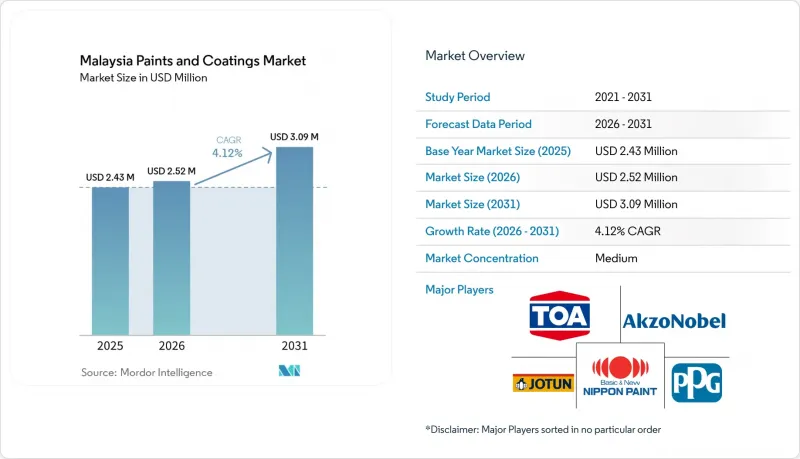
據 Mordor Intelligence 稱,馬來西亞油漆和塗料市場在 2025 年的價值為 24.3 億美元,預計到 2031 年將達到 30.9 億美元,而 2026 年為 25.2 億美元,預測期(2026-2031 年)的複合年成長率為 4.12%。
馬來西亞油漆及塗料市場趨勢及洞察
住宅、商業和基礎設施建設管道
累計2025年,馬來西亞建築業產值將達到1,786億馬幣(約403億美元),年增12.5%。無論是住宅、商業或公共項目,建設活動仍是建築塗料最大的直接消費來源。 2025年預算包括向住宅部撥款100億馬幣(約23億美元),並設立房屋抵押貸款擔保計畫以支持首次住宅。新建住宅在施工的每個階段都需要油漆、底漆、防水系統和相關飾面材料。隨著建築從結構工程推進到室內外裝修,馬來西亞的油漆和塗料市場也從中受益。這種需求基礎廣泛,銷售代理、承包商和專案規範都會在施工開始時產生消費。
建築工程構成比正變得與建築總產值同等重要。 2025年第二季度,非住宅建築成長56.7%,特殊建築成長22.2%,均超過住宅建築的成長。這些項目通常採用環氧地板塗料、防火系統、屋頂塗料和其他特殊產品,而非傳統的室內乳膠塗料。因此,隨著工商業專案規模的擴大,其價值組成可能會轉向更具防護性的應用。柔佛、雪蘭莪和檳城仍然是建設活動和工業發展交會的關鍵地區。馬來西亞的油漆和塗料市場與這項建築項目直接相關,因為項目竣工和後續維護週期都需要塗料。
汽車和電動車製造的擴張
汽車製造業的擴張為馬來西亞的油漆市場創造了一個不斷成長的潛在市場。根據《新海峽時報》引述肯納格證券的一項調查顯示,預計到2025年,馬來西亞註冊的純電動車數量將達到30,848輛,增幅達42%。 2026年8月,Innocom投資3億馬來西亞馬幣(約7,300萬美元)在克林工業園區運作了其第三家油漆廠。該廠將使每班次的年產能增加5萬輛,使該油漆廠的總加工能力達到每年10萬輛車身。由於本地汽車組裝需要在馬來西亞進行噴漆,而不是進口預塗車身,因此對包括電著底漆底漆、底塗層和透明塗層在內的所有噴漆工序都有需求。
EP Manufacturing Berhad於2026年6月在馬六甲州Pego啟動了一座汽車塗料工廠的建設,投資額達2億馬來西亞馬幣(約合4,600萬美元)。該工廠計劃每年加工3萬輛汽車車身,並可相容於純電動汽車(BEV)、混合動力汽車(HEV)、插電式混合動力汽車(PHEV)和內燃機車(ICE)平台。隨著新組裝線的運作,供應商必須獲得水性底漆和麵漆系統、電塗裝塗料以及耐用透明塗層的認證。這些規範推動了對聚氨酯和高固態配方(而非通用乳液)的需求成長。馬來西亞塗料市場正受益於此轉變,因為汽車塗料的選擇取決於性能和生產要求。此次擴張也提升了可靠的本地技術服務對汽車製造商的重要性。
樹脂、二氧化鈦、顏料和溶劑的成本波動
原料價格波動直接威脅塗料生產商的利潤率,尤其是那些購買力有限的生產商。二氧化鈦是此風險的核心,佔建築塗料現金生產成本的25%至30%,佔工業配方成本的12%至18%。 2025年上半年,中國國產金紅石型二氧化鈦的平均價格為每噸1,4461元人民幣(約2,000美元),較2024年同期下降6.65%。西方供應商已宣布,2025年第四季價格將上漲100至150美元/噸。國內小規模生產商通常沒有長期供貨合約,因此難以應對這些價格波動。
貿易措施可能進一步加劇價格壓力。歐盟對中國二氧化鈦徵收的反傾銷稅稅率在14.4%至39.7%之間。歐盟和巴西徵收的關稅已迫使中國將出口目的地轉向亞太經合組織(APEC)市場,包括馬來西亞。短期內,供應增加可能會壓低大宗商品價格,但價格下跌可能會加大那些無法轉向高附加價值配方的製造商的壓力。馬來西亞的油漆和塗料市場深受這種緊張局勢的影響,進口原料和承包商主導的定價同時發揮作用。樹脂、顏料、溶劑和二氧化鈦的成本仍是影響生產者利潤率的重要因素。
細分市場分析
預計到2025年,丙烯酸樹脂將佔據馬來西亞塗料市場44.23%的佔有率,成為該市場最大的樹脂類型。其在內外牆建築塗料領域的廣泛應用支撐了這一地位。丙烯酸樹脂具有優異的耐候性、保色性和經濟的配比成本,並能滿足住宅和商業建築的需求。丙烯酸樹脂既可作為經濟實惠的滾塗乳液,也可作為高品質的彈性體基外牆塗料系統。這種多功能性使其在經銷商和專案管道中擁有廣泛的市場需求。
醇酸樹脂仍然用於木器塗料和一般工業應用,在這些領域,油性光澤塗料仍是首選。環氧樹脂在工業地板和船舶設備的保護塗層中發揮著至關重要的作用。聚酯樹脂用於金屬家具、建築鋁材和家用電器表面處理的粉末塗料。預計到2031年,聚氨酯樹脂的複合年成長率將達到4.67%,使其成為馬來西亞油漆和塗料市場成長最快的樹脂類型。汽車面漆、資料中心鋼骨和可再生能源機架是推動這一成長的主要因素。 2026年5月,寶騰汽車將其AHTV工廠的產能擴大到每年42,000件,從而加強了其在馬來西亞的雙組分透明塗層汽車生產基地。聚氨酯市場也因其在需要柔軟性和抗刮性的應用中的應用而得到支撐。修訂後的MS 134標準的要求進一步提升了人們對低VOC聚氨酯和丙烯酸-聚氨酯系統的興趣。
其他好處:
- Excel格式的市場預測(ME)表
- 3個月的分析師支持
目錄
第1章:引言
- 研究假設和市場定義
- 調查範圍
第2章:調查方法
第3章執行摘要
第4章 市場狀況
- 市場概覽
- 市場促進因素
- 住宅、商業和基礎設施建設訂單前景展望。
- 汽車和電動車生產規模擴大
- 電子、資料中心和電氣設備叢集的成長
- 可再生能源、船舶和能源相關資產對防護塗層的需求。
- 改用低揮發性有機化合物和水性產品
- 在熱帶氣候中引入隔熱抗菌塗層
- 市場限制因素
- 樹脂、二氧化鈦、顏料和溶劑的成本波動
- 揮發性有機化合物、有害空氣污染物及產品合規成本
- 分散的競爭和承包商驅動的價格壓力
- 與商業辦公空間供應過剩和專案進度相關的風險。
- 價值鏈分析
- 波特五力分析
第5章 市場規模與成長預測
- 依樹脂類型
- 丙烯酸纖維
- 阿爾基多
- 聚氨酯
- 環氧樹脂
- 聚酯纖維
- 其他樹脂類型
- 透過技術
- 水溶液
- 溶劑型
- 粉末塗裝
- 紫外線固化塗層
- 按最終用戶行業分類
- 建築學
- 車
- 樹
- 保護塗層
- 一般工業
第6章 競爭情勢
- 市場集中度
- 策略趨勢
- 市佔率和排名分析
- 公司簡介
- Akzo Nobel NV
- Axalta Coating Systems Ltd.
- Chugoku Marine Paints, Ltd.
- Federal Paints Manufacturing(M)Sdn. Bhd.
- Jotun
- Kansai Paint Co., Ltd.
- KCC Corporation
- Kossan Paint(M)Sdn. Bhd.
- KTH Paint Industries Sdn. Bhd.
- MCI Paint Sdn. Bhd.
- Nippon Paint Holdings Co., Ltd.
- Platinum Phase Sdn. Bhd.
- PPG Industries, Inc.
- Seamaster Paint(Malaysia)Sdn. Bhd.
- SK Kaken Co., Ltd.
- Smart Asia Chemical Bhd.
- Suzuka Chemical Co., Ltd.
- Syncoates(M)Sdn. Bhd.
- The Sherwin-Williams Company
- TOA Paint Public Company Limited
第7章 市場機會與未來展望
According to Mordor Intelligence, the Malaysia paints and coatings market size was valued at USD 2.43 billion in 2025 and is estimated to grow from USD 2.52 billion in 2026 to reach USD 3.09 billion by 2031, at a CAGR of 4.12% during the forecast period (2026-2031).
Malaysia Paints and Coatings Market Trends and Insights
Residential, Commercial, and Infrastructure Construction Pipeline
Malaysia's construction sector generated MYR 178.6 billion (USD 40.3 billion) in work value in 2025, representing 12.5% year-over-year growth. Construction activity remains the largest direct source of architectural coating consumption across residential, commercial, and public projects. The 2025 Budget allocated MYR 10 billion (USD 2.3 billion) to the Ministry of Housing, along with mortgage guarantee facilities to support first-time homebuyers. New homes require paint, primers, waterproofing systems, and related finishing materials at multiple stages of construction. The Malaysia Paints and Coatings market also benefits as work progresses from structural construction to interior and exterior finishing. This demand is broad-based, as building starts generate consumption across dealer channels, contractors, and project specifications.
The mix of construction work is becoming as important as total construction output. Nonresidential buildings grew 56.7% in the second quarter of 2025, while special trade activities grew 22.2%, both exceeding residential growth. These projects use epoxy floor coatings, fire-resistant systems, roof finishes, and other specialized products more frequently than conventional interior emulsions. A larger industrial and commercial project base can therefore shift the value mix toward more protective applications. Johor, Selangor, and Penang remain important locations, combining construction activity with industrial development. The Malaysia Paints and Coatings market is directly linked to this building pipeline, as coatings are required at project completion and during subsequent maintenance cycles.
Automotive and Electric Vehicle Manufacturing Expansion
Automotive manufacturing is expanding the addressable base for coatings in Malaysia. Pure electric vehicle registrations reached 30,848 units in 2025, reflecting 42% growth, according to Kenanga Research as cited by the New Straits Times. Inokom launched Paint Shop 3 at its Kulim complex in August 2026, with an investment of MYR 300 million (USD 73 million). The facility adds 50,000 units of annual capacity per shift, bringing total paint-shop throughput to 100,000 vehicle bodies per year. Local vehicle assembly requires coating to be applied in Malaysia rather than importing pre-painted vehicle bodies, creating demand across the e-coat primer, basecoat, and clearcoat stages.
EP Manufacturing Berhad began construction of a MYR 200 million (USD 46 million) vehicle painting facility in Pegoh, Melaka, in June 2026. The planned facility targets 30,000 vehicle bodies annually and is designed to support BEV, HEV, PHEV, and ICE platforms. New assembly lines require suppliers to qualify waterborne primer and topcoat systems, electrodeposition coatings, and durable clearcoats. These specifications support demand for polyurethane and high-solids formulations rather than commodity emulsions. The Malaysia Paints and Coatings market benefits from this shift, as automotive coatings are selected based on performance and production requirements. This expansion also increases the importance of reliable local technical service for vehicle manufacturers.
Resin, Titanium Dioxide, Pigment, and Solvent Cost Volatility
Raw material volatility creates direct margin risk for coating producers, particularly those with limited purchasing capacity. Titanium dioxide is central to this risk, accounting for 25% to 30% of cash production costs for architectural paints and 12% to 18% for industrial formulations. Chinese domestic rutile titanium dioxide averaged 14,461 yuan (equivalent to USD 2,000) per ton in the first half of 2025, down 6.65% from the same period in 2024. Western suppliers announced price increases of USD 100-150 per ton for the fourth quarter of 2025. Smaller domestic producers are less able to absorb these price movements, as they typically lack long-term supply contracts.
Trade actions can further compound pricing pressures. EU anti-dumping duties on Chinese titanium dioxide ranged from 14.4% to 39.7%. Tariffs imposed by the EU and Brazil redirected Chinese exports toward Asia-Pacific Economic Cooperation (APEC) markets, including Malaysia. While greater short-term supply availability can reduce commodity prices, lower prices can intensify pressure on manufacturers that are unable to shift to higher-value formulations. The Malaysia paints and coatings market is exposed to this tension, where imported inputs and contractor-led pricing operate simultaneously. Resin, pigment, solvent, and titanium dioxide costs remain material factors affecting producer margins.
Other drivers and restraints analyzed in the detailed report include:
- Electronics, Data Center, and Electrical Equipment Cluster Growth
- Protective Coating Demand from Renewable Power, Marine, and Energy Assets
- Volatile Organic Compound (VOC), Hazardous Air Pollutant, and Product Compliance Costs
For complete list of drivers and restraints, kindly check the Table Of Contents.
Segment Analysis
Acrylic held 44.23% of the 2025 value, giving it the largest share by resin type in the Malaysia Paints and Coatings market. Its broad use in exterior and interior architectural paints supports this position. Weather resistance, color retention, and accessible formulation costs align with the requirements of residential and commercial buildings. Acrylic can serve as both an economical roller-coat emulsion and a premium elastomeric exterior system. This versatility gives the resin a wide base across dealer and project channels.
Alkyd remains in use in wood finishing and general industrial applications where oil-based gloss paints are still specified. Epoxy is important for protective coatings on industrial floors and marine assets. Polyester is used in powder coating for metal furniture, architectural aluminum, and appliance finishes. Polyurethane is forecast to expand at a 4.67% CAGR through 2031, making it the fastest-growing resin type in the Malaysia Paints and Coatings market. Automotive topcoats, data center steel structures, and renewable energy racking support this growth. Proton expanded its AHTV plant to 42,000 units annually in May 2026, reinforcing the local vehicle-production base for two-pack clearcoats. The market for polyurethane is also supported by its use in flexible and scratch-resistant applications. Revised MS 134 requirements further support interest in low-VOC polyurethane and acrylic-polyurethane systems.
Complete Report Scope:
- By Resin Type
- Acrylic
- Alkyd
- Polyurethane
- Epoxy
- Polyester
- Other Resin Types
- By Technology
- Water-Borne
- Solvent-Borne
- Powder Coating
- UV-Cured Coating
- By End-User Industry
- Architectural
- Automotive
- Wood
- Protective Coating
- General Industrial
List of Companies Covered in this Report:
- Akzo Nobel N.V.
- Axalta Coating Systems Ltd.
- Chugoku Marine Paints, Ltd.
- Federal Paints Manufacturing (M) Sdn. Bhd.
- Jotun
- Kansai Paint Co., Ltd.
- KCC Corporation
- Kossan Paint (M) Sdn. Bhd.
- KTH Paint Industries Sdn. Bhd.
- MCI Paint Sdn. Bhd.
- Nippon Paint Holdings Co., Ltd.
- Platinum Phase Sdn. Bhd.
- PPG Industries, Inc.
- Seamaster Paint (Malaysia) Sdn. Bhd.
- SK Kaken Co., Ltd.
- Smart Asia Chemical Bhd.
- Suzuka Chemical Co., Ltd.
- Syncoates (M) Sdn. Bhd.
- The Sherwin-Williams Company
- TOA Paint Public Company Limited
Additional Benefits:
- The market estimate (ME) sheet in Excel format
- 3 months of analyst support
TABLE OF CONTENTS
1 Introduction
- 1.1 Study Assumptions and Market Definition
- 1.2 Scope of the Study
2 Research Methodology
3 Executive Summary
4 Market Landscape
- 4.1 Market Overview
- 4.2 Market Drivers
- 4.2.1 Residential, Commercial, and Infrastructure Construction Pipeline
- 4.2.2 Automotive and Electric Vehicle Manufacturing Expansion
- 4.2.3 Electronics, Data Center, and Electrical Equipment Cluster Growth
- 4.2.4 Protective Coating Demand from Renewable Power, Marine, and Energy Assets
- 4.2.5 Low-VOC and Water-Borne Specification Shift
- 4.2.6 Tropical-Climate Heat-Reflective and Antimicrobial Coating Adoption
- 4.3 Market Restraints
- 4.3.1 Resin, Titanium Dioxide, Pigment, and Solvent Cost Volatility
- 4.3.2 VOC, Hazardous Air Pollutant, and Product Compliance Costs
- 4.3.3 Fragmented Competition and Contractor-Led Price Pressure
- 4.3.4 Commercial Office Oversupply and Project Timing Risk
- 4.4 Value Chain Analysis
- 4.5 Porter's Five Forces Analysis
- 4.5.1 Bargaining Power of Suppliers
- 4.5.2 Bargaining Power of Buyers
- 4.5.3 Threat of New Entrants
- 4.5.4 Threat of Substitutes
- 4.5.5 Competitive Rivalry
5 Market Size and Growth Forecasts (Value)
- 5.1 By Resin Type
- 5.1.1 Acrylic
- 5.1.2 Alkyd
- 5.1.3 Polyurethane
- 5.1.4 Epoxy
- 5.1.5 Polyester
- 5.1.6 Other Resin Types
- 5.2 By Technology
- 5.2.1 Water-Borne
- 5.2.2 Solvent-Borne
- 5.2.3 Powder Coating
- 5.2.4 UV-Cured Coating
- 5.3 By End-User Industry
- 5.3.1 Architectural
- 5.3.2 Automotive
- 5.3.3 Wood
- 5.3.4 Protective Coating
- 5.3.5 General Industrial
6 Competitive Landscape
- 6.1 Market Concentration
- 6.2 Strategic Moves
- 6.3 Market Share (%)/Ranking Analysis
- 6.4 Company Profiles (includes Global Overview, Market Overview, Core Segments, Financials as available, Strategic Information, Products and Services, and Recent Developments)
- 6.4.1 Akzo Nobel N.V.
- 6.4.2 Axalta Coating Systems Ltd.
- 6.4.3 Chugoku Marine Paints, Ltd.
- 6.4.4 Federal Paints Manufacturing (M) Sdn. Bhd.
- 6.4.5 Jotun
- 6.4.6 Kansai Paint Co., Ltd.
- 6.4.7 KCC Corporation
- 6.4.8 Kossan Paint (M) Sdn. Bhd.
- 6.4.9 KTH Paint Industries Sdn. Bhd.
- 6.4.10 MCI Paint Sdn. Bhd.
- 6.4.11 Nippon Paint Holdings Co., Ltd.
- 6.4.12 Platinum Phase Sdn. Bhd.
- 6.4.13 PPG Industries, Inc.
- 6.4.14 Seamaster Paint (Malaysia) Sdn. Bhd.
- 6.4.15 SK Kaken Co., Ltd.
- 6.4.16 Smart Asia Chemical Bhd.
- 6.4.17 Suzuka Chemical Co., Ltd.
- 6.4.18 Syncoates (M) Sdn. Bhd.
- 6.4.19 The Sherwin-Williams Company
- 6.4.20 TOA Paint Public Company Limited
7 Market Opportunities and Future Outlook
- 7.1 White-Space and Unmet-Need Assessment

 遮蔽塗料市場:全球市場預測,2026-2032年
 東協油漆和塗料市場:市場佔有率分析、行業趨勢和統計數據以及成長預測(2026-2031 年)中東油漆和塗料:市場佔有率分析、行業趨勢和統計數據以及成長預測(2026-2031 年)美國油漆和塗料:市場佔有率分析、行業趨勢和統計數據、成長預測(2026-2031 年)北美油漆和塗料:市場佔有率分析、行業趨勢和統計數據以及成長預測(2026-2031 年)南美洲油漆和塗料市場:市場佔有率分析、行業趨勢和統計數據以及成長預測(2026-2031 年)木榨油市場:全球市場預測(2026-2032)建築塗料市場:2026-2032年全球市場預測(依樹脂類型、技術、塗料類型、最終用途、通路和應用分類)
 全球油漆和塗料市場印度油漆和塗料市場:市場佔有率分析、行業趨勢和統計數據以及成長預測(2026-2031 年)