


 |
市場調查報告書
商品編碼
2115869
東協油漆和塗料市場:市場佔有率分析、行業趨勢和統計數據以及成長預測(2026-2031 年)ASEAN Paints And Coatings - Market Share Analysis, Industry Trends & Statistics, Growth Forecasts (2026 - 2031) |
||||||

※ 本網頁內容可能與最新版本有所差異。詳細情況請與我們聯繫。
據 Mordor Intelligence 稱,東協油漆和塗料市場預計到 2026 年價值 77.8 億美元,高於 2025 年的 74.1 億美元,預計到 2031 年將達到 99.2 億美元。
預計 2026 年至 2031 年的複合年成長率為 4.97%。
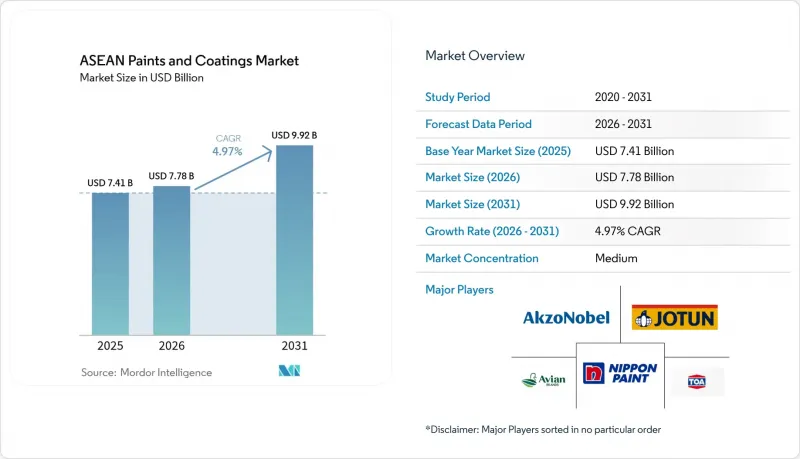
本報告按樹脂類型(丙烯酸樹脂、聚氨酯樹脂等)、工藝(溶劑型塗料、水性塗料等)、應用領域(建築裝飾、防護等)和地區(印尼、馬來西亞、菲律賓、新加坡、泰國、越南等)進行細分。市場預測以美元計價。
東協油漆塗料市場趨勢及洞察
快速的都市化和基礎建設
隨著世界各國政府在道路、鐵路和經濟適用住宅方面投入創紀錄的預算,大規模公共工程項目正在推動東協油漆和塗料市場的發展。越南已撥款300億美元用於多年期交通走廊和能源資產項目,預計這些項目將帶動對高厚度建築和防護塗料的需求。在泰國,全國超過一半的建築支出持續投入東部經濟走廊的大型企劃中,這些項目需要耐腐蝕底漆、交通標線漆和防水卷材。印尼的國家戰略計畫組合(Proyek Strategis Nasional)同樣連接著海上門戶和工業園區,推動了對船體塗料和長效環氧塗料的需求,這些塗料可以減少因維護造成的運作。同時,持續的人口結構變化(向都市區遷移和中等收入家庭的增加)正在擴大高階室內乳膠漆、紋理塗料和防潮面漆的基本客群。目前的專案儲備提供了多周期的前景,至少到 2030 年,這將為樹脂供應商提供穩定的採購計劃。
汽車產業的擴張
東協油漆和塗料市場正受惠於汽車製造商向區域內電動車(EV)生產中心轉型。中國汽車製造商(OEM)在泰國和印尼的工廠投資超過14億美元,用於組裝電池、乘用車和商用貨車。光是泰國的EV3.5計畫就旨在到2027年實現年產52.5萬輛電動車的目標,這將推動對陰極電塗裝底漆、低溫粉末面漆和用於抑制電磁干擾(EMI)的透明塗層的需求。印尼也正沿著類似的道路前進,目標是到2030年代中期實現200萬輛的年產能。隨著生產線產能的提升,一級供應商正在採用紫外光固化塗料,這種塗料在提高生產效率的同時還能降低能源成本,從而促進了汽車行業的強勁生產表現。
石油原料價格波動劇烈
全球需求疲軟和中國產能激增持續擠壓乙烯和丙烯價差,擠壓為東協油漆和塗料市場供應樹脂和溶劑的製造商的利潤空間。苯乙烯、丙烯酸酯和乙二醇等石油相關單體仍容易受到地緣政治衝擊的影響,導致季度成本波動,小型製造商難以承受。受天然氣價格飆升的影響,歐洲供應商將進口添加劑的成本轉嫁給消費者,進一步加劇了印尼和泰國混配商的壓力。鋼鐵和水泥價格的波動使情況更加複雜,因為在大規模建設項目中,塗料競標通常與結構材料捆綁在一起。儘管許多市場領導者正在對沖原料成本,但持續的波動正在降低下游建築承包商的預算可預測性。
細分市場分析
預計到2025年,丙烯酸樹脂將佔東協塗料市場佔有率的41.12%,這反映了其與水性和溶劑型系統的兼容性、優異的保色性和在熱帶氣候下快速乾燥的特性。隨著混配商利用核殼結構和矽改質等級來增強耐污性,丙烯酸樹脂預計將以6.83%的複合年成長率快速成長。鑑於住宅持續的重新粉刷週期,到2031年,東協塗料市場中丙烯酸黏合劑所佔的佔有率可能接近45.2億美元。聚氨酯在汽車面漆和船舶船體塗料領域佔據著一個規模較小但具有重要戰略意義的細分市場,在這些領域,光澤保持性和耐化學性至關重要。聚酯樹脂因其成本績效,仍然是捲材和屋頂塗料的主要材料。另一方面,醇酸樹脂則用於鄉村住宅和防腐蝕底漆,在這些領域,價格比使用壽命更重要。
創新管道依然暢通。研究人員在有機奈米填料改性的環氧樹脂基體中實現了89.87%的防腐蝕效率,從而拓展了環氧樹脂在薄壁鋼結構中的應用範圍。此外,製造商正在開發含有室溫交聯氮丙啶的丙烯酸乳液,這種乳液不含異氰酸酯,卻能達到類似聚氨酯的硬度。隨著上游石化產業單體供應量的增加,樹脂混煉商的價格議價能力不斷提升,並將這些優勢傳遞給下游工藝,從而維持了丙烯酸樹脂平台相對於特種聚氨酯的價格競爭力。
其他好處:
- Excel格式的市場預測(ME)表
- 3個月的分析師支持
目錄
第1章:引言
- 研究的先決條件
- 調查範圍
第2章:調查方法
第3章執行摘要
第4章 市場狀況
- 市場概覽
- 市場促進因素
- 快速的都市化和基礎建設
- 汽車產業的擴張
- 東協地區外國投資增加
- 工業生產的擴張創造了需求。
- 對高階美學日益成長的需求
- 市場限制因素
- 石油原料價格波動劇烈
- 熟練油漆工長期短缺
- 東協化學物質法規協調工作進展緩慢
- 價值鏈分析
- 波特五力模型
第5章 市場規模與成長預測
- 依樹脂類型
- 丙烯酸纖維
- 聚氨酯
- 聚酯纖維
- 其他材料(醇酸樹脂、乙烯基等)
- 透過技術
- 溶劑型塗料
- 水性塗料
- 其他(粉末塗裝、輻射固化(紫外線、電子束等))
- 透過使用
- 用於建築和裝飾
- 為了保護
- 木頭
- 車
- 船
- 包裝
- 按地區
- 印尼
- 馬來西亞
- 菲律賓
- 新加坡
- 泰國
- 越南
- 其他東南亞國協
第6章 競爭情勢
- 市場集中度
- 策略趨勢
- 市佔率分析
- 公司簡介
- 4 Oranges
- Akzo Nobel NV
- Asian Paints Limited
- Asian Paints PPG Pvt. Ltd.
- Avian Brands
- Axalta Coating Systems, LLC
- BASF
- Berger Paints India
- Davies Paints Philippines Inc.
- Haymes
- Jotun
- Kansai Paint Co., Ltd.
- Nippon Paint Holdings Co., Ltd.
- Pacific Paint(BOYSEN)Philippines, Inc.
- Propanraya
- The Sherwin-Williams Company
- TOA Paint(Thailand)Public Company Limited
第7章 市場機會與未來展望
According to Mordor Intelligence, ASEAN paints and coatings market size in 2026 is estimated at USD 7.78 billion, growing from 2025 value of USD 7.41 billion with 2031 projections showing USD 9.92 billion, growing at 4.97% CAGR over 2026-2031.
This report is Segmented by Resin Type (Acrylics, Polyurethane, and More), Technology (Solvent-Borne Coatings, Water-Borne Coatings, Other Technologies), Application (Architectural/Decorative, Protective, and More), and Geography (Indonesia, Malaysia, Philippines, Singapore, Thailand, Vietnam, Rest of ASEAN Countries). The Market Forecasts are Provided in Terms of Value (USD).
ASEAN Paints And Coatings Market Trends and Insights
Rapid Urbanization and Infrastructure Development
Large-scale public-works programs are boosting the ASEAN paints and coatings market as governments deploy record budgets to roads, rail and affordable housing. Vietnam has earmarked USD 30 billion for multi-year transport corridors and energy assets expected to absorb high-build architectural and protective coatings. Thailand's Eastern Economic Corridor continues to channel more than half of national construction outlays into megaprojects that require corrosion-resistant primers, traffic-marking paints and waterproof membranes. Indonesia's Proyek Strategis Nasional portfolio likewise links maritime gateways and industrial estates, lifting demand for marine hull coatings and long-life epoxies that mitigate maintenance downtime. Parallel demographic shifts-urban migration and the rise of middle-income households-are enlarging the customer base for premium interior emulsions, textured finishes and moisture-barrier topcoats. The current project pipeline provides multi-cycle visibility, supporting stable procurement plans for resin suppliers through at least 2030.
Expansion of the Automotive Sector
The ASEAN paints and coatings market benefits from automakers' shift toward regional electric-vehicle hubs. Chinese original-equipment manufacturers (OEMs) have allocated more than USD 1.4 billion to plants in Thailand and Indonesia that will assemble batteries, passenger cars and commercial vans. Thailand's EV3.5 scheme alone targets annual output of up to 525,000 units by 2027, driving demand for cathodic-electrocoat primers, low-temperature powder topcoats and clearcoats that manage electromagnetic interference. Indonesia is charting a similar path, eyeing 2 million-unit capacity toward the mid-2030s. As production lines ramp, tier-one suppliers adopt UV-cured coatings that boost throughput while cutting energy bills, reinforcing the positive volume trajectory for automotive segments.
Volatile Petro-Feedstock Prices
Soft global demand and capacity surges in China have kept ethylene and propylene spreads under pressure, compressing margins for resin and solvent producers that supply the ASEAN paints and coatings market. Crude-linked monomers such as styrene, acrylates and glycols remain susceptible to geopolitical shocks, creating quarterly cost swings that smaller manufacturers struggle to absorb. European suppliers grappling with elevated gas prices have passed through mark-ups on imported additives, further squeezing formulators in Indonesia and Thailand. Steel and cement price volatility adds another layer of complexity because large architectural projects often bundle coating bids with structural materials. Although most market leaders hedge raw materials, sustained volatility reduces budget predictability for downstream construction contractors.
Other drivers and restraints analyzed in the detailed report include:
- Growing Foreign Investments in ASEAN Region
- Expansion of Industrial Manufacturing Creating Demand
- Chronic Skilled-Painter Shortage
For complete list of drivers and restraints, kindly check the Table Of Contents.
Segment Analysis
Acrylic resins underpinned 41.12% of ASEAN paints and coatings market share in 2025, reflecting their compatibility with both water-borne and solvent-cut systems, excellent color retention and rapid-dry properties in tropical climates. They will grow the fastest, at 6.83% CAGR, as formulators exploit core-shell morphology and silicone-modified grades to raise dirt pick-up resistance. The ASEAN paints and coatings market size attributable to acrylic binders could approach USD 4.52 billion by 2031 on sustained residential repaint cycles. Polyurethanes hold a smaller but strategic niche in automotive topcoats and marine hull finishes where gloss retention and chemical resistance are paramount. Polyester resins remain workhorses for coil and roof coatings because of their cost-performance equilibrium, while alkyds cater to rural housing and anticorrosive primers where price outweighs lifespan.
Innovation pipelines are robust: researchers achieved 89.87% corrosion-inhibition efficiency in epoxy matrices modified with organic nanofillers, pushing epoxies into lighter gauge steel structures. Manufacturers are also tailoring acrylic emulsions with ambient-crosslinking aziridines that deliver polyurethane-like hardness without isocyanates. As petrochemical upstreams widen monomer supply, resin formulators gain pricing leverage that can be passed downstream, keeping acrylic platforms competitively priced against specialty polyurethanes.
Complete Report Scope:
- By Resin Type
- Acrylics
- Polyurethane
- Polyester
- Other Resin Types (Alkyds, Vinyl, etc.)
- By Technology
- Solvent-borne Coatings
- Water-borne Coatings
- Other Technologies (Powder Coatings, Radiation Cured (UV, EB), etc.)
- By Application
- Architectural / Decorative
- Protective
- Wood
- Automotive
- Marine
- Packaging
- By Geography
- Indonesia
- Malaysia
- Philippines
- Singapore
- Thailand
- Vietnam
- Rest of ASEAN Countries
List of Companies Covered in this Report:
- 4 Oranges
- Akzo Nobel N.V.
- Asian Paints Limited
- Asian Paints PPG Pvt. Ltd.
- Avian Brands
- Axalta Coating Systems, LLC
- BASF
- Berger Paints India
- Davies Paints Philippines Inc.
- Haymes
- Jotun
- Kansai Paint Co., Ltd.
- Nippon Paint Holdings Co., Ltd.
- Pacific Paint (BOYSEN) Philippines, Inc.
- Propanraya
- The Sherwin-Williams Company
- TOA Paint (Thailand) Public Company Limited
Additional Benefits:
- The market estimate (ME) sheet in Excel format
- 3 months of analyst support
TABLE OF CONTENTS
1 Introduction
- 1.1 Study Assumptions
- 1.2 Scope of the Study
2 Research Methodology
3 Executive Summary
4 Market Landscape
- 4.1 Market Overview
- 4.2 Market Drivers
- 4.2.1 Rapid Urbanization and Infrastructure Development
- 4.2.2 Expansion of the Automotive Sector
- 4.2.3 Growing Foregn Investments in ASEAN Region
- 4.2.4 Expansion of Industrial Manufacturing Creating Demand
- 4.2.5 Increasing Demand for Premium Asthetics
- 4.3 Market Restraints
- 4.3.1 Volatile Petro-Feedstock Prices
- 4.3.2 Chronic Skilled-Painter Shortage
- 4.3.3 Delayed Harmonisation of ASEAN Chemical Regulations
- 4.4 Value Chain Analysis
- 4.5 Porter's Five Forces
- 4.5.1 Threat of New Entrants
- 4.5.2 Bargaining Power of Buyers
- 4.5.3 Bargaining Power of Suppliers
- 4.5.4 Threat of Substitute Products
- 4.5.5 Degree of Competition
5 Market Size and Growth Forecasts (Value)
- 5.1 By Resin Type
- 5.1.1 Acrylics
- 5.1.2 Polyurethane
- 5.1.3 Polyester
- 5.1.4 Other Resin Types (Alkyds, Vinyl, etc.)
- 5.2 By Technology
- 5.2.1 Solvent-borne Coatings
- 5.2.2 Water-borne Coatings
- 5.2.3 Other Technologies (Powder Coatings, Radiation Cured (UV, EB), etc.)
- 5.3 By Application
- 5.3.1 Architectural / Decorative
- 5.3.2 Protective
- 5.3.3 Wood
- 5.3.4 Automotive
- 5.3.5 Marine
- 5.3.6 Packaging
- 5.4 By Geography
- 5.4.1 Indonesia
- 5.4.2 Malaysia
- 5.4.3 Philippines
- 5.4.4 Singapore
- 5.4.5 Thailand
- 5.4.6 Vietnam
- 5.4.7 Rest of ASEAN Countries
6 Competitive Landscape
- 6.1 Market Concentration
- 6.2 Strategic Moves
- 6.3 Market Share Analysis
- 6.4 Company Profiles {(includes Global level Overview, Market level overview, Core Segments, Financials as available, Strategic Information, Market Rank/Share for key companies, Products and Services, and Recent Developments)}
- 6.4.1 4 Oranges
- 6.4.2 Akzo Nobel N.V.
- 6.4.3 Asian Paints Limited
- 6.4.4 Asian Paints PPG Pvt. Ltd.
- 6.4.5 Avian Brands
- 6.4.6 Axalta Coating Systems, LLC
- 6.4.7 BASF
- 6.4.8 Berger Paints India
- 6.4.9 Davies Paints Philippines Inc.
- 6.4.10 Haymes
- 6.4.11 Jotun
- 6.4.12 Kansai Paint Co., Ltd.
- 6.4.13 Nippon Paint Holdings Co., Ltd.
- 6.4.14 Pacific Paint (BOYSEN) Philippines, Inc.
- 6.4.15 Propanraya
- 6.4.16 The Sherwin-Williams Company
- 6.4.17 TOA Paint (Thailand) Public Company Limited
7 Market Opportunities and Future Outlook
- 7.1 White-space and Unmet-need Assessment
- 7.2 Growing Innovations on Eco-Friendly Paints and Coatings

 中東油漆和塗料:市場佔有率分析、行業趨勢和統計數據以及成長預測(2026-2031 年)美國油漆和塗料:市場佔有率分析、行業趨勢和統計數據、成長預測(2026-2031 年)北美油漆和塗料:市場佔有率分析、行業趨勢和統計數據以及成長預測(2026-2031 年)南美洲油漆和塗料市場:市場佔有率分析、行業趨勢和統計數據以及成長預測(2026-2031 年)
 木榨油市場:全球市場預測(2026-2032)建築塗料市場:2026-2032年全球市場預測(依樹脂類型、技術、塗料類型、最終用途、通路和應用分類)
 全球油漆和塗料市場印度油漆和塗料市場:市場佔有率分析、行業趨勢和統計數據以及成長預測(2026-2031 年)塗料市場:2026-2032年全球市場預測(依樹脂類型、技術、產品類型、基材、終端用戶產業及通路分類)
 建築塗料市場規模、佔有率和成長分析:按產品類型、技術、應用、最終用途、分銷管道和地區分類-產業預測,2026-2033年