


 |
市場調查報告書
商品編碼
2120792
南美洲油漆和塗料市場:市場佔有率分析、行業趨勢和統計數據以及成長預測(2026-2031 年)South America Paints And Coatings - Market Share Analysis, Industry Trends & Statistics, Growth Forecasts (2026 - 2031) |
||||||

※ 本網頁內容可能與最新版本有所差異。詳細情況請與我們聯繫。
據 Mordor Intelligence 稱,2025 年南美油漆和塗料市場價值為 73.6 億美元,預計到 2031 年將達到 83.7 億美元,而 2026 年為 75.2 億美元,預測期(2026-2031 年)的複合年成長率為 2.17%。
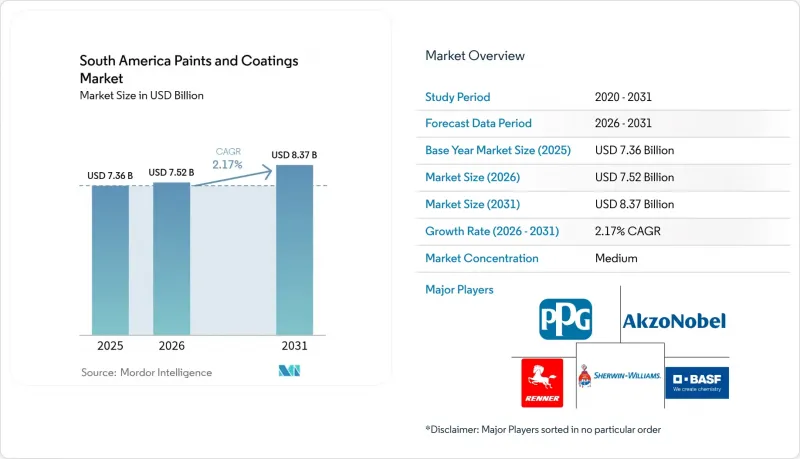
本報告按樹脂類型(丙烯酸樹脂、環氧樹脂、醇酸樹脂、聚酯樹脂等)、工藝(水性、溶劑型、粉末等)、終端用戶行業(建築、汽車、工業用材、一般工業等)和地區(巴西、阿根廷、智利、哥倫比亞、秘魯及其他南美國家)進行細分。市場預測以美元計價。
南美洲油漆和塗料市場趨勢及洞察
住宅和商業建築項目的快速成長
哥倫比亞和智利住宅及基礎設施支出的增加抵消了巴西在2025年初出現的成長放緩,並支撐了建築業的穩定需求。低成本的丙烯酸乳液塗料在社會住宅項目中備受青睞,而商業建築商則要求使用符合綠色建築標準的低排放、防黴的室內塗料。水性丙烯酸塗料在巴西的市場佔有率也在不斷成長,生命週期研究表明,在八項環境指標中的七項上,水性丙烯酸塗料的表現優於溶劑型塗料。此外,政府採購優先考慮含有生物基和回收材料的配方,供應商也不斷拓展其永續產品線。
該地區汽車生產和出口的復甦
2024年,巴西汽車產量達到250萬輛,年增9.7%,汽車製造商(OEM)的底塗層和修補漆消費量也隨之回升。汽車製造商需要耐用、低VOC(目的地有機化合物)且符合更嚴格的排放法規並能適應熱帶氣候的塗料,這推動了對水性底塗層和高固態透明塗層的投資。 PPG在拉丁美洲的銷售額在2024年成長了14.1%,主要得益於其汽車OEM和修補漆產品線。墨西哥邊境沿線出口到北美的組裝廠需要符合美國品質標準的認證塗料,這擴大了高階化學品的目標市場。
對整個南方共同市場地區揮發性有機化合物和溶劑排放實施更嚴格的限制。
根據美國第1113號法規,監管機構正在對建築和工業塗料實施更嚴格的監管。大型供應商正利用全球研發資源推出超低VOC產品線,而中小企業難以應對配方變更帶來的成本壓力。監管合規要求推動了對水性塗料和粉末塗料技術的需求成長,但這暫時造成了一種局面:企業不得不同時持有這兩種類型的庫存,直到傳統的溶劑型產品售罄為止。
細分市場分析
預計到2025年,丙烯酸塗料將維持35.78%的市場佔有率,憑藉其在水性建築塗料領域的廣泛應用,支撐著南美洲塗料市場的銷售量。聚氨酯塗料正以5.62%的複合年成長率成長,這主要得益於其卓越的耐化學性和耐磨性,鋰電池和汽車行業的客戶對其青睞有加。環氧樹脂正被用作船舶和金屬加工設備在腐蝕性環境中的保護塗層,而醇酸樹脂則正被更具成本競爭力的丙烯酸乳液所取代,後者如今能夠滿足中等耐久性需求。聚酯樹脂正助力家用電器和汽車裝飾粉末塗料產量的成長,並幫助巴西成為亞洲以外成長最快的粉末塗料預處理中心之一。特種矽酮和氟聚合物則滿足了反射屋頂和製程設備等需要抵禦強紫外線和化學品腐蝕的細分市場需求。
市場趨勢表明,丙烯酸乳液供應商正投資於生物基單體,以在日益嚴格的VOC法規下實現差異化競爭。同時,聚氨酯化合物生產商正在增加針對氫氧化鋰生產設施最佳化的紫外線穩定脂肪族體系。環氧樹脂供應商則專注於快速固化酚醛樹脂混合物,以最大限度地減少散貨港口維護的停機時間。因此,樹脂需求模式既反映了該地區產業結構的變化,也與環境政策的發展方向一致。
其他好處:
- Excel格式的市場預測(ME)表
- 3個月的分析師支持
目錄
第1章:引言
- 研究假設和市場定義
- 調查範圍
第2章:調查方法
第3章執行摘要
第4章 市場狀況
- 市場概覽
- 市場促進因素
- 住宅和商業建築項目的快速擴張
- 該地區汽車生產和出口的復甦
- 反射塗層在熱帶城市冷屋頂的迅速普及
- 鋰離子電池超級工廠的建造帶動了對特殊塗層需求的成長。
- 裝飾塗料領域線上DIY微型品牌的崛起
- 市場限制因素
- 加強南方共同市場區域內揮發性有機化合物和溶劑排放法規
- 匯率波動推高了進口原料成本。
- 高階辦公大樓外牆採用複合板材的趨勢正在降低對油漆的需求。
- 價值鏈分析
- 監理情勢
- 波特五力模型
第5章 市場規模與成長預測
- 依樹脂類型
- 丙烯酸樹脂
- 環氧樹脂
- 阿爾基多
- 聚酯纖維
- 聚氨酯
- 其他樹脂(矽樹脂、氟樹脂等)
- 透過技術
- 水溶液
- 溶劑型
- 粉末
- 紫外線固化型
- 按最終用戶行業分類
- 建築學
- 車
- 工業木材
- 一般工業
- 一般工業
- 運輸
- 包裝
- 按地區
- 巴西
- 阿根廷
- 智利
- 哥倫比亞
- 秘魯
- 其他南美國家
第6章 競爭情勢
- 市場集中度
- 策略趨勢
- 市佔率** / 排名分析
- 公司簡介
- Akzo Nobel NV
- Axalta Coating Systems
- BASF SE
- Belacor Tintas
- Coral Paints
- Hempel
- Hidracor
- Iquine.
- JAT HOLDINGS PLC,
- Jotun
- Lanco Paints
- Montana Quimica
- Pinturas Popular
- PPG Industries, Inc.
- Renner Herrmann SA
- Sinteplast
- The Sherwin-William Company
- Tigre S/A
- WEG Coatings
第7章 市場機會與未來展望
According to Mordor Intelligence, the South America paints and Coatings Market size was valued at USD 7.36 billion in 2025 and estimated to grow from USD 7.52 billion in 2026 to reach USD 8.37 billion by 2031, at a CAGR of 2.17% during the forecast period (2026-2031).
This report is Segmented by Resin Type (Acrylics, Epoxy, Alkyd, Polyester, and More), Technology (Water-Borne, Solvent-Borne, Powder, and More), End-User Industry (Architectural, Automotive, Industrial Wood, Industrial General, General Industrial, and More), and Geography (Brazil, Argentina, Chile, Colombia, Peru, and Rest of South America). The Market Forecasts are Provided in Terms of Value (USD).
South America Paints And Coatings Market Trends and Insights
Rapid Growth of Residential and Commercial Construction Projects
Elevated housing and infrastructure spending in Colombia and Chile offset Brazil's early-2025 slowdown and underpin steady architectural volume. Social-housing programs favor low-cost acrylic emulsions, whereas commercial builders increasingly require low-emission, mold-resistant interior finishes that meet green-building criteria. Water-borne acrylic systems share the win because Brazilian life-cycle studies show superior performance in seven of eight environmental metrics compared to solvent-borne coatings. Government procurements also prioritize bio-based and recycled-content formulas, prompting suppliers to broaden sustainable product lines.
Recovery of Regional Automotive Production and Exports
Brazil produced 2.5 million vehicles in 2024, a 9.7% increase, reviving OEM (Original Equipment Manufacturer) basecoat and refinish consumption. Automakers demand durable, low-VOC finishes that comply with stricter emission rules and withstand tropical climates, spurring investment in water-borne basecoats and high-solid clearcoats. PPG's Latin America sales climbed 14.1% in 2024, driven largely by automotive OEM and refinish lines. Mexico-border assembly plants that export to North America require coatings certified to US quality standards, widening the addressable market for premium chemistries.
Stricter VOC and Solvent-Emission Limits Across Mercosur
Regulators enforce tighter limits on architectural and industrial coatings, mirroring US Rule 1113 benchmarks. Larger suppliers leverage global R&D to launch ultra-low-VOC lines, while smaller firms struggle with the costs of reformulation. Compliance spurs demand for water-borne and powder technologies but introduces transitional dual inventories as legacy solvent grades sell through.
Other drivers and restraints analyzed in the detailed report include:
- Rapid Adoption of Cool-Roof Reflective Coatings in Tropical Cities
- Lithium-ion Battery Gigafactory Build-outs Demanding Specialty Coatings
- Currency Volatility Inflating Imported Raw-Material Costs
For complete list of drivers and restraints, kindly check the Table Of Contents.
Segment Analysis
Acrylics retained a 35.78% revenue share in 2025, anchoring the South America paints and coatings market through their versatility in water-borne architectural finishes. Polyurethane volumes are climbing at a 5.62% CAGR as lithium battery and automotive customers favor superior chemical and abrasion resistance. Epoxies serve as a protective coating for marine and metal-fabrication assets exposed to corrosive environments, whereas alkyds are being replaced by cost-competitive acrylic emulsions that now meet mid-tier durability needs. Polyester resins support growing powder-coating output for appliances and automotive trim, helping Brazil emerge as one of the fastest-expanding powder pretreatment hubs outside Asia. Specialty silicone and fluoropolymer chemistries fill niches requiring extreme UV or chemical protection on reflective roofs and process equipment.
Market momentum indicates that acrylic-emulsion suppliers are investing in bio-based monomers to differentiate themselves amid tightening VOC rules. Meanwhile, polyurethane formulators add UV-stable aliphatic systems tailored to lithium-hydroxide facilities. Epoxy vendors emphasize rapid-cure novolac blends for minimizing downtime in bulk cargo port maintenance. Thus, resin demand patterns mirror the region's shifting industrial mix while aligning with environmental policy trajectories.
Complete Report Scope:
- By Resin Type
- Acrylics
- Epoxy
- Alkyd
- Polyester
- Polyurethane
- Other Resins (Silicone, Fluoropolymer, etc.)
- By Technology
- Water-borne
- Solvent-borne
- Powder
- UV-cured
- By End-User Industry
- Architectural
- Automotive
- Industrial Wood
- Industrial General
- General Industrial
- Transportation
- Packaging
- By Geography
- Brazil
- Argentina
- Chile
- Colombia
- Peru
- Rest of South America
List of Companies Covered in this Report:
- Akzo Nobel N.V.
- Axalta Coating Systems
- BASF SE
- Belacor Tintas
- Coral Paints
- Hempel
- Hidracor
- Iquine.
- JAT HOLDINGS PLC,
- Jotun
- Lanco Paints
- Montana Quimica
- Pinturas Popular
- PPG Industries, Inc.
- Renner Herrmann SA
- Sinteplast
- The Sherwin-William Company
- Tigre S/A
- WEG Coatings
Additional Benefits:
- The market estimate (ME) sheet in Excel format
- 3 months of analyst support
TABLE OF CONTENTS
1 Introduction
- 1.1 Study Assumptions and Market Definition
- 1.2 Scope of the Study
2 Research Methodology
3 Executive Summary
4 Market Landscape
- 4.1 Market Overview
- 4.2 Market Drivers
- 4.2.1 Rapid Growth of Residential and Commercial Construction Projects
- 4.2.2 Recovery of Regional Automotive Production and Exports
- 4.2.3 Rapid Adoption of Cool-roof Reflective Coatings in Tropical Cities
- 4.2.4 Lithium-ion Battery Gigafactory Build-outs Demanding Specialty Coatings
- 4.2.5 Rise of Online DIY Micro-brands for Decorative Paints
- 4.3 Market Restraints
- 4.3.1 Stricter VOC and Solvent-emission Limits Across Mercosur
- 4.3.2 Currency Volatility Inflating Imported Raw-material Costs
- 4.3.3 Shift to Composite Facade Panels Reducing Paint Demand in Premium Offices
- 4.4 Value Chain Analysis
- 4.5 Regulatory Landscape
- 4.6 Porter's Five Forces
- 4.6.1 Bargaining Power of Suppliers
- 4.6.2 Bargaining Power of Buyers
- 4.6.3 Threat of New Entrants
- 4.6.4 Threat of Substitute Products and Services
- 4.6.5 Degree of Competition
5 Market Size & Growth Forecasts (Value)
- 5.1 By Resin Type
- 5.1.1 Acrylics
- 5.1.2 Epoxy
- 5.1.3 Alkyd
- 5.1.4 Polyester
- 5.1.5 Polyurethane
- 5.1.6 Other Resins (Silicone, Fluoropolymer, etc.)
- 5.2 By Technology
- 5.2.1 Water-borne
- 5.2.2 Solvent-borne
- 5.2.3 Powder
- 5.2.4 UV-cured
- 5.3 By End-User Industry
- 5.3.1 Architectural
- 5.3.2 Automotive
- 5.3.3 Industrial Wood
- 5.3.4 Industrial General
- 5.3.5 General Industrial
- 5.3.6 Transportation
- 5.3.7 Packaging
- 5.4 By Geography
- 5.4.1 Brazil
- 5.4.2 Argentina
- 5.4.3 Chile
- 5.4.4 Colombia
- 5.4.5 Peru
- 5.4.6 Rest of South America
6 Competitive Landscape
- 6.1 Market Concentration
- 6.2 Strategic Moves
- 6.3 Market Share**/Ranking Analysis
- 6.4 Company Profiles (includes Global level Overview, Market level overview, Core Segments, Financials as available, Strategic Information, Market Rank/Share for key companies, Products & Services, Recent Developments)
- 6.4.1 Akzo Nobel N.V.
- 6.4.2 Axalta Coating Systems
- 6.4.3 BASF SE
- 6.4.4 Belacor Tintas
- 6.4.5 Coral Paints
- 6.4.6 Hempel
- 6.4.7 Hidracor
- 6.4.8 Iquine.
- 6.4.9 JAT HOLDINGS PLC,
- 6.4.10 Jotun
- 6.4.11 Lanco Paints
- 6.4.12 Montana Quimica
- 6.4.13 Pinturas Popular
- 6.4.14 PPG Industries, Inc.
- 6.4.15 Renner Herrmann SA
- 6.4.16 Sinteplast
- 6.4.17 The Sherwin-William Company
- 6.4.18 Tigre S/A
- 6.4.19 WEG Coatings
7 Market Opportunities & Future Outlook
- 7.1 White-space and Unmet-need Assessment

 東協油漆和塗料市場:市場佔有率分析、行業趨勢和統計數據以及成長預測(2026-2031 年)中東油漆和塗料:市場佔有率分析、行業趨勢和統計數據以及成長預測(2026-2031 年)美國油漆和塗料:市場佔有率分析、行業趨勢和統計數據、成長預測(2026-2031 年)北美油漆和塗料:市場佔有率分析、行業趨勢和統計數據以及成長預測(2026-2031 年)
 木榨油市場:全球市場預測(2026-2032)建築塗料市場:2026-2032年全球市場預測(依樹脂類型、技術、塗料類型、最終用途、通路和應用分類)
 全球油漆和塗料市場印度油漆和塗料市場:市場佔有率分析、行業趨勢和統計數據以及成長預測(2026-2031 年)塗料市場:2026-2032年全球市場預測(依樹脂類型、技術、產品類型、基材、終端用戶產業及通路分類)
 建築塗料市場規模、佔有率和成長分析:按產品類型、技術、應用、最終用途、分銷管道和地區分類-產業預測,2026-2033年