


 |
市場調查報告書
商品編碼
2114379
中東油漆和塗料:市場佔有率分析、行業趨勢和統計數據以及成長預測(2026-2031 年)Middle-East Paints And Coatings - Market Share Analysis, Industry Trends & Statistics, Growth Forecasts (2026 - 2031) |
||||||

※ 本網頁內容可能與最新版本有所差異。詳細情況請與我們聯繫。
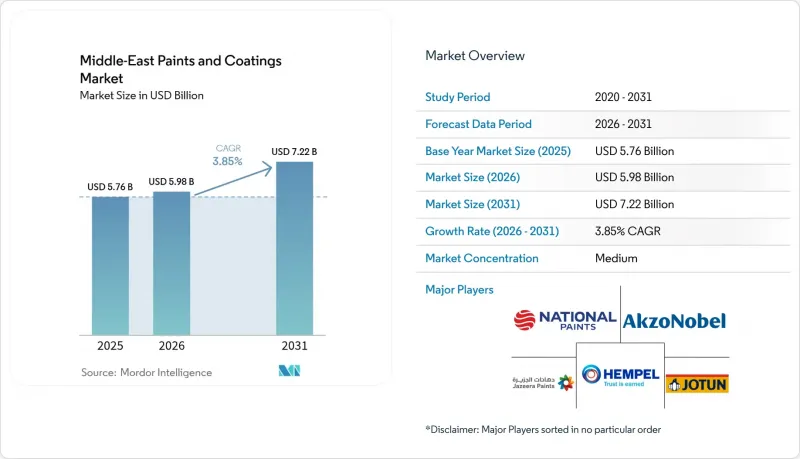
據 Mordor Intelligence 稱,中東油漆和塗料市場預計到 2026 年價值 59.8 億美元,高於 2025 年的 57.6 億美元,預計到 2031 年將達到 72.2 億美元。
預計 2026 年至 2031 年的複合年成長率為 3.85%。
本報告按樹脂類型(丙烯酸樹脂、醇酸樹脂、聚氨酯樹脂、環氧樹脂、聚酯樹脂和其他樹脂)、技術(水性、溶劑型、粉末塗料、UV固化塗料)、最終用戶行業(建築業、汽車業、工業木材業、一般工業、運輸業和其他最終用戶行業)和地區(沙烏地阿拉伯、卡達、科威特、阿曼、伊朗等)對行業進行分類。
中東油漆及塗料市場趨勢及洞察
我們專注於以旅遊業主導的大型計畫(沙烏地阿拉伯的NEOM,杜拜的世博城)。
沙烏地阿拉伯耗資5000億美元的NEOM開發項目和杜拜耗資27億美元的世博城擴建項目,正將投資重點從波動較大的建築領域轉向需要適應氣候的高品質塗料的永久性基礎設施。 NEOM的20萬勞動力正在推動住宅和商業房地產的建設,從而大幅增加塗料的使用;同時,人們對標誌性建築的日益關注也推動了對聚氨酯和自清潔產品的需求。這些項目正在將臨時展覽和酒店設施轉變為需要更高維護週期的長期資產。
商業和住宅建築項目蓬勃發展
中東和北非地區(MENA)高達3.9兆美元的專案儲備預計將在未來十年為中東油漆和塗料市場提供穩定的需求。阿拉伯聯合大公國5,900億美元的投資計畫和沙烏地阿拉伯1.5兆美元的訂單,涵蓋了高價值的綜合用途塔樓、下游能源工廠和物流樞紐,這些項目都需要兼具耐腐蝕性和裝飾性的系統。能源相關契約,例如阿布達比國家石油公司(ADNOC)價值7.2億美元的在地採購協議,正在增加對惡劣高鹽環境下防護塗料的需求。
原料價格波動給利潤率帶來了壓力。
由於二氧化鈦價格徘徊在每噸1974美元左右,加上紅海運輸延誤,生產商不得不增加安全庫存、緊張流動資金並對沖原料風險。儘管海灣合作理事會(GCC)石化產業的擴張預計將在長期內緩解樹脂供應緊張,但短期價格波動仍與全球能源市場密切相關。缺乏整合和採購規模的中小型區域企業受到的衝擊最大,日益成為財力雄厚的競爭對手的收購目標。
細分市場分析
由於價格實惠,丙烯酸樹脂預計到2025年將佔據34.00%的市場佔有率,但聚氨酯預計到2031年將以4.18%的複合年成長率成為最高成長材料,因為設計師要求聚氨酯塗料在沙漠烈日下具有抗紫外線性能,並擁有更長的使用壽命。環氧樹脂和醇酸樹脂塗料在石油天然氣產業和歷史建築修復領域發揮著獨特的作用。在軟材料複合材料技術創新研究所的研究推動下,對混合化學的投資預示著下一代混合材料的出現,這些材料將兼具丙烯酸樹脂的成本效益和聚氨酯的耐久性。製造地也隨之擴張,美國國家塗料公司(National Paints)已將其產能提高至2.64億公升,以滿足快速成長的高階市場需求。
在時間緊迫的「超級專案」中,能夠擴大聚氨酯生產規模且不影響顏色一致性或固化時間的供應商備受青睞。隨著工廠數量的增加,區域買家正在協商更短的前置作業時間和本地技術服務支持,並在沙烏地阿拉伯和阿拉伯聯合大公國的工業園區內建立本地實驗室。這一趨勢正在提升整個中東塗料市場的品質標準,並提高低規格進口產品的進入門檻。
其他好處
- Excel格式的市場預測(ME)表
- 3個月的分析師支持
目錄
第1章:引言
- 研究假設和市場定義
- 調查範圍
第2章:調查方法
第3章執行摘要
第4章 市場狀況
- 市場概覽
- 市場促進因素
- 專注於以旅遊業主導的大型計畫(沙烏地阿拉伯的NEOM,杜拜的世博城)
- 商業和住宅建築工程訂單積壓激增。
- 監管政策轉向低揮發性有機化合物(VOC)水溶液系統
- 為該地區的油漆生產位置提供激勵措施
- 自清潔外牆塗料在高層建築。
- 市場限制因素
- 石油衍生原料價格波動
- 遵守揮發性有機化合物 (VOC) 和室內空氣品質法規的相關成本增加
- 合格噴灑工人短缺
- 價值鏈分析
- 波特五力模型
第5章 市場規模與成長預測
- 依樹脂類型
- 丙烯酸纖維
- 阿爾基多
- 聚氨酯
- 環氧樹脂
- 聚酯纖維
- 其他(矽酮、乙烯基、氟樹脂)
- 透過技術
- 水溶液
- 溶劑型
- 粉末塗裝
- 紫外線固化塗層
- 按最終用戶行業分類
- 建築學
- 車
- 工業木材
- 為了保護
- 運輸
- 一般工業
- 包裝
- 按地區
- 沙烏地阿拉伯
- 阿拉伯聯合大公國
- 卡達
- 科威特
- 阿曼
- 巴林
- 伊朗
- 伊拉克
- 其他中東國家
第6章 競爭情勢
- 市場集中度
- 策略趨勢
- 市佔率和排名分析
- 公司簡介
- Akzo Nobel NV
- Asian Paints Berger
- Axalta Coating Systems
- Beckers Group
- Caparol Paints
- Hempel A/S
- Henkel AG & Co. KGaA
- Jazeera Paints
- Jotun
- Kaizen Paint Middle East FZCO
- National Paints Factories Co. Ltd
- Nippon Paint Factories Co. Ltd
- PPG Industries Inc.
- Ritver Paints & Coatings
- RPM International Inc.
- Sigma Paints
- Tambour
- Terraco UAE Ltd
- The Sherwin-Williams Company
- Thermalite Middle East
第7章 市場機會與未來展望
According to Mordor Intelligence, the Middle East paints and Coatings Market size in 2026 is estimated at USD 5.98 billion, growing from 2025 value of USD 5.76 billion with 2031 projections showing USD 7.22 billion, growing at 3.85% CAGR over 2026-2031.
This report Segments the Industry Into Resin Type (Acrylic, Alkyd, Polyurethane, Epoxy, Polyester, Other Resin Types), Technology (Water-Borne, Solvent-Borne, Powder Coating, and UV-Cured Coating), End-User Industry (Architectural, Automotive, Industrial Wood, General Industrial, Transportation, and Other End-User Industries), and Geography (Saudi Arabia, Qatar, Kuwait, Oman, Iran, and More).
Middle-East Paints And Coatings Market Trends and Insights
Focus on tourism-led giga-projects (Saudi NEOM, Expo City Dubai)
Saudi Arabia's USD 500 billion NEOM development and Dubai's USD 2.7 billion Expo City extension project shift spending from cyclical construction toward permanent infrastructure that demands premium, climate-adapted coatings. NEOM's 200,000-strong workforce creates secondary residential and commercial builds that multiply coating volumes, while the focus on architectural icons shifts preferences toward polyurethane and self-cleaning products. These projects, therefore, convert temporary exhibition or hospitality structures into long-term asset classes that require higher-value maintenance cycles.
Booming commercial and residential construction pipeline
A USD 3.9 trillion MENA project pipeline ensures a predictable pull for the Middle East paints and coatings market across the decade. The UAE's USD 590 billion commitments and Saudi Arabia's USD 1.5 trillion backlog include high-value mixed-use towers, downstream energy plants, and logistics hubs that require both corrosion-resistant and decorative systems. Energy-linked contracts, such as ADNOC's AED 720 million local procurement award, increase protective-coating volume in harsh, salt-laden environments.
Raw-material price volatility pressures margins
Titanium dioxide hovering near USD 1,974 per metric ton and Red Sea shipping delays force producers to boost safety stocks, stretch working capital, and hedge feedstocks. While GCC petrochemical expansion is expected to ease long-term resin supply, short-term price swings still closely mirror global energy markets. Smaller regional firms, lacking integration or procurement scale, feel the squeeze hardest, hastening them as takeover targets for well-capitalized rivals.
Other drivers and restraints analyzed in the detailed report include:
- Regulatory transformation toward low-VOC systems
- Localization incentives for regional paint production
- Compliance costs challenge solvent-based incumbents
For complete list of drivers and restraints, kindly check the Table Of Contents.
Segment Analysis
Acrylics controlled 34.00% of the market in 2025, thanks to their affordability; however, polyurethanes posted the fastest 4.18% CAGR through 2031, as specifiers seek UV resistance and a long lifecycle in desert sun. Epoxy and alkyd grades hold niche roles in oil-and-gas and heritage restoration work. Investment in hybrid chemistries, led by research from the Technology Innovation Institute on soft-material composites, hints at next-generation blends that merge the cost efficiency of acrylic with the robustness of polyurethane. Manufacturing footprints expand accordingly, with National Paints' lifting capacity to 264 million liters to serve premium growth pockets.
Deadline-driven giga-projects reward suppliers able to scale polyurethanes without sacrificing color consistency or cure time. As plant numbers increase, regional buyers negotiate shorter lead times and in-country technical service support, embedding local labs within Saudi and Emirati industrial zones. This dynamic raises the floor for quality across the Middle East paints and coatings market and deepens barriers to low-spec imports.
Complete Report Scope:
- By Resin Type
- Acrylic
- Alkyd
- Polyurethane
- Epoxy
- Polyester
- Others (Silicone, Vinly, Fluoropolymer)
- By Technology
- Water-borne
- Solvent-borne
- Powder Coating
- UV-cured Coating
- By End-user Industry
- Architectural
- Automotive
- Industrial Wood
- Protective
- Transportation
- General Industrial
- Packaging
- By Geography
- Saudi Arabia
- United Arab Emirates
- Qatar
- Kuwait
- Oman
- Bahrain
- Iran
- Iraq
- Rest of Middle East
List of Companies Covered in this Report:
- Akzo Nobel N.V.
- Asian Paints Berger
- Axalta Coating Systems
- Beckers Group
- Caparol Paints
- Hempel A/S
- Henkel AG & Co. KGaA
- Jazeera Paints
- Jotun
- Kaizen Paint Middle East FZCO
- National Paints Factories Co. Ltd
- Nippon Paint Factories Co. Ltd
- PPG Industries Inc.
- Ritver Paints & Coatings
- RPM International Inc.
- Sigma Paints
- Tambour
- Terraco UAE Ltd
- The Sherwin-Williams Company
- Thermalite Middle East
Additional Benefits:
- The market estimate (ME) sheet in Excel format
- 3 months of analyst support
TABLE OF CONTENTS
1 Introduction
- 1.1 Study Assumptions & Market Definition
- 1.2 Scope of the Study
2 Research Methodology
3 Executive Summary
4 Market Landscape
- 4.1 Market Overview
- 4.2 Market Drivers
- 4.2.1 Focus on tourism-led giga-projects (Saudi NEOM, Expo City Dubai)
- 4.2.2 Booming commercial and residential construction pipeline
- 4.2.3 Regulatory shift to low-VOC water-borne systems
- 4.2.4 Localization incentives for regional paint production
- 4.2.5 Rapid uptake of self-cleaning facade coatings for high-rise maintenance
- 4.3 Market Restraints
- 4.3.1 Volatility in petro-derived raw-material prices
- 4.3.2 Stricter VOC and indoor-air-quality compliance costs
- 4.3.3 Shortage of certified spray-application labour
- 4.4 Value Chain Analysis
- 4.5 Porter's Five Forces
- 4.5.1 Bargaining Power of Suppliers
- 4.5.2 Bargaining Power of Buyers
- 4.5.3 Threat of New Entrants
- 4.5.4 Threat of Substitutes
- 4.5.5 Degree of Competition
5 Market Size & Growth Forecasts (Value)
- 5.1 By Resin Type
- 5.1.1 Acrylic
- 5.1.2 Alkyd
- 5.1.3 Polyurethane
- 5.1.4 Epoxy
- 5.1.5 Polyester
- 5.1.6 Others (Silicone, Vinly, Fluoropolymer)
- 5.2 By Technology
- 5.2.1 Water-borne
- 5.2.2 Solvent-borne
- 5.2.3 Powder Coating
- 5.2.4 UV-cured Coating
- 5.3 By End-user Industry
- 5.3.1 Architectural
- 5.3.2 Automotive
- 5.3.3 Industrial Wood
- 5.3.4 Protective
- 5.3.5 Transportation
- 5.3.6 General Industrial
- 5.3.7 Packaging
- 5.4 By Geography
- 5.4.1 Saudi Arabia
- 5.4.2 United Arab Emirates
- 5.4.3 Qatar
- 5.4.4 Kuwait
- 5.4.5 Oman
- 5.4.6 Bahrain
- 5.4.7 Iran
- 5.4.8 Iraq
- 5.4.9 Rest of Middle East
6 Competitive Landscape
- 6.1 Market Concentration
- 6.2 Strategic Moves
- 6.3 Market Share/Ranking Analysis
- 6.4 Company Profiles (includes Global overview, Market overview, Core Segments, Financials, Strategy, Market Rank/Share, Products & Services, Recent Developments)
- 6.4.1 Akzo Nobel N.V.
- 6.4.2 Asian Paints Berger
- 6.4.3 Axalta Coating Systems
- 6.4.4 Beckers Group
- 6.4.5 Caparol Paints
- 6.4.6 Hempel A/S
- 6.4.7 Henkel AG & Co. KGaA
- 6.4.8 Jazeera Paints
- 6.4.9 Jotun
- 6.4.10 Kaizen Paint Middle East FZCO
- 6.4.11 National Paints Factories Co. Ltd
- 6.4.12 Nippon Paint Factories Co. Ltd
- 6.4.13 PPG Industries Inc.
- 6.4.14 Ritver Paints & Coatings
- 6.4.15 RPM International Inc.
- 6.4.16 Sigma Paints
- 6.4.17 Tambour
- 6.4.18 Terraco UAE Ltd
- 6.4.19 The Sherwin-Williams Company
- 6.4.20 Thermalite Middle East
7 Market Opportunities & Future Outlook
- 7.1 White-space and Unmet-Need Assessment

 東協油漆和塗料市場:市場佔有率分析、行業趨勢和統計數據以及成長預測(2026-2031 年)美國油漆和塗料:市場佔有率分析、行業趨勢和統計數據、成長預測(2026-2031 年)北美油漆和塗料:市場佔有率分析、行業趨勢和統計數據以及成長預測(2026-2031 年)南美洲油漆和塗料市場:市場佔有率分析、行業趨勢和統計數據以及成長預測(2026-2031 年)
 木榨油市場:全球市場預測(2026-2032)建築塗料市場:2026-2032年全球市場預測(依樹脂類型、技術、塗料類型、最終用途、通路和應用分類)
 全球油漆和塗料市場印度油漆和塗料市場:市場佔有率分析、行業趨勢和統計數據以及成長預測(2026-2031 年)塗料市場:2026-2032年全球市場預測(依樹脂類型、技術、產品類型、基材、終端用戶產業及通路分類)
 建築塗料市場規模、佔有率和成長分析:按產品類型、技術、應用、最終用途、分銷管道和地區分類-產業預測,2026-2033年