


 |
市場調查報告書
商品編碼
2122609
美國油漆和塗料:市場佔有率分析、行業趨勢和統計數據、成長預測(2026-2031 年)United States Paints And Coatings - Market Share Analysis, Industry Trends & Statistics, Growth Forecasts (2026 - 2031) |
||||||

※ 本網頁內容可能與最新版本有所差異。詳細情況請與我們聯繫。
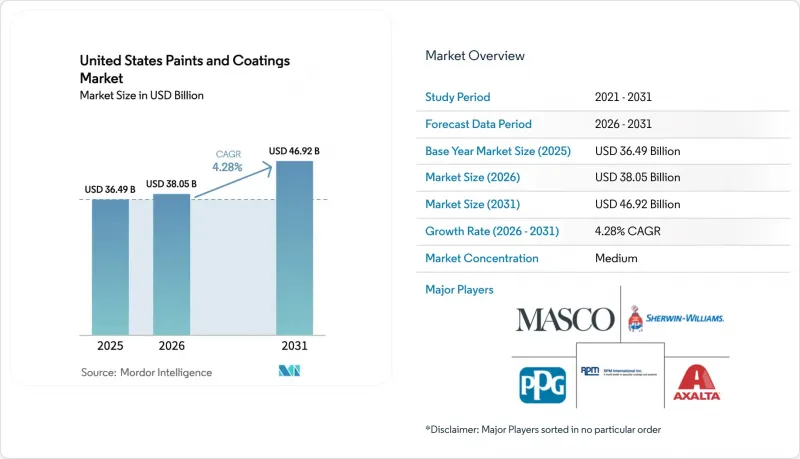
根據 Mordor Intelligence 預測,美國油漆和塗料市場規模將從 2025 年的 364.9 億美元和 2026 年的 380.5 億美元成長到 2031 年的 469.2 億美元,2026 年至 2031 年的年複合成長率(CAGR)為 4.28%。
本報告按樹脂類型(丙烯酸樹脂、醇酸樹脂、聚氨酯樹脂、環氧樹脂、聚酯樹脂及其他樹脂)、技術(水性、溶劑型、粉末塗料、UV技術)、分銷管道(直銷等)和終端用戶行業(建築、汽車、木材、防護塗料等)進行細分。市場預測以美元計價。
美國油漆和塗料市場的趨勢和洞察
聯邦基礎設施支出正在推動防護塗料的發展。
道路和橋樑的預算撥款推動了對富鋅底漆、環氧樹脂和聚氨酯面漆的需求,這些塗料的預期使用壽命均為25年。承包商更傾向於使用單層塗料,例如剪切機司的Acrolon 680,它不僅可以縮短車道封閉時間,而且符合嚴格的SSPC標準。擁有NORSOK和ISO認證記錄的供應商獲得了較高的利潤率,而中西部地區的鋼鐵加工廠也因橋樑維修項目而訂單增加。
住宅裝修熱潮帶動了建築塗料市場的發展。
根據哈佛大學住宅研究聯合中心的預測,到2025年第三季度,住宅裝修支出預計將穩定成長,凸顯了強勁的DIY需求。 2024會計年度,家得寶的油漆銷售表現強勁。在銷售額激增之後,家得寶收購了SRS Distribution,並著手加強其面向專業承包商的平台。 2024年,剪切機司透過增加門市數量和最佳化當日送達網路來擴大業務。同時,BEHR利用其與家得寶的獨家合作關係,顯著提升了Masco的銷售額。雖然電子商務在油漆銷售中所佔佔有率仍然不大,但透過「點擊提貨」方式進行的重複訂單數量已大幅成長,這對工期緊張的承包商來說尤其有利。
二氧化鈦(TiO2)價格波動給利潤率帶來了壓力。
化學塗料公司(Chemoirs)和特諾克斯公司(Tronox)控制著全球大部分二氧化鈦(TiO2)供應,它們在美國的氯化工藝生產設施對塗料生產商構成風險,既面臨能源價格波動的風險,也面臨日益嚴格的環境法規風險。顏料價格仍高於2020年之前的水準。儘管馬斯科公司(Masco)透過避險和填料替代成功提高了利潤率,但這些替代品遮蓋力較差,限制了碳酸鈣和高嶺土在高檔室內塗料中替代二氧化鈦的程度。
細分市場分析
到2025年,丙烯酸樹脂將占美國油漆和塗料市場樹脂消費量的36.18%,這主要得益於其低氣味和快乾的特性,尤其適用於DIY應用。預計到2031年,聚氨酯樹脂將超越所有其他樹脂,年複合成長率將達到5.16%,因為橋樑、船舶和工業領域的使用者優先考慮耐磨性和耐化學性。儘管受VOC法規的影響,醇酸樹脂的需求持續下降,但它們在木材著色劑的滲透方面仍然發揮著重要作用。環氧樹脂在耐久性底漆和地板塗料市場佔據主導地位,這得益於橋樑和離岸風力發電的投資。聚酯樹脂是粉末塗料的關鍵材料,由於家電和家具產量的增加,其需求也在成長,此外,BASF新推出的新戊二醇供應也促進了其發展,因為新戊二醇可以減少產品的碳足跡。
其他樹脂,例如乙烯基樹脂、矽樹脂和氟聚合物,則發揮各自的獨特作用。阿科瑪在肯塔基州擴大了聚偏氟乙烯(PVDF)的產能,以滿足高層建築外牆對抗紫外線性能的要求。陶氏化學和瓦克化學的矽膠樹脂可用於排氣系統的耐熱塗層,而氟聚合物面漆則可保護電動車電池機殼免受電解洩漏的侵害。因此,針對特定應用客製化的聚合物結構增加了化合物的複雜性,阻礙了產品的商品化,並提高了轉換成本。
在美國塗料市場,水性塗料預計到2025年將佔總銷售量的68.24%,到2031年將以5.36%的複合年成長率成長,成為成長最快的塗料類型。溶劑型塗料在航太、船舶和重型機械等細分領域仍然很受歡迎,其耐濕性和低溫噴塗性能彌補了排放法規方面的不足。粉末塗料不含溶劑,轉移效率高達95%,在金屬家具和家用電器領域越來越受歡迎;而具有快速固化和低能耗特性的紫外光固化塗料正在逐步滲透到木地板和包裝市場。
不同應用領域的差異顯著。在建築室內裝潢中,幾乎所有塗料都以乳膠為基底;在汽車OEM領域,則使用混合薄膜堆疊技術;而在工業維護領域,高固態環氧樹脂塗料佔據主導地位。美國環保署 (EPA) 和各州空氣品質控制委員會日益嚴格的法規,持續推動著水性塗料和紫外光固化塗料的研發投入,這些塗料的光澤度和耐刮擦性可與溶劑型塗料相媲美。成功轉型至此領域的製造商,將憑藉永續性採購建立品牌價值。
其他好處:
- Excel格式的市場預測(ME)表
- 3個月的分析師支持
目錄
第1章:引言
- 研究假設和市場定義
- 調查範圍
第2章:調查方法
第3章執行摘要
第4章 市場狀況
- 市場概覽
- 市場促進因素
- 《聯邦基礎設施和就業法案》正在促進橋樑和公路塗裝市場的發展。
- 住宅翻新熱潮推高了民眾對DIY裝修的需求。
- 過渡到水性及紫外線固化系統,以符合VOC法規。
- 汽車生產的復甦帶動了整車代工和汽車修補漆生產的成長。
- 在醫療機構中引入抗菌塗層
- 市場限制因素
- 二氧化鈦價格波動給利潤率帶來了壓力。
- 由於合格的工業油漆工短缺,該項目被延誤了。
- 運費上漲正在擾亂零售商的庫存週期。
- 價值鏈分析
- 波特五力模型
第5章 市場規模與成長預測
- 依樹脂類型
- 丙烯酸纖維
- 阿爾基多
- 聚氨酯
- 環氧樹脂
- 聚酯纖維
- 其他樹脂類型
- 透過技術
- 水溶液
- 溶劑型
- 粉末塗裝
- 紫外線技術
- 透過分銷管道
- 公司自營店
- 獨立油漆零售商
- 大型零售商店及家居建材商店
- 直接向工業OEM廠商銷售
- 電子商務
- 按最終用戶行業分類
- 建築學
- 車
- 樹
- 保護塗層
- 一般工業
- 運輸
- 包裝
第6章 競爭情勢
- 市場集中度
- 策略趨勢
- 市佔率和排名分析
- 公司簡介
- Akzo Nobel NV
- Axalta Coating Systems, LLC
- BASF
- Beckers Group
- Benjamin Moore & Co.
- Carboline
- Diamond Vogel
- Dunn-Edwards Corporation
- Hempel A/S
- ICP Group
- Kelly-Moore Paint Company
- Masco Corporation
- Nippon Paint Holdings Co., Ltd.
- Parker Hannifin
- PPG Industries, Inc.
- RPM International Inc.
- Rust-Oleum Corporation
- Sika AG
- The Sherwin-Williams Company
- Tnemec
- Wacker Chemie AG
第7章 市場機會與未來展望
According to Mordor Intelligence, the United States paints and Coatings Market size is projected to expand from USD 36.49 billion in 2025 and USD 38.05 billion in 2026 to USD 46.92 billion by 2031, registering a CAGR of 4.28% between 2026 to 2031.
This report is Segmented by Resin Type (Acrylic, Alkyd, Polyurethane, Epoxy, Polyester, and Other Resin Types), Technology (Water-Borne, Solvent-Borne, Powder Coating, and UV Technology), Distribution Channel (Company-Owned Stores, and More), and End-User Industry (Architectural, Automotive, Wood, Protective Coatings, and More). The Market Forecasts are Provided in Terms of Value (USD).
United States Paints And Coatings Market Trends and Insights
Federal Infrastructure Spending Propels Protective Coatings
The allocation for roads and bridges is driving demand for zinc-rich primers, epoxies, and polyurethane topcoats, all promising a 25-year service life. Contractors are leaning towards single-coat products like Sherwin-Williams' Acrolon 680, which not only reduces lane-closure time but also adheres to strict SSPC specifications. Suppliers boasting NORSOK and ISO performance records are reaping premium margins, and steel fabrication hubs in the Midwest are witnessing a boost in orders, thanks to bridge refurbishments.
Home-Remodeling Boom Bolsters Architectural Paints
By Q3 2025, Harvard's Joint Center for Housing Studies projects residential remodeling outlays to grow steadily, underscoring the resilience of do-it-yourself (DIY) demand. In fiscal 2024, Home Depot reported strong paint sales. This surge in sales led Home Depot to bolster its pro-contractor platform, following its acquisition of SRS Distribution. In 2024, Sherwin-Williams expanded its footprint by adding more stores, optimizing its network for same-day deliveries. Meanwhile, BEHR capitalized on its exclusive partnership with Home Depot, significantly contributing to Masco's revenue. Although e-commerce accounts for a modest share of paint sales, there's a notable uptick in repeat orders through click-and-collect, particularly benefiting contractors with tight job schedules.
Volatile TiO2 Prices Pressure Margins
Chemours and Tronox control a significant portion of the global TiO2 supply, and their chlorination-based U.S. assets expose formulators to both energy swings and stricter environmental compliance. Pigment prices remain elevated compared to levels seen before 2020. While Masco has successfully enhanced its margins via hedging and substituting extenders, the diminished hiding power of these substitutes constrains the extent to which calcium carbonate or kaolin can replace TiO2 in high-end interior paints.
Other drivers and restraints analyzed in the detailed report include:
- Low-VOC Systems Gain Share Under Stricter Rules
- Automotive Recovery Lifts OEM Coatings
- Freight-Cost Inflation Strains Dealer Inventories
For complete list of drivers and restraints, kindly check the Table Of Contents.
Segment Analysis
In 2025, acrylics commanded 36.18% of resin consumption within the United States paints and coatings market, thanks to low odor and quick dry in DIY applications. Polyurethane is slated for a 5.16% CAGR to 2031, outpacing all other resins as bridge, marine, and industrial users prioritize abrasion and chemical resistance. Alkyd demand keeps shrinking under VOC curbs, yet remains relevant for penetrating wood stains. Epoxy dominates heavy-duty primers and floor coatings, benefiting from bridge and offshore wind investments. Polyester, integral to powder coatings, gains from appliance and furniture output, aided by BASF's new neopentyl glycol supply that lowers product carbon footprints.
Other chemistries, such as vinyl, silicone, and fluoropolymers, fill niche roles. Arkema's PVDF capacity addition in Kentucky supports high-rise facades that need ultraviolet durability. Silicone resins from Dow and Wacker enable heat-stable finishes on exhaust systems, while fluoropolymer topcoats protect EV battery casings against electrolyte spills. Tailored polymer architectures therefore multiply formulation complexity, discouraging commoditization and raising switching costs.
Water-borne systems accounted for 68.24% of the 2025 volume in the United States paints and coatings market and exhibit the swiftest 5.36% CAGR outlook to 2031. Solvent-borne coatings still serve aerospace, marine, and heavy-equipment niches where humidity tolerance and cold-spray properties outweigh emission penalties. Powder coatings, free of solvents and offering 95% transfer efficiency, advance in metal furniture and appliances, while UV-curable coatings penetrate wood flooring and packaging thanks to instant cure and minimal energy use.
End-use variation is stark: architectural interiors are nearly all latex, automotive OEM uses hybrid film stacks, and industrial maintenance leans on high-solids epoxies. Regulatory clamp-downs by the EPA and state air-quality boards continue to push research and development funds toward water-borne and UV chemistries that can match solvent-borne gloss and mar resistance. Manufacturers that master these conversions secure brand equity in sustainability-driven procurement.
Complete Report Scope:
- By Resin Type
- Acrylic
- Alkyd
- Polyurethane
- Epoxy
- Polyester
- Other Resin Types
- By Technology
- Water-borne
- Solvent-borne
- Powder Coating
- UV Technology
- By Distribution Channel
- Company-Owned Stores
- Independent Paint Dealers
- Big-Box Retailers and Home Centers
- Direct to Industrial OEM
- E-Commerce
- By End-user Industry
- Architectural
- Automotive
- Wood
- Protective Coatings
- General Industrial
- Transportation
- Packaging
List of Companies Covered in this Report:
- Akzo Nobel N.V.
- Axalta Coating Systems, LLC
- BASF
- Beckers Group
- Benjamin Moore & Co.
- Carboline
- Diamond Vogel
- Dunn-Edwards Corporation
- Hempel A/S
- ICP Group
- Kelly-Moore Paint Company
- Masco Corporation
- Nippon Paint Holdings Co., Ltd.
- Parker Hannifin
- PPG Industries, Inc.
- RPM International Inc.
- Rust-Oleum Corporation
- Sika AG
- The Sherwin-Williams Company
- Tnemec
- Wacker Chemie AG
Additional Benefits:
- The market estimate (ME) sheet in Excel format
- 3 months of analyst support
TABLE OF CONTENTS
1 Introduction
- 1.1 Study Assumptions and Market Definition
- 1.2 Scope of the Study
2 Research Methodology
3 Executive Summary
4 Market Landscape
- 4.1 Market Overview
- 4.2 Market Drivers
- 4.2.1 Federal Infrastructure and Jobs Act boosts bridge/highway coatings
- 4.2.2 Home-remodeling boom lifts DIY architectural demand
- 4.2.3 Shift to water-borne and UV-curable systems to meet VOC rules
- 4.2.4 Automotive production rebound raises OEM and refinish volumes
- 4.2.5 Antimicrobial coatings adoption in healthcare facilities
- 4.3 Market Restraints
- 4.3.1 Volatile TiO2 prices compress margins
- 4.3.2 Shortage of certified industrial painters delays projects
- 4.3.3 Freight-cost inflation disrupts retailer inventory cycles
- 4.4 Value Chain Analysis
- 4.5 Porter's Five Forces
- 4.5.1 Bargaining Power of Suppliers
- 4.5.2 Bargaining Power of Buyers
- 4.5.3 Threat of New Entrants
- 4.5.4 Threat of Substitutes
- 4.5.5 Industry Rivalry
5 Market Size and Growth Forecasts (Value)
- 5.1 By Resin Type
- 5.1.1 Acrylic
- 5.1.2 Alkyd
- 5.1.3 Polyurethane
- 5.1.4 Epoxy
- 5.1.5 Polyester
- 5.1.6 Other Resin Types
- 5.2 By Technology
- 5.2.1 Water-borne
- 5.2.2 Solvent-borne
- 5.2.3 Powder Coating
- 5.2.4 UV Technology
- 5.3 By Distribution Channel
- 5.3.1 Company-Owned Stores
- 5.3.2 Independent Paint Dealers
- 5.3.3 Big-Box Retailers and Home Centers
- 5.3.4 Direct to Industrial OEM
- 5.3.5 E-Commerce
- 5.4 By End-user Industry
- 5.4.1 Architectural
- 5.4.2 Automotive
- 5.4.3 Wood
- 5.4.4 Protective Coatings
- 5.4.5 General Industrial
- 5.4.6 Transportation
- 5.4.7 Packaging
6 Competitive Landscape
- 6.1 Market Concentration
- 6.2 Strategic Moves
- 6.3 Market Share(%)/Ranking Analysis
- 6.4 Company Profiles (includes Global level Overview, Market level overview, Core Segments, Financials as available, Strategic Information, Market Rank/Share for key companies, Products and Services, and Recent Developments)
- 6.4.1 Akzo Nobel N.V.
- 6.4.2 Axalta Coating Systems, LLC
- 6.4.3 BASF
- 6.4.4 Beckers Group
- 6.4.5 Benjamin Moore & Co.
- 6.4.6 Carboline
- 6.4.7 Diamond Vogel
- 6.4.8 Dunn-Edwards Corporation
- 6.4.9 Hempel A/S
- 6.4.10 ICP Group
- 6.4.11 Kelly-Moore Paint Company
- 6.4.12 Masco Corporation
- 6.4.13 Nippon Paint Holdings Co., Ltd.
- 6.4.14 Parker Hannifin
- 6.4.15 PPG Industries, Inc.
- 6.4.16 RPM International Inc.
- 6.4.17 Rust-Oleum Corporation
- 6.4.18 Sika AG
- 6.4.19 The Sherwin-Williams Company
- 6.4.20 Tnemec
- 6.4.21 Wacker Chemie AG
7 Market Opportunities and Future Outlook
- 7.1 White-Space and Unmet-Need Assessment
- 7.2 Self-Healing Protective Coatings for Offshore Wind Infrastructure

 東協油漆和塗料市場:市場佔有率分析、行業趨勢和統計數據以及成長預測(2026-2031 年)中東油漆和塗料:市場佔有率分析、行業趨勢和統計數據以及成長預測(2026-2031 年)北美油漆和塗料:市場佔有率分析、行業趨勢和統計數據以及成長預測(2026-2031 年)南美洲油漆和塗料市場:市場佔有率分析、行業趨勢和統計數據以及成長預測(2026-2031 年)
 木榨油市場:全球市場預測(2026-2032)建築塗料市場:2026-2032年全球市場預測(依樹脂類型、技術、塗料類型、最終用途、通路和應用分類)
 全球油漆和塗料市場印度油漆和塗料市場:市場佔有率分析、行業趨勢和統計數據以及成長預測(2026-2031 年)塗料市場:2026-2032年全球市場預測(依樹脂類型、技術、產品類型、基材、終端用戶產業及通路分類)
 建築塗料市場規模、佔有率和成長分析:按產品類型、技術、應用、最終用途、分銷管道和地區分類-產業預測,2026-2033年