


 |
市場調查報告書
商品編碼
2154405
人工智慧代理測試與檢驗:市場佔有率分析、產業趨勢與統計、成長預測(2026-2031)AI Agent Testing and Validation - Market Share Analysis, Industry Trends & Statistics, Growth Forecasts (2026 - 2031) |
||||||

※ 本網頁內容可能與最新版本有所差異。詳細情況請與我們聯繫。
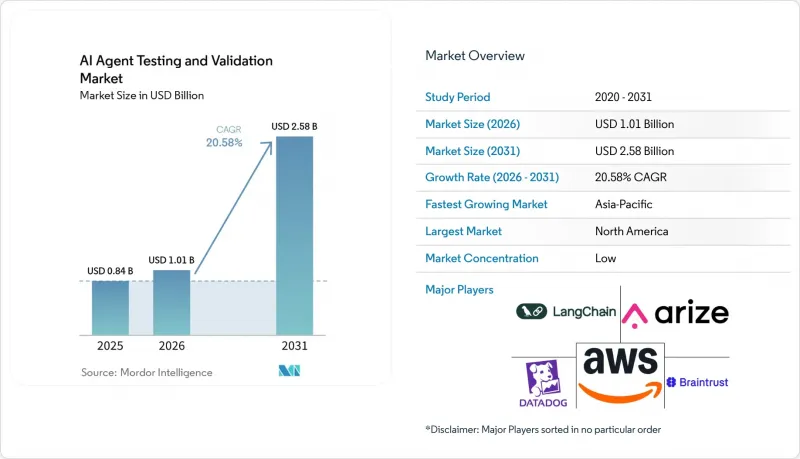
據 Mordor Intelligence 稱,人工智慧代理測試和檢驗市場在 2025 年的價值為 8.4 億美元,預計到 2031 年將達到 25.8 億美元,而 2026 年為 10.1 億美元,預測期(2026-2031 年)的複合年成長率為 20.58%。
全球人工智慧代理測試與檢驗市場趨勢及洞察
自主和多智慧體工作流程的普及
企業正在部署多智慧體系統,其中規劃、搜尋和執行智慧體透過共用記憶體和外部工具進行協作。這種設計增加了工作流程核准前必須檢驗的路徑數。一個智慧體中發生的錯誤可能會波及後續步驟,直到員工或顧客察覺為止。 Patronus AI 的 TRAIL 基準測試包含 148 個人工標註的追蹤記錄、841 個獨立錯誤以及 20 多個智慧體錯誤類別。該基準測試發現,用於識別複雜追蹤記錄中錯誤的最先進模型的整體準確率低於 12%。人工智慧智慧體測試和檢驗市場正是受此龐大測試負擔的驅動,因為評估能力可能會限制企業的部署計劃。
人工智慧軟體交付流程中的持續評估
人工智慧評估不再是發布前的準備工作,而是逐漸成為軟體交付的常規環節。提示、模型或工具定義的變更可能會改變代理程式的行為,而無需改變預期的業務流程。針對程式碼變更運行評估套件,可以在回歸問題影響生產用戶之前將其識別出來。 LangSmith Engine 監控生產環境的運作軌跡,將重複出現的故障分組,識別根本原因並提案修復建議。 Datadog 描述了一種評估流程,該流程涉及在新模型可用時重新運行已標記的測試集,以識別改進和回歸問題。在人工智慧代理測試和檢驗市場中,與交付工作流程的整合與評估方法同樣重要,因為它可以縮短從檢測到故障到執行糾正性測試的時間。
機率檢定的不穩定性及可重複性局限性
大規模語言模型即使在不同的執行過程中使用相同的輸入,也可能產生不同的輸出。這使得區分真正的改進和正常的波動變得困難。 Sierra 的 tau-bench 引入了一個名為「pass^k」的可靠性指標,用於展示隨著智慧體需要重複完成同一任務,成功率是如何下降的。團隊可能需要對每個測試案例進行多次試驗,以獲得足夠可靠的結果,以用於生產環境中的部署決策。這種需求會增加計算資源的使用,並延長檢驗週期。一項對 257 篇論文的回顧表明,與行為評估相比,運行時證據、時間相關性和開放式多智慧體保證的維護仍然不夠完善。這些限制可能會導致人工智慧智慧體測試和檢驗市場的發展速度放緩,因為受監管的用戶要求每次發布都提供一致的證據。
細分市場分析
到2025年,平台將佔據人工智慧代理測試和檢驗市場67.41%的佔有率。這一主導地位反映了企業對支持離線評估、生產監控和回歸測試的單一環境的偏好。整合系統減少了連接各個工具和協調結果所需的工作量。據LangChain稱,LangSmith的商業月度追蹤量年增了12倍,35%的財富500強企業使用了LangChain的服務。這些結果表明,對於大規模營運代理商的企業而言,整合追蹤和評估功能至關重要。平台也適用於擁有內部人工智慧工程團隊並希望直接管理其測試工作流程的技術型買家。
在人工智慧代理測試和檢驗市場,服務領域預計將在2026年至2031年間以21.37%的複合年成長率成長。當買家需要測試框架、黃金資料集或自動化決策系統校準的協助時,他們會使用服務。這對於需要獨立且課責的審查的受監管組織尤其重要。平台收入可以隨著許可證數量和使用量的增加而成長,而服務收入通常與專案和專家投入掛鉤。 2026年,Arize AX推出了代理實驗比較與故障根本原因分析功能。儘管供應商正在降低使用其平台所需的專業知識門檻,但在評估設計中需要專家判斷時,服務仍然具有價值。
到2025年,功能測試和任務完成度測試將佔人工智慧代理測試和檢驗市場規模的34.29%。這些測試仍然是代理執行明確任務(例如填寫表單、搜尋資訊和執行資料庫查詢)的基礎測試層。這些測試有助於團隊驗證工作流程在既定條件下是否產生預期結果。然而,它們並非總是能揭示代理是否使用了未經授權的工具、依賴過時的上下文資訊或偏離了其分配的角色。對多代理金融系統的研究已經發現了與資訊過時、角色偏差和使用未經授權的工具相關的風險。因此,雖然功能測試仍然必要,但它正擴大被能夠檢驗代理完整行為過程的方法所補充。
在人工智慧代理測試和檢驗市場中,安全性、可靠性和對抗性測試預計到2031年將以20.88%的複合年成長率成長。隨著企業在高度敏感的環境中部署代理,自動化紅隊活動正日益融入營運交付流程。微軟的一項研究表明,負責任的人工智慧影響廣泛存在,且難以衡量,涉及超過100種生成式人工智慧產品。該研究還表明,自動化可以擴展風險覆蓋範圍,超越人工檢驗所能達到的水平。在計算成本和回應時間會影響營運結果的高頻工作流程中,效能、成本和延遲測試至關重要。隨著代理配置和底層模型的演進,公平性、偏差、合規性、迴歸性、漂移和工具使用測試的重要性日益凸顯。
區域分析
預計到2025年,北美將佔全球整體收入的40.43%,這主要得益於該地區集中了眾多尖端人工智慧實驗室、企業軟體供應商、評估新創公司和早期採用者。 LangChain、Braintrust、Arize AI、Patronus AI、Galileo Technologies、Scale AI 和 Datadog 等公司總部均設在北美,這使得平台方法論和企業最佳實踐能夠迅速在開發者和買家之間傳播。加拿大的人工智慧安全評估社群提供具有重要商業性價值的評估方法,而隨著科技業採用雲端為基礎的工具,墨西哥的需求也開始成長。大規模的雲端開發者生態系統,例如亞馬遜雲端服務 (AWS)、Google和微軟等公司將評估功能整合到更廣泛的開發環境中,也影響該地區的採用。這使得評估功能能夠交付給可能不會購買專用平台的雲端原生團隊,而現有的雲端協定可以降低初始部署的複雜性。
歐洲正從小規模的基數開始快速擴張,其中德國、英國和法國在企業應用方面處於領先地位。儘管《歐盟條約》第50條規定的透明度義務將於2026年8月生效,但高風險人工智慧系統的要求實施時間表將稍晚。歐洲人工智慧代理測試和檢驗市場的規模得益於對長期合規性文件的需求,這些文件包括版本控制的測試、文件化的覆蓋範圍和可追溯的結果。由於企業需要在代理部署更廣泛地應用於客戶和具有重大影響的應用之前建立測試流程,因此分階段引入的法規導致了多年的建置週期。購買企業也需要使這些流程與高風險系統的資料管治要求及其自身的內部風險管理結構保持一致。
在亞太地區,人工智慧代理測試和檢驗市場預計到2031年將以20.91%的複合年成長率成長,這主要得益於日本、韓國、印度、中國和澳洲等國家正在採用的管治方法,這些方法增加了對代理商檢驗的需求。 2026年7月,日本人工智慧安全研究所修訂了其指南,將人工智慧代理系統納入考量。新加坡的SAFR框架也為金融領域的人工智慧代理測試提供了指南。在南美洲,人工智慧代理的應用仍處於起步階段,巴西在雲端優先的企業應用方面處於領先地位,而阿根廷則正在創造新的需求。在阿拉伯聯合大公國(阿拉伯聯合大公國)和沙烏地阿拉伯,政府主導的需求正透過國家數位化計畫湧現。同時,非洲的採購活動仍集中在南非和奈及利亞的跨國公司。
其他好處:
- Excel格式的市場預測(ME)表
- 3個月的分析師支持
目錄
第1章:引言
- 研究假設和市場定義
- 調查範圍
第2章:調查方法
第3章執行摘要
第4章 市場狀況
- 市場概覽
- 市場促進因素
- 自主和多智慧體工作流程的普及
- 在人工智慧軟體交付流程中進行持續評估。
- 可解釋和可審計的人工智慧保證的監管要求
- 第三方代理商的採購證據要件
- 旨在全面涵蓋罕見事件的合成使用者模擬
- 基於證據的代理工具和狀態轉換檢驗
- 市場限制因素
- 機率檢定的不穩定性及可重複性局限性
- 「人工智慧優先」計畫缺乏高品質的工程人才
- 高精度模擬需要耗費大量的運算資源和資料成本。
- 代理框架和協定之間的標準碎片化
- 宏觀經濟因素對市場的影響
- 產業價值鏈分析
- 科技趨勢
- 監理情勢
- 波特五力分析
第5章 市場規模與成長預測
- 按組件
- 平台
- 服務
- 按測試類型
- 功能測試和任務完成測試
- 測試工具的使用與工作流程
- 安全性、保障性和對抗性測試
- 測試效能、成本和延遲
- 公平性、偏見和合規性測試
- 回歸檢驗和漂移檢驗
- 其他測試類型
- 按部署模式
- 基於雲端的
- 混合
- 現場
- 最終用戶
- 科技公司和人工智慧原生新創公司
- 銀行業、金融服務業及保險業
- 醫療保健和生命科學
- 零售與電子商務
- 資訊科技/通訊
- 製造業、汽車業、物流業
- 政府/國防
- 其他最終用戶
- 按地區
- 北美洲
- 美國
- 加拿大
- 墨西哥
- 南美洲
- 巴西
- 阿根廷
- 智利
- 其他南美國家
- 歐洲
- 德國
- 英國
- 法國
- 義大利
- 西班牙
- 其他歐洲國家
- 亞太地區
- 中國
- 日本
- 印度
- 韓國
- 澳洲
- 其他亞太國家
- 中東
- 阿拉伯聯合大公國
- 沙烏地阿拉伯
- 卡達
- 其他中東國家
- 非洲
- 南非
- 埃及
- 奈及利亞
- 其他非洲國家
- 北美洲
第6章 競爭情勢
- 市場集中度
- 策略趨勢
- 市佔率分析
- 公司簡介
- LangChain Inc.
- Braintrust Data, Inc.
- Arize AI, Inc.
- Patronus AI, Inc.
- Openlayer, Inc.
- Datadog, Inc.
- HoneyHive AI, Inc.
- Deepchecks Technologies Ltd.
- Galileo Technologies, Inc.
- Agenta Technologies, Inc.
- Maxim AI, Inc.
- Langfuse GmbH
- Monte Carlo Data, Inc.
- Fiddler Labs, Inc.
- WhyLabs, Inc.
- Truera, Inc.
- Weights & Biases, Inc.
- Scale AI, Inc.
- Tricentis GmbH
- Amazon Web Services, Inc.
- Google LLC
- Microsoft Corporation
- International Business Machines Corporation
- Anthropic PBC
第7章 市場機會與未來展望
According to Mordor Intelligence, the AI agent testing and Validation Market size was valued at USD 0.84 billion in 2025 and is estimated to grow from USD 1.01 billion in 2026 to reach USD 2.58 billion by 2031, at a CAGR of 20.58% during the forecast period (2026-2031).
Global AI Agent Testing and Validation Market Trends and Insights
Proliferation of Autonomous and Multi-Agent Workflows
Enterprises are deploying multi-agent systems in which planning, retrieval, and execution agents coordinate through shared memory and external tools. This design increases the number of paths that must be examined before a workflow can be approved. An error from one agent can move through later steps before it becomes visible to an employee or customer. Patronus AI's TRAIL benchmark contains 148 human-annotated traces, 841 discrete errors, and more than 20 agentic error categories. The benchmark found joint accuracy below 12% for frontier models tasked with localizing errors in complex traces. The AI Agent Testing and Validation Market is driven by this broader testing burden, as evaluation capacity can constrain enterprise rollout plans.
Continuous Evaluation in AI Software Delivery Pipelines
AI evaluation is becoming part of normal software delivery rather than a task completed only before launch. Changes to prompts, models, or tool definitions can alter agent behavior without changing the intended business process. Running evaluation suites on code changes can identify regressions before they reach production users. LangSmith Engine monitors production traces, groups repeated failures, identifies root causes, and proposes fixes. Datadog described an evaluation process that reruns labeled test sets when new models become available to identify improvements and regressions. In the AI Agent Testing and Validation Market, integration with delivery workflows can matter as much as the evaluation method because it shortens the time between a detected failure and a corrective test.
Probabilistic Test Flakiness and Reproducibility Limits
Large language models can produce different outputs when they receive the same input in separate runs. This makes it harder to separate genuine improvement from ordinary variation. Sierra's tau-bench introduced the pass^k reliability measure to show how success rates decline as agents must repeatedly complete the same task. Teams may need many trials for each test case before the results are reliable enough for a production decision. That need increases computing use and can extend validation cycles. A review of 257 papers found that runtime evidence maintenance, temporal validity, and open-ended multi-agent assurance remained less developed than behavioral evaluation. These limits can slow adoption in the AI Agent Testing and Validation Market, where regulated users need consistent evidence for every release.
Other drivers and restraints analyzed in the detailed report include:
- Regulatory Demand for Explainable and Auditable AI Assurance
- Procurement Evidence Requirements for Third-Party Agents
- Shortage of AI-First Quality Engineering Talent
For complete list of drivers and restraints, kindly check the Table Of Contents.
Segment Analysis
Platforms accounted for 67.41% of the AI Agent Testing and Validation Market in 2025. The lead reflected enterprise preference for a single environment that supports offline evaluation, production monitoring, and regression testing. A unified system can reduce the effort needed to connect separate tools and reconcile their results. LangChain reported 12x year-over-year growth in commercial monthly trace volume for LangSmith, while 35% of Fortune 500 companies used LangChain services. These results show why integrated trace and evaluation functions matter to organizations operating agents at scale. Platforms also suit technology-forward buyers with internal AI engineering teams who want direct control over testing workflows.
Services are projected to grow at a 21.37% CAGR from 2026 to 2031 within the AI Agent Testing and Validation Market. Buyers use services when they need help with test harnesses, golden datasets, or calibration of automated judges. This is particularly relevant for regulated organizations that need an independent and defensible review. Platform revenue can scale with seats or usage, while services revenue usually remains tied to projects and specialist labor. Arize AX introduced functions for agent experiment comparison and root cause analysis of failures in 2026. Vendors are lowering the expertise needed to use platforms, while services remain valuable when evaluation design requires specialist judgment.
Functional and task-completion testing accounted for 34.29% of the AI Agent Testing and Validation Market size in 2025. It remains the baseline test layer for agents that complete clear tasks such as filing forms, retrieving information, or executing a database query. These tests help teams confirm whether a workflow produces the expected result under defined conditions. They do not always reveal whether an agent used an unauthorized tool, relied on outdated context, or deviated from its assigned role. Research on multi-agent financial systems identified risks involving temporal staleness, role drift, and unauthorized tool use. Functional testing therefore remains necessary, but it is being supplemented by methods that review the full trajectory of an agent.
Safety, security, and adversarial testing is forecast to grow at a 20.88% CAGR through 2031 in the AI Agent Testing and Validation Market. Automated red-teaming is moving into operational delivery processes as enterprises deploy agents in sensitive settings. Microsoft Research found that responsible AI harms were widespread and difficult to measure across more than 100 generative AI products. The work also showed that automation can expand risk coverage beyond what manual exercises can review. Performance, cost, and latency testing is also relevant for high-frequency workflows where computing cost and response time affect operating outcomes. Fairness, bias, compliance, regression, drift, and tool-use testing are gaining importance as agent configurations and underlying models change.
Complete Report Scope:
- By Component
- Platforms
- Services
- By Testing Type
- Functional and Task-Completion Testing
- Tool-Use and Workflow Testing
- Safety, Security, and Adversarial Testing
- Performance, Cost, and Latency Testing
- Fairness, Bias, and Compliance Testing
- Regression and Drift Testing
- Other Testing Type
- By Deployment Model
- Cloud-Based
- Hybrid
- On-Premises
- By End User
- Technology Companies and AI-Native Startups
- Banking, Financial Services, and Insurance
- Healthcare and Life Sciences
- Retail and E-commerce
- IT and Telecommunications
- Manufacturing, Automotive, and Logistics
- Government and Defense
- Other End Users
- By Geography
- North America
- United States
- Canada
- Mexico
- South America
- Brazil
- Argentina
- Chile
- Rest of South America
- Europe
- Germany
- United Kingdom
- France
- Italy
- Spain
- Rest of Europe
- Asia-Pacific
- China
- Japan
- India
- South Korea
- Australia
- Rest of Asia-Pacific
- Middle East
- United Arab Emirates
- Saudi Arabia
- Qatar
- Rest of Middle East
- Africa
- South Africa
- Egypt
- Nigeria
- Rest of Africa
- North America
Geography Analysis
North America held 40.43% of global revenue in 2025, supported by its concentration of frontier AI labs, enterprise software vendors, evaluation startups, and early enterprise adopters. LangChain, Braintrust, Arize AI, Patronus AI, Galileo Technologies, Scale AI, and Datadog operate from North American headquarters, which helps platform methods and enterprise practices circulate quickly among developers and buyers. Canada's AI safety research community contributes evaluation methods with commercial relevance, while Mexico is beginning to add demand as its technology sector adopts cloud-based tools. Large cloud developer ecosystems also shape regional uptake, as Amazon Web Services, Google, and Microsoft embed evaluation capabilities into broader development environments. This can bring evaluation functions to cloud-native teams that may not purchase a dedicated platform, while existing cloud contracts can make initial adoption less complex.
Europe is expanding from a smaller base, with Germany, the United Kingdom, and France leading enterprise adoption. Article 50 transparency obligations became applicable in August 2026, while high-risk AI system requirements have a later implementation schedule. The AI Agent Testing and Validation Market size in Europe is supported by the need for records that demonstrate compliance over time, including versioned tests, documented coverage, and trace-linked results. The regulatory sequence creates a multi-year build-out cycle because enterprises need to establish test processes before agent deployments become more widespread in customer-facing and consequential uses. Buyers will also need to align those processes with data governance expectations for high-risk systems and with their own internal risk controls.
Asia-Pacific is projected to grow at a 20.91% CAGR through 2031 in the AI Agent Testing and Validation Market, as Japan, South Korea, India, China, and Australia implement governance approaches that increase the need for documented agent validation. In July 2026, Japan's AI Safety Institute updated its guide to include AI agent system considerations, and Singapore's SAFR framework provides a testing reference point for financial AI agents. South America remains earlier in adoption, with Brazil leading cloud-first enterprise use and Argentina adding emerging demand. The United Arab Emirates and Saudi Arabia are generating government-led demand through national digital programs, while African procurement remains concentrated among multinational enterprises in South Africa and Nigeria.
- LangChain Inc.
- Braintrust Data, Inc.
- Arize AI, Inc.
- Patronus AI, Inc.
- Openlayer, Inc.
- Datadog, Inc.
- HoneyHive AI, Inc.
- Deepchecks Technologies Ltd.
- Galileo Technologies, Inc.
- Agenta Technologies, Inc.
- Maxim AI, Inc.
- Langfuse GmbH
- Monte Carlo Data, Inc.
- Fiddler Labs, Inc.
- WhyLabs, Inc.
- Truera, Inc.
- Weights & Biases, Inc.
- Scale AI, Inc.
- Tricentis GmbH
- Amazon Web Services, Inc.
- Google LLC
- Microsoft Corporation
- International Business Machines Corporation
- Anthropic PBC
Additional Benefits:
- The market estimate (ME) sheet in Excel format
- 3 months of analyst support
TABLE OF CONTENTS
1 INTRODUCTION
- 1.1 Study Assumptions and Market Definition
- 1.2 Scope of the Study
2 RESEARCH METHODOLOGY
3 EXECUTIVE SUMMARY
4 MARKET LANDSCAPE
- 4.1 Market Overview
- 4.2 Market Drivers
- 4.2.1 Proliferation of Autonomous and Multi-Agent Workflows
- 4.2.2 Continuous Evaluation in AI Software Delivery Pipelines
- 4.2.3 Regulatory Demand for Explainable and Auditable AI Assurance
- 4.2.4 Procurement Evidence Requirements for Third-Party Agents
- 4.2.5 Synthetic User Simulation for Rare-Event Coverage
- 4.2.6 Evidence-Based Validation of Agent Tool and State Transitions
- 4.3 Market Restraints
- 4.3.1 Probabilistic Test Flakiness and Reproducibility Limits
- 4.3.2 Shortage of AI-First Quality Engineering Talent
- 4.3.3 High Compute and Data Costs for High-Fidelity Simulation
- 4.3.4 Fragmented Standards Across Agent Frameworks and Protocols
- 4.4 Impact of Macroeconomic Factors on the Market
- 4.5 Industry Value-Chain Analysis
- 4.6 Technology Outlook
- 4.7 Regulatory Landscape
- 4.8 Porter's Five Forces Analysis
- 4.8.1 Threat of New Entrants
- 4.8.2 Bargaining Power of Suppliers
- 4.8.3 Bargaining Power of Buyers
- 4.8.4 Threat of Substitutes
- 4.8.5 Intensity of Competitive Rivalry
5 MARKET SIZE AND GROWTH FORECASTS (VALUE)
- 5.1 By Component
- 5.1.1 Platforms
- 5.1.2 Services
- 5.2 By Testing Type
- 5.2.1 Functional and Task-Completion Testing
- 5.2.2 Tool-Use and Workflow Testing
- 5.2.3 Safety, Security, and Adversarial Testing
- 5.2.4 Performance, Cost, and Latency Testing
- 5.2.5 Fairness, Bias, and Compliance Testing
- 5.2.6 Regression and Drift Testing
- 5.2.7 Other Testing Type
- 5.3 By Deployment Model
- 5.3.1 Cloud-Based
- 5.3.2 Hybrid
- 5.3.3 On-Premises
- 5.4 By End User
- 5.4.1 Technology Companies and AI-Native Startups
- 5.4.2 Banking, Financial Services, and Insurance
- 5.4.3 Healthcare and Life Sciences
- 5.4.4 Retail and E-commerce
- 5.4.5 IT and Telecommunications
- 5.4.6 Manufacturing, Automotive, and Logistics
- 5.4.7 Government and Defense
- 5.4.8 Other End Users
- 5.5 By Geography
- 5.5.1 North America
- 5.5.1.1 United States
- 5.5.1.2 Canada
- 5.5.1.3 Mexico
- 5.5.2 South America
- 5.5.2.1 Brazil
- 5.5.2.2 Argentina
- 5.5.2.3 Chile
- 5.5.2.4 Rest of South America
- 5.5.3 Europe
- 5.5.3.1 Germany
- 5.5.3.2 United Kingdom
- 5.5.3.3 France
- 5.5.3.4 Italy
- 5.5.3.5 Spain
- 5.5.3.6 Rest of Europe
- 5.5.4 Asia-Pacific
- 5.5.4.1 China
- 5.5.4.2 Japan
- 5.5.4.3 India
- 5.5.4.4 South Korea
- 5.5.4.5 Australia
- 5.5.4.6 Rest of Asia-Pacific
- 5.5.5 Middle East
- 5.5.5.1 United Arab Emirates
- 5.5.5.2 Saudi Arabia
- 5.5.5.3 Qatar
- 5.5.5.4 Rest of Middle East
- 5.5.6 Africa
- 5.5.6.1 South Africa
- 5.5.6.2 Egypt
- 5.5.6.3 Nigeria
- 5.5.6.4 Rest of Africa
- 5.5.1 North America
6 COMPETITIVE LANDSCAPE
- 6.1 Market Concentration
- 6.2 Strategic Moves
- 6.3 Market Share Analysis
- 6.4 Company Profiles (includes Global Level Overview, Market Level Overview, Core Segments, Financials as available, Strategic Information, Market Rank/Share, Products and Services, Recent Developments)
- 6.4.1 LangChain Inc.
- 6.4.2 Braintrust Data, Inc.
- 6.4.3 Arize AI, Inc.
- 6.4.4 Patronus AI, Inc.
- 6.4.5 Openlayer, Inc.
- 6.4.6 Datadog, Inc.
- 6.4.7 HoneyHive AI, Inc.
- 6.4.8 Deepchecks Technologies Ltd.
- 6.4.9 Galileo Technologies, Inc.
- 6.4.10 Agenta Technologies, Inc.
- 6.4.11 Maxim AI, Inc.
- 6.4.12 Langfuse GmbH
- 6.4.13 Monte Carlo Data, Inc.
- 6.4.14 Fiddler Labs, Inc.
- 6.4.15 WhyLabs, Inc.
- 6.4.16 Truera, Inc.
- 6.4.17 Weights & Biases, Inc.
- 6.4.18 Scale AI, Inc.
- 6.4.19 Tricentis GmbH
- 6.4.20 Amazon Web Services, Inc.
- 6.4.21 Google LLC
- 6.4.22 Microsoft Corporation
- 6.4.23 International Business Machines Corporation
- 6.4.24 Anthropic PBC
7 MARKET OPPORTUNITIES AND FUTURE OUTLOOK
- 7.1 White-Space and Unmet-Need Assessment

 無塵室認證服務市場:全球市場預測,2026-2032年
 對 2026 年至 2034 年航太測試、檢驗和認證市場進行全球產業分析、區域趨勢和預測,包括市場規模、佔有率、成長和預測。
 航太測試、檢驗和認證市場預測至2034年:按組件、服務類型、測試方法、應用、最終用戶和地區分類的全球分析
 消費品和零售業的測試、檢驗和認證 (TIC):市場佔有率分析、行業趨勢和統計數據以及成長預測 (2026-2031)美洲的測試、檢定和認證 (TIC):市場佔有率分析、行業趨勢和統計數據以及成長預測 (2026-2031)亞太地區測試、檢驗和認證 (TIC):市場佔有率分析、行業趨勢與統計數據及成長預測 (2026-2031)北美測試、檢定和認證 (TIC):市場佔有率分析、行業趨勢和統計數據以及成長預測 (2026–2031)歐洲測試、檢定和認證 (TIC):市場佔有率分析、行業趨勢和統計數據以及成長預測 (2026-2031)測試、檢驗和認證:市場佔有率分析、行業趨勢和統計數據、成長預測(2026-2031 年)自然資源產業的測試、檢驗和認證:市場佔有率分析、行業趨勢和統計數據以及成長預測(2026-2031 年)