

 |
市場調查報告書
商品編碼
2123759
歐洲測試、檢定和認證 (TIC):市場佔有率分析、行業趨勢和統計數據以及成長預測 (2026-2031)Europe Testing, Inspection And Certification (TIC) - Market Share Analysis, Industry Trends & Statistics, Growth Forecasts (2026 - 2031) |
||||||

※ 本網頁內容可能與最新版本有所差異。詳細情況請與我們聯繫。
2025 年歐洲測試、檢驗和認證市場價值為 666.1 億美元,預計到 2031 年將達到 842.8 億美元,而 2026 年為 692.7 億美元,預測期(2026-2031 年)複合年成長率為 4.00%。
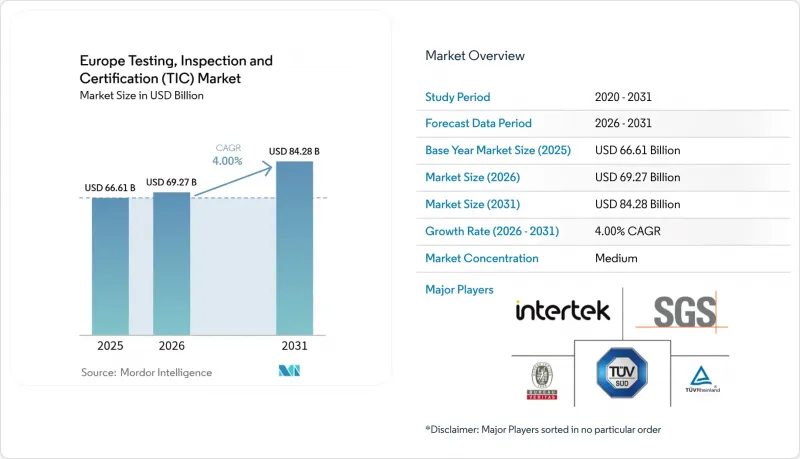
[1] TIC理事會,“什麼是TIC產業?”,tic-council.org。市場結構性成長的驅動力來自歐盟《數位營運韌性法案》、《企業永續發展報告指令》和《網路韌性法案》中加強的監管要求,這些法案均要求在金融、永續性和互聯產品領域提供可驗證的第三方保證。 [2] 歐洲議會,“‘從農場到餐桌’戰略”,europarl.europa.eu。可再生能源的加速普及、持續轉向外包檢驗以及人工智慧驅動的測試技術的快速發展,即使在成員國經濟狀況存在差異的情況下,也進一步增強了成長前景。本報告按服務類型(測試、檢驗、認證)、採購方式(內部和外包)、行業(消費品和零售、資訊通訊技術和電信、汽車和運輸以及其他)、服務交付方式(現場、異地/實驗室、遠端/數位化)和國家/地區進行分類。市場預測以貨幣(美元)表示。
歐洲測試、檢驗和認證 (TIC) 市場的趨勢和洞察
歐盟各行業監管合規的複雜性日益增加。
隨著《資料保護條例》(DORA)、《通訊規範揭露條例》(CSRD) 和《網路韌性法案》於 2024 年生效,金融機構、大型企業和連網產品製造商現在分別需要確保資訊通訊技術風險、永續性揭露和產品網路安全方面的多層第三方保證。目前,約 30% 的合規預算用於外部審計,這為能夠透過單一合約涵蓋網路安全、環境、社會和治理 (ESG) 以及營運韌性的端到端服務提供者創造了新的收入來源。這些領域需求的聚合進一步增強了交叉銷售潛力,尤其是對於擁有整合數位審計平台的服務提供者。在普遍的成本削減措施下,歐洲的測試、檢驗和認證市場彈性相對較低,因為它是少數市場准入受法律強制規定的服務業之一。因此,中期成長取決於服務提供者能否在確保資料完整性標準符合監管機構要求的同時,擴展其多學科專業知識。
需要專門認證的可再生能源專案擴建
在REPowerEU計劃下,有史以來規模最大的風能和太陽能發電項目建設擴張,需要對渦輪機的完整性、功率特性曲線性能和併網安全性進行全面檢驗,這為TIC(技術資訊中心)在船舶分類和環境影響評估方面的專家創造了利潤豐厚的商機。隨著各國主管機關在維持嚴格技術標準的同時縮短核准期限,專案開發商面臨認證瓶頸,進一步提升了擁有深厚專業知識的認證測試實驗室的策略價值。僅北海離岸風力發電的成長就需要高額費用,因為需要在惡劣的環境條件下進行複雜的海底電纜測試和材料認證。隨著可再生能源資產所有者採用人工智慧驅動的無人機監控來管理老化的基礎設施,能夠檢驗硬體和數據分析演算法的認證機構獲得了競爭優勢。因此,歐洲的測試、檢驗和認證市場預計將獲得長期成長動力,並與歐洲大陸的淨零排放目標緊密相連。
中小企業認證和認可高成本
認證費用通常佔中小企業銷售額的2-3%,迫使它們推遲全面合規,在某些情況下甚至錯失出口機會。儘管有互認協議,但多個國家認證機構仍要求提交重複的文件,加重了企業的行政負擔。雖然數位化審核平台降低了交易成本,但維持ISO認證能力的經濟效益仍然有利於大型服務集團,造成了准入差距,這可能會阻礙企業更廣泛地滲透到歐洲的測試、檢驗和認證市場,尤其是在購買力較低的東歐地區。
細分市場分析
到2025年,測試服務市場規模將達到360.9億美元,佔歐洲測試、資訊和通訊(TIC)市場54.20%的佔有率。這是因為先進電子產品、醫療設備和汽車零件在商業化之前都需要進行多方面的性能評估。數位化工作流程,例如基於雲端的測試資料門戶,透過縮短處理時間和提高客戶透明度,進一步增強了早期採用者的競爭優勢。認證服務目前規模較小,但預計將以4.58%的複合年成長率成長,這主要得益於管理體系標準的擴展,這些標準現在涵蓋了網路安全和監管合規指令(CSRD)所要求的保證,並涉及網路安全、業務永續營運和社會責任。檢驗服務在基礎設施生命週期管理中保持穩定的重要性,尤其是在傳統製造地,這些工廠需要定期進行結構評估。
整合了測試調度、即時分析和證書頒發等功能的平台正在模糊傳統服務領域的界限。隨著客戶對一站式合規解決方案的需求日益成長,提供包含實驗室測試和現場/遠端檢驗的單一合約的供應商正在不斷擴大市場佔有率。對人工智慧驅動的缺陷檢測演算法的投入不斷增加,這些演算法在提升實驗室處理能力的同時,也確保了數據的完整性,這進一步鞏固了「測試」領域在歐洲測試、檢驗和認證市場的主導地位。
到2025年,外包檢驗將佔歐洲測試、檢驗和認證市場的63.05%,反映出企業正從資本密集的內部實驗室轉向外包模式。航太和汽車產業的製造商,面對材料科學的進步和安全標準的不斷演變,更傾向於採用可變成本模式,以便根據產量調整支出。外包服務也能幫助企業即時獲得全球認證,縮短出口產品的上市時間,並降低監管風險。
基於績效的合約模式的擴展,使得測試、檢驗和認證 (TIC) 公司在特定範圍內承擔合規責任,從而創造了持續的收入並促進了流程的不斷改進。儘管出於知識產權方面的考慮,一些測試活動仍然在公司內部進行,但外包的整體趨勢預計將保持 4.37% 的複合年成長率,歐洲測試、檢驗和認證市場預計將從與長期框架協議相關的服務合約中獲得穩定的兩位數收入貢獻。
其他好處:
- Excel格式的市場預測(ME)表
- 3個月的分析師支持
目錄
第1章:引言
- 研究假設和市場定義
- 調查範圍
第2章:調查方法
第3章執行摘要
第4章 市場狀況
- 市場概覽
- 市場促進因素
- 歐盟各行業的監管合規複雜性日益增加。
- 需要專門認證的可再生能源專案擴建
- 製造業中資訊通訊技術服務外包的趨勢日益成長。
- 嚴格的食品安全標準,以歐盟「從農場到餐桌」戰略為基礎。
- 人工智慧巡檢無人機在基礎設施維護和管理領域迅速普及
- ESG掛鉤貸款的出現要求進行獨立檢驗和審計。
- 市場限制因素
- 中小企業認證和認可成本高。
- 非歐盟歐洲國家法規結構的差異
- 進階無損檢測(NDT)專家短缺
- 網路安全問題阻礙了遠端和數位化檢查。
- 產業價值鏈分析
- 宏觀經濟因素的影響
- 監理情勢
- 技術展望
- 波特五力分析
第5章 市場規模與成長預測
- 按服務類型
- 測試
- 檢查
- 認證
- 透過採購方式
- 內部
- 外包
- 按行業分類
- 消費品和零售
- 資訊通訊技術與通訊
- 汽車和運輸業
- 航太/國防
- 石油、天然氣和石化產品
- 能源公用事業
- 工業製造和機械
- 化學與材料
- 建築和基礎設施
- 生命科學與醫療保健
- 食品/農業/飲料
- 其他工業領域(環境、永續發展等)
- 按服務交付方式
- 現場
- 異地/檢查室
- 遠端/數位
- 國家
- 德國
- 英國
- 法國
- 義大利
- 西班牙
- 俄羅斯
- 其他歐洲國家
第6章 競爭情勢
- 市場集中度
- 策略趨勢
- 市佔率分析
- 公司簡介
- SGS SA
- Bureau Veritas SA
- Intertek Group plc
- TUV SUD AG
- TUV Rheinland AG
- DEKRA SE
- Applus+Servicios Tecnologicos SLU
- Eurofins Scientific SE
- DNV AS
- Kiwa NV
- Lloyd's Register Group Limited
- British Standards Institution(BSI Group)
- RINA SpA
- UL Solutions Inc.
- ALS Limited
- Element Materials Technology Group Ltd.
- MISTRAS Group, Inc.
- TUV NORD Group
- VDE Testing and Certification Institute
- PhAST GmbH
- Safety Assessment Federation(SAFed)
- Exova Group Ltd.
- IAF International Accreditation Forum, Inc.
第7章 市場機會與未來展望
According to Mordor Intelligence, the european TIC market size was valued at USD 66.61 billion in 2025 and estimated to grow from USD 69.27 billion in 2026 to reach USD 84.28 billion by 2031, at a CAGR of 4.00% during the forecast period (2026-2031).
[1] TIC Council, "What Is the TIC Sector?," tic-council.org The market's structural momentum is anchored in escalating regulatory demands under the EU Digital Operational Resilience Act, Corporate Sustainability Reporting Directive, and Cyber Resilience Act, each of which now compels demonstrable third-party assurance across financial, sustainability, and connected-product domains. [2] European Parliament, "The Farm to Fork Strategy," europarl.europa.eu Accelerated renewable-energy build-outs, a sustained shift toward outsourced verification, and the rapid emergence of AI-enabled inspection technologies further reinforce growth prospects even as economic sentiment remains uneven across member states. This report is Segmented by Service Type (Testing, Inspection, and Certification), Sourcing Type (In-House and Outsourced), Industry Vertical (Consumer Goods and Retail, ICT and Telecom, Automotive and Transportation, and More), Mode of Service Delivery (On-Site, Off-site/Laboratory, and Remote/Digital), and Country. The Market Forecasts are Provided in Terms of Value (USD).
Europe Testing, Inspection And Certification (TIC) Market Trends and Insights
Growing Regulatory Compliance Complexity Across EU Industries
DORA, CSRD, and the Cyber Resilience Act became enforceable during 2024, compelling financial firms, large corporates, and connected-product manufacturers to secure multi-layered third-party assurance for ICT risk, sustainability disclosures, and product cybersecurity, respectively. Compliance budgets now allocate roughly 30% to external audits, translating into fresh revenue pools for end-to-end providers able to cover cyber, ESG, and operational-resilience scopes in a single engagement. Demand aggregation across these domains amplifies cross-selling potential, particularly for providers with integrated digital audit platforms. Because the European TIC market is one of the few service categories legally mandated for market entry, spending remains relatively inelastic even amid broader cost-containment drives. Medium-term growth, therefore, hinges on providers' capacity to scale multidisciplinary expertise while assuring data-integrity standards acceptable to supervisory authorities.
Expansion of Renewable Energy Projects Requiring Specialized Certification
Record wind and solar build-outs under the REPowerEU plan require exhaustive verification of turbine integrity, power-curve performance, and grid-integration safety, creating high-margin opportunities for TIC specialists in marine classification and environmental impact assessment. Project developers face certification bottlenecks as national authorities uphold stringent technical codes but streamline permitting deadlines, magnifying the strategic value of accredited labs with deep domain know-how. Offshore wind growth in the North Sea alone commands premium fees because of complex subsea cabling tests and harsh-environment material qualification. As renewable-asset owners adopt AI-driven drone monitoring to manage aging fleets, certification bodies able to validate both hardware and data analytics algorithms gain a competitive advantage. The European TIC market consequently secures a long-run growth engine that is closely tied to the continent's net-zero timetable.
High Cost of Accreditation and Certification for SMEs
Certification expenses often equal 2-3% of SME revenue, pressuring smaller firms to postpone full compliance and, in some cases, forgo export opportunities. Multiple national accreditation bodies, despite mutual-recognition accords, still impose duplicative paperwork that raises administrative burdens. While digital audit portals are lowering transaction costs, the economics of maintaining ISO-accredited capacity continue to favor large service groups, creating an access gap that can inhibit broader European TIC market penetration, particularly in Eastern Europe, where purchasing power is lower.
Other drivers and restraints analyzed in the detailed report include:
- Rising Outsourcing Trend for TIC Services Among Manufacturers
- Emergence of ESG-Linked Financing Mandating Independent Verification Audits
- Fragmented Regulatory Framework Across Non-EU European States
For complete list of drivers and restraints, kindly check the Table Of Contents.
Segment Analysis
Testing services contributed USD 36.09 billion, equivalent to 54.20% of the European TIC market in 2025, as advanced electronics, medical devices, and automotive components all require multi-disciplinary performance assessments before commercialization. Digital workflows such as cloud-based test-data portals shorten turnaround times and enhance client transparency, deepening competitive moats for early adopters. Certification, though smaller today, is forecast to compound at 4.58% annually, driven by CSRD-mandated assurance and expanding management-system standards that now cover cybersecurity, business continuity, and social responsibility. Inspection maintains steady relevance in infrastructure life-cycle management, especially in legacy manufacturing hubs where periodic structural assessments are compulsory.
Integrated platforms that unify test scheduling, real-time analytics, and certificate issuance are blurring boundaries between traditional service silos. Providers that can bundle lab tests with on-site and remote inspection in a single engagement are capturing wallet share as clients pursue one-stop compliance solutions. Investment is flowing into AI-enabled defect-recognition algorithms that raise lab throughput while preserving data integrity, reinforcing Testing's primacy within the European TIC market.
Outsourced verification accounted for 63.05% of the European TIC market size in 2025, reflecting a decisive shift away from capital-intensive in-house labs. Manufacturers in aerospace and automotive segments, faced with material science advances and evolving safety standards, prefer variable cost models that align spending with production volumes. Outsourced services also provide immediate access to global accreditations, which accelerate time-to-market for exports and mitigate regulatory risk.
Outcome-based contracts under which TIC firms assume compliance responsibility for a defined scope are expanding, generating recurring revenue, and incentivizing continuous process improvement. Although intellectual-property concerns keep some testing activities internal, the broader outsourcing trend is expected to sustain a 4.37% CAGR, positioning the European TIC market for stable double-digit revenue contribution from service contracts linked to long-term framework agreements.
Complete Report Scope:
- By Service Type
- Testing
- Inspection
- Certification
- By Sourcing Type
- In-house
- Outsourced
- By Industry Vertical
- Consumer Goods and Retail
- ICT and Telecom
- Automotive and Transportation
- Aerospace and Defense
- Oil, Gas and Petrochemicals
- Energy and Utilities
- Industrial Manufacturing and Machinery
- Chemicals and Materials
- Construction and Infrastructure
- Life Sciences and Healthcare
- Food, Agriculture and Beverage
- Other Industry Verticals (Environment, Sustainability, etc.)
- By Mode of Service Delivery
- On-site
- Off-site / Laboratory
- Remote / Digital
- By Country
- Germany
- United Kingdom
- France
- Italy
- Spain
- Russia
- Rest of Europe
List of Companies Covered in this Report:
- SGS SA
- Bureau Veritas SA
- Intertek Group plc
- TUV SUD AG
- TUV Rheinland AG
- DEKRA SE
- Applus+ Servicios Tecnologicos S.L.U.
- Eurofins Scientific SE
- DNV AS
- Kiwa NV
- Lloyd's Register Group Limited
- British Standards Institution (BSI Group)
- RINA S.p.A.
- UL Solutions Inc.
- ALS Limited
- Element Materials Technology Group Ltd.
- MISTRAS Group, Inc.
- TUV NORD Group
- VDE Testing and Certification Institute
- PhAST GmbH
- Safety Assessment Federation (SAFed)
- Exova Group Ltd.
- IAF International Accreditation Forum, Inc.
Additional Benefits:
- The market estimate (ME) sheet in Excel format
- 3 months of analyst support
TABLE OF CONTENTS
1 INTRODUCTION
- 1.1 Study Assumptions and Market Definition
- 1.2 Scope of the Study
2 RESEARCH METHODOLOGY
3 EXECUTIVE SUMMARY
4 MARKET LANDSCAPE
- 4.1 Market Overview
- 4.2 Market Drivers
- 4.2.1 Growing regulatory compliance complexity across EU industries
- 4.2.2 Expansion of renewable energy projects requiring specialized certification
- 4.2.3 Rising outsourcing trend for TIC services among manufacturers
- 4.2.4 Stringent food-safety standards under EU Farm-to-Fork strategy
- 4.2.5 Rapid proliferation of AI-enabled inspection drones in infrastructure maintenance
- 4.2.6 Emergence of ESG-linked financing mandating independent verification audits
- 4.3 Market Restraints
- 4.3.1 High cost of accreditation and certification for SMEs
- 4.3.2 Fragmented regulatory framework across non-EU European states
- 4.3.3 Talent shortage of advanced NDT specialists
- 4.3.4 Cyber-security concerns hampering remote/digital inspections
- 4.4 Industry Value Chain Analysis
- 4.5 Impact of Macroeconomic Factors
- 4.6 Regulatory Landscape
- 4.7 Technological Outlook
- 4.8 Porter's Five Forces Analysis
- 4.8.1 Bargaining Power of Suppliers
- 4.8.2 Bargaining Power of Buyers
- 4.8.3 Threat of New Entrants
- 4.8.4 Threat of Substitutes
- 4.8.5 Competitive Rivalry
5 MARKET SIZE AND GROWTH FORECASTS (VALUES)
- 5.1 By Service Type
- 5.1.1 Testing
- 5.1.2 Inspection
- 5.1.3 Certification
- 5.2 By Sourcing Type
- 5.2.1 In-house
- 5.2.2 Outsourced
- 5.3 By Industry Vertical
- 5.3.1 Consumer Goods and Retail
- 5.3.2 ICT and Telecom
- 5.3.3 Automotive and Transportation
- 5.3.4 Aerospace and Defense
- 5.3.5 Oil, Gas and Petrochemicals
- 5.3.6 Energy and Utilities
- 5.3.7 Industrial Manufacturing and Machinery
- 5.3.8 Chemicals and Materials
- 5.3.9 Construction and Infrastructure
- 5.3.10 Life Sciences and Healthcare
- 5.3.11 Food, Agriculture and Beverage
- 5.3.12 Other Industry Verticals (Environment, Sustainability, etc.)
- 5.4 By Mode of Service Delivery
- 5.4.1 On-site
- 5.4.2 Off-site / Laboratory
- 5.4.3 Remote / Digital
- 5.5 By Country
- 5.5.1 Germany
- 5.5.2 United Kingdom
- 5.5.3 France
- 5.5.4 Italy
- 5.5.5 Spain
- 5.5.6 Russia
- 5.5.7 Rest of Europe
6 COMPETITIVE LANDSCAPE
- 6.1 Market Concentration
- 6.2 Strategic Moves
- 6.3 Market Share Analysis
- 6.4 Company Profiles (includes Global level Overview, Market level overview, Core Segments, Financials as available, Strategic Information, Market Rank/Share for key companies, Products and Services, and Recent Developments)
- 6.4.1 SGS SA
- 6.4.2 Bureau Veritas SA
- 6.4.3 Intertek Group plc
- 6.4.4 TUV SUD AG
- 6.4.5 TUV Rheinland AG
- 6.4.6 DEKRA SE
- 6.4.7 Applus+ Servicios Tecnologicos S.L.U.
- 6.4.8 Eurofins Scientific SE
- 6.4.9 DNV AS
- 6.4.10 Kiwa NV
- 6.4.11 Lloyd's Register Group Limited
- 6.4.12 British Standards Institution (BSI Group)
- 6.4.13 RINA S.p.A.
- 6.4.14 UL Solutions Inc.
- 6.4.15 ALS Limited
- 6.4.16 Element Materials Technology Group Ltd.
- 6.4.17 MISTRAS Group, Inc.
- 6.4.18 TUV NORD Group
- 6.4.19 VDE Testing and Certification Institute
- 6.4.20 PhAST GmbH
- 6.4.21 Safety Assessment Federation (SAFed)
- 6.4.22 Exova Group Ltd.
- 6.4.23 IAF International Accreditation Forum, Inc.
7 MARKET OPPORTUNITIES AND FUTURE OUTLOOK
- 7.1 White-space and Unmet-Need Assessment

 消費品和零售業的測試、檢驗和認證 (TIC):市場佔有率分析、行業趨勢和統計數據以及成長預測 (2026-2031)美洲的測試、檢定和認證 (TIC):市場佔有率分析、行業趨勢和統計數據以及成長預測 (2026-2031)亞太地區測試、檢驗和認證 (TIC):市場佔有率分析、行業趨勢與統計數據及成長預測 (2026-2031)北美測試、檢定和認證 (TIC):市場佔有率分析、行業趨勢和統計數據以及成長預測 (2026–2031)測試、檢驗和認證:市場佔有率分析、行業趨勢和統計數據、成長預測(2026-2031 年)自然資源產業的測試、檢驗和認證:市場佔有率分析、行業趨勢和統計數據以及成長預測(2026-2031 年)
 2026-2030年全球測驗、檢驗和認證市場
 測試、檢驗和認證市場:2026-2032年全球市場預測(按服務類型、採購方式、技術、合規要求、應用、組織規模和最終用戶行業分類)證書測試市場:2026-2032年全球市場預測(依測試服務、階段、產業、部署類型、最終用戶和組織規模分類)日本的測試、檢定和認證 (TIC):市場佔有率分析、行業趨勢和統計數據以及成長預測 (2026-2031)