


 |
市場調查報告書
商品編碼
2116944
美洲的測試、檢定和認證 (TIC):市場佔有率分析、行業趨勢和統計數據以及成長預測 (2026-2031)Americas Testing, Inspection And Certification (TIC) - Market Share Analysis, Industry Trends & Statistics, Growth Forecasts (2026 - 2031) |
||||||

※ 本網頁內容可能與最新版本有所差異。詳細情況請與我們聯繫。
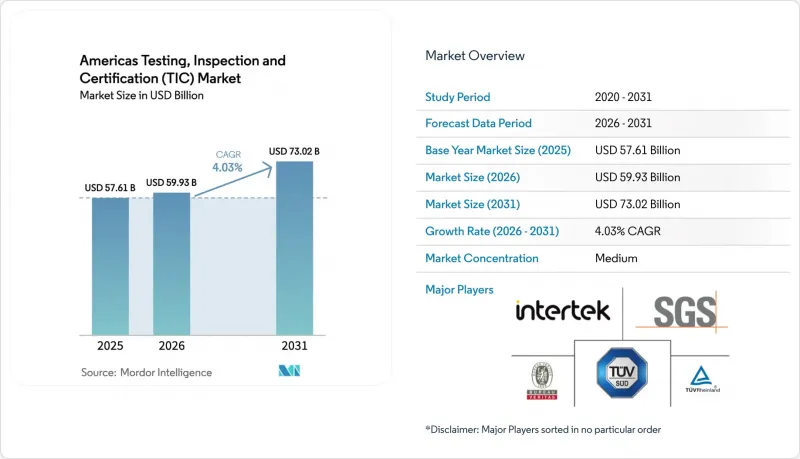
根據 Mordor Intelligence 預測,美洲的 TIC 市場規模預計將從 2025 年的 576.1 億美元成長到 2026 年的 599.3 億美元,然後從 2026 年到 2031 年以 4.03% 的複合成長率成長,到 2031 億美元達到 730.2 億美元。
本報告按服務類型(測試、檢驗、認證)、採購方式(內部和外包)、行業(消費品和零售、資訊通訊技術和電信、汽車和交通運輸以及其他)、服務交付方式(現場、異地/實驗室、遠端/數位化)以及地區(北美和南美)進行分類。市場預測以美元計價。
美洲測試、檢驗和認證 (TIC) 市場的趨勢和見解。
由於近岸外包,合規性測試激增,正在重塑市場動態。
疫情期間供應鏈的中斷加速了向本地化生產的轉變,墨西哥邊境州的新建工廠在產品進口到美國之前,必須接受全面的安全、環境和品質審核。企業報告稱,70%的技術職位仍然空缺,他們越來越依賴外包來滿足ISO 17025和特定產業標準。這種連鎖反應也波及到需要檢驗倉庫自動化系統的物流公司和負責監督區域合規性的金融服務中心。隨著近岸外包擴展到需要複雜、多學科測試的消費性電子產品、汽車傳動系統和精密機械領域,美洲的測試、資訊和通訊(TIC)市場正在不斷擴張。
強制性ESG審計正在創造新的收入來源。
根據美國證券交易委員會 (SEC) 適用於 2025 年起大規模加速申報公司的規則,範圍 1 和範圍 2 的排放量需要第三方保證,加拿大的《碳排放交易法》(CSA) 也實施了類似的揭露準則。這些規則的域外適用意味著拉丁美洲各地的子公司必須提交檢驗的碳排放清單,這為成熟的碳排放交易公司創造了跨境業務機會。保險公司正在加速這一趨勢,要求在承保產物保險之前提供 ESG 合規證明。作為回應,服務提供者正在推出碳計量、供應鏈透明度和社會影響審計服務,透過吸引高保費合約來推動美洲碳排放交易市場的成長。
工程師短缺限制了市場擴張。
聯合國教科文組織警告稱,該地區技術教育的匱乏導致70%的墨西哥科技公司難以招募合格人才。射頻表徵、化學分析和先進材料等專業領域的需求持續旺盛,迫使服務提供者設立密集培訓項目,並延長投資回報週期。這些稀缺技能人才的薪資上漲正在擠壓利潤空間,尤其是在商品化的分析服務領域。雖然資深專家的跨國流動緩解了人才短缺的瓶頸,但也增加了簽證和搬遷成本。
細分市場分析
至2025年,測試解決方案將佔銷售額的60.02%,凸顯其在各產業產品檢驗的基礎性作用。認證服務雖然規模較小,但由於ESG審計、網路安全認證和功能安全認證的監管重要性日益增強,預計將以4.74%的複合年成長率成長。檢驗服務佔據中等規模的細分市場,為基礎設施健康維護項目和預測性維護計劃提供支援。電池安全措施清楚地表明,市場對高度複雜測試的需求正在轉變,在這些測試中,專家判斷和專用測試實驗室至關重要。隨著強制要求揭露經審計資訊的法規日益普及,美洲的認證服務市場預計將會擴張。
隨著檢測實驗室在獲得UL 2580和IATF 16949等特定產業認證之前,優先尋求ISO 17025基準認證,競爭格局正在改變。 UL Solutions已擴展其電動車電池測試業務,以爭取高階項目,這表明其正向高價值細分市場轉型。規模較小、財務狀況欠佳的公司越來越依賴網路合作夥伴的分包模式,這進一步強化了外包生態系統。自動化和數據分析正在滲透到常規測試中,使技術人員能夠專注於數據解讀,但高技能專業人才的短缺阻礙了處理規模的擴大。
即使到了2025年,企業仍將把68.72%的檢驗預算外包,預計這一趨勢將以4.55%的複合年成長率持續到2031年。風險緩解、監管機構提出的獨立核准建議以及不斷擴充的標準目錄都在推動外包比例的成長。美洲TIC市場的外包活動受益於跨境製造活動,這些活動增加了單一營業單位合規的困難。
數位轉型進一步增強了這種吸引力。供應商正在整合即時儀錶板、無縫資料饋送和符合審計要求的報告功能,以減輕內部管理負擔。即使是擁有自有實驗室的大型原始設備製造商 (OEM) 公司,在產品上市前也需要獲得公正的認證。因此,儘管外包模式仍然至關重要,但混合模式正在興起,在這種模式下,公司本身的實驗室進行預篩檢,而外部合作夥伴則頒發合格證書。
其他好處:
- Excel格式的市場預測(ME)表
- 3個月的分析師支持
目錄
第1章:引言
- 研究假設和市場定義
- 調查範圍
第2章:調查方法
第3章執行摘要
第4章 市場狀況
- 市場概覽
- 市場促進因素
- 近岸外包的擴張增加了對現場合規性測試的需求。
- 美國證券交易委員會(SEC)和加拿大證券監管機構(CSA)正在收緊ESG審計要求。
- 隨著 5G/6G 部署的加速,無線設備將需要新的認證。
- 墨西哥和巴西的鋰離子電池超級工廠正在迅速擴張。
- 食品供應鏈中有關數位追溯的法律法規
- 保險承銷商正在收緊其損害預防檢查條款。
- 市場限制因素
- 拉丁美洲各地合格醫療技術人員短缺
- 南方共同市場和美墨加協定之間存在著一套分裂的管理體制。
- 人工智慧驅動的遠端檢測硬體需要大量的資金投入。
- 各大汽車製造商正在提升其內部測試能力。
- 產業價值鏈分析
- 宏觀經濟因素的影響
- 監理情勢
- 技術展望
- 波特五力分析
第5章 市場規模與成長預測
- 按服務類型
- 測試
- 檢查
- 認證
- 透過採購方式
- 內部
- 外包
- 按行業分類
- 消費品和零售
- 資訊通訊技術與通訊
- 汽車和運輸業
- 航太/國防
- 石油、天然氣和石化產品
- 能源公用事業
- 工業製造和機械
- 化學與材料
- 建築和基礎設施
- 生命科學與醫療保健
- 食品/農業/飲料
- 其他工業領域(環境、永續發展等)
- 按服務交付方式
- 現場
- 異地/檢查室
- 遠端/數位
- 按地區
- 北美洲
- 美國
- 加拿大
- 墨西哥
- 南美洲
- 巴西
- 阿根廷
- 智利
- 其他南美國家
- 北美洲
第6章 競爭情勢
- 市場集中度
- 策略趨勢
- 市佔率分析
- 公司簡介
- Bureau Veritas SA
- SGS SA
- Intertek Group plc
- TUV SUD AG
- TUV Rheinland AG
- TUV NORD GROUP
- DEKRA SE
- Applus+Services SA
- Eurofins Scientific SE
- DNV AS
- UL Solutions Inc.
- NSF International
- CSA Group Testing and Certification Inc.
- ALS Limited
- Kiwa NV
- Lloyd's Register Group Services Ltd.
- Element Materials Technology Group Ltd.
- MISTRAS Group, Inc.
- BSI Group(The British Standards Institution)
- American Bureau of Shipping
- Inmetro-Brazilian National Institute of Metrology, Quality and Technology
- Control Union Certifications
- LGC Limited
- Nemko Group AS
- Perry Johnson Laboratory Accreditation, Inc.
第7章 市場機會與未來展望
According to Mordor Intelligence, the americas tIC market size is expected to grow from USD 57.61 billion in 2025 to USD 59.93 billion in 2026 and is forecast to reach USD 73.02 billion by 2031 at 4.03% CAGR over 2026-2031.
This report is Segmented by Service Type (Testing, Inspection, and Certification), Sourcing Type (In-House and Outsourced), Industry Vertical (Consumer Goods and Retail, ICT and Telecom, Automotive and Transportation, and More), Mode of Service Delivery (On-Site, Off-site/Laboratory, and Remote/Digital), and Region (North America and South America). The Market Forecasts are Provided in Terms of Value (USD).
Americas Testing, Inspection And Certification (TIC) Market Trends and Insights
Near-shoring compliance testing surge reshapes market dynamics
Local production shifts accelerated after pandemic-era supply chain disruptions, prompting new factories in Mexico's border states to commission extensive safety, environmental, and quality audits before products may enter the United States. Companies report that 70% of open technical roles remain unfilled, which obliges heavier reliance on outsourced providers to satisfy ISO 17025 and sector-specific standards. Spillover benefits reach logistics firms that require verification of warehouse automation systems, as well as financial service centers tasked with regional compliance oversight. The Americas TIC market enlarges as near-shoring also extends to consumer electronics, automotive drivetrains, and precision machinery that demand complex multi-discipline testing.
ESG auditing mandates create new revenue streams
The U.S. SEC rule, effective for 2025 large accelerated filers, obliges third-party assurance of Scope 1 and Scope 2 emissions, while the Canadian CSA implements parallel disclosure guidelines. The extraterritorial reach means subsidiaries across Latin America must submit verified carbon inventories, leading to cross-border engagements for established TIC firms. Insurers add weight by requesting ESG compliance certificates before underwriting property and casualty coverage. In response, providers launch carbon accounting, supply-chain transparency, and social-impact audit services, stimulating premium-rate contracts that lift overall Americas TIC market growth.
Technician shortage constrains market expansion
UNESCO warns that regional technical education shortfalls leave 70% of Mexican technology firms scrambling to source qualified workers. Specialized domains such as RF characterization, chemical analytics, and advanced materials see persistent vacancy rates, forcing providers to build intensive training pipelines that extend payback periods. Wage inflation for scarce skill sets compresses margins, especially for commoditized assays. Cross-border relocation of senior experts mitigates bottlenecks but adds visa and relocation costs.
Other drivers and restraints analyzed in the detailed report include:
- 5G / 6G equipment certification drives technical innovation
- Li-ion battery gigafactory expansion fuels specialized testing
- Regulatory fragmentation increases compliance costs
For complete list of drivers and restraints, kindly check the Table Of Contents.
Segment Analysis
Testing solutions delivered 60.02% of 2025 revenue, underlining their foundational role in product validation across every vertical. Certification, though smaller, is set to grow at a 4.74% CAGR because ESG audits, cybersecurity seals, and functional-safety endorsements carry increasing regulatory weight. Inspection services occupy the median niche, sustaining infrastructure integrity projects and preventive maintenance programs. Battery safety initiatives illustrate how demand migrates toward high-complexity assays where expert judgment and purpose-built chambers matter. The Americas TIC market size for certification services is projected to widen in tandem with mandates that require audited disclosures.
Competitive positioning shifts as labs pursue ISO 17025 baseline accreditation before layering sector-specific endorsements such as UL 2580 or IATF 16949. UL Solutions expanded its electric-vehicle battery test line to capture premium assignments, signaling a pivot toward high-value niches. Smaller firms without capital latitude gravitate to subcontract models under network partners, reinforcing the outsourced ecosystem. Automation and data analytics permeate routine tests, freeing skilled personnel to focus on interpretive tasks, yet staff shortages in advanced disciplines temper volume scalability.
Corporations continued to channel 68.72% of verification budgets to external partners in 2025, a pattern projected to hold with a 4.55% CAGR through 2031. Risk mitigation, regulator preference for independent sign-off, and ever-broadening standard catalogs underpin the outsourced share. The Americas TIC market share for outsourced activities benefits from cross-border manufacturing that complicates single-entity compliance.
Digital transformation amplifies this appeal. Providers embed real-time dashboards, seamless data feeds, and audit-ready report generators, reducing internal administrative loads. Mega-OEMs that have built captive labs still require impartial attestations before product launch. Consequently, the outsourced model remains integral, while hybrid arrangements surface in which corporate labs run pre-screens and external partners supply conformance certificates.
Complete Report Scope:
- By Service Type
- Testing
- Inspection
- Certification
- By Sourcing Type
- In-house
- Outsourced
- By Industry Vertical
- Consumer Goods and Retail
- ICT and Telecom
- Automotive and Transportation
- Aerospace and Defense
- Oil, Gas and Petrochemicals
- Energy and Utilities
- Industrial Manufacturing and Machinery
- Chemicals and Materials
- Construction and Infrastructure
- Life Sciences and Healthcare
- Food, Agriculture and Beverage
- Other Industry Verticals (Environment, Sustainability, etc.)
- By Mode of Service Delivery
- On-site
- Off-site / Laboratory
- Remote / Digital
- By Region
- North America
- United States
- Canada
- Mexico
- South America
- Brazil
- Argentina
- Chile
- Rest of South America
- North America
List of Companies Covered in this Report:
- Bureau Veritas SA
- SGS SA
- Intertek Group plc
- TUV SUD AG
- TUV Rheinland AG
- TUV NORD GROUP
- DEKRA SE
- Applus+ Services SA
- Eurofins Scientific SE
- DNV AS
- UL Solutions Inc.
- NSF International
- CSA Group Testing and Certification Inc.
- ALS Limited
- Kiwa NV
- Lloyd's Register Group Services Ltd.
- Element Materials Technology Group Ltd.
- MISTRAS Group, Inc.
- BSI Group (The British Standards Institution)
- American Bureau of Shipping
- Inmetro - Brazilian National Institute of Metrology, Quality and Technology
- Control Union Certifications
- LGC Limited
- Nemko Group AS
- Perry Johnson Laboratory Accreditation, Inc.
Additional Benefits:
- The market estimate (ME) sheet in Excel format
- 3 months of analyst support
TABLE OF CONTENTS
1 INTRODUCTION
- 1.1 Study Assumptions and Market Definition
- 1.2 Scope of the Study
2 RESEARCH METHODOLOGY
3 EXECUTIVE SUMMARY
4 MARKET LANDSCAPE
- 4.1 Market Overview
- 4.2 Market Drivers
- 4.2.1 Rising near-shoring drives demand for local compliance testing
- 4.2.2 Stricter ESG auditing mandates by U.S. SEC and Canadian CSA
- 4.2.3 Accelerated 5G/6G roll-outs require new radio-equipment certification
- 4.2.4 Surging Li-ion battery gigafactories in Mexico and Brazil
- 4.2.5 Digital traceability legislation in food supply chains
- 4.2.6 Insurance underwriters tightening loss-control inspection clauses
- 4.3 Market Restraints
- 4.3.1 Shortage of qualified lab technicians across LATAM
- 4.3.2 Fragmented regulatory regimes between Mercosur and USMCA
- 4.3.3 High capex for AI-driven remote inspection hardware
- 4.3.4 Rising in-house testing capabilities by mega OEMs
- 4.4 Industry Value Chain Analysis
- 4.5 Impact of Macroeconomic Factors
- 4.6 Regulatory Landscape
- 4.7 Technological Outlook
- 4.8 Porter's Five Forces Analysis
- 4.8.1 Threat of New Entrants
- 4.8.2 Bargaining Power of Buyers
- 4.8.3 Bargaining Power of Suppliers
- 4.8.4 Threat of Substitutes
- 4.8.5 Competitive Rivalry
5 MARKET SIZE AND GROWTH FORECASTS (VALUES)
- 5.1 By Service Type
- 5.1.1 Testing
- 5.1.2 Inspection
- 5.1.3 Certification
- 5.2 By Sourcing Type
- 5.2.1 In-house
- 5.2.2 Outsourced
- 5.3 By Industry Vertical
- 5.3.1 Consumer Goods and Retail
- 5.3.2 ICT and Telecom
- 5.3.3 Automotive and Transportation
- 5.3.4 Aerospace and Defense
- 5.3.5 Oil, Gas and Petrochemicals
- 5.3.6 Energy and Utilities
- 5.3.7 Industrial Manufacturing and Machinery
- 5.3.8 Chemicals and Materials
- 5.3.9 Construction and Infrastructure
- 5.3.10 Life Sciences and Healthcare
- 5.3.11 Food, Agriculture and Beverage
- 5.3.12 Other Industry Verticals (Environment, Sustainability, etc.)
- 5.4 By Mode of Service Delivery
- 5.4.1 On-site
- 5.4.2 Off-site / Laboratory
- 5.4.3 Remote / Digital
- 5.5 By Region
- 5.5.1 North America
- 5.5.1.1 United States
- 5.5.1.2 Canada
- 5.5.1.3 Mexico
- 5.5.2 South America
- 5.5.2.1 Brazil
- 5.5.2.2 Argentina
- 5.5.2.3 Chile
- 5.5.2.4 Rest of South America
- 5.5.1 North America
6 COMPETITIVE LANDSCAPE
- 6.1 Market Concentration
- 6.2 Strategic Moves
- 6.3 Market Share Analysis
- 6.4 Company Profiles (includes Global level Overview, Market level overview, Core Segments, Financials as available, Strategic Information, Market Rank/Share for key companies, Products and Services, and Recent Developments)
- 6.4.1 Bureau Veritas SA
- 6.4.2 SGS SA
- 6.4.3 Intertek Group plc
- 6.4.4 TUV SUD AG
- 6.4.5 TUV Rheinland AG
- 6.4.6 TUV NORD GROUP
- 6.4.7 DEKRA SE
- 6.4.8 Applus+ Services SA
- 6.4.9 Eurofins Scientific SE
- 6.4.10 DNV AS
- 6.4.11 UL Solutions Inc.
- 6.4.12 NSF International
- 6.4.13 CSA Group Testing and Certification Inc.
- 6.4.14 ALS Limited
- 6.4.15 Kiwa NV
- 6.4.16 Lloyd's Register Group Services Ltd.
- 6.4.17 Element Materials Technology Group Ltd.
- 6.4.18 MISTRAS Group, Inc.
- 6.4.19 BSI Group (The British Standards Institution)
- 6.4.20 American Bureau of Shipping
- 6.4.21 Inmetro - Brazilian National Institute of Metrology, Quality and Technology
- 6.4.22 Control Union Certifications
- 6.4.23 LGC Limited
- 6.4.24 Nemko Group AS
- 6.4.25 Perry Johnson Laboratory Accreditation, Inc.
7 MARKET OPPORTUNITIES AND FUTURE OUTLOOK
- 7.1 White-space and Unmet-need Assessment

 消費品和零售業的測試、檢驗和認證 (TIC):市場佔有率分析、行業趨勢和統計數據以及成長預測 (2026-2031)亞太地區測試、檢驗和認證 (TIC):市場佔有率分析、行業趨勢與統計數據及成長預測 (2026-2031)北美測試、檢定和認證 (TIC):市場佔有率分析、行業趨勢和統計數據以及成長預測 (2026–2031)歐洲測試、檢定和認證 (TIC):市場佔有率分析、行業趨勢和統計數據以及成長預測 (2026-2031)測試、檢驗和認證:市場佔有率分析、行業趨勢和統計數據、成長預測(2026-2031 年)自然資源產業的測試、檢驗和認證:市場佔有率分析、行業趨勢和統計數據以及成長預測(2026-2031 年)
 2026-2030年全球測驗、檢驗和認證市場
 測試、檢驗和認證市場:2026-2032年全球市場預測(按服務類型、採購方式、技術、合規要求、應用、組織規模和最終用戶行業分類)證書測試市場:2026-2032年全球市場預測(依測試服務、階段、產業、部署類型、最終用戶和組織規模分類)日本的測試、檢定和認證 (TIC):市場佔有率分析、行業趨勢和統計數據以及成長預測 (2026-2031)