

 |
市場調查報告書
商品編碼
2124647
亞太地區測試、檢驗和認證 (TIC):市場佔有率分析、行業趨勢與統計數據及成長預測 (2026-2031)Asia-Pacific Testing, Inspection And Certification (TIC) - Market Share Analysis, Industry Trends & Statistics, Growth Forecasts (2026 - 2031) |
||||||

※ 本網頁內容可能與最新版本有所差異。詳細情況請與我們聯繫。
據 Mordor Intelligence 稱,2025 年亞太地區 TIC 市場規模為 1,248.5 億美元,預計到 2031 年將達到 1,675.9 億美元,而 2026 年為 1,311.3 億美元,預測期(2026-2031 年)複合年成長率為 5.03%。
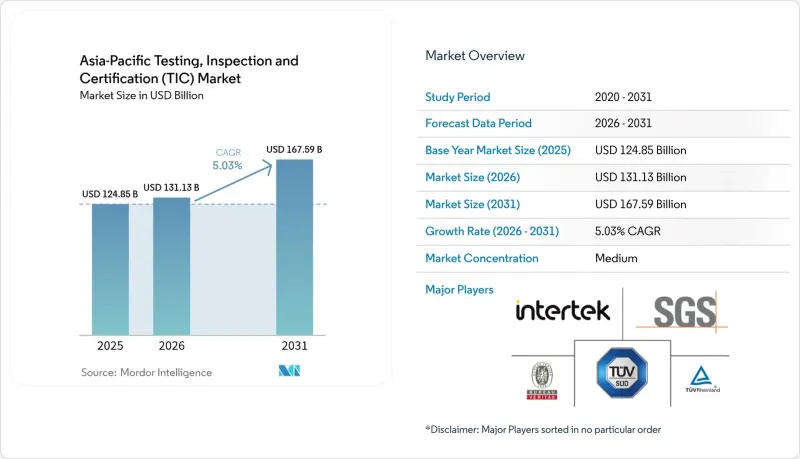
本報告按服務類型(測試、檢驗、認證)、採購方式(內部和外包)、行業(消費品和零售、資訊通訊技術和電信、汽車和交通運輸等)、服務交付方式(現場、異地/實驗室、遠端/數位化)以及國家/地區進行分類。市場預測以美元計價。
亞太地區檢測、檢驗與認證 (TIC) 市場趨勢與洞察
供應鏈的日益複雜化,特別是以貿易為中心的供應鏈,正在推動區域對貿易相關資訊中心(TIC)的需求。
亞洲是全球製造業的核心,支撐著一條涵蓋數百家一級和二級供應商的複雜跨區域供應鏈。光是東協數位經濟就計劃在2030年實現1兆美元的成長,因此,從化學品到家用電子電器等各類產品對合格評定的需求日益成長。測試、認證和認證(TIC)公司正積極響應企業發展。 QIMA已與韓國檢測研究院簽署合作備忘錄(MoU),旨在加強跨境品管。同時,SGS推出了「SMART」雲端平台,可實現對供應鏈的即時監控。即將簽署的《東協數位經濟框架協議》預計將進一步協調跨國數據法規,並提升成員國對統一測試和認證服務的需求。
ESG和永續性審計正在各個區域市場加速推進。
在亞太地區市值排名前110位的公司中,目前已有98家披露永續發展信息,較五年前不足一半的情況顯著改善,這反映出上市監管更加嚴格以及投資者審查力度加大。澳洲的AASB S2氣候變遷法規要求企業自2025年起提交經外部保證的排放報告,而新加坡則要求企業在2027會計年度之前對範圍1和範圍2的數據進行有限保證。 ISSA 5000於2024年下半年在全球範圍內推出,為永續發展保證制定了標準,並為服務提供者提供了一套一致的調查方法,以滿足客戶在多個框架下的營運需求。 2023年,亞太地區的永續債券發行量年增40%,進一步推動了對發行前和發行後檢驗以及生命週期碳評估的需求。
先進半導體測試能力的限制阻礙了其發展。
亞洲擁有全球超過80%的組裝、測試和封裝產能,但技術純熟勞工短缺和兼容極紫外光刻(EUV)技術的測試平台不足,阻礙了下一代生產線的擴張。光是印度就需要額外25萬名工程師來推進其新興的晶圓代工廠業務,而越南目前僅擁有所需半導體人才的五分之一。扇出型晶圓級封裝和3D堆疊檢測需要昂貴的高精度設備,小規模檢測實驗室難以資金籌措這筆費用,導致認證前置作業時間延長,晶片製造商的成本增加。
細分市場分析
到2025年,測試產業將佔據亞太地區TIC市場佔有率的57.90%。這是因為產品安全、品管和法規遵循是所有製造供應鏈的基礎。由於其在半導體產業的極高參與度,其規模正在進一步擴大。全球超過80%的組裝和測試工作都在該地區完成,這需要高頻良率監控和故障分析程序。受測試產業的推動,隨著晶圓廠向5奈米以下節點過渡,亞太地區TIC市場規模預計將穩定成長,這將導致複雜性增加,並需要新的故障識別協定。
認證產業預計將成為成長最快的產業,到2031年複合年成長率將達到5.62%,這主要得益於強制性ESG保證、自願性排碳權檢驗以及新型氫燃料品質標誌的推出。 Leon Inspection在實施人工智慧頻譜分析和基於區塊鏈的數據鏈以加快出口商CE標誌認證流程後,其2024年海外銷售額成長了21.3%。隨著各國政府從自我聲明轉向第三方保證,投資於數位憑證庫和自動化檢驗工具的供應商有望獲得更大的市場佔有率。
預計到2025年,外包服務供應商將佔亞太地區TIC市場規模的63.10%,複合年成長率達5.32%。透過將合規營運外包給專業機構,OEM廠商可以將資源集中於設計和分銷,同時利用深厚的專業知識、跨國認證和可擴展的實驗室網路。 SGS的SMART平台整合了數千家工廠的排程、文件和分析功能,為外包合作夥伴提供了一種提高透明度和確保新合約簽訂的機制。
在智慧財產權高度保密的領域,以及將連續製程測試融入生產線的領域,例如藥物原料藥分析和石油化學原料監測,內部實驗室仍然至關重要。然而,即使是這些公司,也擴大將一些專業測試外包,例如歐盟出口電池的再生材料含量認證,因為外部實驗室能夠快速且低成本地提供認證結果。
其他好處:
- Excel格式的市場預測(ME)表
- 3個月的分析師支持
目錄
第1章:引言
- 研究假設和市場定義
- 調查範圍
第2章:調查方法
第3章執行摘要
第4章 市場狀況
- 市場概覽
- 市場促進因素
- 亞太地區以貿易為中心的供應鏈的複雜性。
- 擴大永續性和ESG相關審計範圍
- 電動車和電池安全相關法規的協調統一正在加速推進。
- 數位醫療的快速普及需要即時合規性。
- 澳洲和日本的綠色氫能先導計畫正在擴大
- 人工智慧驅動的預測性維護能夠實現「無需測試」的檢查。
- 市場限制因素
- 先進半導體領域合格測試實驗室短缺
- 分散的國家認證體系
- 新興東協國家的人均資訊通訊技術支出較低。
- 遠端/數位化檢查中的網路安全問題
- 產業價值鏈分析
- 宏觀經濟因素的影響
- 監理情勢
- 技術展望
- 波特五力分析
第5章 市場規模與成長預測
- 按服務類型
- 測試
- 檢查
- 認證
- 透過採購方式
- 內部
- 外包
- 按行業分類
- 消費品和零售
- 資訊通訊技術/通訊
- 汽車和運輸業
- 航太/國防
- 石油、天然氣和石化產品
- 能源公用事業
- 工業製造和機械
- 化學與材料
- 建築和基礎設施
- 生命科學與醫療保健
- 食品/農業/飲料
- 其他工業領域(環境、永續發展等)
- 按服務交付方式
- 現場
- 異地/檢查室
- 遠端/數位
- 國家
- 中國
- 日本
- 印度
- 韓國
- ASEAN
- 其他亞太國家
第6章 競爭情勢
- 市場集中度
- 策略趨勢
- 市佔率分析
- 公司簡介
- SGS SA
- Bureau Veritas SA
- Intertek Group plc
- TUV SUD AG
- TUV Rheinland AG
- DEKRA SE
- UL Solutions Inc.
- TUV NORD Group
- DNV AS
- Eurofins Scientific SE
- Applus Services SA
- ALS Limited
- Lloyd's Register Group Ltd.
- BSI Group
- CSA Group
- Centre Testing International Group Co., Ltd.(CTI)
- China Certification and Inspection Group(CIC)
- Korea Testing and Research Institute(KTR)
- PT SUCOFINDO
- SIRIM QAS International Sdn Bhd
- Japan Quality Assurance Organization(JQA)
- QIMA Ltd.
- TUV Austria AG
- KIWA NV
- Petrochem Inspection and Testing Ltd.
第7章 市場機會與未來展望
According to Mordor Intelligence, the Asia-Pacific TIC market size was valued at USD 124.85 billion in 2025 and estimated to grow from USD 131.13 billion in 2026 to reach USD 167.59 billion by 2031, at a CAGR of 5.03% during the forecast period (2026-2031).
This report is Segmented by Service Type (Testing, Inspection, and Certification), Sourcing Type (In-House and Outsourced), Industry Vertical (Consumer Goods and Retail, ICT and Telecom, Automotive and Transportation, and More), Mode of Service Delivery (On-Site, Off-site/Laboratory, and Remote/Digital), and Country. The Market Forecasts are Provided in Terms of Value (USD).
Asia-Pacific Testing, Inspection And Certification (TIC) Market Trends and Insights
Trade-centric supply-chain complexity drives regional TIC demand
Asia sits at the heart of global manufacturing and now supports intricate, multi-jurisdictional supply chains that span hundreds of tier-1 and tier-2 suppliers. The ASEAN digital economy alone is targeting USD 1 trillion by 2030, a scale that intensifies conformity-assessment needs from chemicals to consumer electronics. TIC firms respond by expanding regional footprints. QIMA signed an MoU with Korea Testing and Research Institute to deepen cross-border quality control, while SGS launched its SMART cloud platform to provide real-time supply-chain oversight. The forthcoming ASEAN Digital Economy Framework Agreement is expected to harmonize cross-border data rules and further lift demand for unified testing and certification services across member states.
ESG and sustainability audits accelerate across regional markets
Ninety-eight of the region's 110 largest listed companies now publish sustainability disclosures, compared with fewer than half a decade earlier, reflecting tightened listing-rule requirements and rising investor scrutiny. Australia's AASB S2 climate rules mandate externally assured emissions statements from 2025, and Singapore will require limited assurance of Scope 1 and 2 data by fiscal year 2027. The global release of ISSA 5000 in late 2024 established a baseline for sustainability assurance, giving providers a consistent methodology to serve clients operating across multiple frameworks. Regional sustainable-bond issuance jumped 40% year-on-year in 2023, generating additional demand for pre- and post-issuance verifications and life-cycle carbon evaluations.
Advanced semiconductor testing capacity constraints limit growth
Asia hosts more than 80% of global assembly, test, and packaging capacity, yet shortages of skilled labor and EUV-ready test benches slow the expansion of next-generation fabrication lines. India alone needs an additional 250,000 engineers for its nascent foundry push, while Vietnam currently fulfils only one-fifth of the required semiconductor talent. Fan-out wafer-level packaging and 3D stack inspections demand expensive, high-precision gear that smaller labs struggle to finance, elongating certification lead times and raising costs for chipmakers.
Other drivers and restraints analyzed in the detailed report include:
- EV battery safety regulations drive harmonization and testing demand
- Digital-health compliance creates real-time testing opportunities
- Cyber-security vulnerabilities challenge digital inspection adoption
For complete list of drivers and restraints, kindly check the Table Of Contents.
Segment Analysis
Testing held 57.90% of the Asia-Pacific TIC market share in 2025, as product safety, quality control, and regulatory compliance underpin every manufacturing supply chain. Heavy semiconductor exposure amplifies volumes because over 80% of global assembly and test work is carried out within the region, requiring high-frequency yield monitoring and failure-analysis routines. Asia-Pacific TIC market size attributed to testing is projected to grow steadily as fabs migrate to sub-5 nm nodes that raise complexity and require new fault-isolation protocols.
Certification is the fastest-advancing slice at a 5.62% CAGR through 2031, propelled by mandatory ESG assurance, voluntary carbon-credit verification, and new hydrogen-fuel quality marks. Leon Inspection's overseas revenue climbed 21.3% in 2024 after it deployed AI-enabled spectral analysis and blockchain-backed data chains to speed CE-mark issuance for exporters. Providers investing in digital certificate vaults and auto-validation tools are positioned to capture share as governments pivot from self-declaration to third-party assurance.
Outsourced providers controlled 63.10% of the Asia-Pacific TIC market size in 2025 and are forecast to expand at a 5.32% CAGR. Moving compliance tasks to specialists allows OEMs to focus resources on design and distribution while accessing deep domain expertise, multi-country accreditation, and scalable lab networks. SGS's SMART platform integrates scheduling, document management, and analytics across thousands of factories, illustrating how outsourced partners enhance transparency to win new contracts.
In-house labs remain relevant in sectors where intellectual property is sensitive or continuous-process testing is embedded in the production line, such as pharmaceutical API analysis or petrochemical feedstock monitoring. Yet even these operators increasingly outsource niche tests such as recycled-content proof for EU battery exports when external labs can supply accredited results faster and at lower cost.
Complete Report Scope:
- By Service Type
- Testing
- Inspection
- Certification
- By Sourcing Type
- In-house
- Outsourced
- By Industry Vertical
- Consumer Goods and Retail
- ICT and Telecom
- Automotive and Transportation
- Aerospace and Defense
- Oil, Gas and Petrochemicals
- Energy and Utilities
- Industrial Manufacturing and Machinery
- Chemicals and Materials
- Construction and Infrastructure
- Life Sciences and Healthcare
- Food, Agriculture and Beverage
- Other Industry Verticals (Environment, Sustainability, etc.)
- By Mode of Service Delivery
- On-site
- Off-site / Laboratory
- Remote / Digital
- By Country
- China
- Japan
- India
- South Korea
- ASEAN
- Rest of Asia-Pacific
List of Companies Covered in this Report:
- SGS SA
- Bureau Veritas SA
- Intertek Group plc
- TUV SUD AG
- TUV Rheinland AG
- DEKRA SE
- UL Solutions Inc.
- TUV NORD Group
- DNV AS
- Eurofins Scientific SE
- Applus Services SA
- ALS Limited
- Lloyd's Register Group Ltd.
- BSI Group
- CSA Group
- Centre Testing International Group Co., Ltd. (CTI)
- China Certification and Inspection Group (CIC)
- Korea Testing and Research Institute (KTR)
- PT SUCOFINDO
- SIRIM QAS International Sdn Bhd
- Japan Quality Assurance Organization (JQA)
- QIMA Ltd.
- TUV Austria AG
- KIWA N.V.
- Petrochem Inspection and Testing Ltd.
Additional Benefits:
- The market estimate (ME) sheet in Excel format
- 3 months of analyst support
TABLE OF CONTENTS
1 INTRODUCTION
- 1.1 Study Assumptions and Market Definition
- 1.2 Scope of the Study
2 RESEARCH METHODOLOGY
3 EXECUTIVE SUMMARY
4 MARKET LANDSCAPE
- 4.1 Market Overview
- 4.2 Market Drivers
- 4.2.1 Trade-centric supply-chain complexity in Asia-Pacific
- 4.2.2 Ramp-up of sustainability and ESG-linked audits
- 4.2.3 Accelerated regulatory harmonisation for EV and battery safety
- 4.2.4 Rapid digital-health adoption demanding real-time compliance
- 4.2.5 Green hydrogen pilot projects scaling in Australia and Japan
- 4.2.6 AI-driven predictive maintenance enabling "test-less" inspection
- 4.3 Market Restraints
- 4.3.1 Shortage of accredited labs for advanced semiconductors
- 4.3.2 Fragmented national accreditation regimes
- 4.3.3 Low TIC spend-per-capita in emerging ASEAN
- 4.3.4 Cyber-security concerns on remote / digital inspections
- 4.4 Industry Value Chain Analysis
- 4.5 Impact of Macroeconomic Factors
- 4.6 Regulatory Landscape
- 4.7 Technological Outlook
- 4.8 Porter's Five Forces Analysis
- 4.8.1 Threat of New Entrants
- 4.8.2 Bargaining Power of Suppliers
- 4.8.3 Bargaining Power of Buyers
- 4.8.4 Threat of Substitutes
- 4.8.5 Competitive Rivalry
5 MARKET SIZE AND GROWTH FORECASTS (VALUES)
- 5.1 By Service Type
- 5.1.1 Testing
- 5.1.2 Inspection
- 5.1.3 Certification
- 5.2 By Sourcing Type
- 5.2.1 In-house
- 5.2.2 Outsourced
- 5.3 By Industry Vertical
- 5.3.1 Consumer Goods and Retail
- 5.3.2 ICT and Telecom
- 5.3.3 Automotive and Transportation
- 5.3.4 Aerospace and Defense
- 5.3.5 Oil, Gas and Petrochemicals
- 5.3.6 Energy and Utilities
- 5.3.7 Industrial Manufacturing and Machinery
- 5.3.8 Chemicals and Materials
- 5.3.9 Construction and Infrastructure
- 5.3.10 Life Sciences and Healthcare
- 5.3.11 Food, Agriculture and Beverage
- 5.3.12 Other Industry Verticals (Environment, Sustainability, etc.)
- 5.4 By Mode of Service Delivery
- 5.4.1 On-site
- 5.4.2 Off-site / Laboratory
- 5.4.3 Remote / Digital
- 5.5 By Country
- 5.5.1 China
- 5.5.2 Japan
- 5.5.3 India
- 5.5.4 South Korea
- 5.5.5 ASEAN
- 5.5.6 Rest of Asia-Pacific
6 COMPETITIVE LANDSCAPE
- 6.1 Market Concentration
- 6.2 Strategic Moves
- 6.3 Market Share Analysis
- 6.4 Company Profiles (includes Global level Overview, Market level overview, Core Segments, Financials as available, Strategic Information, Market Rank/Share for key companies, Products and Services, and Recent Developments)
- 6.4.1 SGS SA
- 6.4.2 Bureau Veritas SA
- 6.4.3 Intertek Group plc
- 6.4.4 TUV SUD AG
- 6.4.5 TUV Rheinland AG
- 6.4.6 DEKRA SE
- 6.4.7 UL Solutions Inc.
- 6.4.8 TUV NORD Group
- 6.4.9 DNV AS
- 6.4.10 Eurofins Scientific SE
- 6.4.11 Applus Services SA
- 6.4.12 ALS Limited
- 6.4.13 Lloyd's Register Group Ltd.
- 6.4.14 BSI Group
- 6.4.15 CSA Group
- 6.4.16 Centre Testing International Group Co., Ltd. (CTI)
- 6.4.17 China Certification and Inspection Group (CIC)
- 6.4.18 Korea Testing and Research Institute (KTR)
- 6.4.19 PT SUCOFINDO
- 6.4.20 SIRIM QAS International Sdn Bhd
- 6.4.21 Japan Quality Assurance Organization (JQA)
- 6.4.22 QIMA Ltd.
- 6.4.23 TUV Austria AG
- 6.4.24 KIWA N.V.
- 6.4.25 Petrochem Inspection and Testing Ltd.
7 MARKET OPPORTUNITIES AND FUTURE OUTLOOK
- 7.1 White-space and Unmet-Need Assessment

 消費品和零售業的測試、檢驗和認證 (TIC):市場佔有率分析、行業趨勢和統計數據以及成長預測 (2026-2031)美洲的測試、檢定和認證 (TIC):市場佔有率分析、行業趨勢和統計數據以及成長預測 (2026-2031)北美測試、檢定和認證 (TIC):市場佔有率分析、行業趨勢和統計數據以及成長預測 (2026–2031)歐洲測試、檢定和認證 (TIC):市場佔有率分析、行業趨勢和統計數據以及成長預測 (2026-2031)測試、檢驗和認證:市場佔有率分析、行業趨勢和統計數據、成長預測(2026-2031 年)自然資源產業的測試、檢驗和認證:市場佔有率分析、行業趨勢和統計數據以及成長預測(2026-2031 年)
 2026-2030年全球測驗、檢驗和認證市場
 測試、檢驗和認證市場:2026-2032年全球市場預測(按服務類型、採購方式、技術、合規要求、應用、組織規模和最終用戶行業分類)證書測試市場:2026-2032年全球市場預測(依測試服務、階段、產業、部署類型、最終用戶和組織規模分類)日本的測試、檢定和認證 (TIC):市場佔有率分析、行業趨勢和統計數據以及成長預測 (2026-2031)