


 |
市場調查報告書
商品編碼
2117215
消費品和零售業的測試、檢驗和認證 (TIC):市場佔有率分析、行業趨勢和統計數據以及成長預測 (2026-2031)Consumer Goods And Retail Testing, Inspection, And Certification - Market Share Analysis, Industry Trends & Statistics, Growth Forecasts (2026 - 2031) |
||||||

※ 本網頁內容可能與最新版本有所差異。詳細情況請與我們聯繫。
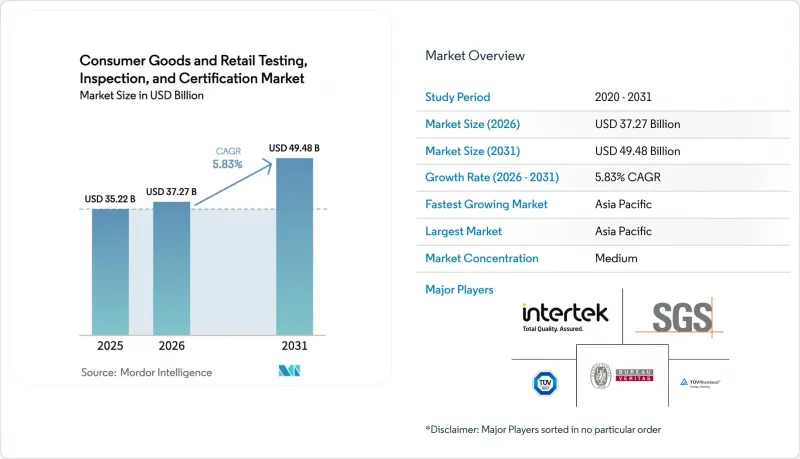
根據 Mordor Intelligence 預測,消費品和零售業的測試、檢驗和認證 (TIC) 市場規模預計將從 2025 年的 352.2 億美元成長到 2026 年的 372.7 億美元,到 2031 年將達到 494.8 億美元,2026 年的複合年成長率為 2031 年。
本報告按服務類型(測試服務、檢驗服務、認證服務)、採購方式(內部採購和外包)以及地區(北美、南美、歐洲、亞太、中東和非洲)進行細分。市場預測以美元計價。
消費品和零售業測試、檢驗和認證 (TIC) 市場的全球趨勢和見解。
嚴格的永續性和可追溯性要求
歐盟的實質審查指令和企業永續性永續性指令,以及美國的《維吾爾族強迫勞動法》,都要求企業記錄其整個供應鏈的環境和社會健康狀況,這使得第三方檢驗至關重要。由於供應鏈排放佔消費品排放量的近80%,因此上游工程審計和生命週期評估正從可選服務轉變為強制性服務。提供原料可追溯性、強迫勞動篩檢和生物多樣性影響認證的測試、檢驗和認證(TIC)提供者,如今正獲得類似年金的長期合約。這些監管要求也推動了對數位化監管鏈平台的需求,這些平台能夠將審計數據直接整合到ESG報告中,從而增加了更換認證檢測實驗室的成本。隨著監管機構擴大監管範圍,將循環經濟指標納入其中,認證收入也正從傳統的安全測試轉向多元化。
D2C自有品牌的崛起
目前,數以千計的D2C(直接面對消費者)企業依賴亞馬遜「合規管理」等電商平台控制面板。自2024年4月起,亞馬遜已強制要求膳食補充劑在上架前必須獲得第三方認證。規模較小、上市時間緊迫的團隊更傾向於選擇承包服務包,這些服務包將規格檢查、標籤審核和海關手續整合到單一工作流程中。 Factored Quality等平台可將典型的上線時間縮短三個月,並將每個SKU的合規成本降低1萬美元,從而使提供API驅動文件傳輸的TIC公司受益。因此,隨著微型品牌的激增,消費品和零售業的測試、檢驗和認證(TIC)市場正在轉型為由快速回應的測試實驗室驅動的高容量業務。
專業領域合格的TIC人員短缺
食品安全審核員、永續性負責人和網路安全檢驗需要接受數年HACCP、FSMA、新型食品、ISO 27001和安全程式碼審查的培訓。調查顯示,北美食品檢測實驗室的職缺率超過20%,迫使服務提供者延後專案並延長截止日期。 ESG和AI檢驗標準的快速發展加劇了人才短缺,因為這些標準的更新速度超過了人才培養的速度。雖然企業正透過收購專業公司和與大學合作來應對這一問題,但這些措施需要較長的能力建設前置作業時間,這限制了檢測、檢驗和認證市場的短期獲利能力。
細分市場分析
預計到2025年,測試服務將佔測試、檢驗和認證市場收入的54.07%,凸顯了在產品交付零售商之前檢驗其電氣安全性、化學成分和機械耐久性仍然是重中之重。諸如IEC 62368-1和ISO 10993等強制性協議要求電子和醫療設備製造商在多個生產階段提交樣品。跨國實驗室正利用其固定資產的高運轉率,而本地專家則透過專注於需要快速回應的消費品批次而取得成功。然而,認證服務的複合年成長率最高,達到6.28%,這主要得益於投資者和監管機構要求對有關氣候變遷、道德採購和循環設計等方面的聲明進行獨立檢驗。向認證服務的轉變也帶來了利潤率的提高。儘管文件審查和工廠審核所需的資本相對較少,但其收費卻很高,這提高了那些將員工重新培訓為審核員的服務提供者的息稅前利潤率。
歐洲各地加強反「綠色清洗」法規以及加州《可回收材料標籤真實性法案》正在推動對「從搖籃到大門」碳足跡認證的需求。同時,金融機構正將第三方ESG評估納入貸款協議。這些變化使得認證不再只是合規的輔助手段,而是品牌獲取資金的「安全隔離網閘」。因此,到2030年,與傳統安全標準相關的消費品和零售測試、檢驗和認證(TIC)市場規模可能會翻倍。能夠將實驗室測試數據與審核員專業知識相結合的供應商可以獲得一站式優勢,並進一步區別於僅提供實體測試報告的公司。
區域分析
預計到2025年,亞太地區將佔全球銷售額的41.72%,並在2031年之前以6.41%的複合年成長率成長,這主要得益於其強大的製造業基礎和國內消費者對產品品質日益成長的期望。 2024年,中國國家衛生健康委員會收緊了對新食品安全文件的要求,強制要求進口商和本土創新者在產品上市前提交毒性、緻敏性和營養等效性數據。這導致檢測實驗室的運作受到影響。在印度,電子產品和紡織品出口商現在除了需要獲得BIS標誌外,還需要同時獲得FCC和CE認證,這增加了對跨司法管轄區認證服務的需求。在東南亞,隨著品牌不再從單一國家採購並實現供應鏈多元化,需要在越南、印尼和泰國等國進行審核,以確保標準的一致性。
儘管歐洲和北美地區的絕對成長率相對較低,但有關永續性和網路韌性的立法正在推動專業服務的蓬勃發展。歐盟的《永續發展報告指令》將要求約5萬家公司從2025會計年度開始提交經第三方檢驗的ESG報告。同時,即將實施的《網路韌性法案》為連網產品設定了最低安全標準,增加了韌體、滲透測試和漏洞評估測試的數量。在北美,《通膨控制法案》下聯邦政府對可再生能源專案的激勵措施正在推動風力發電機和光學模組認證的激增,而美國國家標準與技術研究院(NIST)更新的網路安全框架也提升了對物聯網安全保障審計的需求。
中東和非洲正在湧現新的機遇,沙烏地阿拉伯的「2030願景」產業叢集計畫強制要求進行裝運前檢驗和工廠審核。然而,非洲各地標準不一,迫使測試與認證公司進行重複測試,增加了交易成本。儘管區域經濟共同體正在考慮協調標準,但實際落實仍遙遙無期。拉丁美洲的情況較為複雜。在墨西哥的汽車產業,電磁相容性測試和零件疲勞測試進展順利,但小規模經濟體監管政策的不一致阻礙了對測試實驗室的大規模投資。
其他好處:
- Excel格式的市場預測(ME)表
- 3個月的分析師支持
目錄
第1章:引言
- 研究假設和市場定義
- 調查範圍
第2章:調查方法
第3章執行摘要
第4章 市場狀況
- 市場概覽
- 市場促進因素
- 嚴格的永續性和可追溯性要求
- D2C(直接面對消費者)自有品牌的崛起
- 人工智慧驅動的自動化視覺測試的整合
- 跨境電子商務商品分銷的擴張
- 擴大有關新食品的食品安全法規
- 對經ESG認證的消費品的需求以及資金籌措管道
- 市場限制因素
- 新興市場管理體制碎片化
- 特定專業領域合格的TIC人員短缺
- 即時測試設備高成本
- 網路連線測試設備的網路安全風險
- 產業價值鏈分析
- 宏觀經濟因素的影響
- 監理情勢
- 技術展望
- 波特五力分析
第5章 市場規模與成長預測
- 按服務類型
- 測試服務
- 檢查服務
- 身份驗證服務
- 透過採購方式
- 內部
- 外包
- 按地區
- 北美洲
- 美國
- 加拿大
- 墨西哥
- 南美洲
- 巴西
- 阿根廷
- 其他南美國家
- 歐洲
- 德國
- 英國
- 法國
- 義大利
- 西班牙
- 俄羅斯
- 其他歐洲國家
- 亞太地區
- 中國
- 日本
- 印度
- 韓國
- 東南亞
- 其他亞太國家
- 中東和非洲
- 中東
- 沙烏地阿拉伯
- 阿拉伯聯合大公國
- 土耳其
- 其他中東國家
- 非洲
- 南非
- 奈及利亞
- 其他非洲國家
- 中東
- 北美洲
第6章 競爭情勢
- 市場集中度
- 策略趨勢
- 市佔率分析
- 公司簡介
- SGS SA
- Bureau Veritas SA
- Intertek Group plc
- TUV SUD AG
- TUV Rheinland AG
- UL Solutions Inc.
- Eurofins Scientific SE
- ALS Limited
- DEKRA SE
- DNV AS
- TUV NORD GROUP
- Applus+Services SA
- Kiwa NV
- QIMA Ltd.
- Cotecna Inspection SA
- Hong Kong Standards and Testing Centre
- NSF International
- China Certification and Inspection Group
- Mistras Group Inc.
- Core Laboratories NV
- SGS Taiwan Ltd.
- Baltazar Testing Labs SA
- RINA SpA
- Intertek Testing Services NA Inc.
- UL India Private Ltd.
第7章 市場機會與未來展望
According to Mordor Intelligence, the consumer goods and retail testing, inspection, and certification market size is expected to grow from USD 35.22 billion in 2025 to USD 37.27 billion in 2026 and is forecast to reach USD 49.48 billion by 2031 at 5.83% CAGR over 2026-2031.
This report is Segmented by Service Type (Testing Services, Inspection Services, and Certification Services), Sourcing Type (In-House and Outsourced), and Geography (North America, South America, Europe, Asia-Pacific, and the Middle East and Africa). The Market Forecasts are Provided in Terms of Value (USD).
Global Consumer Goods And Retail Testing, Inspection, And Certification Market Trends and Insights
Stringent Sustainability and Traceability Mandates
Third-party verification has become pivotal as the EU Corporate Sustainability Due Diligence Directive, the Corporate Sustainability Reporting Directive, and the U.S. Uyghur Forced Labor Prevention Act push companies to document environmental and social integrity throughout supply chains. Supply chains account for nearly 80% of consumer-goods emissions, so upstream audits and lifecycle assessments have shifted from optional to obligatory service lines. TIC providers offering material tracing, forced-labor screening, and biodiversity impact attestations now command long-term annuity-like contracts. These mandates also drive demand for digital chain-of-custody platforms that embed audit data directly into ESG reports, strengthening switching costs for accredited labs. As regulators widen the scope to circular-economy metrics, certification revenues diversify beyond classic safety testing.
Rise of Direct-to-Consumer Private-Label Brands
Thousands of D2C merchants now lean on marketplace dashboards such as Amazon's Manage Your Compliance, which, since April 2024, requires third-party certification for dietary supplements before listings go live. Lean teams with tight launch calendars favor turnkey bundles that combine specification checks, label reviews, and customs clearance in a single workflow. Platforms like Factored Quality cut typical onboarding by three months and slash compliance costs by USD 10,000 per stock-keeping unit, rewarding TIC firms that provide API-driven documentation feeds. The surge of micro-brands, therefore, transforms the consumer goods and retail testing, inspection, and certification market into a volume business with rapid-response labs.
Shortage of Qualified TIC Talent in Specialized Verticals
Food-safety auditors, sustainability verifiers, and cybersecurity testers require multi-year training in HACCP, FSMA, novel foods, ISO 27001, and secure-code review. Surveys show vacancy rates topping 20% in North American food labs, forcing providers to defer projects and lengthen turnaround times.The talent gap widens as ESG and AI validation standards multiply faster than training pipelines. Firms react by acquiring boutique specialists and partnering with universities, yet these measures deliver capacity only after long lead times, capping near-term revenue capture in the testing, inspection, and certification market.
Other drivers and restraints analyzed in the detailed report include:
- Growth in Cross-Border E-Commerce Product Flows
- Integration of AI-Enabled Automated Visual Inspection
- Fragmented Regulatory Regimes Across Emerging Markets
For complete list of drivers and restraints, kindly check the Table Of Contents.
Segment Analysis
Testing services represented 54.07% of 2025 revenue in the testing, inspection, and certification market, underscoring the enduring priority of verifying electrical safety, chemical composition, and mechanical resilience before goods ship to retailers. Mandatory protocols such as IEC 62368-1 and ISO 10993 compel manufacturers of electronics and medical devices to submit samples, often at multiple production stages. Multinational laboratories capitalize on high fixed-asset utilization, while regional specialists thrive by focusing on fast-turnaround consumer-goods batches. Certification services, however, deliver the fastest 6.28% CAGR, fueled by investors and regulators who now require independent validation of climate claims, ethical sourcing, and circular-design credentials. The pivot toward certification also raises margin profiles: documentation review and factory audits command premium pricing despite lighter capital requirements, widening EBIT spreads for providers that re-train staff into auditors.
Growing anti-greenwashing rules across Europe and California's Truth in Labeling for Recyclable Materials Act propel demand for cradle-to-gate carbon-footprint stamps, while financial institutions embed third-party ESG ratings into lending covenants. These shifts elevate certification from a compliance afterthought to a gatekeeper for brand access to capital. The consumer goods and retail testing, inspection, and certification market size linked to sustainability credentials could therefore double relative to legacy safety scopes by 2030. Players that combine laboratory test data with auditor insights gain a one-stop advantage, further differentiating themselves from firms confined to physical test reports.
Complete Report Scope:
- By Service Type
- Testing Services
- Inspection Services
- Certification Services
- By Sourcing Type
- In-house
- Outsourced
- By Geography
- North America
- United States
- Canada
- Mexico
- South America
- Brazil
- Argentina
- Rest of South America
- Europe
- Germany
- United Kingdom
- France
- Italy
- Spain
- Russia
- Rest of Europe
- Asia-Pacific
- China
- Japan
- India
- South Korea
- South-East Asia
- Rest of Asia-Pacific
- Middle East and Africa
- Middle East
- Saudi Arabia
- United Arab Emirates
- Turkey
- Rest of Middle East
- Africa
- South Africa
- Nigeria
- Rest of Africa
- Middle East
- North America
Geography Analysis
Asia-Pacific anchored 41.72% of global revenue in 2025 and will expand at a 6.41% CAGR through 2031 thanks to manufacturing depth and rising domestic quality expectations. China's National Health Commission tightened novel-foods safety dossiers in 2024, obliging importers and local innovators to submit toxicology, allergenicity, and nutritional-equivalence data before market entry, driving laboratory backlogs. India's electronics and textile exporters must now navigate BIS marks plus parallel FCC and CE approvals, boosting demand for multi-jurisdiction bundling. Southeast Asia benefits from supply-chain diversification as brands pivot from single-country sourcing, requiring audits across Vietnam, Indonesia, and Thailand to ensure standard consistency.
Europe and North America exhibit lower absolute growth, yet sustainability and cyber-resilience statutes invigorate specialized services. The EU Corporate Sustainability Reporting Directive obliges roughly 50,000 companies to file third-party-verified ESG statements starting FY 2025. Simultaneously, the forthcoming Cyber Resilience Act sets baseline security thresholds for connected products, creating incremental testing volume for firmware, penetration, and vulnerability assessments. In North America, federal incentives for renewable-energy projects under the Inflation Reduction Act create a pipeline of wind-turbine and solar-module certifications, while the National Institute of Standards and Technology refreshes its cybersecurity framework, raising demand for IoT assurance audits.
The Middle East and Africa present nascent opportunities, with Saudi Arabia's Vision 2030 industrial clusters mandating pre-shipment inspections and factory audits. Nonetheless, fragmented local standards in Africa raise transaction costs as TIC firms must duplicate tests. Regional economic communities consider harmonization, yet implementation timelines remain long-term. Latin America's story is mixed: Mexico's automotive hub sustains steady EMC and component-fatigue testing, whereas inconsistent rule changes in smaller economies deter broad laboratory investments.
- SGS SA
- Bureau Veritas SA
- Intertek Group plc
- TUV SUD AG
- TUV Rheinland AG
- UL Solutions Inc.
- Eurofins Scientific SE
- ALS Limited
- DEKRA SE
- DNV AS
- TUV NORD GROUP
- Applus+ Services S.A.
- Kiwa N.V.
- QIMA Ltd.
- Cotecna Inspection SA
- Hong Kong Standards and Testing Centre
- NSF International
- China Certification and Inspection Group
- Mistras Group Inc.
- Core Laboratories N.V.
- SGS Taiwan Ltd.
- Baltazar Testing Labs SA
- RINA S.p.A.
- Intertek Testing Services NA Inc.
- UL India Private Ltd.
Additional Benefits:
- The market estimate (ME) sheet in Excel format
- 3 months of analyst support
TABLE OF CONTENTS
1 INTRODUCTION
- 1.1 Study Assumptions and Market Definition
- 1.2 Scope of the Study
2 RESEARCH METHODOLOGY
3 EXECUTIVE SUMMARY
4 MARKET LANDSCAPE
- 4.1 Market Overview
- 4.2 Market Drivers
- 4.2.1 Stringent sustainability and traceability mandates
- 4.2.2 Rise of direct-to-consumer (D2C) private-label brands
- 4.2.3 Integration of AI-enabled automated visual inspection
- 4.2.4 Growth in cross-border e-commerce product flows
- 4.2.5 Expansion of food safety regulations on novel foods
- 4.2.6 Demand for ESG-verified consumer goods funding access
- 4.3 Market Restraints
- 4.3.1 Fragmented regulatory regimes across emerging markets
- 4.3.2 Shortage of qualified TIC talent in specialised verticals
- 4.3.3 High cost of real-time testing instrumentation
- 4.3.4 Cyber-security risks in connected inspection devices
- 4.4 Industry Value Chain Analysis
- 4.5 Impact of Macroeconomic Factors
- 4.6 Regulatory Landscape
- 4.7 Technological Outlook
- 4.8 Porter's Five Forces Analysis
- 4.8.1 Threat of New Entrants
- 4.8.2 Bargaining Power of Suppliers
- 4.8.3 Bargaining Power of Buyers
- 4.8.4 Threat of Substitutes
- 4.8.5 Competitive Rivalry
5 MARKET SIZE AND GROWTH FORECASTS (VALUE)
- 5.1 By Service Type
- 5.1.1 Testing Services
- 5.1.2 Inspection Services
- 5.1.3 Certification Services
- 5.2 By Sourcing Type
- 5.2.1 In-house
- 5.2.2 Outsourced
- 5.3 By Geography
- 5.3.1 North America
- 5.3.1.1 United States
- 5.3.1.2 Canada
- 5.3.1.3 Mexico
- 5.3.2 South America
- 5.3.2.1 Brazil
- 5.3.2.2 Argentina
- 5.3.2.3 Rest of South America
- 5.3.3 Europe
- 5.3.3.1 Germany
- 5.3.3.2 United Kingdom
- 5.3.3.3 France
- 5.3.3.4 Italy
- 5.3.3.5 Spain
- 5.3.3.6 Russia
- 5.3.3.7 Rest of Europe
- 5.3.4 Asia-Pacific
- 5.3.4.1 China
- 5.3.4.2 Japan
- 5.3.4.3 India
- 5.3.4.4 South Korea
- 5.3.4.5 South-East Asia
- 5.3.4.6 Rest of Asia-Pacific
- 5.3.5 Middle East and Africa
- 5.3.5.1 Middle East
- 5.3.5.1.1 Saudi Arabia
- 5.3.5.1.2 United Arab Emirates
- 5.3.5.1.3 Turkey
- 5.3.5.1.4 Rest of Middle East
- 5.3.5.2 Africa
- 5.3.5.2.1 South Africa
- 5.3.5.2.2 Nigeria
- 5.3.5.2.3 Rest of Africa
- 5.3.5.1 Middle East
- 5.3.1 North America
6 COMPETITIVE LANDSCAPE
- 6.1 Market Concentration
- 6.2 Strategic Moves
- 6.3 Market Share Analysis
- 6.4 Company Profiles {(includes Global level Overview, Market level overview, Core Segments, Financials as available, Strategic Information, Market Rank/Share for key companies, Products and Services, and Recent Developments)}
- 6.4.1 SGS SA
- 6.4.2 Bureau Veritas SA
- 6.4.3 Intertek Group plc
- 6.4.4 TUV SUD AG
- 6.4.5 TUV Rheinland AG
- 6.4.6 UL Solutions Inc.
- 6.4.7 Eurofins Scientific SE
- 6.4.8 ALS Limited
- 6.4.9 DEKRA SE
- 6.4.10 DNV AS
- 6.4.11 TUV NORD GROUP
- 6.4.12 Applus+ Services S.A.
- 6.4.13 Kiwa N.V.
- 6.4.14 QIMA Ltd.
- 6.4.15 Cotecna Inspection SA
- 6.4.16 Hong Kong Standards and Testing Centre
- 6.4.17 NSF International
- 6.4.18 China Certification and Inspection Group
- 6.4.19 Mistras Group Inc.
- 6.4.20 Core Laboratories N.V.
- 6.4.21 SGS Taiwan Ltd.
- 6.4.22 Baltazar Testing Labs SA
- 6.4.23 RINA S.p.A.
- 6.4.24 Intertek Testing Services NA Inc.
- 6.4.25 UL India Private Ltd.
7 MARKET OPPORTUNITIES AND FUTURE OUTLOOK
- 7.1 White-space and Unmet-Need Assessment

 美洲的測試、檢定和認證 (TIC):市場佔有率分析、行業趨勢和統計數據以及成長預測 (2026-2031)亞太地區測試、檢驗和認證 (TIC):市場佔有率分析、行業趨勢與統計數據及成長預測 (2026-2031)北美測試、檢定和認證 (TIC):市場佔有率分析、行業趨勢和統計數據以及成長預測 (2026–2031)歐洲測試、檢定和認證 (TIC):市場佔有率分析、行業趨勢和統計數據以及成長預測 (2026-2031)測試、檢驗和認證:市場佔有率分析、行業趨勢和統計數據、成長預測(2026-2031 年)自然資源產業的測試、檢驗和認證:市場佔有率分析、行業趨勢和統計數據以及成長預測(2026-2031 年)
 2026-2030年全球測驗、檢驗和認證市場
 測試、檢驗和認證市場:2026-2032年全球市場預測(按服務類型、採購方式、技術、合規要求、應用、組織規模和最終用戶行業分類)證書測試市場:2026-2032年全球市場預測(依測試服務、階段、產業、部署類型、最終用戶和組織規模分類)日本的測試、檢定和認證 (TIC):市場佔有率分析、行業趨勢和統計數據以及成長預測 (2026-2031)