


 |
市場調查報告書
商品編碼
2097244
自然資源產業的測試、檢驗和認證:市場佔有率分析、行業趨勢和統計數據以及成長預測(2026-2031 年)Testing, Inspection, and Certification for the Natural Resources Industry - Market Share Analysis, Industry Trends & Statistics, Growth Forecasts (2026 - 2031) |
||||||

※ 本網頁內容可能與最新版本有所差異。詳細情況請與我們聯繫。
根據 Mordor Intelligence 預測,自然資源產業的測試、檢驗和認證市場規模預計將從 2025 年的 13.7 億美元成長到 2026 年的 14.1 億美元,到 2031 年將達到 16.3 億美元,2026 年至 2031 年的複合成長率為 2.94%。
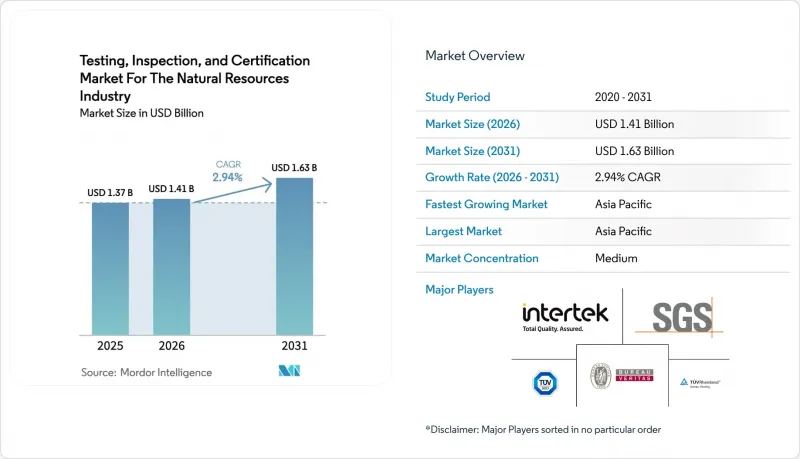
本報告按服務類型(測試服務、檢驗服務、認證服務)、採購方式(內部和外包)以及地區(北美、南美、歐洲、亞太、中東和非洲)進行細分。市場預測以美元計價。
自然資源產業測試、檢驗和認證的全球趨勢和見解。
嚴格的環境法規要求由第三方進行合規性測試。
全球監管正從營運商的自我報告轉向涵蓋排放、地下水品質、廢棄物管理和土壤影響的強制性獨立檢驗。美國環保署 (EPA) 2024 年發布的《全氟烷基和多氟烷基物質 (PFAS) 國家飲用水主要法規》增加了對油氣井周圍區域的廣泛採樣要求,為獲得認證的實驗室創造了新的收入來源。同時,歐盟《工業排放指令》的修訂強制要求由第三方校準的持續排放監測。加州和德克薩斯州等美國州強制要求使用光學氣體成像技術進行季度甲烷外洩測試,而實施碳定價機制的國家則要求提供檢驗的溫室氣體測量數據。因此,自然資源產業的測試、檢驗和認證 (TIC) 產業正受益於大量的測試和現場審核,因為監管碎片化催生了有利於經驗豐富的服務提供者的區域性細分市場。
全球對能源和礦產資源的需求不斷成長,推動了探勘活動的發展。
全部區域能源消耗持續維持4%的年成長率,推動了液化天然氣、管道和採礦項目的蓬勃發展,而這些項目都需要進行全面的地質、環境和資產健康評估。可再生能源設施本身依賴鋰、鈷和鎳的開採,這也增加了對環境影響評估和專業分析測試的需求。中國「一帶一路」計劃的資金正注入中亞的石油和採礦項目,這些項目需要證明其符合多邊貸款標準,從而引入了國際檢驗要求。日本、澳洲和印度的新興氫能經濟對電解槽、儲存槽和輸送管提出了全新的認證需求。隨著探勘預算的增加,自然資源產業的測試、檢驗和認證(TIC)服務也不斷擴展,提供先進的實驗室分析、結構檢驗和認證審核服務,以滿足日益複雜的專案設計規範。
產品價格波動導致TIC預算週期性削減。
當原油和基底金屬基準價格波動導致現金流緊張時,業者被迫大幅削減非核心支出,而可自由支配的檢驗項目往往成為削減目標。世界銀行數據顯示,自2020年以來,價格波動性增加了40%,景氣衰退期間支出平均削減15%至25%。聯準會的一項研究指出,檢測、檢驗和認證(TIC)成本通常被視為間接成本,因此在預算縮減時更容易受到削減的影響。結果,服務供應商的收入下降幅度高達40%,阻礙了諸如建設新實驗室和培訓檢驗員等長期投資。因此,自然資源產業的檢測、檢驗和認證(TIC)企業需要實現產品和地理多元化,以穩定其收入週期,但小規模的區域性企業可能缺乏足夠的資本韌性來應對景氣衰退。
細分市場分析
到2025年,檢測服務將佔總收入的53.25%,這反映了對碳氫化合物流、關鍵礦石和新興污染物進行必要的實驗室分析的重要性。環境監管機構強制要求進行定量檢驗,而這項工作只能由獲得認證的實驗室使用可追溯的參考物質和記錄在案的不確定度來完成,這鞏固了檢測服務的主導地位。隨著PFAS、微塑膠和微量金屬檢測規程的不斷發展,分析專案的範圍也不斷擴大,在自然資源產業的檢測、檢驗和認證這一大領域,各個細分市場都持續保持兩位數的成長。
儘管規模仍然較小,但由於機構投資者和貸款機構要求對ESG指標進行第三方認證,認證服務業正以3.55%的複合年成長率保持領先地位。用於量化溫室氣體清單和排碳權的新標準ISO 14064推動了對獨立證書的需求,而電池材料供應鏈則需要持續檢驗儲存歷史。檢測服務在檢查管道、儲存槽和重型機械的結構完整性方面仍然發揮著核心作用,但隨著許多定期目視檢查轉向無人機和感測器平台,其成長速度正在放緩。儘管如此,自然資源產業的測試、檢驗和認證需求依然穩定,因為當存在災難性故障風險且僅依賴數位化替代方案不足以應對時,檢測仍然發揮著至關重要的作用。
區域分析
亞太地區38.55%的市佔率支撐著該地區的大規模能源和基礎設施投資,從中國的液化天然氣進口終端到印尼的鎳礦,不一而足。該地區3.78%的複合年成長率主要得益於可再生能源的擴張、材料測試需求的成長以及更嚴格的當地環境法規(強制要求第三方審核)。光是中國到2050年實現70%可再生能源的藍圖,每年就催生數千個檢驗項目。澳洲、菲律賓和越南正在進一步推進銅、鋰和稀土元素的開發,這些資源必須向全球買家證明其永續。日本和韓國的氫能經濟計畫正在推動對新型電解槽和儲能技術認證的需求,並將自然資源產業的測試、檢驗和認證(TIC)服務範圍擴展到新興的清潔能源中心。
在北美,成熟的頁岩氣和頁岩油開發區由於需要進行水力壓裂液分析、生產水處理檢驗和甲烷排放監測(所有這些都由美國環境保護署 (EPA) 的規定強制執行),產生了大量的工作量。 《通膨控制法案》下的國內採購要求正在加速電池金屬提取專案的推進,從而增加了對分析測試和環境、社會及治理 (ESG) 審計的需求。加拿大油砂和北極地區的近海油田開發案需要進行低溫材料測試和遠端檢測,而墨西哥上游產業的自由化則為根據美國石油學會 (API) 標準進行海洋安全檢驗創造了機會。儘管大宗商品價格波動有時會給探勘預算帶來壓力,但該地區健全的法律規範維持了對第三方服務的基本需求,為服務於自然資源行業的測試、檢驗和認證企業提供了穩定的收入。
歐洲嚴格的永續發展框架催生了以可再生能源組件測試、碳捕獲項目檢驗和回收流程認證為核心的獨特服務組合。 《企業永續發展報告指令》(CSRD) 要求數千家公司提供詳細的第三方資料保證,從而拓展了認證業務的收入來源。挪威的離岸風力發電電場和二氧化碳儲存設施正在推動對海洋岩地工程測試和海底管線檢測的需求。德國的工業脫碳基金正在加速氫能基礎設施的建設,這需要對電解槽效率、儲存設施完整性和管道材料適用性檢驗。同時,東歐國家正在採納符合歐盟標準的法規,這增加了對經認證的測試、檢驗和認證 (TIC) 實驗室的需求,這些實驗室為跨境能源和礦產流動提供支援。這些趨勢共同促成了歐洲成為自然資源產業測試、檢驗和認證 (TIC) 的高價值、高技術要求市場。
其他好處:
- Excel格式的市場預測(ME)表
- 3個月的分析師支持
目錄
第1章:引言
- 研究假設和市場定義
- 調查範圍
第2章:調查方法
第3章執行摘要
第4章 市場狀況
- 市場概覽
- 市場促進因素
- 嚴格的環境法規要求由第三方進行合格評定測試。
- 全球對能源和礦產資源的需求不斷成長,活性化了探勘活動的增加。
- 產品供應鏈日益複雜,因此需要進行可追溯性審核。
- 擴大數位化油田和智慧採礦的應用,這需要即時檢測服務。
- 關鍵礦物(鋰、鎳、鈷)價值鏈的快速擴張推動了對專業分析測試的需求。
- 受 ESG(環境、社會和治理)因素的影響,對獨立永續發展認證的投資壓力日益增大。
- 市場限制因素
- 商品價格波動導致TIC預算根據經濟週期進行削減。
- 偏遠資源中心缺乏合格的檢驗員
- 內部感測器和分析技術的引入降低了對外部檢測的需求。
- 限制進入資源豐富地區(TICs)的地緣政治制裁。
- 產業價值鏈分析
- 宏觀經濟因素的影響
- 監理情勢
- 技術展望
- 五力分析
- 新進入者的威脅
- 供應商的議價能力
- 買方的議價能力
- 替代品的威脅
- 產業競爭
第5章 市場規模與成長預測
- 按服務類型
- 測試服務
- 檢查服務
- 身份驗證服務
- 透過採購方式
- 內部
- 外包
- 按地區
- 北美洲
- 美國
- 加拿大
- 墨西哥
- 南美洲
- 巴西
- 阿根廷
- 其他南美國家
- 歐洲
- 德國
- 英國
- 法國
- 義大利
- 西班牙
- 俄羅斯
- 其他歐洲國家
- 亞太地區
- 中國
- 日本
- 印度
- 韓國
- 東南亞
- 其他亞太國家
- 中東和非洲
- 中東
- 沙烏地阿拉伯
- 阿拉伯聯合大公國
- 土耳其
- 其他中東國家
- 非洲
- 南非
- 奈及利亞
- 其他非洲國家
- 中東
- 北美洲
第6章 競爭情勢
- 市場集中度
- 策略趨勢
- 市佔率分析
- 公司簡介
- SGS SA
- Bureau Veritas SA
- Intertek Group plc
- ALS Limited
- TUV SUD AG
- TUV Rheinland Group
- DEKRA SE
- Applus Services SA
- DNV AS
- Eurofins Scientific SE
- Element Materials Technology Group
- RINA SpA
- Kiwa NV
- UL Solutions Inc.
- Core Laboratories NV
- Petrofac Limited(TIC division)
- Fugro NV
- SGE Lab Asia Pte Ltd
- Inspectorate International Ltd
- Moody International Ltd
- Petrolab Engineering Ltd
- CCIC(China Certification and Inspection Group)
- SGEPL India Private Ltd
- Geosyntec Consultants Inc.
- Control Union Certifications BV
第7章 市場機會與未來展望
According to Mordor Intelligence, the testing, inspection, and certification market size for the natural resources industry is expected to grow from USD 1.37 billion in 2025 to USD 1.41 billion in 2026 and is forecast to reach USD 1.63 billion by 2031 at 2.94% CAGR over 2026-2031.
This report is Segmented by Service Type (Testing Services, Inspection Services, and Certification Services), Sourcing Type (In-House and Outsourced), and Geography (North America, South America, Europe, Asia-Pacific, and the Middle East and Africa). The Market Forecasts are Provided in Terms of Value (USD).
Global Testing, Inspection, and Certification for the Natural Resources Industry Trends and Insights
Stringent Environmental Regulations Mandating Third-Party Compliance Testing
Global oversight is pivoting from operator self-reporting to mandatory independent verification that covers emissions, groundwater quality, waste management, and soil impacts. The U.S. Environmental Protection Agency's 2024 PFAS National Primary Drinking Water Regulation added extensive sampling obligations near oil and gas wells, creating new revenue streams for accredited laboratories. Parallel changes to the European Union Industrial Emissions Directive require continuous emissions monitoring calibrated by third parties. U.S. states such as California and Texas demand quarterly methane-leak inspections using optical gas imaging, while nations adopting carbon-pricing regimes stipulate verified greenhouse-gas measurement. The Testing, Inspection, and Certification for the Natural Resources Industry, therefore, benefits from large volumes of laboratory work and on-site audits as regulatory fragmentation generates localized niches that favor seasoned providers.
Rising Global Demand for Energy and Minerals Driving Exploration Activities
A sustained annual 4% growth in energy consumption across Asia-Pacific is spurring fresh LNG, pipeline, and mining projects, each requiring exhaustive geological, environmental, and asset-integrity examinations. Renewable-energy installations themselves depend on lithium, cobalt, and nickel extraction, intensifying demand for environmental impact assessments and specialized assay testing. China's Belt and Road financing funnels capital into Central Asian oil and mining ventures that must demonstrate compliance with multilateral lending standards, thereby importing international verification requirements. Emerging hydrogen economies in Japan, Australia, and India introduce brand-new certification needs for electrolyzers, storage tanks, and transport pipelines. As exploration budgets climb, the Testing, Inspection, and Certification for the Natural Resources Industry expands through the provision of sophisticated laboratory analytics, structural inspections, and certification audits tailored to ever more complex project-design specifications.
Commodity-Price Volatility Causing Cyclical TIC Budget Cuts
Swings in crude oil and base-metal benchmarks lead operators to slash non-core expenditures when cash flows tighten, putting discretionary verification programs in the firing line. World Bank data show post-2020 price variance up 40%, mirrored by average 15-25% spending cuts during downturns. Federal Reserve studies note TIC costs are often treated as overhead, letting them fall disproportionately when budgets shrink. Service providers consequently endure revenue lulls of up to 40%, hindering long-term investment in new laboratories and inspector training. The Testing, Inspection, and Certification for the Natural Resources Industry must therefore diversify across commodities and geographies to smooth revenue cycles, yet smaller regional firms may lack the capital resilience to ride out sharp contractions.
Other drivers and restraints analyzed in the detailed report include:
- Increasing Complexity of Commodity Supply Chains Necessitating Traceability Audits
- Growing Adoption of Digital Oilfields and Smart Mining Requiring Real-Time Inspection Services
- Shortage of Certified Inspectors for Remote Resource Sites
For complete list of drivers and restraints, kindly check the Table Of Contents.
Segment Analysis
Testing services generated 53.25% of revenue in 2025, reflecting indispensable laboratory analysis of hydrocarbon streams, critical mineral ores, and emerging contaminants. That dominance persists because environmental regulators enforce quantitative verification, a task that only accredited laboratories can execute with traceable standards and documented uncertainty. Evolving protocols for PFAS, microplastics, and trace metals are widening the analytical menu and sustaining double-digit sub-segment growth inside the broader Testing, Inspection, and Certification for the Natural Resources Industry.
Certification services, though smaller, register the fastest 3.55% CAGR as institutional investors and lenders demand third-party attestation of ESG metrics. New ISO 14064 standards for greenhouse-gas inventory and carbon-credit quantification are elevating demand for independent certificates, while battery-material supply chains require continuous chain-of-custody validation. Inspection services remain the stalwart for structural integrity checks on pipelines, storage tanks, and heavy equipment, yet their growth lags as more visual routines migrate to drone and sensor platforms. Even so, inspection retains a critical role when catastrophic failure risks preclude relying solely on digital surrogates, ensuring stable demand within the Testing, Inspection, and Certification for the Natural Resources Industry.
Complete Report Scope:
- By Service Type
- Testing Services
- Inspection Services
- Certification Services
- By Sourcing Type
- In-house
- Outsourced
- By Geography
- North America
- United States
- Canada
- Mexico
- South America
- Brazil
- Argentina
- Rest of South America
- Europe
- Germany
- United Kingdom
- France
- Italy
- Spain
- Russia
- Rest of Europe
- Asia-Pacific
- China
- Japan
- India
- South Korea
- South-East Asia
- Rest of Asia-Pacific
- Middle East and Africa
- Middle East
- Saudi Arabia
- United Arab Emirates
- Turkey
- Rest of Middle East
- Africa
- South Africa
- Nigeria
- Rest of Africa
- Middle East
- North America
Geography Analysis
Asia-Pacific's 38.55% share underscores vast energy and infrastructure spending, from LNG import terminals in China to nickel mines in Indonesia. The region's 3.78% CAGR is powered by renewable-energy build-outs that increase demand for materials testing and by tightening local environmental laws that prescribe third-party audits. China's roadmap to 70% renewable electricity by 2050 alone spawns thousands of verification projects annually. Australia, the Philippines, and Vietnam add further momentum with copper, lithium, and rare-earth developments that must prove sustainable sourcing to global buyers. Japan and South Korea's hydrogen-economy ambitions drive certification requests for new electrolyzer and storage technologies, expanding the Testing, Inspection, and Certification for the Natural Resources Industry footprint into emerging clean-energy hubs.
North America contributes substantial volume through mature shale plays that require hydraulic-fracturing-fluid analysis, produced-water treatment validation, and methane-emissions monitoring under Environmental Protection Agency rules. Domestic-content requirements in the Inflation Reduction Act accelerate mining projects for battery metals, translating into assay testing and ESG audits. Canada's oil-sands and Arctic offshore prospects demand cold-weather materials testing and remote inspection, while Mexico's upstream liberalization opens offshore safety-verification opportunities aligned with American Petroleum Institute standards. Although commodity price volatility periodically dents exploration budgets, the region's robust regulatory oversight maintains a baseline need for third-party services, securing stable revenue for the Testing, Inspection, and Certification for the Natural Resources Industry.
Europe's stringent sustainability framework shapes a distinctive service mix centered on renewable-energy-component testing, carbon-capture project validation, and recycling-process certification. The Corporate Sustainability Reporting Directive compels granular third-party data assurance for thousands of companies, expanding certification revenue pools. Norway's offshore wind fields and CO2 storage sites foster demand for marine geotechnical testing and subsea pipeline inspection. Germany's industrial decarbonization funds catalyze hydrogen infrastructure build-outs that require verifying electrolyzer efficiency, storage integrity, and pipeline material compatibility. Meanwhile, Eastern European states adopt EU-aligned regulations, boosting demand for accredited TIC laboratories to support cross-border energy and mineral flows. Collectively, these dynamics anchor Europe as a high-value but technically demanding arena within the Testing, Inspection, and Certification for the Natural Resources Industry.
- SGS SA
- Bureau Veritas SA
- Intertek Group plc
- ALS Limited
- TUV SUD AG
- TUV Rheinland Group
- DEKRA SE
- Applus Services SA
- DNV AS
- Eurofins Scientific SE
- Element Materials Technology Group
- RINA SpA
- Kiwa NV
- UL Solutions Inc.
- Core Laboratories NV
- Petrofac Limited (TIC division)
- Fugro NV
- SGE Lab Asia Pte Ltd
- Inspectorate International Ltd
- Moody International Ltd
- Petrolab Engineering Ltd
- CCIC (China Certification and Inspection Group)
- SGEPL India Private Ltd
- Geosyntec Consultants Inc.
- Control Union Certifications BV
Additional Benefits:
- The market estimate (ME) sheet in Excel format
- 3 months of analyst support
TABLE OF CONTENTS
1 INTRODUCTION
- 1.1 Study Assumptions and Market Definition
- 1.2 Scope of the Study
2 RESEARCH METHODOLOGY
3 EXECUTIVE SUMMARY
4 MARKET LANDSCAPE
- 4.1 Market Overview
- 4.2 Market Drivers
- 4.2.1 Stringent environmental regulations mandating third-party compliance testing
- 4.2.2 Rising global demand for energy and minerals driving exploration activities
- 4.2.3 Increasing complexity of commodity supply chains necessitating traceability audits
- 4.2.4 Growing adoption of digital oilfields and smart mining requiring real-time inspection services
- 4.2.5 Rapid expansion of critical minerals value chain (lithium, nickel, cobalt) spurring specialized assay testing
- 4.2.6 ESG-driven investment pressure for independent sustainability certification
- 4.3 Market Restraints
- 4.3.1 Commodity-price volatility causing cyclical TIC budget cuts
- 4.3.2 Shortage of certified inspectors for remote resource sites
- 4.3.3 In-house sensor and analytics adoption reducing external testing demand
- 4.3.4 Geopolitical sanctions restricting TIC access in resource-rich regions
- 4.4 Industry Value Chain Analysis
- 4.5 Impact of Macroeconomic Factors
- 4.6 Regulatory Landscape
- 4.7 Technological Outlook
- 4.8 Porter's Five Forces Analysis Analysis
- 4.8.1 Threat of New Entrants
- 4.8.2 Bargaining Power of Suppliers
- 4.8.3 Bargaining Power of Buyers
- 4.8.4 Threat of Substitutes
- 4.8.5 Industry Rivalry
5 MARKET SIZE AND GROWTH FORECASTS (VALUE)
- 5.1 By Service Type
- 5.1.1 Testing Services
- 5.1.2 Inspection Services
- 5.1.3 Certification Services
- 5.2 By Sourcing Type
- 5.2.1 In-house
- 5.2.2 Outsourced
- 5.3 By Geography
- 5.3.1 North America
- 5.3.1.1 United States
- 5.3.1.2 Canada
- 5.3.1.3 Mexico
- 5.3.2 South America
- 5.3.2.1 Brazil
- 5.3.2.2 Argentina
- 5.3.2.3 Rest of South America
- 5.3.3 Europe
- 5.3.3.1 Germany
- 5.3.3.2 United Kingdom
- 5.3.3.3 France
- 5.3.3.4 Italy
- 5.3.3.5 Spain
- 5.3.3.6 Russia
- 5.3.3.7 Rest of Europe
- 5.3.4 Asia-Pacific
- 5.3.4.1 China
- 5.3.4.2 Japan
- 5.3.4.3 India
- 5.3.4.4 South Korea
- 5.3.4.5 South-East Asia
- 5.3.4.6 Rest of Asia-Pacific
- 5.3.5 Middle East and Africa
- 5.3.5.1 Middle East
- 5.3.5.1.1 Saudi Arabia
- 5.3.5.1.2 United Arab Emirates
- 5.3.5.1.3 Turkey
- 5.3.5.1.4 Rest of Middle East
- 5.3.5.2 Africa
- 5.3.5.2.1 South Africa
- 5.3.5.2.2 Nigeria
- 5.3.5.2.3 Rest of Africa
- 5.3.5.1 Middle East
- 5.3.1 North America
6 COMPETITIVE LANDSCAPE
- 6.1 Market Concentration
- 6.2 Strategic Moves
- 6.3 Market Share Analysis
- 6.4 Company Profiles {(includes Global level Overview, Market level overview, Core Segments, Financials as available, Strategic Information, Market Rank/Share for key companies, Products and Services, and Recent Developments)}
- 6.4.1 SGS SA
- 6.4.2 Bureau Veritas SA
- 6.4.3 Intertek Group plc
- 6.4.4 ALS Limited
- 6.4.5 TUV SUD AG
- 6.4.6 TUV Rheinland Group
- 6.4.7 DEKRA SE
- 6.4.8 Applus Services SA
- 6.4.9 DNV AS
- 6.4.10 Eurofins Scientific SE
- 6.4.11 Element Materials Technology Group
- 6.4.12 RINA SpA
- 6.4.13 Kiwa NV
- 6.4.14 UL Solutions Inc.
- 6.4.15 Core Laboratories NV
- 6.4.16 Petrofac Limited (TIC division)
- 6.4.17 Fugro NV
- 6.4.18 SGE Lab Asia Pte Ltd
- 6.4.19 Inspectorate International Ltd
- 6.4.20 Moody International Ltd
- 6.4.21 Petrolab Engineering Ltd
- 6.4.22 CCIC (China Certification and Inspection Group)
- 6.4.23 SGEPL India Private Ltd
- 6.4.24 Geosyntec Consultants Inc.
- 6.4.25 Control Union Certifications BV
7 MARKET OPPORTUNITIES AND FUTURE OUTLOOK
- 7.1 White-space and Unmet-need Assessment

 無塵室認證服務市場:全球市場預測,2026-2032年
 對 2026 年至 2034 年航太測試、檢驗和認證市場進行全球產業分析、區域趨勢和預測,包括市場規模、佔有率、成長和預測。
 人工智慧代理測試與檢驗:市場佔有率分析、產業趨勢與統計、成長預測(2026-2031)
 航太測試、檢驗和認證市場預測至2034年:按組件、服務類型、測試方法、應用、最終用戶和地區分類的全球分析消費品和零售業的測試、檢驗和認證 (TIC):市場佔有率分析、行業趨勢和統計數據以及成長預測 (2026-2031)美洲的測試、檢定和認證 (TIC):市場佔有率分析、行業趨勢和統計數據以及成長預測 (2026-2031)亞太地區測試、檢驗和認證 (TIC):市場佔有率分析、行業趨勢與統計數據及成長預測 (2026-2031)北美測試、檢定和認證 (TIC):市場佔有率分析、行業趨勢和統計數據以及成長預測 (2026–2031)歐洲測試、檢定和認證 (TIC):市場佔有率分析、行業趨勢和統計數據以及成長預測 (2026-2031)測試、檢驗和認證:市場佔有率分析、行業趨勢和統計數據、成長預測(2026-2031 年)