


 |
市場調查報告書
商品編碼
2154309
菲律賓紙板市場:市場佔有率分析、產業趨勢與統計、成長預測(2026-2031)Philippines Cartonboard - Market Share Analysis, Industry Trends & Statistics, Growth Forecasts (2026 - 2031) |
||||||

※ 本網頁內容可能與最新版本有所差異。詳細情況請與我們聯繫。
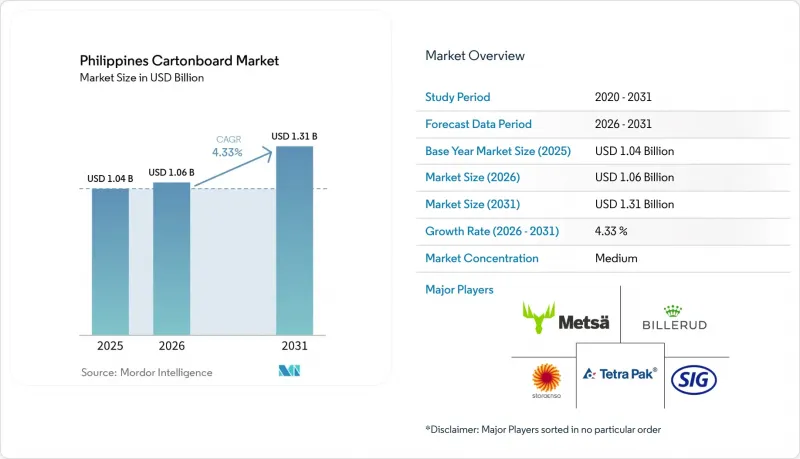
根據 Mordor Intelligence 預測,菲律賓紙板市場規模將從 2025 年的 10.4 億美元和 2026 年的 10.6 億美元成長到 2031 年的 13.1 億美元,2026 年至 2031 年的年複合成長率(CAGR)為 4.33%。
菲律賓紙板市場趨勢與洞察
對優質零售和貨架即用型瓦楞紙板包裝的需求不斷成長。
菲律賓現代零售業的興起提高了零售展示標準,進而導致對印刷品質更高、結構更堅固的「貨架即用型」瓦楞紙板的需求增加。注重產品展示的零售集團和門市模式鼓勵品牌商在更廣泛的產品類別中,拋棄普通的二級包裝,轉而使用紙張重量的可折疊紙板和塗佈紙。來自泰國和印尼的進口產品已以整齊美觀、貨架即用的包裝形式在市場上流通,悄然提升了在同一門店銷售產品的本土製造商的產品展示標準。零售商也正在擴大自有品牌產品的包裝規模,採用更注重展示效果的大包裝,從而增加了可折疊瓦楞紙板的使用,而非僅將其作為軟包裝袋的替代品。這對菲律賓瓦楞紙板市場具有重大意義,因為即使潛在的消費者需求保持不變,這也提高了瓦楞紙板的單位加工附加價值。此外,在食品、個人護理和醫療保健包裝行業,印刷品質、展示效果和貨架一致性仍然是選擇加工商的重要因素。
包裝食品和飲料消費的成長
包裝食品和飲料生產的擴張持續支撐著菲律賓紙板市場,帶動了紙盒、紙套和液體包裝等產品的持續需求。預計到2026年,食品和飲料製造業將成長5%,這將帶動餅乾、蒸餾食品、乳製品和日常食品等需要可印刷且具有保護性的二級包裝的紙板需求。常溫保存的食品和湯類尤其重要,因為這些品類需要能夠保護產品在儲存和運輸過程中品質並便於清晰標示的包裝。此外,中呂宋和卡拉巴鬆地區的食品加工投資規模龐大,通常會帶動包裝需求,並增加工業走廊附近加工商的訂單。因此,需求基礎並非集中在單一食品類別,而是涵蓋廣泛的產品,這使得菲律賓紙板市場更能抵禦特定品類變化的影響。這也進一步鞏固了紙板作為實用包裝材料的地位,適用於透過現代零售和傳統分銷管道銷售的產品。
進口纖維和紙漿成本的波動
菲律賓瓦楞紙板市場仍極易受到進口纖維和紙漿成本波動的影響,因為加工商缺乏利用國產原生紙板進行避險的手段。全球紙張原料價格和運費的上漲迅速擠壓加工商的利潤空間,因為高檔紙板主要來自海外供應商。這種壓力對中型加工商尤其嚴峻,他們被迫在餐飲服務、家居用品和大眾市場快速日常消費品(FMCG)的合約中展開價格競爭。 2026年,菲律賓貿易和工業部(DTI)否決了對進口瓦楞紙板原紙徵收保障性關稅的提案。這使得國內買家完全暴露在國際價格波動週期之下。菲律賓瓦楞紙板市場受到的影響不僅限於投入成本不確定性的增加,還會導致本已捉襟見肘的勞動市場投資決策的延遲。此外,在原物料價格波動的影響速度遠超加工商轉嫁成本能力的情況下,與客戶協商合約價格也變得更加困難。
細分市場分析
預計到2025年,折疊紙板將在菲律賓瓦楞紙板市場佔據33.12%的市場佔有率,顯著超越其他產品等級。其主導地位源自於其均衡的成本、可靠的加工性能以及在食品、化妝品、藥品和菸草等產品的二次包裝中的廣泛應用。此外,來自海外成熟造紙廠的預塗佈進口產品的供應,使得加工商更容易維持品牌零售包裝的印刷標準,這也是其備受青睞的另一個原因。這種多功能性和易加工性使得折疊紙板成為菲律賓瓦楞紙板行業眾多主流消費品應用領域的首選。未漂白實心紙板在高階菸草和保健品包裝中仍然發揮著重要作用,因為這些產品的白色、印刷精度和防篡改結構至關重要。
白紙塑合板憑藉其價格優勢,繼續在家庭和一般商品包裝領域佔據主導地位;而未漂白紙板則用於較重的零售展示和覆膜外包裝。預計到2031年,液體包裝紙板的複合年成長率將達到5.51%,使其成為菲律賓紙板市場成長最快的類別。這一成長勢頭反映了人們對無菌飲料日益成長的需求、向纖維基包裝形式的廣泛轉變以及對廢棄紙板回收系統的日益重視。小型無菌包裝方案的擴展也將促進該類別紙板進入價格敏感型應用領域,同時不會改變其核心價值提案。儘管食品服務紙板的市場規模仍然較小,但隨著馬尼拉大都會區和宿霧市對紙杯、翻蓋式容器和外帶容器的需求不斷成長,以及都市區外帶和配送需求的增加,其重要性正在日益凸顯。
其他好處:
- Excel格式的市場預測(ME)表
- 3個月的分析師支持
目錄
第1章:引言
- 研究假設和市場定義
- 調查範圍
第2章:調查方法
第3章執行摘要
第4章 市場狀況
- 市場概覽
- 宏觀經濟因素對市場的影響
- 市場促進因素
- 高階零售和展示用瓦楞紙板包裝的需求不斷成長。
- 包裝食品和飲料消費量增加
- 拓展無菌且可在室溫下儲存的紙包裝產品的應用
- 電子商務對二次包裝的需求
- 紡織品包裝領域日益重視永續性
- 品牌從塑膠容器過渡到紙盒
- 市場限制因素
- 進口纖維和紙漿成本的波動
- 該地區紙板綜合生產能力不足
- 對濕度敏感度和阻隔性能的限制
- 替代包裝材料的競爭
- 產業價值鏈分析
- 監理情勢
- 技術展望
- 波特五力分析
第5章 市場規模與成長預測
- 按產品等級
- 固態漂白板
- 未漂白紙板
- 折疊紙板
- 帶有白線的塑合板
- 液體包裝板
- 餐飲服務業的董事會
- 按包裝類型
- 折疊紙箱
- 液體包裝
- 袖套和托盤
- 其他包裝形式(杯子、食品服務業的容器)
- 按最終用戶行業分類
- 食物
- 飲料
- 藥品和醫療保健
- 菸草
- 化妝品和盥洗用品
- 其他終端用戶產業(玩具、服飾、汽車、家居用品、電器、餐飲服務業)
第6章 競爭情勢
- 市場集中度
- 策略趨勢
- 市佔率分析
- 公司簡介
- Tetra Pak International SA
- SIG Group AG
- Stora Enso Oyj
- Billerud AB
- Metsa Board Corporation
- International Paper Company
- WestRock Company
- Smurfit Westrock plc
- Mondi plc
- Nippon Paper Industries Co., Ltd.
- Oji Holdings Corporation
- Nine Dragons Paper Holdings Limited
- SCG Packaging Public Company Limited
- Asia Pulp and Paper Co., Ltd.
- UPM-Kymmene Corporation
- Mayr-Melnhof Karton AG
- Sappi Limited
- Graphic Packaging International, LLC
- Packaging Corporation of America
- Rengo Co., Ltd.
- DNP Group
第7章 市場機會與未來展望
According to Mordor Intelligence, the Philippines cartonboard market size is projected to expand from USD 1.04 billion in 2025 and USD 1.06 billion in 2026 to USD 1.31 billion by 2031, registering a CAGR of 4.33% between 2026 and 2031.
Philippines Cartonboard Market Trends and Insights
Rising Demand For Premium Retail And Shelf-Ready Cartonboard Packaging
Modern trade in the Philippines has pushed retail presentation standards higher, which is raising the need for shelf-ready carton formats with better print quality and stronger structural finish. Organized retail groups and presentation-led store formats are encouraging brand owners to move beyond plain secondary outers and into higher-grammage folding boxboard and coated substrates in more categories. Imported products from Thailand and Indonesia already arrive in cleaner shelf-ready formats, and that is quietly raising the presentation benchmark for domestic manufacturers that sell into the same aisles. Retailers are also expanding private-label products in larger presentation-focused packs, which supports more folding carton use rather than flexible pouch substitution. This matters for the Philippines cartonboard market because it supports higher board value per converted unit, even when underlying consumer demand remains steady. It also keeps print quality, display readiness, and shelf consistency central to converter selection in food, personal care, and healthcare packaging.
Expansion Of Packaged Food And Beverage Consumption
Expansion in packaged food and beverage output continues to anchor the Philippines cartonboard market because it creates recurring demand across cartons, sleeves, and liquid packs. In 2026, the food and beverage manufacturing sector is projected to grow 5%, which supports carton demand in biscuits, ready meals, dairy, and pantry staples that need printable and protective secondary packaging. Shelf-stable meals and soups are especially relevant because these categories depend on packaging that protects product quality and supports clear labeling during storage and distribution. This pattern also matters because food processing investment in Central Luzon and CALABARZON usually pulls packaging demand with it, which strengthens order flow for converters near industrial corridors. The demand base is therefore broad rather than concentrated in a single food line, which makes the Philippines cartonboard market more resilient to changes in one category alone. It also reinforces the role of cartonboard as a practical packaging substrate for products that move through both modern retail and traditional trade.
Volatility In Imported Fiber And Pulp Costs
The Philippines cartonboard market remains exposed to imported fiber and pulp costs because the converting base does not have a local virgin-board hedge. When global paper inputs or freight rates rise, converters feel margin pressure quickly because premium board grades are sourced from overseas suppliers. That pressure is harder to absorb for mid-tier converters that compete on price in foodservice, household, and mass FMCG contracts. In 2026, the DTI rejected a proposal for a safeguard duty on imported corrugating medium paper, which left local buyers fully exposed to international pricing cycles. The effect on the Philippines cartonboard market is not only higher input uncertainty, but also slower investment decisions when working capital is already stretched. It also makes customer contract pricing more difficult in a market where raw material swings can reach converters faster than they can pass costs forward.
Other drivers and restraints analyzed in the detailed report include:
- Growth In Aseptic And Shelf-Stable Carton Applications
- E-Commerce-Driven Secondary Packaging Demand
- Limited Local Integrated Cartonboard Capacity
For complete list of drivers and restraints, kindly check the Table Of Contents.
Segment Analysis
Folding Boxboard held 33.12% of the Philippines cartonboard market share in 2025, which kept it well ahead of other product grades in the Philippines cartonboard market. Its lead comes from balanced cost, dependable converting behavior, and wide use across food, cosmetics, pharmaceutical, and tobacco secondary packs. Converters also favor this grade because coated imported supply is available from established overseas mills, which helps them maintain print standards for branded retail packaging. In the Philippines cartonboard industry, that combination of versatility and converting ease makes Folding Boxboard the default choice for a wide range of mainstream consumer applications. Solid Bleached Board stays important in premium tobacco and healthcare packs where brightness, print precision, and tamper-evident structures matter.
White-Lined Chipboard keeps a price-led role in household and general merchandise packaging, while Solid Unbleached Board serves heavier retail displays and laminated outer packs. Liquid Packaging Board is projected to grow at 5.51% CAGR through 2031, which makes it the fastest-moving grade in the Philippines cartonboard market. That momentum reflects stronger aseptic beverage interest, a wider push toward fiber-based formats, and rising attention to used-carton recovery systems. The expansion of smaller aseptic pack options should also help the grade reach more price-sensitive use cases without changing its core value proposition. Food Service Board remains smaller, but it is gaining relevance as urban takeaway and delivery demand lift paperboard cups, clamshells, and carry containers in Metro Manila and Cebu.
Complete Report Scope:
- By Product Grade
- Solid Bleached Board
- Solid Unbleached Board
- Folding Boxboard
- White-Lined Chipboard
- Liquid Packaging Board
- Food Service Board
- By Packaging Format
- Folding Cartons
- Liquid Packaging
- Sleeve and Tray
- Other Packaging Formats (Cups, Foodservice Containers)
- By End-User Industry
- Food
- Beverage
- Pharmaceutical and Healthcare
- Tobacco
- Cosmetics and Toiletries
- Other End-User Industries (Toy, Apparel, Automotive, Household, Electrical, Foodservice)
List of Companies Covered in this Report:
- Tetra Pak International S.A.
- SIG Group AG
- Stora Enso Oyj
- Billerud AB
- Metsa Board Corporation
- International Paper Company
- WestRock Company
- Smurfit Westrock plc
- Mondi plc
- Nippon Paper Industries Co., Ltd.
- Oji Holdings Corporation
- Nine Dragons Paper Holdings Limited
- SCG Packaging Public Company Limited
- Asia Pulp and Paper Co., Ltd.
- UPM-Kymmene Corporation
- Mayr-Melnhof Karton AG
- Sappi Limited
- Graphic Packaging International, LLC
- Packaging Corporation of America
- Rengo Co., Ltd.
- DNP Group
Additional Benefits:
- The market estimate (ME) sheet in Excel format
- 3 months of analyst support
TABLE OF CONTENTS
1 INTRODUCTION
- 1.1 Study Assumptions and Market Definition
- 1.2 Scope of the Study
2 RESEARCH METHODOLOGY
3 EXECUTIVE SUMMARY
4 MARKET LANDSCAPE
- 4.1 Market Overview
- 4.2 Impact of Macroeconomic Factors on the Market
- 4.3 Market Drivers
- 4.3.1 Rising Demand for Premium Retail and Shelf-Ready Cartonboard Packaging
- 4.3.2 Expansion of Packaged Food and Beverage Consumption
- 4.3.3 Growth in Aseptic and Shelf-Stable Carton Applications
- 4.3.4 E-Commerce-Driven Secondary Packaging Demand
- 4.3.5 Rising Sustainability Preference for Fiber-Based Packaging
- 4.3.6 Brand Migration From Plastic to Paperboard Cartons
- 4.4 Market Restraints
- 4.4.1 Volatility in Imported Fiber and Pulp Costs
- 4.4.2 Limited Local Integrated Cartonboard Capacity
- 4.4.3 Moisture Sensitivity and Barrier Performance Constraints
- 4.4.4 Price Competition From Alternative Packaging Substrates
- 4.5 Industry Value Chain Analysis
- 4.6 Regulatory Landscape
- 4.7 Technological Outlook
- 4.8 Porter's Five Forces Analysis
- 4.8.1 Threat of New Entrants
- 4.8.2 Bargaining Power of Suppliers
- 4.8.3 Bargaining Power of Buyers
- 4.8.4 Threat of Substitutes
- 4.8.5 Intensity of Competitive Rivalry
5 MARKET SIZE AND GROWTH FORECASTS (VALUE)
- 5.1 By Product Grade
- 5.1.1 Solid Bleached Board
- 5.1.2 Solid Unbleached Board
- 5.1.3 Folding Boxboard
- 5.1.4 White-Lined Chipboard
- 5.1.5 Liquid Packaging Board
- 5.1.6 Food Service Board
- 5.2 By Packaging Format
- 5.2.1 Folding Cartons
- 5.2.2 Liquid Packaging
- 5.2.3 Sleeve and Tray
- 5.2.4 Other Packaging Formats (Cups, Foodservice Containers)
- 5.3 By End-User Industry
- 5.3.1 Food
- 5.3.2 Beverage
- 5.3.3 Pharmaceutical and Healthcare
- 5.3.4 Tobacco
- 5.3.5 Cosmetics and Toiletries
- 5.3.6 Other End-User Industries (Toy, Apparel, Automotive, Household, Electrical, Foodservice)
6 COMPETITIVE LANDSCAPE
- 6.1 Market Concentration
- 6.2 Strategic Moves
- 6.3 Market Share Analysis
- 6.4 Company Profiles (includes Global Level Overview, Market Level Overview, Core Segments, Financials as available, Strategic Information, Market Rank/Share, Products and Services, Recent Developments)
- 6.4.1 Tetra Pak International S.A.
- 6.4.2 SIG Group AG
- 6.4.3 Stora Enso Oyj
- 6.4.4 Billerud AB
- 6.4.5 Metsa Board Corporation
- 6.4.6 International Paper Company
- 6.4.7 WestRock Company
- 6.4.8 Smurfit Westrock plc
- 6.4.9 Mondi plc
- 6.4.10 Nippon Paper Industries Co., Ltd.
- 6.4.11 Oji Holdings Corporation
- 6.4.12 Nine Dragons Paper Holdings Limited
- 6.4.13 SCG Packaging Public Company Limited
- 6.4.14 Asia Pulp and Paper Co., Ltd.
- 6.4.15 UPM-Kymmene Corporation
- 6.4.16 Mayr-Melnhof Karton AG
- 6.4.17 Sappi Limited
- 6.4.18 Graphic Packaging International, LLC
- 6.4.19 Packaging Corporation of America
- 6.4.20 Rengo Co., Ltd.
- 6.4.21 DNP Group
7 MARKET OPPORTUNITIES AND FUTURE OUTLOOK
- 7.1 White-space and unmet-need assessment

 反向折疊紙盒市場報告:趨勢、預測和競爭分析(至2035年)
 瓦楞紙板折疊市場規模、佔有率和成長分析:按產品類型、瓦楞類型、材料、應用、最終用途產業和地區分類-2026-2033年產業預測
 瓦楞紙板製造機械市場規模、佔有率和成長分析:按機器類型、自動化程度、紙板類型、應用、最終用戶和地區分類-2026-2033年產業預測
 瓦楞紙板折疊包裝市場分析及預測(至2035年):類型、產品、技術、應用、材料類型、製程、最終用戶、功能、解決方案
 貨架襯墊市場規模、佔有率和成長分析:按材料、產品類型、應用、最終用戶、分銷管道、厚度和地區分類-2026-2033年產業預測
 中東和非洲紙板市場:市場佔有率分析、行業趨勢和統計數據以及成長預測(2026-2031 年)德國紙板:市場佔有率分析、產業趨勢與統計、成長預測(2026-2031)法國紙板:市場佔有率分析、產業趨勢與統計、成長預測(2026-2031)北美紙板:市場佔有率分析、產業趨勢與統計、成長預測(2026-2031)南美洲紙板市場:市場佔有率分析、產業趨勢與統計、成長預測(2026-2031)