


 |
市場調查報告書
商品編碼
2072665
南美洲紙板市場:市場佔有率分析、產業趨勢與統計、成長預測(2026-2031)South America Cartonboard - Market Share Analysis, Industry Trends & Statistics, Growth Forecasts (2026 - 2031) |
||||||

※ 本網頁內容可能與最新版本有所差異。詳細情況請與我們聯繫。
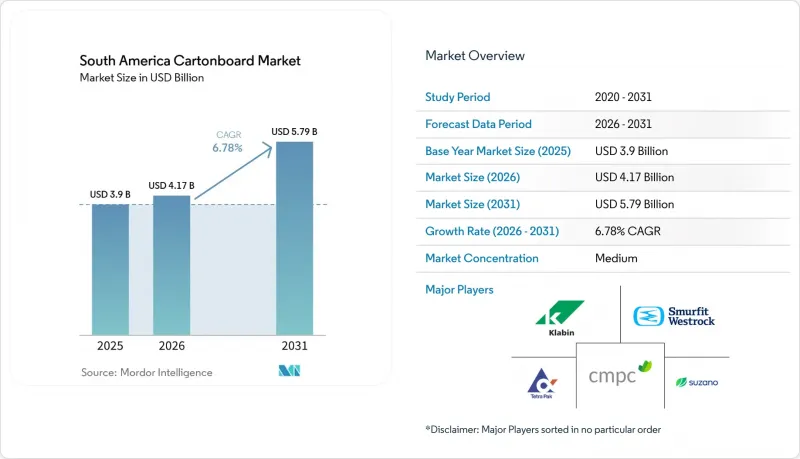
根據 Mordor Intelligence 預測,南美紙板市場規模將從 2025 年的 39 億美元成長到 2026 年的 41.7 億美元,然後在 2031 年達到 57.9 億美元,2026 年至 2031 年的複合年成長率為 6.78%。
本報告按產品等級(實心漂白紙板、實心未漂白紙板、折疊紙盒用紙板等)、包裝形式(折疊紙盒、液體包裝、紙套和托盤等)、終端用戶行業(食品飲料等)以及地區(巴西、阿根廷、哥倫比亞、智利、秘魯和其他南美國家)進行細分。市場預測以美元(USD)計價。
南美洲紙板市場趨勢與洞察
強制性塑膠替代品和品牌永續性目標
在南美洲紙板市場,法規已將塑膠替代品從品牌自願計劃轉變為合規挑戰。巴西第12688號法令建立了全國性的塑膠包裝逆向物流系統,強制要求到2026年塑膠回收再利用率達32%,到2040年達到50%。該法令還強制要求大型企業從2026年起在新塑膠包裝中使用至少22%的再生材料,並明確豁免紙本和紙板包裝。哥倫比亞第2232號法律和第1407號決議、智利第21368號法律以及秘魯關於可回收和可生物分解餐具的擬議法規,擴大了紡織品包裝和塑膠產品之間的政策差距,後者更難合規。這種轉變迫使品牌所有者不僅要重新設計受監管的單一產品,還要重新設計其更廣泛的SKU組合,因為區域包裝系統和採購標準擴大在產品組合層面進行管理。此外,這一趨勢正推動食品服務業、醫療相關二次包裝以及某些化妝品系列擴大採用紙板容器,因為在這些領域,可回收性和品牌展示都至關重要。對於南美紙板市場而言,這形成了一種政策支持的需求上限,使其相比許多其他包裝材料而言,更不易受到消費暫時放緩的影響。
包裝食品的需求與零售業的現代化
受加工食品需求和現代零售業態穩步發展的推動,南美紙板市場持續保持強勁的需求基礎。根據Empapel預測,到2025年,紙板產量預計將達到75.6萬噸,其中食品包裝仍是其生產組合中最大的終端用途領域。該資訊來源還報告稱,2026年1月紙板出貨量將達到創紀錄的34.7萬噸,顯示預測期初期訂單量強勁。此外,根據巴西零售協會(ABRE)預測,儘管巴西包裝總產量預計在2025年將下降0.3%,但食品和衛生用品包裝的產量基本上保持穩定,這支撐了紙板在必需品包裝中發揮的防禦性作用。在巴西以外,秘魯、哥倫比亞和智利的零售業正在逐步恢復正常,這促使品牌製造商從簡單的軟包裝轉向印刷紙板盒,從而增強商店展示效果並實現更清晰的品牌差異化。這種結構意味著,雖然南美紙板市場仍然依靠必需品的消費來支撐,但加工商在需要高價值圖形、便捷包裝形式和更先進規格的應用領域,仍有提高利潤率的空間。
原生紙漿和再生纖維的成本波動
原料成本波動仍然是南美紙板市場生產商和加工商利潤率面臨的最緊迫威脅。這種壓力不僅源自於原生紙漿的價格,也源自於外匯波動,匯率波動會改變許多加工業者仍依賴的進口紙板、化學品和特殊原料的該地貨幣成本。對於再生纖維而言,不確定性更大,因為回收品質和供應量取決於消費模式和非正規回收系統的組織速度。 Birelude 在 2026 年第一季中期報告中指出,儘管持續投資以提高紙板質量,但仍面臨定價挑戰。這表明,供應商信心可以與短期價格緊張的局面並存。 Meyer Melnhof 也同樣在 2026 年繼續專注於降低固定成本、標準化流程和重組,這反映出在成本波動速度可能超過售價的市場中,企業需要採取審慎的應對措施。當這些成本波動與進口商品的激進定價同時發生時,本地造紙企業就會失去定價權,而加工商也會面臨成本轉嫁空間越來越小的局面。
細分市場分析
2025年,可折疊紙板在南美紙板市場佔據41.81%的佔有率。同時,預計2026年至2031年間,南美洲普通漂白紙板的市場規模將以8.09%的複合年成長率成長。可折疊紙板憑藉其在食品、藥品和個人保健產品包裝中兼具的印刷適性、剛性和成本優勢,繼續保持其作為大眾市場主要紙板等級的地位。巴西綜合造紙廠本地生產的紙板進一步鞏固了其市場地位。與完全依賴進口的採購模式相比,這使得買家能夠更有效地管理前置作業時間和營運資金需求。由於醫藥和化妝品包裝領域對更高白度、更清晰的印刷效果以及與全像、壓紋和防偽工藝的兼容性的需求不斷成長,普通漂白紙板的成長速度正在加快。根據其“發展計劃”,比勒魯德公司計劃在2024年至2027年間投資14億瑞典克朗(約合1.288億美元),用於升級其位於昆內塞克和埃斯卡納巴的實心漂白紙板生產設施。這顯示全球供應商預期南美洲對實心漂白紙板的需求將持續成長。
白襯紙板在對成本要求較高的食品飲料二級包裝中仍然被廣泛應用,其需求主要受再生纖維經濟效益的推動,因為再生纖維能夠降低包裝等級的成本。未漂白實心紙板在工業和散裝應用中仍然十分重要,因為在這些應用中,結構強度比高階圖案或亮白表面更為關鍵。液體包裝紙板和食品服務板是南美紙板行業中最具專業性的領域之一,其應用不僅取決於紙板的供應情況,還取決於阻隔性能、衛生標準以及加工商的製程控制。醫藥和高階食品包裝的合規要求也在不斷提高可追溯性和印刷適性標準,逐步推動價值重心轉移到更高規格的漂白紙板和優質折疊紙板。邁耶·梅爾霍夫的「面向未來」計畫(截至2026年初已領先完成)表明,歐洲供應商將繼續致力於提升再生紙板等級的出口競爭力,以支持該地區的中端應用。
其他好處:
- Excel格式的市場預測(ME)表
- 3個月的分析師支持
目錄
第1章:引言
- 研究假設和市場定義
- 調查範圍
第2章:調查方法
第3章執行摘要
第4章 市場狀況
- 市場概覽
- 宏觀經濟因素對市場的影響
- 市場促進因素
- 食品和消費品包裝中的塑膠替代品
- 乳製品和果汁產業對無菌飲料紙盒的需求
- 美容、個人護理和保健產品紙盒的優質化。
- 貨架即用型和電商用可折疊紙盒的成長。
- 安裝食品服務配送和外帶指示牌。
- 出口導向認證和可追溯性需求
- 市場限制因素
- 在阻隔性至關重要的應用領域,與軟塑膠展開競爭。
- 紙漿、能源和澱粉成本的波動
- 從亞洲進口低成本折疊式板
- 液態紙盒回收的摩擦與 EPR(爆炸性處理率)。
- 產業價值鏈分析
- 監理情勢
- 技術展望
- 波特五力分析
第5章 市場規模與成長預測
- 按產品等級
- 固體漂白紙板
- 固體未漂白紙板
- 折疊紙板
- 球場用球的白色底面
- 用於液體包裝的紙板
- 食品服務用紙板
- 按包裝類型
- 折疊紙箱
- 液體包裝
- 袖套和托盤
- 其他包裝形式(杯子、食品服務容器)
- 按最終用戶行業分類
- 食物
- 飲料
- 藥品和醫療保健
- 菸草
- 化妝品和盥洗用品
- 其他終端用戶產業(玩具、服飾、汽車、家居用品、電器、餐飲服務業)
- 按地區
- 巴西
- 阿根廷
- 哥倫比亞
- 智利
- 秘魯
- 其他南美國家
第6章 競爭情勢
- 市場集中度
- 策略趨勢
- 市佔率分析
- 公司簡介
- Klabin SA
- Suzano SA
- Smurfit Westrock plc
- Graphic Packaging International, LLC
- Tetra Pak International SA
- SIG Group AG
- Empresas CMPC SA
- Mayr-Melnhof Karton AG
- Papeles y Cartones SA
- Cartones America SA
- Sonoco Products Company
- Ibema Companhia Brasileira de Papel
- BO Packaging SA
- Industrias VANNI SA
- PAPELERA DEL SUR SA
- CORRUGADORA NACIONAL CRANSA SA
- INPACO SAICEI
第7章 市場機會與未來展望
According to Mordor Intelligence, the south america cartonboard market size is expected to grow from USD 3.9 billion in 2025 to USD 4.17 billion in 2026 and is forecast to reach USD 5.79 billion by 2031 at 6.78% CAGR over 2026-2031.
This report is Segmented by Product Grade (Solid Bleached Board, Solid Unbleached Board, Folding Boxboard, and More), Packaging Format (Folding Cartons, Liquid Packaging, Sleeve and Tray, and More), End-User Industry (Food, Beverage, and More), and Geography (Brazil, Argentina, Colombia, Chile, Peru, and Rest of South America). The Market Forecasts are Provided in Terms of Value (USD).
South America Cartonboard Market Trends and Insights
Plastic Substitution Mandates And Brand Sustainability Targets
Regulation has moved plastic substitution from a voluntary brand agenda into a compliance issue across the South America cartonboard market. Brazil's Decree 12,688 created a national reverse logistics system for plastic packaging, required a 32% plastic recycling rate in 2026, set a path to 50% by 2040, and imposed a minimum 22% recycled-content obligation in new plastic packaging from 2026 for larger companies, while paper and cardboard packaging remained explicitly exempt. Colombia's Law 2232, Resolution 1407, Chile's Ley 21.368, and Peru's draft recyclable and biodegradable tableware regulation widened the policy gap between fiber-based formats and harder-to-comply plastic items. That shift is pushing brand owners to redesign broader SKU portfolios rather than only the units directly covered by regulation, because regional packaging systems and procurement standards are increasingly managed at portfolio level. It also supports stronger carton adoption in foodservice, healthcare-adjacent secondary packaging, and selected beauty lines where recyclability claims now matter alongside brand presentation. For the South America cartonboard market, this creates a policy-backed demand floor that is less exposed to short consumer slowdowns than many other packaging materials.
Packaged Food Demand And Retail Modernization
Processed food demand and the steady spread of modern retail formats continue to give the South America cartonboard market a reliable volume base. Empapel reported 756,000 tonnes of paperboard production in 2025, and food packaging remained the single largest end-use area within that output mix. The same source showed that January 2026 carton shipments reached a record 347,000 tonnes, which signaled firm order flow at the start of the forecast period. ABRE also reported that Brazil's overall packaging production volume slipped 0.3% in 2025, yet food and hygiene packaging volumes remained broadly stable, which confirmed cartonboard's defensive role in essential-goods packaging. Outside Brazil, retail formalization in Peru, Colombia, and Chile is encouraging branded suppliers to move from simpler flexible formats toward printed cartons that improve shelf presence and support clearer brand differentiation. This mix keeps the South America cartonboard market tied to staple consumption while still leaving room for higher-value graphics, convenience formats, and stronger converter margins in better specified applications.
Virgin Pulp And Recovered Fiber Cost Volatility
Input cost volatility remains the most immediate margin threat for producers and converters in the South America cartonboard market. The pressure does not come only from virgin pulp pricing, because exchange-rate swings also change the local-currency cost of imported board, chemicals, and specialty inputs that many converters still need. Recovered fiber adds a second layer of uncertainty because collection quality and availability move with consumption patterns and with the speed at which informal recovery systems become more organized. Billerud described prices as challenged in its first-quarter 2026 interim report even while it continued to fund board upgrades, which shows how supply-side confidence can coexist with tight near-term pricing conditions. Mayr-Melnhof likewise kept its 2026 focus on fixed-cost reduction, process harmonization, and structural adjustments, which reflected the need for discipline in a market where costs can move faster than selling prices. When those cost swings meet aggressive imported offers, local mills lose pricing power and converters face narrower pass-through windows.
Other drivers and restraints analyzed in the detailed report include:
- Beverage And Dairy Carton Demand In Aseptic And Chilled Formats
- Pharmaceutical And Healthcare Packaging Demand With Traceability And Hygiene Needs
- Competition From Flexible Plastic And Lightweight Alternative Formats
For complete list of drivers and restraints, kindly check the Table Of Contents.
Segment Analysis
Folding boxboard held 41.81% of the South America cartonboard market share in 2025, while the South America cartonboard market size for solid bleached board is projected to expand at 8.09% CAGR from 2026 to 2031. Folding boxboard remained the core volume grade because it balanced printability, stiffness, and cost across food, pharmaceutical outer-carton, and personal care packaging. Its position was also reinforced by the availability of locally produced grades from integrated Brazilian mills, which helped buyers manage lead time and working-capital needs more effectively than fully import-dependent sourcing models. Solid bleached board is rising faster because pharmaceutical and cosmetics packs increasingly require higher whiteness, cleaner print reproduction, and better compatibility with holographic, embossed, and anti-counterfeit finishing. Billerud's Evolution Program is allocating SEK 1.4 billion (USD 128.8 million) across 2024-2027 to upgrade its Quinnesec and Escanaba mills for solid bleached board production, which shows that global suppliers expect durable SBS demand in South America.
White-lined chipboard continues to serve cost-sensitive secondary packaging in food and beverage, especially where recycled fiber economics support a lower-cost grade mix. Solid unbleached board remains relevant in industrial and bulk uses that need structural strength more than premium graphics or bright white surfaces. Liquid packaging board and food service board sit at the most specialized end of the South America cartonboard industry because they depend on barrier chemistry, hygiene compliance, and converter process control rather than only board availability. Compliance needs in pharmaceutical and premium food packs are also raising the bar for traceability and print performance, which supports gradual value migration toward better specified bleached and premium folding grades. Mayr-Melnhof's Fit-For-Future program, which remained ahead of schedule in early 2026, suggests that European suppliers will keep targeting export competitiveness in recycled cartonboard grades that feed the region's mid-tier applications.
Complete Report Scope:
- By Product Grade
- Solid Bleached Board
- Solid Unbleached Board
- Folding Boxboard
- White-Lined Chipboard
- Liquid Packaging Board
- Food Service Board
- By Packaging Format
- Folding Cartons
- Liquid Packaging
- Sleeve and Tray
- Other Packaging Formats (Cups, Foodservice Containers)
- By End-User Industry
- Food
- Beverage
- Pharmaceutical and Healthcare
- Tobacco
- Cosmetics and Toiletries
- Other End-User Industries (Toy, Apparel, Automotive, Household, Electrical, Foodservice)
- By Geography
- Brazil
- Argentina
- Colombia
- Chile
- Peru
- Rest of South America
List of Companies Covered in this Report:
- Klabin S.A.
- Suzano S.A.
- Smurfit Westrock plc
- Graphic Packaging International, LLC
- Tetra Pak International S.A.
- SIG Group AG
- Empresas CMPC S.A.
- Mayr-Melnhof Karton AG
- Papeles y Cartones S.A.
- Cartones America S.A.
- Sonoco Products Company
- Ibema Companhia Brasileira de Papel
- BO Packaging S.A.
- Industrias VANNI S.A.
- PAPELERA DEL SUR S.A.
- CORRUGADORA NACIONAL CRANSA S.A.
- INPACO S.A.I.C.E.I.
Additional Benefits:
- The market estimate (ME) sheet in Excel format
- 3 months of analyst support
TABLE OF CONTENTS
1 INTRODUCTION
- 1.1 Study Assumptions and Market Definition
- 1.2 Scope of the Study
2 RESEARCH METHODOLOGY
3 EXECUTIVE SUMMARY
4 MARKET LANDSCAPE
- 4.1 Market Overview
- 4.2 Impact of Macroeconomic Factors on the Market
- 4.3 Market Drivers
- 4.3.1 Plastic Substitution in Food and Consumer Packaging
- 4.3.2 Aseptic Beverage Carton Demand in Dairy and Juice
- 4.3.3 Premiumization in Beauty, Personal Care, and Healthcare Cartons
- 4.3.4 Growth in Shelf-Ready and E-Commerce Folding Cartons
- 4.3.5 Foodservice Board Adoption for Delivery and Takeaway
- 4.3.6 Export-Oriented Certification and Traceability Needs
- 4.4 Market Restraints
- 4.4.1 Competition From Flexible Plastics in Barrier-Sensitive Uses
- 4.4.2 Volatility in Pulp, Energy, and Starch Costs
- 4.4.3 Low-Priced Asian Folding Board Imports
- 4.4.4 Liquid-Carton Recycling and EPR Friction
- 4.5 Industry Value Chain Analysis
- 4.6 Regulatory Landscape
- 4.7 Technological Outlook
- 4.8 Porter's Five Forces Analysis
- 4.8.1 Threat of New Entrants
- 4.8.2 Bargaining Power of Suppliers
- 4.8.3 Bargaining Power of Buyers
- 4.8.4 Threat of Substitutes
- 4.8.5 Competitive Rivalry
5 MARKET SIZE AND GROWTH FORECASTS (VALUE)
- 5.1 By Product Grade
- 5.1.1 Solid Bleached Board
- 5.1.2 Solid Unbleached Board
- 5.1.3 Folding Boxboard
- 5.1.4 White-Lined Chipboard
- 5.1.5 Liquid Packaging Board
- 5.1.6 Food Service Board
- 5.2 By Packaging Format
- 5.2.1 Folding Cartons
- 5.2.2 Liquid Packaging
- 5.2.3 Sleeve and Tray
- 5.2.4 Other Packaging Formats (Cups, Foodservice Containers)
- 5.3 By End-User Industry
- 5.3.1 Food
- 5.3.2 Beverage
- 5.3.3 Pharmaceutical and Healthcare
- 5.3.4 Tobacco
- 5.3.5 Cosmetics and Toiletries
- 5.3.6 Other End-User Industries (Toy, Apparel, Automotive, Household, Electrical, Foodservice)
- 5.4 By Geography
- 5.4.1 Brazil
- 5.4.2 Argentina
- 5.4.3 Colombia
- 5.4.4 Chile
- 5.4.5 Peru
- 5.4.6 Rest of South America
6 COMPETITIVE LANDSCAPE
- 6.1 Market Concentration
- 6.2 Strategic Moves
- 6.3 Market Share Analysis
- 6.4 Company Profiles (includes Global Level Overview, Market Level Overview, Core Segments, Financials as available, Strategic Information, Market Rank/Share, Products and Services, Recent Developments)
- 6.4.1 Klabin S.A.
- 6.4.2 Suzano S.A.
- 6.4.3 Smurfit Westrock plc
- 6.4.4 Graphic Packaging International, LLC
- 6.4.5 Tetra Pak International S.A.
- 6.4.6 SIG Group AG
- 6.4.7 Empresas CMPC S.A.
- 6.4.8 Mayr-Melnhof Karton AG
- 6.4.9 Papeles y Cartones S.A.
- 6.4.10 Cartones America S.A.
- 6.4.11 Sonoco Products Company
- 6.4.12 Ibema Companhia Brasileira de Papel
- 6.4.13 BO Packaging S.A.
- 6.4.14 Industrias VANNI S.A.
- 6.4.15 PAPELERA DEL SUR S.A.
- 6.4.16 CORRUGADORA NACIONAL CRANSA S.A.
- 6.4.17 INPACO S.A.I.C.E.I.
7 MARKET OPPORTUNITIES AND FUTURE OUTLOOK
- 7.1 White-Space and Unmet-Need Assessment

 瓦楞紙板折疊市場規模、佔有率和成長分析:按產品類型、瓦楞類型、材料、應用、最終用途產業和地區分類-2026-2033年產業預測
 瓦楞紙板製造機械市場規模、佔有率和成長分析:按機器類型、自動化程度、紙板類型、應用、最終用戶和地區分類-2026-2033年產業預測
 瓦楞紙板折疊包裝市場分析及預測(至2035年):類型、產品、技術、應用、材料類型、製程、最終用戶、功能、解決方案
 瓦楞紙板市場:全球預測,2026-2032年
 貨架襯墊市場規模、佔有率和成長分析:按材料、產品類型、應用、最終用戶、分銷管道、厚度和地區分類-2026-2033年產業預測
 中東和非洲紙板市場:市場佔有率分析、行業趨勢和統計數據以及成長預測(2026-2031 年)德國紙板:市場佔有率分析、產業趨勢與統計、成長預測(2026-2031)法國紙板:市場佔有率分析、產業趨勢與統計、成長預測(2026-2031)北美紙板:市場佔有率分析、產業趨勢與統計、成長預測(2026-2031)歐洲紙板:市場佔有率分析、產業趨勢與統計、成長預測(2026-2031)