


 |
市場調查報告書
商品編碼
2125668
東南亞車載資訊服務:市場佔有率分析、產業趨勢與統計及成長預測(2026-2031 年)Southeast Asia Telematics - Market Share Analysis, Industry Trends & Statistics, Growth Forecasts (2026 - 2031) |
||||||

※ 本網頁內容可能與最新版本有所差異。詳細情況請與我們聯繫。
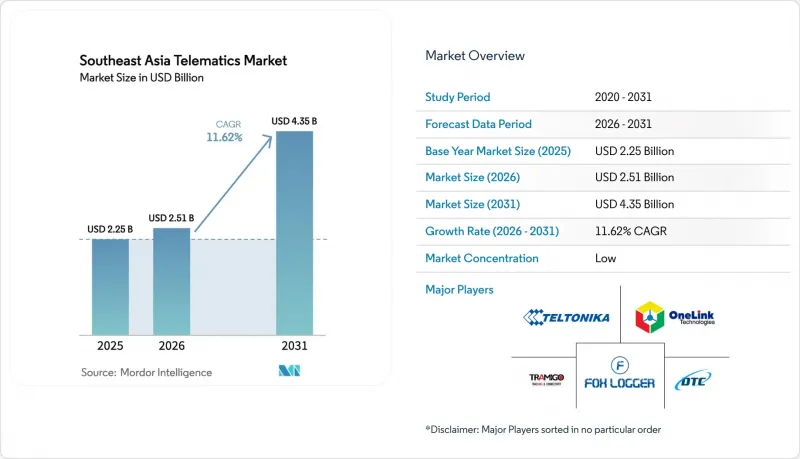
據 Mordor Intelligence 稱,東南亞遠端資訊處理市場在 2025 年的價值為 22.5 億美元,預計到 2031 年將從 2026 年的 25.1 億美元成長到 43.5 億美元,在預測期(2026-2031 年)內的複合成長率為 11.62%。
本報告按車輛類型(輕型商用車 (LCV)、中型商用車 (MCV) 等)、解決方案(車隊/車輛管理、定位服務等)、終端用戶行業(運輸和物流、電子商務最後一公里配送等)、連接技術(行動電話(2G/3G)、4G LTE 等)和國家/地區進行細分。市場預測以價值(美元)表示。
東南亞車載資訊服務市場趨勢與洞察
四級安全和排放氣體法規促進了其實施。
隨著東南亞各國政府實施多層次的燃油效率目標、基於二氧化碳排放量的稅收、在地採購要求以及零排放承諾,車載資訊系統正從單純的效率提升選項演變為一項監管要求。東協燃油藍圖要求到2025年將平均車輛燃油消耗量降低26%,並要求業者即時監控車輛使用量。泰國的消費稅制度鼓勵減少二氧化碳排放,而印尼的在地採購要求則引導買家選擇本地整合的車載資訊系統模組。此外,在「亞洲零排放共同體」框架下開展的氫能和生質燃料試點計畫需要詳細的營運數據以確保合規,這進一步將車載資訊系統融入車隊營運。因此,車載資訊系統的普及不再僅取決於投資報酬率(ROI),如果車隊營運商未能連接系統,將面臨違規處罰,這推動了東南亞車載資訊系統市場兩位數的成長。
電子商務最後一公里配送的蓬勃發展正在推動輕型商用車遠端資訊處理技術的發展。
線上零售平台不斷刷新配送速度的標桿,要求從倉庫到家門口全程可視。 Grab 的超級應用服務已覆蓋 800 多個城市,依靠聯網的輕型商用車和摩托車車隊,實現了不到一小時的配送時限。馬來西亞的數位經濟在 2020 年已佔 GDP 的 22.6%,並以每年 8.5% 的速度成長,這正推動物流營運商升級其追蹤系統。在越南,預計到 2024 年,電動摩托車的市場佔有率將超過 9%,車隊儀錶板正在添加電池狀態和續航里程管理等資料集。這些趨勢正在推動對即時路線規劃、駕駛員行為評估和充電週期分析的持續需求,所有這些都促進了東南亞遠端資訊處理市場的擴張。
高昂的初始硬體和整合成本
全球半導體短缺持續存在,汽車半導體的前置作業時間長達50週。這推高了裝置價格,並限制了SKU的供應。車隊營運商面臨日益擴大的資本成本差距。大型企業正在簽訂多年供貨契約,而中小企業則推遲部署或選擇功能有限的解決方案。 2021年,產能缺口達到820萬台,其影響將持續到2025年的訂單,推高硬體的平均售價(ASP),並減緩東南亞車載資訊服務市場的短期成長動能。
細分市場分析
至2025年,輕型商用車將佔東南亞遠端資訊處理市場36.92%的佔有率。這主要得益於小包裹和雜貨配送服務對詳細路線分析的需求。為了滿足嚴格的服務等級協定(SLA),營運商正在實施基於攝影機的駕駛員評估、冷鏈溫度感測器以及與電子接受(ePOD)的整合。二輪車細分市場成長最為迅猛,預計2031年將以12.05%的年複合成長率(CAGR)主要得益於越南和印尼的共享出行和宅配車輛的電氣化,以及電池充電狀態警報和換電站地圖功能的加入。
Zapp位於泰國的微型工廠每年可生產21,500輛電動機車,每輛摩托車都配備CAN總線端口,用於動力傳動系統數據。在採礦和建設產業,運作儀錶板和地理圍欄功能可確保中型商用車的現場設備合規性。在乘用車領域,保險公司提供的連網保險折扣和支援售後OBD適配器的共享出行平台進一步推動了市場需求。這些趨勢共同強化了東南亞車載資訊服務產業的多元化特徵,解決方案供應商能夠靈活應對各種負載容量等級的需求。
到2025年,「車隊和車輛管理」將佔東南亞遠端資訊處理市場41.55%的佔有率,提供核心的GPS追蹤、維護計畫和駕駛員警報功能。長途和區域運輸業者幾乎普遍採用該技術,旨在將每輛車的油耗降低3%至5%。 「遠距資訊處理保險」正以13.14%的複合年成長率成長,透過將保費與駕駛行為評分和里程數掛鉤,重新定義風險定價。 NTUC Income與Carro合作推出的「按里程付費」服務清楚地展現了這一轉變。 MS&AD的185萬份聯網保單正在擴展精算資料集,並支援人工智慧驅動的風險走廊基準分析。這些應用案例表明,在東南亞遠端資訊處理產業,擴展分析能力(而不僅僅是硬體)才是供應商之間關鍵的差異化因素。
定位服務正與地圖和叫車平台整合,而預測性維護則憑藉邊緣人工智慧驅動的故障檢測技術蓬勃發展。供應商正將使用情況、振動和流體溫度資料輸入雲端機器學習模型,從而減少意外停機時間並提高殘值計算的準確性。目前,競爭優勢體現在開放的API、無線功能升級以及與第三方TMS和ERP套件的快速整合。
其他好處:
- Excel格式的市場預測(ME)表
- 3個月的分析師支持
目錄
第1章:引言
- 研究假設和市場定義
- 調查範圍
第2章:調查方法
第3章執行摘要
第4章 市場狀況
- 市場概覽
- 市場促進因素
- 四級安全和排放氣體法規正在推動其廣泛應用。
- 電子商務最後一公里配送的蓬勃發展正在推動輕型商用車遠端資訊處理技術的發展。
- 4G/5G的部署將實現即時資訊服務。
- 柴油價格波動和碳排放稅。
- 試辦計畫:推行按里程計費的道路稅(印尼)
- 越南的預付保險與電信公司合作
- 市場限制因素
- 初始硬體和整合成本相對較高。
- 跨越不規則邊界的網路漫遊
- 遙測資料出口中與資料主權相關的瓶頸
- 一線城市以外地區合格承包商短缺
- 供應鏈分析
- 監理情勢
- 技術展望
- 波特五力分析
- 供應商的議價能力
- 買方的議價能力
- 新進入者的威脅
- 替代品的威脅
- 競爭公司之間的競爭
- 對與市場相關的宏觀經濟趨勢進行評估
第5章 市場規模與成長預測
- 車輛類型
- 輕型商用車(LCV)
- 中型商用車(MCV)
- 搭乘用車
- 其他
- 透過解決方案
- 車隊/車輛管理
- 定位服務
- 遠端資訊處理保險
- 預測性保護
- 其他
- 按最終用戶行業分類
- 運輸和物流
- 電子商務的最後一公里
- 大眾運輸
- 建築和採礦
- 石油和天然氣
- 其他
- 透過連接技術
- 蜂窩網路(2G/3G)
- 4G LTE
- 5G
- 衛星
- 其他
- 國家
- 泰國
- 印尼
- 馬來西亞
- 新加坡
- 越南
- 其他東南亞國家
第6章 競爭情勢
- 市場集中度
- 策略趨勢
- 市佔率分析
- 公司簡介
- DTC Enterprise
- GPSiam
- Forth Tracking System
- Thai GPS Tracker
- Guarantee GPS
- Onelink Technology
- Thai Global Technologies
- East Innovation(EyeFleet)
- Xsense Information Service
- PT Navindo Technologies
- Foxlogger
- Maxxfleet
- IntelliTrac
- TransTrack
- UTrack
- Gigabyte Indonesia
- i-Tracking(S)Pte Ltd
- Tramigo Singapore
- Evo Systems SDN BHD
- Omnicomm Vietnam
- i-Fleet(CelcomDigi)
- EUPFIN Technology
- FindMyCar Philippines
- Manila GPS Trackers
- SkyFy Technology
- Vectras Inc.
- Teltonika Asia
- Explosoft International
- Get Prepared SDN BHD
第7章 市場機會與未來展望
According to Mordor Intelligence, the Southeast Asia telematics market size was valued at USD 2.25 billion in 2025 and estimated to grow from USD 2.51 billion in 2026 to reach USD 4.35 billion by 2031, at a CAGR of 11.62% during the forecast period (2026-2031).
This report is Segmented by Vehicle Type (Light Commercial Vehicle (LCV), Medium Commercial Vehicle (MCV), and More), Solution (Fleet/Vehicle Management, Location-Based Services, and More), End-User Industry (Transport and Logistics, E-Commerce Last-Mile, and More), Connectivity Technology (Cellular (2G/3G), 4G LTE, and More), by Country. The Market Forecasts are Provided in Terms of Value (USD).
Southeast Asia Telematics Market Trends and Insights
Four-tier Safety and Emissions Mandates Drive Adoption
Governments across Southeast Asia are layering fuel-economy targets, CO2-based taxes, local-content rules, and zero-emission commitments, turning telematics from an efficiency option into a regulatory requirement. The ASEAN Fuel Economy Roadmap insists on a 26% reduction in average fleet fuel consumption by 2025, obliging operators to monitor vehicle usage in real time.Thailand's excise system rewards CO2 cuts, while Indonesia's local-content thresholds steer buyers toward domestically integrated telematics modules. Emerging hydrogen and biofuel pilots under the Asia Zero Emission Community also require granular operating data for compliance, further embedding telematics in fleet workflows. As a result, adoption no longer hinges on ROI alone; fleets must connect or face non-compliance penalties, sustaining double-digit growth for the Southeast Asia telematics market.
E-commerce Last-mile Boom Fuels LCV Telematics
Online retail platforms continue to set delivery-speed benchmarks that require point-to-point visibility from warehouse to doorstep. Grab's super-app services in 800+ cities rely on connected LCV and two-wheeler fleets to hit sub-one-hour delivery windows. Malaysia's digital economy already contributed 22.6% of GDP in 2020 and is expanding 8.5% per year, pressuring logistics providers to upgrade tracking systems.Vietnam's electric two-wheelers crossed 9% market share in 2024, adding battery-health and range-management datasets to fleet dashboards. These dynamics underpin sustained demand for real-time routing, driver-behavior scoring, and charge-cycle analytics, all of which expand the Southeast Asia telematics market.
High Upfront Hardware and Integration Cost
Global chip shortages linger, with automotive semiconductor lead times stretching to 50 weeks, inflating device prices and limiting SKU availability. Fleet operators face a widening cost-of-capital gap: larger firms lock multi-year supply contracts, while SMEs postpone deployments or opt for stripped-down feature sets. Production shortfalls hit 8.2 million vehicles in 2021 and still ripple through 2025 order books, keeping average hardware ASPs elevated and dampening the Southeast Asia telematics market's near-term growth trajectory.
Other drivers and restraints analyzed in the detailed report include:
- 4G/5G Rollout Enables Real-time Data Services
- Fleet Cost-reduction Amid Diesel Volatility and Carbon Tax
- Data-sovereignty Bottlenecks on Telemetry Export
For complete list of drivers and restraints, kindly check the Table Of Contents.
Segment Analysis
Light Commercial Vehicles commanded 36.92% of the Southeast Asia telematics market size in 2025, anchored in parcel and grocery delivery runs that demand granular route analytics. Operators deploy camera-based driver scoring, cold-chain temperature probes, and ePOD integrations to hit tight service-level agreements. Two-Wheelers are registering the fastest 12.05% CAGR to 2031 as Vietnam and Indonesia electrify ride-hailing and courier fleets, adding battery state-of-charge alerts and swap-station mapping features.
Zapp's micro-factory in Thailand can build 21,500 electric motorcycles per year, each shipping with CAN-bus ports for real-time power-train data. For Medium Commercial Vehicles in mining and construction, uptime dashboards and geofencing ensure equipment-site compliance. Passenger Cars round out demand as insurers bundle connected-policy discounts and ride-sharing platforms fit aftermarket OBD dongles. Collectively these dynamics reinforce the Southeast Asia telematics industry's multi-segment nature, keeping solution providers agile across payload classes.
Fleet and Vehicle Management accounted for 41.55% of the Southeast Asia telematics market size in 2025, offering core GPS tracking, maintenance scheduling, and driver alerts. Adoption is nearly universal among long-haul and regional haul operators seeking 3%-5% fuel-burn cuts per vehicle. Telematics Insurance, growing at 13.14% CAGR, is redefining risk pricing by aligning premiums with behavioral scores and mileage, a shift highlighted by NTUC Income's pay-as-you-drive launch with Carro. MS&AD's 1.85 million connected policies expand the actuarial dataset, enabling AI to benchmark risk corridors. These use cases underscore how analytics extensions not hardware alone differentiate vendors in the Southeast Asia telematics industry.
Location-Based Services tie into mapping and dispatch platforms, while Predictive Maintenance gains momentum through edge-AI fault detection. Vendors that pull usage, vibration, and fluid-temperature data into cloud ML models reduce unplanned downtime and enhance residual-value calculations. Competitive advantage now lies in API openness, over-the-air feature upgrades, and integration speed with third-party TMS or ERP suites.
Complete Report Scope:
- By Vehicle Type
- Light Commercial Vehicle (LCV)
- Medium Commercial Vehicle (MCV)
- Passenger Cars
- Others
- By Solution
- Fleet/Vehicle Management
- Location-Based Services
- Telematics Insurance
- Predictive Maintenance
- Others
- By End-user Industry
- Transport and Logistics
- E-commerce Last-Mile
- Public Transportation
- Construction and Mining
- Oil and Gas
- Others
- By Connectivity Technology
- Cellular (2G/3G)
- 4G LTE
- 5G
- Satellite
- Others
- By Country
- Thailand
- Indonesia
- Malaysia
- Singapore
- Vietnam
- Rest of Southeast Asia
List of Companies Covered in this Report:
- DTC Enterprise
- GPSiam
- Forth Tracking System
- Thai GPS Tracker
- Guarantee GPS
- Onelink Technology
- Thai Global Technologies
- East Innovation (EyeFleet)
- Xsense Information Service
- PT Navindo Technologies
- Foxlogger
- Maxxfleet
- IntelliTrac
- TransTrack
- UTrack
- Gigabyte Indonesia
- i-Tracking (S) Pte Ltd
- Tramigo Singapore
- Evo Systems SDN BHD
- Omnicomm Vietnam
- i-Fleet (CelcomDigi)
- EUPFIN Technology
- FindMyCar Philippines
- Manila GPS Trackers
- SkyFy Technology
- Vectras Inc.
- Teltonika Asia
- Explosoft International
- Get Prepared SDN BHD
Additional Benefits:
- The market estimate (ME) sheet in Excel format
- 3 months of analyst support
TABLE OF CONTENTS
1 INTRODUCTION
- 1.1 Study Assumptions and Market Definition
- 1.2 Scope of the Study
2 RESEARCH METHODOLOGY
3 EXECUTIVE SUMMARY
4 MARKET LANDSCAPE
- 4.1 Market Overview
- 4.2 Market Drivers
- 4.2.1 Four-tier safety and emissions mandates drive adoption
- 4.2.2 E-commerce last-mile boom fuels LCV telematics
- 4.2.3 4G/5G rollout enables real-time data services
- 4.2.4 Fleet cost-reduction amid diesel volatility and carbon tax
- 4.2.5 Mileage-based road-tax pilots (Indonesia)
- 4.2.6 Vietnam PAYD insurance-telco alliances
- 4.3 Market Restraints
- 4.3.1 High upfront hardware and integration cost
- 4.3.2 Patchy cross-border network roaming
- 4.3.3 Data-sovereignty bottlenecks on telemetry export
- 4.3.4 Shortage of certified installers outside tier-1 cities
- 4.4 Supply-Chain Analysis
- 4.5 Regulatory Landscape
- 4.6 Technological Outlook
- 4.7 Porter's Five Force Analysis
- 4.7.1 Bargaining Power of Suppliers
- 4.7.2 Bargaining Power of Buyers
- 4.7.3 Threat of New Entrants
- 4.7.4 Threat of Substitutes
- 4.7.5 Intensity of Competitive Rivalry
- 4.8 Assesment of Macroeconomic Trends on Market
5 MARKET SIZE AND GROWTH FORECASTS (VALUE)
- 5.1 By Vehicle Type
- 5.1.1 Light Commercial Vehicle (LCV)
- 5.1.2 Medium Commercial Vehicle (MCV)
- 5.1.3 Passenger Cars
- 5.1.4 Others
- 5.2 By Solution
- 5.2.1 Fleet/Vehicle Management
- 5.2.2 Location-Based Services
- 5.2.3 Telematics Insurance
- 5.2.4 Predictive Maintenance
- 5.2.5 Others
- 5.3 By End-user Industry
- 5.3.1 Transport and Logistics
- 5.3.2 E-commerce Last-Mile
- 5.3.3 Public Transportation
- 5.3.4 Construction and Mining
- 5.3.5 Oil and Gas
- 5.3.6 Others
- 5.4 By Connectivity Technology
- 5.4.1 Cellular (2G/3G)
- 5.4.2 4G LTE
- 5.4.3 5G
- 5.4.4 Satellite
- 5.4.5 Others
- 5.5 By Country
- 5.5.1 Thailand
- 5.5.2 Indonesia
- 5.5.3 Malaysia
- 5.5.4 Singapore
- 5.5.5 Vietnam
- 5.5.6 Rest of Southeast Asia
6 COMPETITIVE LANDSCAPE
- 6.1 Market Concentration
- 6.2 Strategic Moves
- 6.3 Market Share Analysis
- 6.4 Company Profiles (includes Global level Overview, Market level Overview, Core Segments, Financials as available, Strategic Information, Market Rank/Share for key companies, Products and Services, Recent Developments)
- 6.4.1 DTC Enterprise
- 6.4.2 GPSiam
- 6.4.3 Forth Tracking System
- 6.4.4 Thai GPS Tracker
- 6.4.5 Guarantee GPS
- 6.4.6 Onelink Technology
- 6.4.7 Thai Global Technologies
- 6.4.8 East Innovation (EyeFleet)
- 6.4.9 Xsense Information Service
- 6.4.10 PT Navindo Technologies
- 6.4.11 Foxlogger
- 6.4.12 Maxxfleet
- 6.4.13 IntelliTrac
- 6.4.14 TransTrack
- 6.4.15 UTrack
- 6.4.16 Gigabyte Indonesia
- 6.4.17 i-Tracking (S) Pte Ltd
- 6.4.18 Tramigo Singapore
- 6.4.19 Evo Systems SDN BHD
- 6.4.20 Omnicomm Vietnam
- 6.4.21 i-Fleet (CelcomDigi)
- 6.4.22 EUPFIN Technology
- 6.4.23 FindMyCar Philippines
- 6.4.24 Manila GPS Trackers
- 6.4.25 SkyFy Technology
- 6.4.26 Vectras Inc.
- 6.4.27 Teltonika Asia
- 6.4.28 Explosoft International
- 6.4.29 Get Prepared SDN BHD
7 MARKET OPPORTUNITIES AND FUTURE OUTLOOK
- 7.1 White-space and Unmet-need Assessment

 2026-2030年全球汽車售後市場遠端資訊處理市場
 全球車用通訊系統市場:按服務、車輛類型、外形尺寸、產品/服務、連接方式、車隊管理服務和地區分類-預測至2033年
 亞太地區車載資訊服務:市場佔有率分析、產業趨勢與統計及成長預測(2026-2031 年)歐洲車用通訊系統:市場佔有率分析、行業趨勢和統計數據以及成長預測(2026-2031 年)歐洲車載資訊服務:市場佔有率分析、產業趨勢與統計及成長預測(2026-2031 年)車用通訊系統系統:市場佔有率分析、行業趨勢和統計數據、成長預測(2026-2031 年)
 車載資訊服務市場 - 全球預測,2026-2032 年
 全球汽車遠端資訊處理市場(第11版)租賃車輛遠端資訊處理(第四版)
 車用通訊系統市場預測至2034年:按類型、產品、連接方式、動力方式、應用、最終用戶和地區分類的全球分析