


 |
市場調查報告書
商品編碼
2124255
歐洲車載資訊服務:市場佔有率分析、產業趨勢與統計及成長預測(2026-2031 年)Europe Telematics - Market Share Analysis, Industry Trends & Statistics, Growth Forecasts (2026 - 2031) |
||||||

※ 本網頁內容可能與最新版本有所差異。詳細情況請與我們聯繫。
根據 Mordor Intelligence 預測,歐洲車載資訊服務市場將從 2025 年的 2,449 萬台成長到 2026 年的 2,816 萬台,到 2031 年將達到 5,663 萬台,2026 年至 2031 年的複合年成長率為 14.97%。
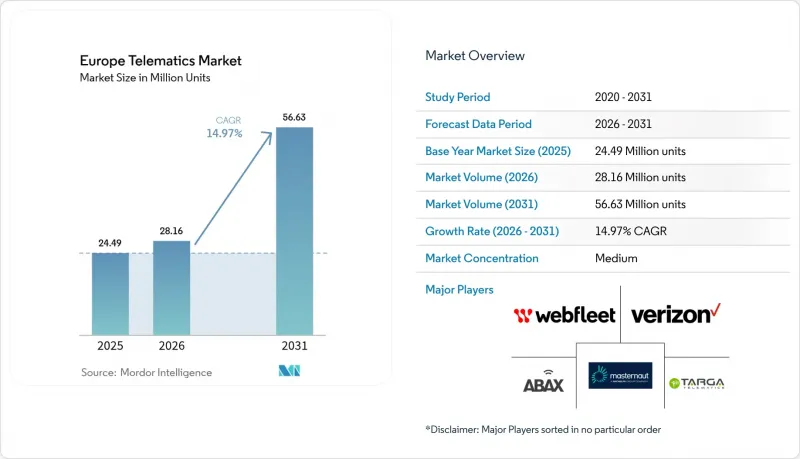
本報告按車輛類型(商用車和乘用車)、解決方案類型(車隊管理和資產追蹤等)、技術(嵌入式、有線/智慧型手機連接、售後黑盒子)、部署模式(OEMLine-Fit平台和售後服務服務供應商)以及地區進行細分。市場預測以銷售量(單位)為基礎。
歐洲車載資訊服務市場的趨勢與洞察
歐盟 eCall 和智慧行車記錄器監管合規計劃
歐洲車載資訊服務市場正受益於歐盟一項統一指令的直接推動,該指令強制要求2.5噸以上的貨車必須相容於下一代eCall系統並安裝Smart Tachograph 2。硬體更新週期集中在2026年7月的行車記錄器部署截止日期和2027年1月的4G/5G eCall系統過渡期前後,這不僅確保了供應商能夠清楚了解市場需求,也使他們能夠銷售與高利潤分析服務捆綁的合規模組。隨著營運商整合採購以應對這些不可更改的里程碑,解決方案供應商受益於更少的相關人員反對和更清晰的預算核准,從而大幅縮短了銷售流程,並加快了整個歐洲車載資訊服務市場的銷售成長速度。
原始設備製造商正在迅速轉向嵌入式連接平台。
如今,汽車製造商 (OEM) 將聯網汽車資料視為實現客戶全生命週期獲利的策略資產。 Targa Telematics 與大眾汽車集團等公司的合作代表著一種結構性轉變。車輛中標準化的Line-Fit模組簡化了車隊部署,實現了每週的功能更新,並減少了因售後設備故障而導致的售後支援需求。嵌入式通道還支援獨特的診斷、空中下載 (OTA) 更新和能源管理控制,從而在售後很長一段時間內拓展收入來源。因此,歐洲車載資訊服務市場越來越重視那些能夠透過收集和分析 OEM 數據來大規模提升價值的供應商。
混合車隊的高額改造和整合成本
歐洲車隊很少大量採購規格相同的車輛,而是傾向於選擇車齡、製造商和引擎技術各異的車輛。部署各種不同的黑盒子設備會導致資料孤島和複雜的維護,這對利潤微薄的個體運營商來說尤其沉重。整合成本不僅限於硬體,還包括駕駛員培訓、韌體更新以及適應傳統CAN總線的特性,所有這些都會消耗有限的營運資金。因此,小規模的車隊要么推遲部署,要么僅滿足監管規定的最低要求,這在短期內拉低了歐洲車載資訊服務市場的潛在複合年成長率。
細分市場分析
2025年,商用車輛將佔據歐洲遠端資訊處理市場64.21%的佔有率,透過降低燃油成本、提高路線遵守率和改善駕駛行為,帶來可預測的投資報酬率。由於監管報告要求與泛歐走廊貨運能力的擴張密切相關,市場需求依然強勁,而歐洲遠端資訊處理市場也建立在堅實的基礎上。隨著電動公共交通車輛需要監測電池電量並管理車庫充電,公車和長途客車正在創造額外收入。這些任務是傳統票務系統無法完成的。
儘管乘用車市場目前規模較小,但預計到2031年,其複合年成長率將達到16.79%,成為成長最快的市場之一。這主要得益於嵌入式SIM卡的普及和基於使用量的保險(UBI)模式的興起,這些模式正在推動消費者群體的快速成長。預計到2028年,有效的UBI合約數量將從2023年的1300萬份增至1760萬份,這將為精算模型提供大量新數據,從而為安全駕駛提供特定的保費折扣。輕型商用車(LCV)正在彌合乘用車與普通汽車之間的差距,它們不僅吸收了電子技術,還滿足了事業層級物流指標的需求,預計在整個預測期內將保持兩位數的持續成長。
到2025年,車隊管理和資產追蹤平台將佔據歐洲遠端資訊處理市場37.12%的佔有率,反映出其在燃油成本最佳化、維護計畫最佳化以及履行安全責任方面的成熟價值。持續的功能增強、基於影片的駕駛員培訓、貨物溫度檢驗以及多模態儀錶板整合,使得這些平台在主要物流運營商中保持著較高的合約續約率。
同時,隨著精算模型從靜態人口統計資料轉向即時行為評分,保險和基於使用量的遠端資訊處理產業以15.61%的複合年成長率引領成長。光是義大利就擁有950萬份有效的保險遠端資訊處理契約,其最佳實踐正在向德國、英國和法國推廣。安全保障子部門也在成長,這得益於eCall的強制部署;隨著原始設備製造商(OEM)向第三方開發人員開放預測性維護程式碼庫,遠端診斷也變得越來越普及,從而擴大了歐洲遠端資訊處理市場的解決方案範圍。
其他好處:
- Excel格式的市場預測(ME)表
- 3個月的分析師支持
目錄
第1章:引言
- 研究假設和市場定義
- 調查範圍
第2章:調查方法
第3章執行摘要
第4章 市場狀況
- 市場概覽
- 市場促進因素
- 歐盟 eCall 和智慧行車記錄器合規計劃
- OEM廠商向嵌入式連線平台的快速轉型
- 這是由電子商務和最後一公里物流的最佳化所驅動的。
- 降低車隊所有者的連接和感測器成本。
- 強制過渡到下一代(4G/5G)電子呼叫
- HDV 的二氧化碳排放監測法規正在推動環保駕駛分析。
- 市場限制因素
- 混合車輛列車組的維修和整合成本高昂
- 供應商因資料隱私和GDPR而產生的責任風險
- 2G/3G 服務的停止使用,需要儘早進行硬體升級。
- 遠距資訊處理領域資料科學人才短缺
- 監理情勢
- 技術展望
- 波特五力分析
- 宏觀經濟因素對市場的影響
第5章 市場規模與成長預測
- 車輛類型
- 商用車輛(輕型商用車、中型商用車、重型商用車、巴士)
- 搭乘用車
- 按解決方案類型
- 車輛管理和資產追蹤
- 安全保障(eCall、SVT)
- 保險/基於里程的遠端資訊處理
- 資訊娛樂和導航
- 遠距離診斷和預測性維護
- 透過技術
- 嵌入式
- 有線/智慧型手機連接
- 用於售後市場的黑盒子
- 部署模式
- OEMLine-Fit平台
- 售後服務提供者
- 國家
- 英國
- 德國
- 法國
- 義大利
- 西班牙
- 荷蘭
- 瑞典
- 挪威
- 丹麥
- 芬蘭
- 波蘭
- 俄羅斯
- 其他歐洲國家
第6章 競爭情勢
- 市場集中度
- 策略趨勢
- 市佔率分析
- 公司簡介
- Webfleet Solutions BV
- Targa Telematics SpA
- Verizon Communications Inc.(Verizon Connect)
- ABAX UK Ltd.
- Masternaut Limited
- Gurtam Inc.
- MiX Telematics Limited
- Mercedes-Benz Group AG
- Volvo Group
- Scania AB
- MAN Truck and Bus SE
- DAF Trucks NV
- Robert Bosch GmbH
- Continental AG
- Trimble Inc.
- CalAmp Corp.
- Geotab Inc.
- Teletrac Navman Group Ltd.
- AddSecure AB
- Microlise Group PLC
- Trakm8 Holdings PLC
- OCTO Telematics SpA
- Transics International BVBA
第7章 市場機會與未來展望
According to Mordor Intelligence, the Europe telematics market size is expected to grow from 24.49 million installed units in 2025 to 28.16 million installed units in 2026 and is forecast to reach 56.63 million installed units by 2031 at 14.97% CAGR over 2026-2031.
This report is Segmented by Vehicle Type (Commercial Vehicles and Passenger Cars), Solution Type (Fleet Management and Asset Tracking, and More), Technology (Embedded, Tethered/Smartphone-Integrated, and Aftermarket Black-Box), Deployment Mode (OEM Line-Fit Platforms and Aftermarket Service Providers), and Geography. The Market Forecasts are Provided in Terms of Volume (Units).
Europe Telematics Market Trends and Insights
EU eCall and Smart Tachograph Compliance Timeline
The Europe telematics market receives a direct uplift from synchronized EU directives that stipulate Next Generation eCall readiness and Smart Tachograph 2 installation across vans above 2.5 tonnes. Hardware refresh cycles concentrate around the July 2026 tachograph deadline and the January 2027 4G/5G eCall cut-over, giving providers reliable demand visibility while allowing bundling of compliance modules with higher-margin analytics services. As operators consolidate procurement to meet these immovable milestones, solution vendors benefit from fewer stakeholder objections and clearer budget approvals, effectively flattening lengthy sales funnels and accelerating unit run-rates across the Europe telematics market.
Rapid OEM Shift to Embedded Connectivity Platforms
OEMs now view connected-vehicle data as a strategic asset for lifetime customer monetization. Partnerships such as Targa Telematics and Volkswagen Group demonstrate a structural pivot: line-fit modules ship with the vehicle, streamlining fleet onboarding, enabling weekly feature drops, and reducing support queries tied to aftermarket device faults. Embedded channels also unlock proprietary diagnostics, over-the-air (OTA) updates, and energy-management controls, extending revenue streams long after initial sale. Consequently, the Europe telematics market increasingly rewards providers that master OEM data ingestion and analytic enrichment at scale.
High Retrofit and Integration Costs for Mixed Fleets
European fleets seldom buy homogenous vehicle batches; age, make, and engine technology vary widely. Installing disparate black-box devices leads to data silos and support churn, especially for owner-operators juggling thin profit margins. Integration expenses roll beyond hardware, driver onboarding, firmware updates, and legacy CAN-bus quirks consume scarce operating capital. Consequently, smaller fleets defer deployments or restrict rollouts to regulatory minimums, shaving a potential rate off the Europe telematics market CAGR in the near term.
Other drivers and restraints analyzed in the detailed report include:
- E-commerce and Last-Mile Logistics Optimization Push
- Falling Connectivity and Sensor Costs for Fleet Owners
- Data-Privacy and GDPR-Driven Vendor Liability Risk
For complete list of drivers and restraints, kindly check the Table Of Contents.
Segment Analysis
Commercial vehicles accounted for 64.21% of the Europe telematics market share in 2025, delivering predictable ROI through fuel saving, route adherence, and driver-behavior improvements. Demand stays resilient as regulatory reporting aligns with freight-capacity expansion across pan-European corridors, anchoring the Europe telematics market size to a stable, heavy-duty foundation. Buses and coaches add incremental revenue as electrified public-transport fleets require battery-state-of-charge monitoring and depot-charging orchestration, tasks unserved by legacy ticketing systems.
Passenger cars, while smaller today, post the highest growth pace at a 16.79% CAGR to 2031 as embedded SIM penetration and usage-based insurance (UBI) unlock consumer segments. Active UBI policies are set to climb from 13.0 million in 2023 to 17.6 million in 2028, funneling fresh data volumes into actuarial models that reward safe driving with tangible premium discounts. Light commercial vehicles (LCVs) bridge both worlds, absorbing passenger-car electronics while satisfying business-grade logistics metrics, ensuring sustained double-digit adoption rates throughout the forecast window.
Fleet-management and asset-tracking platforms held 37.12% of the Europe telematics market size in 2025, reflecting mature value proofs around fuel costs, maintenance scheduling, and duty-of-care compliance. Continuous feature enrichment, video-based driver coaching, cargo-temperature validation, and multi-modal dashboard aggregation, keeps renewal rates high among large logistics operators.
Insurance and usage-based telematics, however, top the growth chart at a 15.61% CAGR as actuarial models migrate from static demographics to real-time behavioral scoring. Italy alone hosts 9.5 million active insurance-telematics policies, propagating best practices to Germany, the UK, and France. Safety-and-security sub-verticals ride mandatory eCall adoption, while remote diagnostics gain traction as OEMs expose prognostic code libraries to third-party developers, widening the solutions funnel across the Europe telematics market.
Complete Report Scope:
- By Vehicle Type
- Commercial Vehicles (LCV, MCV, HCV, Buses)
- Passenger Cars
- By Solution Type
- Fleet Management and Asset Tracking
- Safety and Security (eCall, SVT)
- Insurance / Usage-Based Telematics
- Infotainment and Navigation
- Remote Diagnostics and Predictive Maintenance
- By Technology
- Embedded
- Tethered / Smartphone-Integrated
- Aftermarket Black-Box
- By Deployment Mode
- OEM Line-Fit Platforms
- Aftermarket Service Providers
- By Country
- United Kingdom
- Germany
- France
- Italy
- Spain
- Netherlands
- Sweden
- Norway
- Denmark
- Finland
- Poland
- Russia
- Rest of Europe
List of Companies Covered in this Report:
- Webfleet Solutions B.V.
- Targa Telematics S.p.A.
- Verizon Communications Inc. (Verizon Connect)
- ABAX UK Ltd.
- Masternaut Limited
- Gurtam Inc.
- MiX Telematics Limited
- Mercedes-Benz Group AG
- Volvo Group
- Scania AB
- MAN Truck and Bus SE
- DAF Trucks N.V.
- Robert Bosch GmbH
- Continental AG
- Trimble Inc.
- CalAmp Corp.
- Geotab Inc.
- Teletrac Navman Group Ltd.
- AddSecure AB
- Microlise Group PLC
- Trakm8 Holdings PLC
- OCTO Telematics S.p.A.
- Transics International BVBA
Additional Benefits:
- The market estimate (ME) sheet in Excel format
- 3 months of analyst support
TABLE OF CONTENTS
1 INTRODUCTION
- 1.1 Study Assumptions and Market Definition
- 1.2 Scope of the Study
2 RESEARCH METHODOLOGY
3 EXECUTIVE SUMMARY
4 MARKET LANDSCAPE
- 4.1 Market Overview
- 4.2 Market Drivers
- 4.2.1 EU eCall and Smart Tachograph compliance timeline
- 4.2.2 Rapid OEM shift to embedded connectivity platforms
- 4.2.3 E-commerce and last-mile logistics optimisation push
- 4.2.4 Falling connectivity and sensor costs for fleet owners
- 4.2.5 Next-Gen (4G/5G) eCall migration mandate
- 4.2.6 HDV CO2 monitoring rules nudging eco-driving analytics
- 4.3 Market Restraints
- 4.3.1 High retrofit and integration costs for mixed fleets
- 4.3.2 Data-privacy and GDPR-driven vendor liability risk
- 4.3.3 2G/3G sunset forcing premature hardware replacement
- 4.3.4 Shortage of telematics data-science talent
- 4.4 Regulatory Landscape
- 4.5 Technological Outlook
- 4.6 Porter's Five Forces Analysis
- 4.6.1 Bargaining Power of Suppliers
- 4.6.2 Bargaining Power of Buyers
- 4.6.3 Threat of New Entrants
- 4.6.4 Threat of Substitute Products
- 4.6.5 Intensity of Competitive Rivalry
- 4.7 Impact of Macroeconomic Factors on the Market
5 MARKET SIZE AND GROWTH FORECASTS (UNITS)
- 5.1 By Vehicle Type
- 5.1.1 Commercial Vehicles (LCV, MCV, HCV, Buses)
- 5.1.2 Passenger Cars
- 5.2 By Solution Type
- 5.2.1 Fleet Management and Asset Tracking
- 5.2.2 Safety and Security (eCall, SVT)
- 5.2.3 Insurance / Usage-Based Telematics
- 5.2.4 Infotainment and Navigation
- 5.2.5 Remote Diagnostics and Predictive Maintenance
- 5.3 By Technology
- 5.3.1 Embedded
- 5.3.2 Tethered / Smartphone-Integrated
- 5.3.3 Aftermarket Black-Box
- 5.4 By Deployment Mode
- 5.4.1 OEM Line-Fit Platforms
- 5.4.2 Aftermarket Service Providers
- 5.5 By Country
- 5.5.1 United Kingdom
- 5.5.2 Germany
- 5.5.3 France
- 5.5.4 Italy
- 5.5.5 Spain
- 5.5.6 Netherlands
- 5.5.7 Sweden
- 5.5.8 Norway
- 5.5.9 Denmark
- 5.5.10 Finland
- 5.5.11 Poland
- 5.5.12 Russia
- 5.5.13 Rest of Europe
6 COMPETITIVE LANDSCAPE
- 6.1 Market Concentration
- 6.2 Strategic Moves
- 6.3 Market Share Analysis
- 6.4 Company Profiles (includes Global level Overview, Market level overview, Core Segments, Financials as available, Strategic Information, Market Rank/Share for key companies, Products and Services, and Recent Developments)
- 6.4.1 Webfleet Solutions B.V.
- 6.4.2 Targa Telematics S.p.A.
- 6.4.3 Verizon Communications Inc. (Verizon Connect)
- 6.4.4 ABAX UK Ltd.
- 6.4.5 Masternaut Limited
- 6.4.6 Gurtam Inc.
- 6.4.7 MiX Telematics Limited
- 6.4.8 Mercedes-Benz Group AG
- 6.4.9 Volvo Group
- 6.4.10 Scania AB
- 6.4.11 MAN Truck and Bus SE
- 6.4.12 DAF Trucks N.V.
- 6.4.13 Robert Bosch GmbH
- 6.4.14 Continental AG
- 6.4.15 Trimble Inc.
- 6.4.16 CalAmp Corp.
- 6.4.17 Geotab Inc.
- 6.4.18 Teletrac Navman Group Ltd.
- 6.4.19 AddSecure AB
- 6.4.20 Microlise Group PLC
- 6.4.21 Trakm8 Holdings PLC
- 6.4.22 OCTO Telematics S.p.A.
- 6.4.23 Transics International BVBA
7 MARKET OPPORTUNITIES AND FUTURE OUTLOOK
- 7.1 White-space and Unmet-Need Assessment

 東南亞車載資訊服務:市場佔有率分析、產業趨勢與統計及成長預測(2026-2031 年)
 2026-2030年全球汽車售後市場遠端資訊處理市場
 全球車用通訊系統市場:按服務、車輛類型、外形尺寸、產品/服務、連接方式、車隊管理服務和地區分類-預測至2033年亞太地區車載資訊服務:市場佔有率分析、產業趨勢與統計及成長預測(2026-2031 年)歐洲車用通訊系統:市場佔有率分析、行業趨勢和統計數據以及成長預測(2026-2031 年)車用通訊系統系統:市場佔有率分析、行業趨勢和統計數據、成長預測(2026-2031 年)
 車載資訊服務市場 - 全球預測,2026-2032 年
 全球汽車遠端資訊處理市場(第11版)租賃車輛遠端資訊處理(第四版)
 車用通訊系統市場預測至2034年:按類型、產品、連接方式、動力方式、應用、最終用戶和地區分類的全球分析