


 |
市場調查報告書
商品編碼
2115818
歐洲車用通訊系統:市場佔有率分析、行業趨勢和統計數據以及成長預測(2026-2031 年)Europe Automotive Telematics - Market Share Analysis, Industry Trends & Statistics, Growth Forecasts (2026 - 2031) |
||||||

※ 本網頁內容可能與最新版本有所差異。詳細情況請與我們聯繫。
據 Mordor Intelligence 稱,歐洲車用通訊系統市場預計到 2026 年價值將達到 196.4 億美元,高於 2025 年的 171.2 億美元,預計到 2031 年將達到 390.9 億美元。
預計 2026 年至 2031 年的複合年成長率為 14.76%。
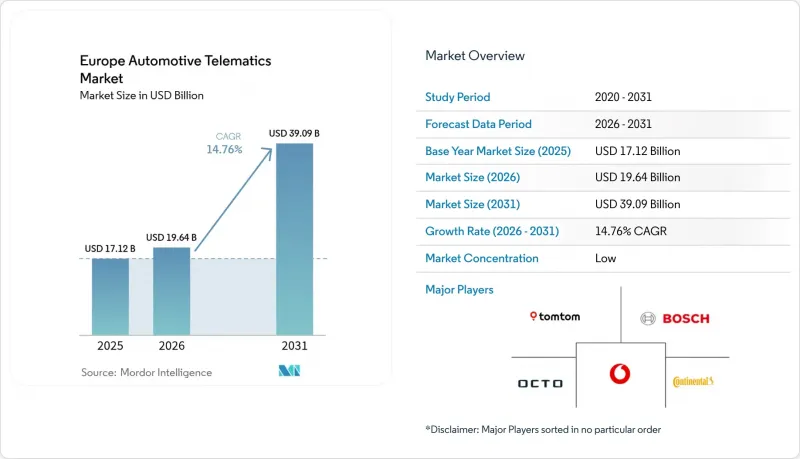
本報告按服務(資訊娛樂與導航、車隊管理、安全保障及其他)、銷售管道(OEM原廠配套、售後市場)、連接解決方案(嵌入式及其他)、車輛類型(摩托車及其他)、最終用戶(個人消費者、車隊營運商及其他)和國家/地區進行細分。市場預測以美元計價。
歐洲車用通訊系統市場的趨勢與洞察
車隊管理領域的數位化浪潮
歐洲車隊營運商正擴大採用遠端資訊處理技術進行路線最佳化、駕駛員績效管理和預測性維護。這些措施旨在防止燃油盜竊、最大限度地減少停機時間並提高客戶滿意度。案例研究表明,預測性維護可以顯著減少意外停機。此外,地理圍籬技術正在簡化交付證明工作流程,從而縮短計費週期並提高營運效率。一家知名車隊管理平台最近的一項調查顯示,相當一部分歐洲車隊經理計劃在不久的將來擴大遠端資訊處理技術的應用。其動機包括應對日益嚴格的排放氣體法規以及更清晰地了解電動車的投資回報率 (ROI)。平台整合趨勢日益顯著,例如,一家技術供應商收購了一家行動出行部門,將硬體、連接和軟體整合到一份合約中。這種方法簡化了整合流程,並顯著降低了車隊購買者的總擁有成本 (TCO),使其成為更具吸引力的企業選擇。
歐洲5G和V2X部署
歐洲互聯設施(CEF)正投入大量資金,在數千公里的高速公路沿線安裝路側單元(ROU)。這項計畫旨在實現協同自適應主動式車距維持定速系統和車隊行駛,從而顯著降低卡車油耗。德國高速公路和法國A10高速公路等主要公路正處於C-V2X部署的前沿。汽車製造商正積極將高通和恩智浦的先進晶片組整合到即將推出的車型中,以滿足預期的監管要求。除了提升安全性之外,低延遲5G技術的整合也將催生遠距駕駛穿梭巴士試驗和動態限速資訊分發等創新應用。這些進步進一步證明了持續投資基礎建設的必要性。
GDPR合規成本增加
根據《一般資料保護規則》(GDPR),遠端資訊處理服務提供者必須整合使用者許可管理儀表板,在資料儲存和傳輸過程中實施加密,並長期維護詳細的稽核日誌。這些法律和技術要求顯著增加了專案成本,對缺乏足夠資源和專門團隊來確保合規的中小型售後市場營運商構成了挑戰。此外,GDPR 也使商業化流程更加複雜和漫長,因為在啟動新的分析或獲利計畫之前必須進行隱私影響評估。擁有 ISO 27001 等認證和即時使用者許可管理系統的公司可以吸引那些優先考慮風險緩解的企業車隊。然而,這些公司需要承擔更高的營運成本,這可能會導致注重成本的客戶選擇合規措施較不嚴格的替代方案。
細分市場分析
到2025年,車隊管理將佔業務收益的36.94%,並將繼續成為歐洲車用通訊系統市場的基石。其價值提案顯而易見:即時追蹤可減少燃油竊盜,駕駛員培訓可預防事故,路線最佳化可縮短交付時間,從而全面提升車隊生產力和客戶滿意度。其次是診斷和預測性維護,它使車隊能夠從被動維護轉向基於狀態的維護,從而減少停機時間。安全模組受益於eCall部署數量的不斷成長,但隨著這些功能成為標配,利潤空間正受到擠壓。
V2X 和 OTA 服務雖然目前規模較小,但卻是成長最快的類別,複合年成長率高達 16.95%。 OTA 更新使汽車製造商能夠在車輛的整個生命週期內引入新功能和安全補丁,從而降低召回成本並持續創造收入。 V2X 支援協同駕駛和路口預警,將車輛定位為更廣泛交通網路中的節點。保險遠端資訊處理的成長主要集中在英國和義大利等高滲透率市場,這些市場的保費基於里程和使用情況,並為安全駕駛的駕駛員提供折扣。隨著服務的不斷發展,預計歐洲車用通訊系統市場中 OTA 模組的市場規模將超過傳統安全功能,這標誌著該平台正在從「追蹤」轉向「持續軟體交付」。
受監管要求和汽車製造商管理資料足跡的需求驅動,OEM整合式遠端資訊處理系統將在2025年佔總部署量的79.71%。工廠安裝的系統與CAN總線深度整合,可實現遠端診斷和安全的OTA韌體更新。這種緊密整合也保障了資料所有權,而資料所有權是基於訂閱服務模式的先決條件。
售後市場正以16.48%的複合年成長率快速成長,不僅滿足了擁有2018年之前生產的車輛的車隊的需求,也吸引了那些希望在不購買新車的情況下獲得保險折扣的成本意識強的消費者。即插即用的OBD-II適配器和硬佈線追蹤器能夠以大約三分之一的OEM解決方案成本實現更快的升級。隨著2G/3G網路的逐步淘汰,許多老舊的售後設備正逐漸被淘汰,從而推動了對4G/5G相容設備的需求成長。未來,預計OEM製造商將保持較大的市場佔有率,而售後市場將繼續滿足改裝需求,最終達到平衡狀態。這一趨勢凸顯了歐洲車用通訊系統市場中監管要求與對高度適應性解決方案的需求之間的相互作用。
其他好處:
- Excel格式的市場預測(ME)表
- 3個月的分析師支持
目錄
第1章:引言
- 研究假設和市場定義
- 調查範圍
第2章:調查方法
第3章執行摘要
第4章 市場狀況
- 市場概覽
- 市場促進因素
- 歐盟的「eCall」計畫和安全法規正在起到推動作用。
- 車隊管理領域的數位化浪潮
- 市場對車載資訊娛樂和導航系統的需求正在激增。
- 歐洲5G和V2X部署
- 與環境、社會及治理 (ESG) 相關的二氧化碳排放報告要求
- OEM廠商推動軟體定義營收成長
- 市場限制因素
- GDPR合規成本不斷上升
- 小型汽車嵌入式硬體的高物料清單 (BOM)
- OEM資料模式碎片化
- 與逐步淘汰 2G/3G 網路相關的維修費用
- 價值供應鏈分析
- 監理情勢
- 技術展望
- 波特五力模型
第5章 市場規模與成長預測
- 按服務
- 資訊娛樂和導航
- 車隊管理
- 安全保障
- 診斷和預測性診斷
- 保險遠端資訊處理
- V2X 和 OTA 更新
- 按銷售管道類型分類
- 原廠適配
- 售後市場
- 連接解決方案
- 嵌入式
- 智慧型手機整合
- 有線/可攜式
- 車輛類型
- 摩托車
- 搭乘用車
- 掀背車
- 轎車
- 運動型多用途車(SUV)
- 多用途車輛
- 輕型商用車
- 中型和重型商用車輛
- 最終用戶
- 一般消費者
- 車隊營運商
- 保險和租賃公司
- 汽車共享和出行服務提供者
- 國家
- 德國
- 英國
- 法國
- 義大利
- 西班牙
- 俄羅斯
- 其他歐洲國家
第6章 競爭情勢
- 市場集中度
- 策略趨勢
- 市佔率分析
- 公司簡介
- Continental AG
- Robert Bosch GmbH
- TomTom International BV.(Webfleet Solutions)
- Octo Group SpA
- Targa Telematics
- Vodafone Automotive
- Harman International
- Verizon Connect
- MiX Telematics
- CalAmp Corp.
- Teltonika Telematics
- Ruptela UAB
- Visteon Corporation
- Aptiv
- ACTIA Group
第7章 市場機會與未來展望
According to Mordor Intelligence, Europe automotive telematics market size in 2026 is estimated at USD 19.64 billion, growing from 2025 value of USD 17.12 billion with 2031 projections showing USD 39.09 billion, growing at 14.76% CAGR over 2026-2031.
This report is Segmented by Service (Infotainment and Navigation, Fleet Management, Safety and Security, and More), Sales Channel Type (OEM-Fitted and Aftermarket), Connectivity Solution (Embedded, and More), Vehicle Type (Two-Wheelers, and More), End-User (Private Consumers, Fleet Operators, and More), and Country. Market Forecasts are Provided in Terms of Value (USD).
Europe Automotive Telematics Market Trends and Insights
Fleet-Management Digitization Wave
European fleets are increasingly adopting telematics for route optimization, driver scorecarding, and predictive maintenance. These efforts aim to combat fuel theft, minimize downtime, and enhance customer satisfaction. Deployments reveal that predictive maintenance can significantly reduce unplanned stoppages. Additionally, geofencing streamlines proof-of-delivery workflows, helping to accelerate invoicing cycles and improve operational efficiency. A recent survey from a prominent fleet-management platform highlighted that a substantial portion of European fleet managers intend to broaden their telematics usage in the near future. Their motivations include addressing stricter emission regulations and achieving better visibility into the return on investment for electric vehicles. The trend of platform consolidation is becoming more evident, as demonstrated by a technology vendor acquiring a mobility unit to integrate hardware, connectivity, and software into a single contract. This approach simplifies integration processes and significantly reduces the total cost of ownership for fleet buyers, making it a more attractive option for businesses.
5G and V2X Rollout Across Europe
The Connecting Europe Facility has allocated significant funding to equip thousands of kilometers of highways with roadside units. This effort is designed to enable cooperative adaptive cruise control and platooning, which can lead to notable reductions in truck fuel consumption. Key corridors, such as Germany's autobahn and France's A10, are at the forefront of C-V2X implementation. Original Equipment Manufacturers are proactively embedding advanced chipsets from Qualcomm and NXP into upcoming vehicle models to align with anticipated regulatory requirements. In addition to improving safety, the integration of 5G technology, with its low latency capabilities, supports innovative applications like remote-driven shuttle pilots and dynamic speed-limit broadcasts. These advancements further reinforce the rationale for sustained investments in infrastructure development.
GDPR Compliance Cost Inflation
Telematics providers are required to incorporate consent dashboards, implement encryption during data storage and transmission, and maintain extensive audit logs for an extended period, as mandated by the General Data Protection Regulation (GDPR). These legal and technical requirements significantly increase program costs, creating challenges for smaller aftermarket players that often lack the resources or dedicated teams to ensure compliance. Additionally, GDPR complicates and lengthens the commercialization process, as privacy-impact assessments must be conducted before launching any new analytic or monetization initiative. Companies that achieve recognized certifications, such as ISO 27001, and implement real-time consent management systems can appeal to enterprise fleets that prioritize risk mitigation. However, these firms face higher operational costs, which may drive cost-conscious customers to opt for alternatives with less stringent compliance measures.
Other drivers and restraints analyzed in the detailed report include:
- OEM Push for Software-Defined Revenue
- EU eCall and Safety-Mandate Tailwinds
- 2G/3G Sunset Retrofit Burden
For complete list of drivers and restraints, kindly check the Table Of Contents.
Segment Analysis
Fleet management accounted for 36.94% of 2025 service revenue and remains the backbone of the Europe automotive telematics market. The value proposition is concrete: real-time tracking reduces fuel theft, driver coaching prevents accidents, and route optimization shortens delivery windows, collectively enhancing fleet productivity and customer satisfaction. Diagnostics and prognostics are next in line, enabling fleets to transition from reactive to condition-based maintenance, thereby reducing downtime. Safety and security modules benefit from the eCall installed base, yet margins compress as the features become standard.
V2X and OTA services, although smaller today, are the fastest-growing categories, with a 16.95% CAGR. OTA updates enable automakers to introduce new features and security patches throughout a vehicle's life, thereby reducing recall costs and generating recurring revenue. V2X enables cooperative driving and intersection warnings, positioning vehicles as nodes within a larger transportation network. Insurance telematics growth is concentrated in high-penetration markets such as the UK and Italy, where usage-based policies reward safe driving with lower premiums. As services evolve, the Europe automotive telematics market size for OTA modules is expected to surpass that of legacy safety features, underscoring a shift in platform from tracking to continuous software delivery.
OEM-installed telematics represented 79.71% of total 2025 deployments, driven by regulatory mandates and automakers' need to control data footprints. Factory systems integrate deeply with the CAN bus, enabling remote diagnostics and secure OTA firmware updates. This tight integration also safeguards data ownership, a prerequisite for subscription-based service models.
The aftermarket is expanding at 16.48% CAGR, addressing fleets with pre-2018 vehicles and appealing to cost-sensitive consumers who seek insurance discounts without buying new cars. Plug-and-play OBD-II dongles and hard-wired trackers cost roughly one-third of OEM solutions and can be upgraded more quickly. With the phase-out of 2G/3G networks, many legacy aftermarket devices are becoming obsolete, leading to a growing preference for 4G/5G-compatible units. Over time, the market is expected to reach a balance, with original equipment manufacturers dominating a significant share while the aftermarket segment continues to cater to retrofit needs. This trend underscores the interplay between regulatory requirements and the demand for adaptable solutions within the European automotive telematics market.
Complete Report Scope:
- By Service
- Infotainment and Navigation
- Fleet Management
- Safety and Security
- Diagnostics and Prognostics
- Insurance Telematics
- V2X and OTA Updates
- By Sales Channel Type
- OEM-fitted
- Aftermarket
- By Connectivity Solution
- Embedded
- Integrated-smartphone
- Tethered / Portable
- By Vehicle Type
- Two-Wheelers
- Passenger Cars
- Hatchbacks
- Sedans
- Sports Utility Vehicles
- Multi Puropse Vehicles
- Light Commercial Vehicles
- Medium and Heavy Commercial Vehicles
- By End-User
- Private Consumers
- Fleet Operators
- Insurance and Leasing Firms
- Car-Sharing and Mobility Providers
- By Country
- Germany
- United Kingdom
- France
- Italy
- Spain
- Russia
- Rest of Europe
List of Companies Covered in this Report:
- Continental AG
- Robert Bosch GmbH
- TomTom International BV. (Webfleet Solutions)
- Octo Group S.p.A
- Targa Telematics
- Vodafone Automotive
- Harman International
- Verizon Connect
- MiX Telematics
- CalAmp Corp.
- Teltonika Telematics
- Ruptela UAB
- Visteon Corporation
- Aptiv
- ACTIA Group
Additional Benefits:
- The market estimate (ME) sheet in Excel format
- 3 months of analyst support
TABLE OF CONTENTS
1 Introduction
- 1.1 Study Assumptions and Market Definition
- 1.2 Scope of the Study
2 Research Methodology
3 Executive Summary
4 Market Landscape
- 4.1 Market Overview
- 4.2 Market Drivers
- 4.2.1 EU ecall and Safety-Mandate Tailwinds
- 4.2.2 Fleet-Management Digitization Wave
- 4.2.3 Infotainment and Navigation Demand Surge
- 4.2.4 5G and V2X Rollout Across Europe
- 4.2.5 ESG-Linked CO2 Reporting Requirements
- 4.2.6 OEM Push for Software-Defined Revenue
- 4.3 Market Restraints
- 4.3.1 GDPR Compliance Cost Inflation
- 4.3.2 High Embedded-Hardware BOM in Small Cars
- 4.3.3 Fragmented OEM Data Schemas
- 4.3.4 2G/3G Sunset Retrofit Burden
- 4.4 Value / Supply-Chain Analysis
- 4.5 Regulatory Landscape
- 4.6 Technological Outlook
- 4.7 Porter's Five Forces
- 4.7.1 Bargaining Power of Suppliers
- 4.7.2 Bargaining Power of Buyers
- 4.7.3 Threat of New Entrants
- 4.7.4 Threat of Substitutes
- 4.7.5 Industry Rivalry
5 Market Size and Growth Forecasts (Value, USD)
- 5.1 By Service
- 5.1.1 Infotainment and Navigation
- 5.1.2 Fleet Management
- 5.1.3 Safety and Security
- 5.1.4 Diagnostics and Prognostics
- 5.1.5 Insurance Telematics
- 5.1.6 V2X and OTA Updates
- 5.2 By Sales Channel Type
- 5.2.1 OEM-fitted
- 5.2.2 Aftermarket
- 5.3 By Connectivity Solution
- 5.3.1 Embedded
- 5.3.2 Integrated-smartphone
- 5.3.3 Tethered / Portable
- 5.4 By Vehicle Type
- 5.4.1 Two-Wheelers
- 5.4.2 Passenger Cars
- 5.4.2.1 Hatchbacks
- 5.4.2.2 Sedans
- 5.4.2.3 Sports Utility Vehicles
- 5.4.2.4 Multi Puropse Vehicles
- 5.4.3 Light Commercial Vehicles
- 5.4.4 Medium and Heavy Commercial Vehicles
- 5.5 By End-User
- 5.5.1 Private Consumers
- 5.5.2 Fleet Operators
- 5.5.3 Insurance and Leasing Firms
- 5.5.4 Car-Sharing and Mobility Providers
- 5.6 By Country
- 5.6.1 Germany
- 5.6.2 United Kingdom
- 5.6.3 France
- 5.6.4 Italy
- 5.6.5 Spain
- 5.6.6 Russia
- 5.6.7 Rest of Europe
6 Competitive Landscape
- 6.1 Market Concentration
- 6.2 Strategic Moves
- 6.3 Market Share Analysis
- 6.4 Company Profiles (Includes Global level Overview, Market level overview, Core Segments, Financials as available, Strategic Information, Market Rank/Share for key companies, Products & Services, and Recent Developments)
- 6.4.1 Continental AG
- 6.4.2 Robert Bosch GmbH
- 6.4.3 TomTom International BV. (Webfleet Solutions)
- 6.4.4 Octo Group S.p.A
- 6.4.5 Targa Telematics
- 6.4.6 Vodafone Automotive
- 6.4.7 Harman International
- 6.4.8 Verizon Connect
- 6.4.9 MiX Telematics
- 6.4.10 CalAmp Corp.
- 6.4.11 Teltonika Telematics
- 6.4.12 Ruptela UAB
- 6.4.13 Visteon Corporation
- 6.4.14 Aptiv
- 6.4.15 ACTIA Group
7 Market Opportunities & Future Outlook

 東南亞車載資訊服務:市場佔有率分析、產業趨勢與統計及成長預測(2026-2031 年)
 2026-2030年全球汽車售後市場遠端資訊處理市場
 全球車用通訊系統市場:按服務、車輛類型、外形尺寸、產品/服務、連接方式、車隊管理服務和地區分類-預測至2033年亞太地區車載資訊服務:市場佔有率分析、產業趨勢與統計及成長預測(2026-2031 年)歐洲車載資訊服務:市場佔有率分析、產業趨勢與統計及成長預測(2026-2031 年)車用通訊系統系統:市場佔有率分析、行業趨勢和統計數據、成長預測(2026-2031 年)
 車載資訊服務市場 - 全球預測,2026-2032 年
 全球汽車遠端資訊處理市場(第11版)租賃車輛遠端資訊處理(第四版)
 車用通訊系統市場預測至2034年:按類型、產品、連接方式、動力方式、應用、最終用戶和地區分類的全球分析