


 |
市場調查報告書
商品編碼
2113818
車用通訊系統系統:市場佔有率分析、行業趨勢和統計數據、成長預測(2026-2031 年)Automotive Telematics System - Market Share Analysis, Industry Trends & Statistics, Growth Forecasts (2026 - 2031) |
||||||

※ 本網頁內容可能與最新版本有所差異。詳細情況請與我們聯繫。
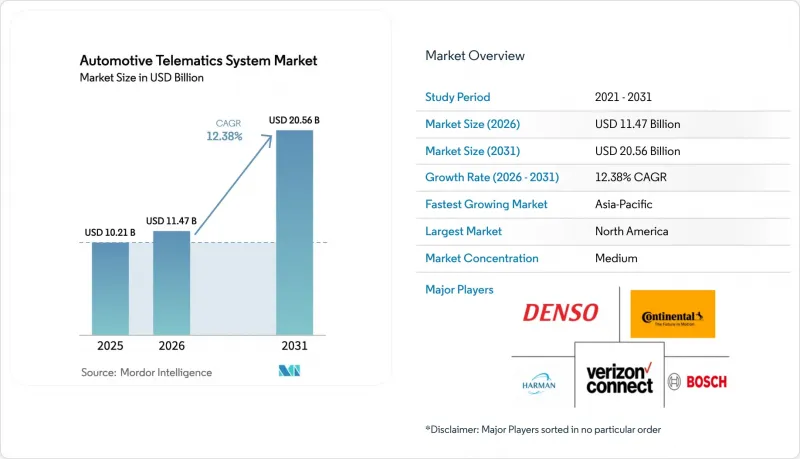
據 Mordor Intelligence 稱,車用通訊系統系統市場預計到 2026 年價值 114.7 億美元,高於 2025 年的 102.1 億美元,預計到 2031 年將達到 205.6 億美元。
預計 2026 年至 2031 年的複合年成長率為 12.38%。
本報告按服務(資訊娛樂導航、車隊管理等)、銷售管道(OEM原廠配套、售後市場)、連接解決方案(嵌入式、智慧型手機連接等)、車輛類型(摩托車、乘用車等)、最終用戶(個人消費者、車隊營運商等)和地區進行細分。市場規模和預測均以美元計價。
全球車用通訊系統系統市場趨勢與洞察
政府對 eCall 和類似技術的監管正在推動基本網路連接的發展。
歐盟的eCall法規以及俄羅斯和巴西類似法規下強制實施的緊急呼叫系統,已將行動電話模組列為新乘用車的標準配置,為付費附加服務奠定了基礎。亞太地區各國也制定了類似的框架,確保車用通訊系統市場(即使在低成本細分市場)的最低滲透率。汽車製造商正利用這些強制性硬體提供高價值的遠距離診斷和被盜車輛找回服務,從而提高每輛車的平均收入。一級供應商正在積極回應,推出整合5G TCU,以滿足事故通知和空中下載(OTA)更新的需求。因此,規模經濟正在推動部署量的增加,降低單位成本,並促進其在大眾市場的更廣泛應用。
在燃油價格波動的情況下,最佳化車輛運行的需求日益成長。
柴油和汽油價格的波動持續擠壓物流行業的利潤空間,迫使車隊營運商實施即時遠端資訊處理技術,以減少怠速時間和遏制危險駕駛。研究表明,啟用高級路線導航和駕駛員培訓模組可降低10-15%的燃油成本。美國和英國的保險公司對車隊的分析發現,將遠端資訊處理數據與駕駛員培訓計劃相結合,可將事故和保險索賠率降低70%以上。公共產業、建設公司和市政服務機構目前正將遠端資訊處理技術納入其採購政策,將終端用戶群擴展到長途貨運之外。預測維護需求的人工智慧 (AI)附加元件功能進一步提高了運轉率,加快了平台投資回報,並加速了擁有多樣化資產的車隊採用該技術。
高成本的設備和資料方案成本阻礙了入門級市場的滲透。
在印度、巴西和東南亞等低利潤率的汽車細分市場,消費者對價格的敏感度正在抑制可選互聯功能的普及。由於家庭支出中很大一部分用於資料方案套餐,這些市場的合約續約尤其困難。當地行動電話營運商缺乏跨區域的M2M費率方案,也使出口變得更加複雜。硬體製造商正在努力縮小晶片組和系統模組的體積以降低組件成本,但預計到2025年,通貨膨脹的不利因素將抵消部分成本優勢。靈活的計量收費和政府對交通安全解決方案的獎勵可以緩解這些障礙,但這些措施的實施情況因地區而異。
細分市場分析
到2025年,車隊管理服務將佔車用通訊系統市場25.05%的佔有率,成為最大的收入來源。物流、公共產業和現場服務業的車隊依靠路線最佳化、燃油監控和駕駛員培訓來應對柴油價格波動,從而維持獲利能力。安全模組仍然是標準配置,預測性維護儀表板有助於防止代價高昂的路邊故障。與企業資源計畫 (ERP) 系統整合的診斷 API 已成為歐美車隊的標準配置,並在東南亞地區也越來越受歡迎。受軟體定義車輛 (SDV) 架構持續部署新功能的推動,V2X 和 OTA 服務的車用通訊系統市場規模預計將以 31.02% 的複合年成長率成長。汽車製造商正在採用雙無線電模組來同時支援蜂窩 V2X 和 5.9 GHz ITS-G5,從而實現協同感知、訊號優先級控制和空中韌體升級,以符合不斷發展的安全標準。
另一個需求來源是與保險公司的合作,他們將事故人工智慧重建功能添加到車聯網(V2X)資料饋送中,從而提高了責任評估的準確性。車載資訊娛樂供應商也從單向串流媒體轉向雙向雲端遊戲,這增加了資料方案的使用。諸如美國運輸部(DOT)的5G藍圖等政策舉措鼓勵交通基礎設施所有者實施車道級預警功能,從而促進公共和私有資料集整合的生態系統。因此,車載資訊服務平台整合了邊緣運算資源和虛擬化網路功能,以滿足不同服務層級的延遲和頻寬需求。
汽車製造商確保資料所有權並實現人機介面無縫整合,使得工廠出貨時裝載的車載資訊系統在2025年佔據了66.45%的收入。歐洲的eCall法規以及電動車遠端管理功能的日益普及,進一步推動了組裝上嵌入式系統的採用。同時,受老舊車輛改裝和私人車主對非連網汽車的需求成長的推動,車用通訊系統售後市場的佔有率預計將以19.2%的複合年成長率成長。售後市場供應商正透過快速安裝、獨立於設備的雲端控制面板和付費使用制合約來脫穎而出。
即使使用不同製造商的車輛,叫車業者也依賴售後解決方案來標準化數據並實現統一的車輛分析。然而,為了吸引開發者,原始設備製造商 (OEM) 正在開放免費增值 API,這可能會在中期內削弱售後附加元件產品的市場。歐盟資料法對資料可攜性的監管可能會使第三方服務供應商的議價能力增強,並重塑這些管道的經濟結構。
區域分析
北美地區保持主導地位,預計到2025年將佔全球收入的26.90%,這得益於其密集的4G/5G網路、成熟的車隊管理體係以及早期向基於使用量的保險模式的轉變。聯邦事故資料標準推動了開放API的普及,簡化了保險公司和執法機關的存取流程;同時,營運商逐步淘汰3G網路引發了一波硬體升級浪潮,主要針對長途運輸公司和配送車隊。售後市場的高滲透率與原廠安裝設備的成長相輔相成,因為擁有多品牌車輛的企業車隊需要一個統一的合規性報告儀錶板。
亞太地區是成長最快的地區,複合年成長率高達20.9%。這主要得益於中國強制實施的聯網汽車要求以及印度的商用車數位化法規(強制安裝AIS-140車載資訊系統單元)。為了滿足中國工業和資訊化部(工信部)的數據共用要求,當地汽車製造商正在新能源汽車中標準化4G模組,從而為增值應用打造龐大的嵌入式基礎。日本和韓國正在進行V2X走廊試點項目,展示低延遲安全訊息。與此同時,東南亞目前依賴智慧型手機解決方案的共享出行車輛正開始轉向嵌入式硬體,因為電動車保固需要更詳細的電池分析。區域電信業者正在建立跨國漫遊合作夥伴關係,以降低資料通訊成本,預計這項措施將在2026年至2027年間擴展到小規模的車隊。
在歐洲,市場預計將保持穩定成長,這得益於eCall的普遍普及以及利用遠端資訊處理數據進行實際檢驗的新型二氧化碳排放監測系統。儘管GDPR和即將推出的歐盟資料法規將增加營運的複雜性,但它們也將為注重隱私保護的分析供應商創造新的市場機會。中東和非洲地區雖然仍在發展中,但沿岸地區的智慧城市走廊和南非保險公司試點的基於里程的保險方案正在推動市場成長,並且隨著衛星物聯網和低功耗網路的應用,其覆蓋範圍正從城市中心擴展到其他地區。在全部區域,統一的聯合國歐洲經濟委員會網路安全法規正在生效,這將有助於採購符合規定的硬體,並使安全的空中升級功能成為高階和入門級車輛的強制性功能。
其他好處:
- Excel格式的市場預測(ME)表
- 3個月的分析師支持
目錄
第1章:引言
- 研究的先決條件
- 調查範圍
第2章:調查方法
第3章執行摘要
第4章 市場狀況
- 市場概覽
- 市場促進因素
- 政府電子呼叫系統和類似監管措施
- 燃油價格波動驅動了對車輛營運最佳化的需求。
- 保險公司推出萬能里程保險(UBI)。
- 電動車充電網路與遠端資訊處理平台的整合
- 利用 OEM API 市場實現車載資料貨幣化
- 聯合國歐洲經濟委員會即將推出的OTA網路安全法規(R155/R156)
- 市場限制因素
- 入門級車輛的終端和資料方案成本高昂
- 全球汽車半導體供不應求依然存在。
- 《消費者資料隱私與跨境資料主權法案》
- 各國對遠端資訊處理服務課稅的複雜性
- 價值供應鏈分析
- 監理情勢
- 技術展望
- 波特五力模型
第5章 市場規模與成長預測
- 按服務
- 資訊娛樂和導航
- 車隊管理
- 安全保障
- 診斷和預測性維護
- 保險遠端資訊處理
- V2X 和 OTA 更新
- 按銷售管道類型分類
- 原廠適配
- 售後市場
- 連接解決方案
- 嵌入式
- 智慧型手機整合
- 有線/可攜式
- 車輛類型
- 摩托車
- 搭乘用車
- 掀背車
- 轎車
- SUV 和 MPV
- 輕型商用車
- 中型和重型商用車輛
- 最終用戶
- 一般消費者
- 車隊營運商
- 保險和租賃公司
- 汽車共享和出行服務提供者
- 按地區
- 北美洲
- 美國
- 加拿大
- 其他北美國家
- 南美洲
- 巴西
- 阿根廷
- 其他南美國家
- 歐洲
- 德國
- 英國
- 法國
- 義大利
- 西班牙
- 俄羅斯
- 其他歐洲國家
- 亞太地區
- 中國
- 日本
- 印度
- 韓國
- 其他亞太國家
- 中東和非洲
- 埃及
- 土耳其
- 沙烏地阿拉伯
- 阿拉伯聯合大公國
- 其他中東和非洲國家
- 北美洲
第6章 競爭情勢
- 市場集中度
- 策略趨勢
- 市佔率分析
- 公司簡介
- Continental AG
- Robert Bosch GmbH
- Denso Corporation
- Visteon Corporation
- Aptiv plc
- Harman International(Samsung)
- Panasonic Automotive
- Valeo SA
- Marelli SpA
- Mitsubishi Electric Corp.
- LG Electronics
- Verizon Connect
- Octo Telematics
- Geotab Inc.
- Trimble Transportation
- ACTIA Group
- Samsara Inc.
- HERE Technologies
- Teltonika IoT Group
第7章 市場機會與未來展望
According to Mordor Intelligence, automotive telematics system market size in 2026 is estimated at USD 11.47 billion, growing from 2025 value of USD 10.21 billion with 2031 projections showing USD 20.56 billion, growing at 12.38% CAGR over 2026-2031.
This report is Segmented by Service (Infotainment & Navigation, Fleet Management and More), Sales Channel Type (OEM-Fitted and Aftermarket), Connectivity Solution (Embedded, Integrated-Smartphone and More), Vehicle Type (Two-Wheelers, Passenger Cars and More), End-User (Private Consumers, Fleet Operators and More) and Geography. The Market Sizes and Forecasts are Provided in Terms of Value (USD).
Global Automotive Telematics System Market Trends and Insights
Government eCall & Similar Mandates Drive Baseline Connectivity
Mandatory emergency-call systems under the EU eCall regulation and comparable rules in Russia and Brazil have made cellular modules standard equipment in new passenger cars, laying a foundation for added paid services. Countries in Asia-Pacific are drafting alike frameworks, ensuring the automotive telematics market keeps a minimum penetration rate even in budget segments. Automakers leverage this compulsory hardware for value-added remote diagnostics and stolen-vehicle recovery, which lifts average revenue per unit. Tier-1 suppliers respond with integrated 5G TCUs that meet both accident notification and over-the-air-update needs. The resulting installed base expedites scale economies, pushing unit costs down and facilitating wider mass-market deployment.
Fleet-Optimization Demand Intensifies Amid Fuel-Price Volatility
Diesel and gasoline price swings continue to pressure logistics margins, prompting fleets to adopt real-time telematics that cut idle time and penalize aggressive driving. Studies show 10-15% fuel-cost reduction when advanced routing and driver coaching modules are enabled. Insurer analyses covering US and UK fleets find crash and claim frequencies fall more than 70% once telematics data is fused with driver-training programs. Utilities, construction firms, and municipal services now embed telematics in procurement policies, broadening the end-user base beyond long-haul trucking. Artificial-intelligence add-ons that predict maintenance further improve uptime, increasing the platform's payback and accelerating adoption in mixed-asset fleets.
High Device & Data-Plan Costs Limit Entry-Level Market Penetration
Low-margin vehicle segments in India, Brazil and Southeast Asia face consumer price sensitivity that squeezes optional connectivity features. Data-plan fees constitute a larger share of household spending in these markets, making subscription renewals particularly challenging. Local mobile operators rarely provide pan-regional M2M tariffs, adding complexity to exports. Hardware makers are miniaturizing chipsets and system-on-modules to cut bill-of-materials costs, yet inflationary headwinds in 2025 offset part of the gain. Flexible pay-per-use plans and government incentives for road-safety solutions could mitigate the barrier but are unevenly implemented.
Other drivers and restraints analyzed in the detailed report include:
- Usage-Based-Insurance Adoption Accelerates Insurer Digital Transformation
- EV Charging-Network Integration Creates New Service Paradigms
- Semiconductor Shortages Disrupt Telematics Hardware Supply Chains
For complete list of drivers and restraints, kindly check the Table Of Contents.
Segment Analysis
Fleet-management services generated the largest revenue slice in 2025, capturing 25.05% of the automotive telematics market. Logistics, utilities, and field-service fleets rely on routing optimization, fuel monitoring, and driver coaching to maintain margins amid volatile diesel prices. Safety and security modules remain a staple, and predictive-maintenance dashboards help defer costly roadside breakdowns. Diagnostics APIs that integrate with enterprise resource-planning systems are now standard in Western fleets and are gaining traction in Southeast Asia. The automotive telematics market size for V2X & OTA services is projected to expand at 31.02% CAGR, propelled by software-defined vehicle architectures that demand continuous feature deployment. Automakers use dual-radio modules to support both cellular-V2X and 5.9 GHz ITS-G5, unlocking cooperative perception, traffic-signal priority, and over-the-air firmware upgrades that keep vehicles compliant with evolving safety standards.
Second-order demand sources include insurer partnerships that add crash-AI reconstruction to V2X data feeds, improving liability assessments. Infotainment vendors also see an upgraded pathway from one-way streaming to bi-directional cloud gaming, creating incremental data-plan usage. Policy initiatives such as the U.S. DOT's 5G Roadmap encourage transportation-infrastructure owners to enable lane-level warnings, fostering an ecosystem where public and private datasets converge. Consequently, telematics platforms bundle edge-computing resources and virtualized network functions to meet varying latency and bandwidth requirements across service tiers.
Factory-installed telematics controlled 66.45% of 2025 revenue as automakers seized data ownership and ensured seamless human-machine interface integration. European eCall mandates and proliferating EV remote-management features further support embedded adoption at the assembly line. The automotive telematics market share of aftermarket boxes, however, is set to escalate as legacy fleets and private owners retrofit non-connected vehicles, a segment growing at 19.2% CAGR. Aftermarket suppliers differentiate through rapid installation, device-agnostic cloud dashboards, and pay-as-you-go contracts.
Ride-hailing operators rely on aftermarket solutions to standardize data across mixed vehicle makes, enabling unified fleet analytics. Yet OEMs are countered by exposing freemium APIs to entice developers, which may cannibalize aftermarket add-ons over the medium term. Regulatory scrutiny over data portability under the EU Data Act could tip bargaining power toward third-party service providers, potentially reshaping channel economics.
Complete Report Scope:
- By Service
- Infotainment and Navigation
- Fleet Management
- Safety & Security
- Diagnostics and Prognostics
- Insurance Telematics
- V2X and OTA Updates
- By Sales Channel Type
- OEM-fitted
- Aftermarket
- By Connectivity Solution
- Embedded
- Integrated-smartphone
- Tethered / Portable
- By Vehicle Type
- Two-Wheelers
- Passenger Cars
- Hatchbacks
- Sedans
- SUVs and MPVs
- Light Commercial Vehicles
- Medium and Heavy Commercial Vehicles
- By End-User
- Private Consumers
- Fleet Operators
- Insurance and Leasing Firms
- Car-Sharing and Mobility Providers
- By Geography
- North America
- United States
- Canada
- Rest of North America
- South America
- Brazil
- Argentina
- Rest of South America
- Europe
- Germany
- United Kingdom
- France
- Italy
- Spain
- Russia
- Rest of Europe
- Asia-Pacific
- China
- Japan
- India
- South Korea
- Rest of Asia-Pacific
- Middle East and Africa
- Egypt
- Turkey
- Saudi Arabia
- United Arab of Emirates
- Rest of Middle East and Africa
- North America
Geography Analysis
North America retained leadership with 26.90% of 2025 revenue, supported by dense 4G/5G coverage, mature fleet-management adoption, and early migration to usage-based insurance. Federal crash-data standards encourage open APIs that simplify insurer and law-enforcement access, while carrier sunsets of 3G networks drove a wave of hardware upgrades across long-haul carriers and delivery fleets. Strong aftermarket penetration complements factory-fit growth because mixed-brand enterprise fleets require uniform dashboards for compliance reporting.
Asia-Pacific is the fastest-growing territory at a 20.9% CAGR, propelled by China's connected-vehicle mandates and India's commercial-vehicle digitization rules that make AIS-140 telematics units compulsory. Local automakers pre-install 4G modules in new-energy vehicles to comply with MIIT data-sharing requirements, generating a large, embedded base for value-added apps. Japan and South Korea run V2X corridor pilots that showcase low-latency safety messages, while Southeast Asian ride-hailing fleets rely on smartphone-centric solutions that are beginning to migrate toward embedded hardware as electric-vehicle warranties demand deeper battery analytics. Regional telecom operators are forming cross-border roaming alliances to cut data costs, a move likely to lift small-fleet adoption in 2026-2027.
Europe delivers steady growth underpinned by universal eCall compliance and emerging CO2-emission monitoring schemes that use telematics payloads for real-world verification. GDPR and the forthcoming EU Data Act raise operating complexity but also create new market space for privacy-preserving analytics vendors. The Middle East and Africa, though still nascent, gain momentum from Gulf smart-city corridors and South African insurers piloting mileage-based premiums, with satellite-IoT and low-power networks extending reach beyond urban centers. Harmonized UNECE cybersecurity rules apply across these regions, guiding procurement toward compliant hardware and making secure over-the-air update capability a non-negotiable feature for both premium and entry-level vehicles.
- Continental AG
- Robert Bosch GmbH
- Denso Corporation
- Visteon Corporation
- Aptiv plc
- Harman International (Samsung)
- Panasonic Automotive
- Valeo SA
- Marelli SpA
- Mitsubishi Electric Corp.
- LG Electronics
- Verizon Connect
- Octo Telematics
- Geotab Inc.
- Trimble Transportation
- ACTIA Group
- Samsara Inc.
- HERE Technologies
- Teltonika IoT Group
Additional Benefits:
- The market estimate (ME) sheet in Excel format
- 3 months of analyst support
TABLE OF CONTENTS
1 Introduction
- 1.1 Study Assumptions
- 1.2 Scope of the Study
2 Research Methodology
3 Executive Summary
4 Market Landscape
- 4.1 Market Overview
- 4.2 Market Drivers
- 4.2.1 Government eCall & similar mandates
- 4.2.2 Fleet-optimization demand amid fuel-price volatility
- 4.2.3 Usage-based-insurance (UBI) adoption by insurers
- 4.2.4 EV charging-network integration with telematics platforms
- 4.2.5 Monetization of in-vehicle data via OEM API marketplaces
- 4.2.6 Upcoming UNECE OTA-cyber-security regulations (R155/R156)
- 4.3 Market Restraints
- 4.3.1 High device & data-plan cost for entry-level vehicles
- 4.3.2 Persistent global automotive semiconductor shortages
- 4.3.3 Consumer data-privacy & cross-border data-sovereignty laws
- 4.3.4 Country-specific telematics service taxation complexity
- 4.4 Value / Supply-Chain Analysis
- 4.5 Regulatory Landscape
- 4.6 Technological Outlook
- 4.7 Porter's Five Forces
- 4.7.1 Threat of New Entrants
- 4.7.2 Bargaining Power of Buyers
- 4.7.3 Bargaining Power of Suppliers
- 4.7.4 Threat of Substitutes
- 4.7.5 Intensity of Competitive Rivalry
5 Market Size & Growth Forecasts (Value, USD)
- 5.1 By Service
- 5.1.1 Infotainment and Navigation
- 5.1.2 Fleet Management
- 5.1.3 Safety & Security
- 5.1.4 Diagnostics and Prognostics
- 5.1.5 Insurance Telematics
- 5.1.6 V2X and OTA Updates
- 5.2 By Sales Channel Type
- 5.2.1 OEM-fitted
- 5.2.2 Aftermarket
- 5.3 By Connectivity Solution
- 5.3.1 Embedded
- 5.3.2 Integrated-smartphone
- 5.3.3 Tethered / Portable
- 5.4 By Vehicle Type
- 5.4.1 Two-Wheelers
- 5.4.2 Passenger Cars
- 5.4.2.1 Hatchbacks
- 5.4.2.2 Sedans
- 5.4.2.3 SUVs and MPVs
- 5.4.3 Light Commercial Vehicles
- 5.4.4 Medium and Heavy Commercial Vehicles
- 5.5 By End-User
- 5.5.1 Private Consumers
- 5.5.2 Fleet Operators
- 5.5.3 Insurance and Leasing Firms
- 5.5.4 Car-Sharing and Mobility Providers
- 5.6 By Geography
- 5.6.1 North America
- 5.6.1.1 United States
- 5.6.1.2 Canada
- 5.6.1.3 Rest of North America
- 5.6.2 South America
- 5.6.2.1 Brazil
- 5.6.2.2 Argentina
- 5.6.2.3 Rest of South America
- 5.6.3 Europe
- 5.6.3.1 Germany
- 5.6.3.2 United Kingdom
- 5.6.3.3 France
- 5.6.3.4 Italy
- 5.6.3.5 Spain
- 5.6.3.6 Russia
- 5.6.3.7 Rest of Europe
- 5.6.4 Asia-Pacific
- 5.6.4.1 China
- 5.6.4.2 Japan
- 5.6.4.3 India
- 5.6.4.4 South Korea
- 5.6.4.5 Rest of Asia-Pacific
- 5.6.5 Middle East and Africa
- 5.6.5.1 Egypt
- 5.6.5.2 Turkey
- 5.6.5.3 Saudi Arabia
- 5.6.5.4 United Arab of Emirates
- 5.6.5.5 Rest of Middle East and Africa
- 5.6.1 North America
6 Competitive Landscape
- 6.1 Market Concentration
- 6.2 Strategic Moves
- 6.3 Market Share Analysis
- 6.4 Company Profiles (Includes Global Level Overview, Market Level Overview, Core Segments, Financials as Available, Strategic Information, Market Rank/Share for Key Companies, Products & Services, and Recent Developments)
- 6.4.1 Continental AG
- 6.4.2 Robert Bosch GmbH
- 6.4.3 Denso Corporation
- 6.4.4 Visteon Corporation
- 6.4.5 Aptiv plc
- 6.4.6 Harman International (Samsung)
- 6.4.7 Panasonic Automotive
- 6.4.8 Valeo SA
- 6.4.9 Marelli SpA
- 6.4.10 Mitsubishi Electric Corp.
- 6.4.11 LG Electronics
- 6.4.12 Verizon Connect
- 6.4.13 Octo Telematics
- 6.4.14 Geotab Inc.
- 6.4.15 Trimble Transportation
- 6.4.16 ACTIA Group
- 6.4.17 Samsara Inc.
- 6.4.18 HERE Technologies
- 6.4.19 Teltonika IoT Group
7 Market Opportunities & Future Outlook
- 7.1 White-space & Unmet-need Assessment

 東南亞車載資訊服務:市場佔有率分析、產業趨勢與統計及成長預測(2026-2031 年)
 2026-2030年全球汽車售後市場遠端資訊處理市場
 全球車用通訊系統市場:按服務、車輛類型、外形尺寸、產品/服務、連接方式、車隊管理服務和地區分類-預測至2033年亞太地區車載資訊服務:市場佔有率分析、產業趨勢與統計及成長預測(2026-2031 年)歐洲車用通訊系統:市場佔有率分析、行業趨勢和統計數據以及成長預測(2026-2031 年)歐洲車載資訊服務:市場佔有率分析、產業趨勢與統計及成長預測(2026-2031 年)
 車載資訊服務市場 - 全球預測,2026-2032 年
 全球汽車遠端資訊處理市場(第11版)租賃車輛遠端資訊處理(第四版)
 車用通訊系統市場預測至2034年:按類型、產品、連接方式、動力方式、應用、最終用戶和地區分類的全球分析