


 |
市場調查報告書
商品編碼
2125629
德國自助倉儲:市場佔有率分析、產業趨勢與統計及成長預測(2026-2031)Germany Self Storage - Market Share Analysis, Industry Trends & Statistics, Growth Forecasts (2026 - 2031) |
||||||

※ 本網頁內容可能與最新版本有所差異。詳細情況請與我們聯繫。
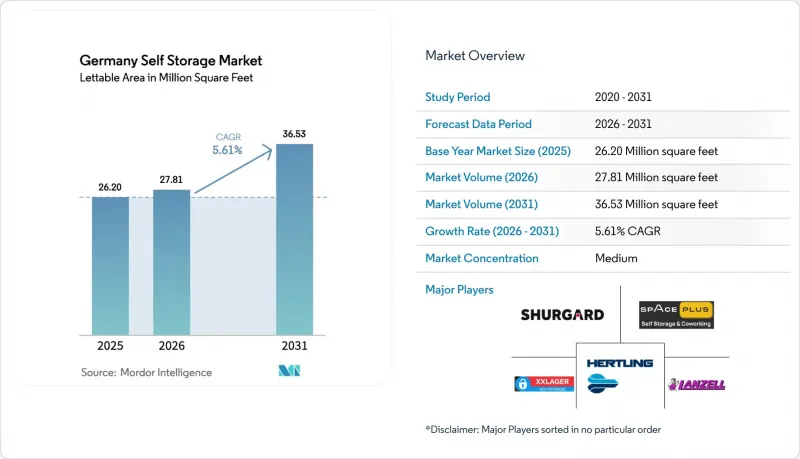
根據 Mordor Intelligence 預測,德國自助倉儲市場預計將從 2025 年的 2,620 萬平方英尺成長到 2026 年的 2,781 萬平方英尺,到 2031 年達到 3,653 萬平方英尺,2026 年至 2031 年的複合年成長率預計為 5.61%。
本報告按最終用戶(個人和企業)、儲存空間大小(小型和中型單位(小於 40 平方英尺)、大型單位(40 平方英尺及以上)和其他)、儲存類型(空調和非空調)以及所有權類型(自有和租賃)進行細分。市場預測以體積(百萬平方英尺)為單位。
德國自助倉儲市場趨勢與洞察
都市化和平均居住面積縮小
德國持續的都市區進程導致人均居住面積減少,引發了將多餘物品轉移到外部設施的結構性轉變。預計到2024年,單人居住將佔所有住房單位的41.9%,但2020年至2024年間,新建公寓的平均面積卻縮水了約3平方公尺。在柏林和慕尼黑,每平方公尺的租金溢價已超過20歐元(約21.40美元),促使居民將自助倉儲作為一種經濟實惠的「替代空間」。服務提供者透過提供包括代客取貨、數位化庫存管理和保險在內的捆綁服務,吸引客戶簽訂多年合約。更長的居住提高了入住率的穩定性,並使業主能夠將與通貨膨脹掛鉤的租金上漲轉嫁給租戶,這一趨勢支撐了德國自助倉儲市場的穩健發展。由於地方政府的高密度住房計畫預計將進一步減少居住空間,因此受此因素驅動的需求預計至少到 2030 年仍將保持在高位。
電子商務的發展以及中小企業的庫存需求。
2024年,電子商務佔德國零售總額的15.1%,小包裹量超過43億件。沒有專屬倉庫的小規模企業紛紛在高速公路交會處附近租用倉儲空間,用於存放暢銷商品,並為隔天達服務做準備。萊茵-魯爾區的一些企業提供配備貨架和裝卸平台的倉儲單元,租金溢價高達兩位數,入住率接近滿租,推動了德國自助倉儲市場的短期成長。企業租戶願意為便捷的營運支付額外費用,這有助於抵消個人需求的季節性波動,從而為按小時而非固定占地面積。
嚴格的區域分類法規和漫長的規劃核准流程
根據德國建築規範(Baugesetzbuch),許多混合用途區域禁止自助倉儲,迫使開發商轉向郊區工業區。在巴伐利亞州,強制性的影響評估和與當地居民舉行的公開聽證會意味著,新建待開發區設施的核准需要18到24個月。在柏林和漢堡,歷史建築保護區的規定禁止建築立面改動,這阻礙了透過改造現有建築進行再開發的機會。漫長的授權流程帶來的持有成本降低了獲利能力,這使得擁有長期持有土地財力的投資者更佔優勢,並阻礙了德國自助倉儲市場的自然成長。同時,小規模的參與企業傾向於改造租賃物業,因為這些物業的規劃限制較少,但這些位置通常不太顯眼,迫使他們依賴數位行銷來吸引客戶。
細分市場分析
預計到2025年,個人租戶將佔德國倉儲容量的73.92%,凸顯了德國自助倉儲市場作為家庭擴展儲存空間解決方案的發展趨勢。都市區通常將季節性體育用品、紀念品和傳家寶家具等物品存放在外部倉儲單元,將其視為家庭的半永久性附屬空間。營運商正透過實施嚴格的保險、針對特定物品的條碼管理以及全天候智慧型手機存取系統來應對這一需求,以確保個人需求能夠保持穩定的收入來源,儘管增速較為溫和。目前規模較小的企業用戶正以6.37%的複合年成長率成長,這反映了電子商務企業、建築公司和專業服務公司儲存客戶文件的需求。據Suergard稱,企業租戶在德國的收入佔比為28%,但其實際佔用面積僅22%,這意味著盈利仍有很大的提升空間。
在整個預測期內,個人需求的成長預計將會放緩,但仍將受到城市密度和人口結構變化的支持。倉儲設施業者會根據樓層分類建築空間,將底層和直達通道分配給每天運送托盤貨物的中小型企業,而將樓上樓層提供給每年僅使用幾次的普通家庭。這種空間分層設計可以最大限度地提高每平方英尺的收入,並平衡尖峰負載。隨著德國自助倉儲產業採用動態定價,此策略的重要性日益突顯。企業用戶透過增加工作日的訪客數量以及提高接受小包裹等輔助服務的利用率,為實現除純租金之外的收入來源多元化做出了貢獻。
到2025年,面積小於40平方英尺的單位將佔總庫存的47.34%,這反映了都市區生活空間供應緊張的現狀,同時也得益於其較高的周轉率,從而可以進行更精細的價格調整。面積大於40平方英尺的較大單元的複合年成長率更高,達到5.84%,這主要是因為中小企業需要靠近都市區配送路線的貨架空間。配備Sensorberg技術的智慧鎖可以實現對較大單位的無人值守管理,簡化送貨司機的出入流程,並減輕安全管理的負擔。營運商正在維修舊式佈局,拆除內部隔牆,並將連續區域合併,以滿足庫存水準波動較大的企業租戶的需求。
儘管每平方英尺租金增速略有放緩,但大型倉位的月租金表現依然強勁,在企業使用量不斷成長的地區,整體淨營業收入(NOI)也因此得到提升。同時,在人口密集的地區,微型儲物櫃和雙層堆疊式倉位被廣泛用作宅配收發箱,這展現了德國自助倉儲市場尺寸策略的靈活性。基於物聯網佔用感測器捕捉到的季度需求趨勢,業主們正利用模組化隔間靈活調整倉位尺寸,打造高度靈活的資產組合,既能滿足個人需求的下降,又能應對企業庫存的激增。
其他好處:
- Excel格式的市場預測(ME)表
- 3個月的分析師支持
目錄
第1章:引言
- 研究假設和市場定義
- 調查範圍
第2章:調查方法
第3章執行摘要
第4章 市場狀況
- 市場概覽
- 市場促進因素
- 都市化和平均住宅面積縮小
- 電子商務的成長以及中小企業對庫存的需求。
- 學生和上班族遷往住宅的趨勢正在加速。
- 投資者的熱情和機構投資者的資金投入正在推動這些設施的快速擴張。
- 企業文件保存要求正在推動異地文件儲存的普及。
- 智慧門鎖和透過應用程式實現的 24/7 全天候訪問,使得在二線城市創建無人微型商店成為可能。
- 市場限制因素
- 限制性分區規劃和冗長的規劃核准程序
- 都市區土地價格和建築成本不斷上漲
- 按需行動儲存新創公司之間的競爭日益激烈。
- ESG維修要求的收緊導致資本投資預算增加。
- 產業價值鏈分析
- 監理情勢
- 宏觀經濟因素的影響
- 波特五力分析
- 投資分析
- PESTLE分析
- 消費者在選擇自助倉儲設施時需要考慮的關鍵因素
- 德國市場動態
- 運轉率分析
- 平均租金趨勢
- 盈利分析
- 平均設施規模
第5章 市場規模及成長預測(單位)
- 最終用戶
- 對於個人
- 商業
- 按儲存容量
- 小型至中型單位(小於40平方英尺)
- 大型單元(40平方英尺或以上)
- 其他(置物櫃/雙層)
- 依儲存類型
- 溫控型
- 非溫控型
- 按所有權結構
- 所有權類型
- 租賃
第6章 競爭情勢
- 市場集中度
- 策略趨勢
- 市佔率分析
- 公司簡介
- Shurgard Self-Storage SA
- SelfStorage Dein Lagerraum GmbH(MyPlace Self-Storage)
- Space Plus Store GmbH
- Rousselet Groupe SA(HOMEBOX)
- Pickens Selfstorage GmbH
- Lagerbox Holding GmbH and Co. KG
- 1BOX Deutschland GmbH
- Storebox Holding GmbH
- ZeitLager GmbH
- XXLAGER Selfstorage GmbH
- BOXIE24 Deutschland GmbH
- Store Room Self-Storage
- SecurCare Self Storage
- KingBox Self-Storage GmbH
- CityBox24 GmbH
- CubeStorage Deutschland GmbH
- Jojo-Lagerhaus GmbH
- Easy-Selfstorage GmbH
- Container Self-Storage AG
第7章 市場機會與未來展望
According to Mordor Intelligence, the Germany self storage market size is expected to increase from 26.2 million square feet in 2025 to 27.81 million square feet in 2026 and reach 36.53 million square feet by 2031, growing at a CAGR of 5.61% over 2026-2031.
This report is Segmented by End-User (Personal, and Business), Storage Size (Small and Medium Units (Less Than 40 Sq Ft), Large Units (Above 40 Sq Ft), and More), Storage Type (Climate-Controlled, and Non-Climate-Controlled), Ownership Pattern (Owned, and Leased). The Market Forecasts are Provided in Terms of Volume (Million Sq Ft).
Germany Self Storage Market Trends and Insights
Urbanization and Shrinking Average Dwelling Size
Germany's sustained urban migration is compressing per-capita living area, triggering a structural hand-off of surplus belongings to external facilities. Single-person households reached 41.9% of total dwellings in 2024, while average new-build apartment sizes fell by roughly 3 square meters during 2020-2024. Berlin and Munich command rent premiums above EUR 20 (USD 21.4) per square meter, nudging tenants to treat self-storage as an affordable annex. Operators are bundling concierge retrieval, digital inventories, and insurance to lock customers into multi-year contracts. Longer dwell durations lift occupancy stability and let owners pass through inflation-linked escalators, a pattern that underpins the resilience of the Germany self-storage market. With room sizes set to tighten further under municipal densification plans, demand visibility on this driver remains high through at least 2030.
Growth in E-Commerce and SME Inventory Requirements
E-commerce penetration hit 15.1% of German retail sales in 2024 and parcel throughput topped 4.3 billion consignments. Small merchants that lack dedicated warehouses are leasing storage bays near autobahn interchanges to stage fast-moving SKUs for next-day dispatch. Rhine-Ruhr operators outfitting units with pallet racking and loading docks command double-digit rent premiums and near-full occupancy, reinforcing the short-cycle growth of the Germany self-storage market. Business tenants' willingness to pay for operational features helps balance seasonal volatility in personal demand and provides upside for revenue-management systems that price space by hourly access rather than static square footage.
Restrictive Zoning and Lengthy Planning Approvals
Germany's Baugesetzbuch framework excludes self-storage from many mixed-use zones, pushing developers to outlying industrial parcels. In Bavaria, approvals for greenfield facilities stretch 18-24 months due to mandatory impact assessments and community hearings. Heritage overlays in Berlin and Hamburg bar facade changes, stalling adaptive-reuse opportunities. Carrying costs during protracted entitlements erode returns and favor deep-pocketed investors that can warehouse land, hampering the organic scaling pace of the Germany self-storage market. Smaller entrants instead gravitate toward leased conversions where zoning hurdles are lower, but those sites often lack prime visibility and must rely on digital marketing to capture demand.
Other drivers and restraints analyzed in the detailed report include:
- Investor Appetite and Institutional Capital Driving Rapid Facility Expansion
- Accelerating Residential Mobility Among Students and Professionals
- Escalating Urban Land and Construction Costs
For complete list of drivers and restraints, kindly check the Table Of Contents.
Segment Analysis
Personal tenants occupied 73.92% of capacity in 2025, underscoring how the Germany self-storage market evolved as a household space-extension solution. Urban renters store seasonal sports gear, archived memorabilia, and heirloom furniture, often treating external units as semi-permanent home annexes. Operators have responded with curated insurance, item-level barcoding, and 24/7 smartphone-based entry, ensuring that personal demand remains a stable revenue pillar despite modest growth. Business users, although currently smaller, are scaling at a 6.37% CAGR, reflecting e-commerce sellers, trades contractors, and professional-services firms archiving client files. Shurgard notes that corporate renters deliver 28% of German revenue while occupying 22% of square footage, highlighting stronger yield potential.
Over the forecast horizon, personal demand growth moderates but remains structurally supported by urban densification and demographic churn. Facility operators segment buildings by floor, dedicating ground-level and drive-up bays to SMEs shipping palletized inventory daily, while upper floors cater to households that access units only a few times per year. This spatial stratification maximizes revenue per square foot and balances peak usage loads, a tactic increasingly critical as the Germany self-storage industry integrates dynamic pricing engines. Business occupants reinforce weekday traffic and raise ancillary-service uptake, such as receipt-handling and parcel dispatch, thereby diversifying income streams beyond pure rent.
Units below 40 square feet held 47.34% of total inventory in 2025, mirroring tight urban living but also benefiting from high turnover that enables granular repricing. Large bays above 40 square feet enjoy a faster 5.84% CAGR because SMEs need pallet-racked space close to urban delivery corridors. Sensorberg-enabled smart locks now allow unmanned control of oversized units, streamlining access for van drivers and reducing security overhead. Operators retrofit older layouts, removing internal walls to stitch together contiguous zones that appeal to commercial renters with variable inventory volumes.
Larger bays deliver superior absolute monthly rent even though square-foot rates moderate slightly, lifting facility-level NOI where enterprise adoption is rising. Conversely, micro-lockers and double-stacked configurations are flourishing as courier drop-boxes in dense neighborhoods, underlying the versatility of sizing strategies within the Germany self-storage market. Owners leverage modular partitions to pivot between size mixes according to quarterly demand signals captured via IoT occupancy sensors, creating a nimble asset base that can capture both personal downsizing waves and business inventory bursts.
Complete Report Scope:
- By End-User
- Personal
- Business
- By Storage Size
- Small and Medium Units (Less than 40 sq ft)
- Large Units (Above 40 sq ft)
- Others (Lockers/Double-Stacked)
- By Storage Type
- Climate-Controlled
- Non-Climate-Controlled
- By Ownership Pattern
- Owned
- Leased
List of Companies Covered in this Report:
- Shurgard Self-Storage SA
- SelfStorage Dein Lagerraum GmbH (MyPlace Self-Storage)
- Space Plus Store GmbH
- Rousselet Groupe SA (HOMEBOX)
- Pickens Selfstorage GmbH
- Lagerbox Holding GmbH and Co. KG
- 1BOX Deutschland GmbH
- Storebox Holding GmbH
- ZeitLager GmbH
- XXLAGER Selfstorage GmbH
- BOXIE24 Deutschland GmbH
- Store Room Self-Storage
- SecurCare Self Storage
- KingBox Self-Storage GmbH
- CityBox24 GmbH
- CubeStorage Deutschland GmbH
- Jojo-Lagerhaus GmbH
- Easy-Selfstorage GmbH
- Container Self-Storage AG
Additional Benefits:
- The market estimate (ME) sheet in Excel format
- 3 months of analyst support
TABLE OF CONTENTS
1 INTRODUCTION
- 1.1 Study Assumptions and Market Definition
- 1.2 Scope of the Study
2 RESEARCH METHODOLOGY
3 EXECUTIVE SUMMARY
4 MARKET LANDSCAPE
- 4.1 Market Overview
- 4.2 Market Drivers
- 4.2.1 Urbanisation and Shrinking Average Dwelling Size
- 4.2.2 Growth in E-Commerce and SME Inventory Requirements
- 4.2.3 Accelerating Residential Mobility Among Students and Professionals
- 4.2.4 Investor Appetite and Institutional Capital Driving Rapid Facility Expansion
- 4.2.5 Corporate Archiving Mandates Boosting Off-Site Document Storage
- 4.2.6 Smart-Lock and App-Based 24/7 Access Enabling Unmanned Micro-Stores in Tier-2 Cities
- 4.3 Market Restraints
- 4.3.1 Restrictive Zoning and Lengthy Planning Approvals
- 4.3.2 Escalating Urban Land and Construction Costs
- 4.3.3 Intensifying Competition from On-Demand Mobile Storage Start-Ups
- 4.3.4 Stricter ESG Retrofit Requirements Inflating CapEx Budgets
- 4.4 Industry Value Chain Analysis
- 4.5 Regulatory Landscape
- 4.6 Impact of Macroeconomic Factors
- 4.7 Porter's Five Forces Analysis
- 4.7.1 Bargaining Power of Suppliers
- 4.7.2 Bargaining Power of Buyers
- 4.7.3 Threat of New Entrants
- 4.7.4 Threat of Substitutes
- 4.7.5 Intensity of Competitive Rivalry
- 4.8 Investment Analysis
- 4.9 PESTEL Analysis
- 4.10 Key Considerations of Consumers while Selecting a Self-Storage Facility
- 4.11 Market Dynamics in Germany
- 4.11.1 Analysis of Occupancy Rates
- 4.11.2 Average Rental Trends
- 4.11.3 Profitability Analysis
- 4.11.4 Average Facility Size
5 MARKET SIZE AND GROWTH FORECASTS (UNIT)
- 5.1 By End-User
- 5.1.1 Personal
- 5.1.2 Business
- 5.2 By Storage Size
- 5.2.1 Small and Medium Units (Less than 40 sq ft)
- 5.2.2 Large Units (Above 40 sq ft)
- 5.2.3 Others (Lockers/Double-Stacked)
- 5.3 By Storage Type
- 5.3.1 Climate-Controlled
- 5.3.2 Non-Climate-Controlled
- 5.4 By Ownership Pattern
- 5.4.1 Owned
- 5.4.2 Leased
6 COMPETITIVE LANDSCAPE
- 6.1 Market Concentration
- 6.2 Strategic Moves
- 6.3 Market Share Analysis
- 6.4 Company Profiles (includes Global Level Overview, Market Level Overview, Core Segments, Financials as available, Strategic Information, Market Rank/Share, Products and Services, Recent Developments)
- 6.4.1 Shurgard Self-Storage SA
- 6.4.2 SelfStorage Dein Lagerraum GmbH (MyPlace Self-Storage)
- 6.4.3 Space Plus Store GmbH
- 6.4.4 Rousselet Groupe SA (HOMEBOX)
- 6.4.5 Pickens Selfstorage GmbH
- 6.4.6 Lagerbox Holding GmbH and Co. KG
- 6.4.7 1BOX Deutschland GmbH
- 6.4.8 Storebox Holding GmbH
- 6.4.9 ZeitLager GmbH
- 6.4.10 XXLAGER Selfstorage GmbH
- 6.4.11 BOXIE24 Deutschland GmbH
- 6.4.12 Store Room Self-Storage
- 6.4.13 SecurCare Self Storage
- 6.4.14 KingBox Self-Storage GmbH
- 6.4.15 CityBox24 GmbH
- 6.4.16 CubeStorage Deutschland GmbH
- 6.4.17 Jojo-Lagerhaus GmbH
- 6.4.18 Easy-Selfstorage GmbH
- 6.4.19 Container Self-Storage AG
7 MARKET OPPORTUNITIES AND FUTURE OUTLOOK
- 7.1 White-Space and Unmet-Need Assessment

 新加坡自助倉儲:市場佔有率分析、產業趨勢與統計及成長預測(2026-2031)越南自助倉儲:市場佔有率分析、產業趨勢與統計及成長預測(2026-2031)亞太地區自助倉儲:市場佔有率分析、產業趨勢與統計及成長預測(2026-2031)歐洲自助倉儲:市場佔有率分析、產業趨勢與統計及成長預測(2026-2031 年)美國自助倉儲:市場佔有率分析、產業趨勢與統計及成長預測(2026-2031)自助倉儲:市場佔有率分析、產業趨勢與統計、成長預測(2026-2031)
 城市按需儲存服務市場預測至2034年-按服務類型、儲存格式、預訂模式、儲存容量、服務期限、最終用戶和地區分類的全球分析
 自助倉儲市場規模、佔有率、趨勢和預測:按儲存單元規模、最終用途和地區分類,2026-2034 年
 2026年全球自助倉儲市場報告
 自助倉儲市場:2026-2032年全球市場預測(按單位類型、租賃期限、單位面積、存取方式及最終用戶分類)