


 |
市場調查報告書
商品編碼
2116006
越南自助倉儲:市場佔有率分析、產業趨勢與統計及成長預測(2026-2031)Vietnam Self-Storage - Market Share Analysis, Industry Trends & Statistics, Growth Forecasts (2026 - 2031) |
||||||

※ 本網頁內容可能與最新版本有所差異。詳細情況請與我們聯繫。
越南自助倉儲市場預計到 2026 年將達到 1.2752 億美元,高於 2025 年的 1.1 億美元,預計到 2031 年將達到 2.6665 億美元。
預計從 2026 年到 2031 年,其複合年成長率將達到 15.93%。
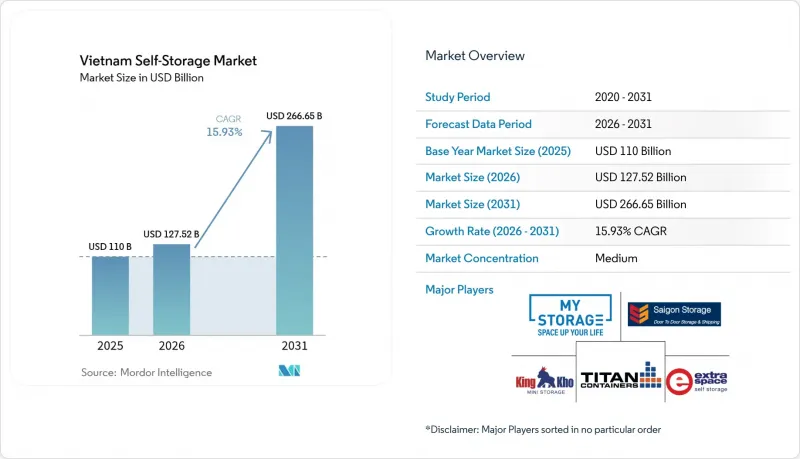
本報告按最終用戶(個人、企業)、設施類型(空調、非空調、代客/全方位服務、貨櫃式戶外)、單元面積(100平方英尺)和用途(私人住宅、季節性商品、家具存儲、商業庫存、電子商務)進行細分。市場預測以美元(USD)計價。
越南自助倉儲市場趨勢及洞察
都市區生活空間的萎縮正在推動異地儲存的需求。
在越南主要城市,單間公寓和一房出租房的數量穩定成長,在胡志明市,這類房型佔新租屋合約的40%。鑑於越南的住宅中位數是家庭收入中位數的32.5倍,居民不可避免地需要尋找安全的戶外收納空間。為此,越南自助倉儲市場的營運商正將多層倉儲設施選址在環城公路沿線,這些區域的地價相對較低,且靠近人口密集的住宅。由於都市區土地資源短缺是長期趨勢,營運商對投資建設具備全天候存取和遠端監控功能的專用設施充滿信心。在預測期內,這些設施將形成一個分散式網路,並隨著城市發展而不斷擴展,從而顯著推動越南自助倉儲市場的長期成長。
電子商務中小企業對微型倉配空間的需求
預計到2023年,越南線上零售市場規模將超過200億美元,並持續以每年約29%的速度成長。因此,小規模經銷商越來越需要靠近客戶的可擴展庫存儲存場所。靈活的租賃協議、計量型模式以及內建的條碼追蹤功能,使自助倉儲成為一種極具吸引力的選擇,它介於使用家中空餘房間作為臨時存儲空間和使用大型倉庫之間。領先的營運商正在將儲存空間改造為微型倉配中心,透過結合基於雲端的管理控制面板、與末端配送服務商的合作以及安全的卸貨區域來實現這一目標。越南自助倉儲市場受益於更快的入庫和出庫週期,從而實現了同一面積內更高的周轉率。雖然需求主要集中在胡志明市和河內,但隨著電子商務物流的成熟,類似的趨勢也開始在其他區域城市出現。
市中心土地短缺推高了設施成本。
第一區和第三區的黃金位置是周邊地區的數倍,這給新建設的可行性帶來了壓力。整修成多層設施可以部分緩解土地短缺,但結構維修成本高。許多業者正將目光轉向環城公路沿線的地塊,這些地塊的進入門檻更低,並依靠接駁車接送服務來方便客戶。雖然這些措施持續擴大了越南的自助倉儲市場,但也導致潛在複合年成長率下降了幾個百分點,尤其對於長期資本有限的新參與企業更是如此。
細分市場分析
受都市區中產階級購買力不斷增強的推動,消費者群體預計到2025年將佔越南自助倉儲市場佔有率的67.20%。隨著住宅日益萎縮,越來越多的家庭將笨重的家具、季節性裝飾品和休閒設備存放在異地單元中,這構成了基本運轉率的基礎。雖然由都市區推動的越南自助倉儲市場規模預計將穩步成長,但其成長速度將低於企業需求。目前規模較小的企業市場預計到2031年將以18.58%的複合年成長率成長,這反映出中小企業(SME)標準化營運並尋求規範化倉儲的趨勢。為了抓住這個市場,營運商正在實施即插即用的庫存管理入口網站、條碼掃描和溫控通道,以符合新的包裝法規和生產者責任召回(EPR)規則。
由於商品週轉速度比家居用品更快,商業領域的成長動能直接轉化為每平方英尺收入的提升。揀貨、包裝和最後一公里配送等加值物流服務,在基本租金之外創造了額外的收入來源。在整個調查期間,交叉銷售保險、季節性剩餘空間的利用以及隔夜包裹服務進一步提升了越南自助倉儲行業的平均單位收入。成功的倉儲設施位置於主要交通網路附近,既服務都市區宅配業者,也服務住宅客戶,且不影響交通便利性。這種需求的融合緩解了運轉率的波動,並支撐了越南自助倉儲市場的長期成長。
至2025年,非空調儲物間將佔越南自助倉儲市場規模的56.40%。這是因為它們價格適中,能夠滿足大多數日常需求。然而,高濕度和溫度的快速變化會對電子產品、藝術品和木製古董造成損害。目前,濕度低於55%、環境溫度低於攝氏25度C的空調儲物空間正逐漸佔據市場佔有率,受到富裕收藏家和企業檔案館的青睞。差異化策略包括配備高效能空氣微粒過濾器(HEPA)的通風系統、遠端環境監控以及階梯式定價以促進提升銷售。營運商預測,高階市場的成長速度將超過普通市場,從而擴大越南自助倉儲市場的單元類型和總收入。
代客泊車和全方位服務模式預計將以22.85%的複合年成長率成長,它們通過直接從客戶處取貨並將其存儲在集中式倉庫中,解決了“最後一公里”配送難題。雖然這種模式在倉儲空間方面的資本負擔較低,但它需要路線最佳化軟體和耐多溫區配送車輛,而這些功能擴大透過與科技公司的合作來提供。戶外貨櫃式倉儲的目標客戶是需要超大或不規則形狀空間的建設公司和活動承包商,通常位置大都會郊區的工業區。每種類型的設施都服務於不同的客戶群,這凸顯了越南自助倉儲市場正在多元化發展,以滿足多層次的需求,同時又不損害其核心價值提案。
其他好處:
- Excel格式的市場預測(ME)表
- 3個月的分析師支持
目錄
第1章:引言
- 研究假設和市場定義
- 調查範圍
第2章:調查方法
第3章執行摘要
第4章 市場狀況
- 市場概覽
- 市場促進因素
- 一線城市生活空間的萎縮正在推動異地儲存的需求。
- 電子商務中小企業對微型倉配空間的需求
- 外籍人士和數位遊民的湧入推動了對短期儲存的需求。
- 由於住宅裝修和混合辦公模式的興起,對家具儲物空間的需求激增。
- 政府推行微型企業正規註冊制度,意味著倉儲必須符合法規。
- 越來越多的富裕收藏家正在尋找有空調的家具。
- 市場限制因素
- 市中心土地稀缺導致設施租金上漲。
- 模糊的許可框架導致許可證核准流程延誤。
- 胡志明市以外的消費者意識較低。
- 外匯波動導致進口模組化單元的資本投資出現波動
- 價值供應鏈分析
- 監管和許可展望
- 波特五力分析
- 新冠疫情對越南自助倉儲市場的影響
- 投資和資金籌措分析
第5章 市場規模與成長預測
- 最終用戶
- 一般消費者
- 商業
- 依設施類型
- 溫度和濕度控制設施
- 沒有空調的設施
- 代客泊車/全方位倉儲服務
- 貨櫃式戶外存儲
- 按單位大小
- 超過 25 平方英尺(儲物櫃)
- 26-50平方英尺(小型)
- 51-100平方英尺(中等大小)
- 100平方英尺或以下(大)
- 按應用用例
- 家居用品
- 季節性商品和體育用品
- 家居裝修的家具和儲物解決方案
- 商用庫存和文件
- 電子商務微型倉配
- 按地區(城市)
- 胡志明市
- 河內
- 峴港及中部沿海地區
- 東南工業部(平陽省、同奈省)
- 其他地區(芹苴和湄公河地區、北部省份)
第6章 競爭情勢
- 市場集中度
- 策略趨勢
- 市佔率分析
- 公司簡介
- KingKho Mini Storage
- MyStorage
- Saigon Storage
- TITAN Containers Vietnam
- Extra Space Asia
- Cube Self Storage Vietnam
- StorHub Self Storage
- SpaceBox Self Storage
- Boxful
- WorkStore Enabler Vietnam
- Keep It Storage
- Kho247
- Self Storage Co Vietnam
- 247Boxes Storage
- StorageTree Vietnam
- FlexStorage VN
- OneBox Self Storage
- U-Space Vietnam
- Central Self Storage VN
- Vietnam Moving and Self Storage
第7章 市場機會與未來展望
According to Mordor Intelligence, the Vietnam self-storage market size in 2026 is estimated at USD 127.52 million, growing from 2025 value of USD 110 million with 2031 projections showing USD 266.65 million, growing at 15.93% CAGR over 2026-2031.
This report is Segmented by End-User (Consumer, Business), Facility Type (Climate-Controlled, Non-Climate-Controlled, Valet/Full-Service, Containerised Outdoor), Unit Size ( 100 Sq Ft), and Application Use-Case (Personal Household, Seasonal Items, Furniture Storage, Business Inventory, E-Commerce). The Market Forecasts are Provided in Terms of Value (USD).
Vietnam Self-Storage Market Trends and Insights
Shrinking Urban Living Space Boosting Off-Site Storage
Vietnam's largest cities see a steady rise in studio and one-bedroom rentals, with 40% of new leases in Ho Chi Minh City fitting that description. When coupled with median home prices equal to 32.5 times median household income, residents inevitably look beyond their walls for secure storage. Operators in the Vietnam self-storage market respond by positioning multi-story sites along ring roads where land is cheaper yet still close to dense residential clusters. The long-run nature of urban land compression gives providers the confidence to invest in purpose-built facilities equipped with 24/7 access and remote monitoring. Over the forecast horizon, these sites form a distributed grid that expands in step with city sprawl and contributes materially to the long-term growth of the Vietnam self-storage market.
E-Commerce SMEs' Need for Micro-Fulfillment Space
With national online retail surpassing USD 20 billion in 2023 and rising roughly 29% each year, small sellers require scalable inventory points near customers. Flexible leases, pay-as-you-go fees, and embedded barcode tracking make self-storage an attractive middle ground between improvised spare-room stockpiles and full-scale warehousing. Leading operators now bundle cloud-based management dashboards, last-mile courier tie-ups, and secure unloading bays, effectively turning storage corridors into micro-fulfillment nodes. The Vietnam self-storage market benefits because the same square footage can earn higher turnover as goods cycle in and out more rapidly. Demand is densest in Ho Chi Minh City and Hanoi, yet secondary cities begin to emulate this pattern as regional e-commerce logistics mature.
Scarce Central-District Land Elevating Facility Costs
Prime sites inside District 1 and District 3 cost multiples of peripheral zones, squeezing feasibility for ground-up builds. Multi-story conversions of obsolete retail and commercial property partially offset land scarcity but carry higher structural retrofit expenses. Many operators pivot to ring-road parcels where entry costs are affordable, then rely on shuttle pickup to maintain customer convenience. These work-arounds keep the Vietnam self-storage market expanding yet shave a few points off potential CAGR, especially for entrants lacking patient capital.
Other drivers and restraints analyzed in the detailed report include:
- Expat and Digital-Nomad Influx Driving Short-Term Demand
- Home-Renovation and Hybrid-Work Furniture Storage Spike
- Ambiguous Licensing Framework Causing Permitting Delays
For complete list of drivers and restraints, kindly check the Table Of Contents.
Segment Analysis
The consumer segment retained 67.20% of Vietnam self-storage market share in 2025 on the back of rising urban middle-class purchasing power. Shrinking apartments mean families send bulky furniture, seasonal decor, and recreational gear to off-site units, anchoring baseline occupancy. Vietnam self-storage market size attributable to urban residents is expected to advance steadily but at a lower clip than business demand. The business cohort, currently smaller, is expanding at an 18.58% CAGR to 2031, reflecting the surge of SMEs formalizing operations and seeking compliant storage. Operators courting this segment roll out plug-and-play inventory portals, barcode scanning, and temperature-monitored aisles that align with new packaging and EPR rules.
Momentum in the business segment feeds directly into higher revenue per square foot because turnover of parcels is faster than household belongings. Value-added logistics, such as pick-and-pack or last-mile dispatch desks, generate fee layers beyond core rent. Throughout the review period, the Vietnam self-storage industry sees cross-selling of insurance, seasonal surplus space, and late-night access packages as incremental boosters of average unit revenue. Successful facilities locate near arterial transport links to serve both city couriers and residential customers without sacrificing accessibility. This blend of demand cushions occupancy cycles and sustains the long-term trajectory of the Vietnam self-storage market.
Non-climate-controlled rooms commanded 56.40% of Vietnam self-storage market size in 2025 because they satisfy the majority of everyday needs at accessible price points. High humidity and temperature swings, however, pose risks to electronics, artwork, and wooden antiques. Wealthier collectors and corporate archives now account for a growing slice of bookings in climate-controlled aisles where humidity remains under 55% and ambient temperature stays below 25 °C. Differentiation strategies involve HEPA-filtered ventilation, remote environmental monitoring, and tiered pricing that encourages upsell. Operators forecast the premium tier to grow faster than the general pool, widening both unit spread and total revenue within the Vietnam self-storage market.
Valet and full-service concepts, on track for 22.85% CAGR, solve last-mile pain points by picking up items directly from customers and storing them in centralized depots. This format is capital-light on storefront space yet demands route-optimization software and multi-temperature vans, capabilities increasingly sourced through tech partnerships. Outdoor containerized storage targets construction firms and event contractors needing oversized or irregular-shape space, often in industrial belts outside the urban ring. Each facility archetype serves a distinct client set, underscoring how the Vietnam self-storage market diversifies to capture multiple layers of demand without diluting its core proposition.
Complete Report Scope:
- By End-User
- Consumer
- Business
- By Facility Type
- Climate-Controlled Facilities
- Non-Climate-Controlled Facilities
- Valet / Full-Service Storage
- Containerised Outdoor Storage
- By Unit Size
- Greater than 25 sq ft (Locker)
- 26 - 50 sq ft (Small)
- 51 - 100 sq ft (Medium)
- Less than 100 sq ft (Large)
- By Application Use-Case
- Personal Household Goods
- Seasonal Items and Sports Gear
- Furniture and Renovation Storage
- Business Inventory and Documents
- E-commerce Micro-Fulfillment
- By Geography (City)
- Ho Chi Minh City
- Hanoi
- Da Nang and Central Coast
- South-East Industrial Provinces (Binh Duong, Dong Nai)
- Other Regions (Can Tho and Mekong, Northern Provinces)
List of Companies Covered in this Report:
- KingKho Mini Storage
- MyStorage
- Saigon Storage
- TITAN Containers Vietnam
- Extra Space Asia
- Cube Self Storage Vietnam
- StorHub Self Storage
- SpaceBox Self Storage
- Boxful
- WorkStore Enabler Vietnam
- Keep It Storage
- Kho247
- Self Storage Co Vietnam
- 247Boxes Storage
- StorageTree Vietnam
- FlexStorage VN
- OneBox Self Storage
- U-Space Vietnam
- Central Self Storage VN
- Vietnam Moving and Self Storage
Additional Benefits:
- The market estimate (ME) sheet in Excel format
- 3 months of analyst support
TABLE OF CONTENTS
1 INTRODUCTION
- 1.1 Study Assumptions and Market Definition
- 1.2 Scope of the Study
2 RESEARCH METHODOLOGY
3 EXECUTIVE SUMMARY
4 MARKET LANDSCAPE
- 4.1 Market Overview
- 4.2 Market Drivers
- 4.2.1 Shrinking Urban Living Space in Tier-1 Cities Boosting Off-Site Storage
- 4.2.2 E-commerce SMEs' Need for Micro-Fulfillment Space
- 4.2.3 Expat and Digital-Nomad Influx Driving Short-Term Storage Demand
- 4.2.4 Home-Renovation and Hybrid-Work Furniture Storage Spike
- 4.2.5 Government Push to Formalize Micro-Businesses Requiring Compliant Storage
- 4.2.6 Rising Affluent Collectors Seeking Climate-Controlled Units
- 4.3 Market Restraints
- 4.3.1 Scarce Central-District Land Elevating Facility Rental Costs
- 4.3.2 Ambiguous Licensing Framework Causing Permitting Delays
- 4.3.3 Low Consumer Awareness Beyond Ho Chi Minh City
- 4.3.4 FX-Driven Capex Volatility for Imported Modular Units
- 4.4 Value / Supply-Chain Analysis
- 4.5 Regulatory and Licensing Outlook
- 4.6 Porter's Five Forces Analysis
- 4.6.1 Threat of New Entrants
- 4.6.2 Bargaining Power of Buyers/Consumers
- 4.6.3 Bargaining Power of Suppliers
- 4.6.4 Threat of Substitutes
- 4.6.5 Intensity of Competitive Rivalry
- 4.7 Impact of COVID-19 on the Vietnam Self-Storage Market
- 4.8 Investment and Funding Analysis
5 MARKET SIZE AND GROWTH FORECASTS (VALUE)
- 5.1 By End-User
- 5.1.1 Consumer
- 5.1.2 Business
- 5.2 By Facility Type
- 5.2.1 Climate-Controlled Facilities
- 5.2.2 Non-Climate-Controlled Facilities
- 5.2.3 Valet / Full-Service Storage
- 5.2.4 Containerised Outdoor Storage
- 5.3 By Unit Size
- 5.3.1 Greater than 25 sq ft (Locker)
- 5.3.2 26 - 50 sq ft (Small)
- 5.3.3 51 - 100 sq ft (Medium)
- 5.3.4 Less than 100 sq ft (Large)
- 5.4 By Application Use-Case
- 5.4.1 Personal Household Goods
- 5.4.2 Seasonal Items and Sports Gear
- 5.4.3 Furniture and Renovation Storage
- 5.4.4 Business Inventory and Documents
- 5.4.5 E-commerce Micro-Fulfillment
- 5.5 By Geography (City)
- 5.5.1 Ho Chi Minh City
- 5.5.2 Hanoi
- 5.5.3 Da Nang and Central Coast
- 5.5.4 South-East Industrial Provinces (Binh Duong, Dong Nai)
- 5.5.5 Other Regions (Can Tho and Mekong, Northern Provinces)
6 COMPETITIVE LANDSCAPE
- 6.1 Market Concentration
- 6.2 Strategic Moves
- 6.3 Market Share Analysis
- 6.4 Company Profiles (includes Global-level Overview, Market-level Overview, Core Segments, Financials as available, Strategic Information, Market Rank/Share, Products and Services, Recent Developments)
- 6.4.1 KingKho Mini Storage
- 6.4.2 MyStorage
- 6.4.3 Saigon Storage
- 6.4.4 TITAN Containers Vietnam
- 6.4.5 Extra Space Asia
- 6.4.6 Cube Self Storage Vietnam
- 6.4.7 StorHub Self Storage
- 6.4.8 SpaceBox Self Storage
- 6.4.9 Boxful
- 6.4.10 WorkStore Enabler Vietnam
- 6.4.11 Keep It Storage
- 6.4.12 Kho247
- 6.4.13 Self Storage Co Vietnam
- 6.4.14 247Boxes Storage
- 6.4.15 StorageTree Vietnam
- 6.4.16 FlexStorage VN
- 6.4.17 OneBox Self Storage
- 6.4.18 U-Space Vietnam
- 6.4.19 Central Self Storage VN
- 6.4.20 Vietnam Moving and Self Storage
7 MARKET OPPORTUNITIES AND FUTURE OUTLOOK
- 7.1 White-Space and Unmet-Need Assessment

 德國自助倉儲:市場佔有率分析、產業趨勢與統計及成長預測(2026-2031)新加坡自助倉儲:市場佔有率分析、產業趨勢與統計及成長預測(2026-2031)亞太地區自助倉儲:市場佔有率分析、產業趨勢與統計及成長預測(2026-2031)歐洲自助倉儲:市場佔有率分析、產業趨勢與統計及成長預測(2026-2031 年)美國自助倉儲:市場佔有率分析、產業趨勢與統計及成長預測(2026-2031)自助倉儲:市場佔有率分析、產業趨勢與統計、成長預測(2026-2031)
 城市按需儲存服務市場預測至2034年-按服務類型、儲存格式、預訂模式、儲存容量、服務期限、最終用戶和地區分類的全球分析
 自助倉儲市場規模、佔有率、趨勢和預測:按儲存單元規模、最終用途和地區分類,2026-2034 年
 2026年全球自助倉儲市場報告
 自助倉儲市場:2026-2032年全球市場預測(按單位類型、租賃期限、單位面積、存取方式及最終用戶分類)