


 |
市場調查報告書
商品編碼
2123352
歐洲自助倉儲:市場佔有率分析、產業趨勢與統計及成長預測(2026-2031 年)Europe Self-storage - Market Share Analysis, Industry Trends & Statistics, Growth Forecasts (2026 - 2031) |
||||||

※ 本網頁內容可能與最新版本有所差異。詳細情況請與我們聯繫。
據 Mordor Intelligence 稱,2025 年歐洲自助倉儲市場價值 270 億美元,預計到 2031 年將達到 342.1 億美元,而 2026 年為 280.9 億美元,預測期(2026-2031 年)複合年成長率為 4.02%。
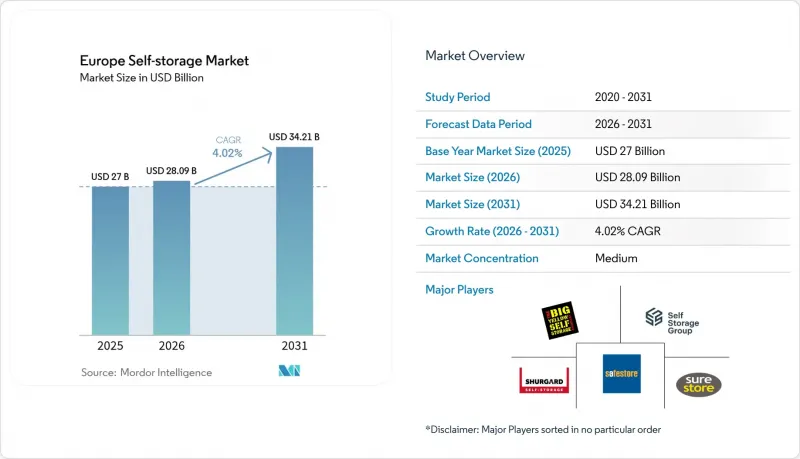
本報告按使用者類型(個人、企業)、儲存類型(CFC、非CFC)、空間大小(90平方英尺以下、91-150平方英尺及以上)、應用領域(家居用品、電商微型倉配及其他)和國家進行細分。市場預測以美元計價。
歐洲自助倉儲市場趨勢與洞察
都市區生活空間壓縮與微型生活
不斷上漲的地價導致都市區平均居住面積日益縮小,促使他們選擇利用本地倉儲設施來取代城市生活。在英國,過去三年新增了100多個多功能倉儲設施,為營運商創造了每年10億英鎊的收入,租戶們在此存放家具和季節性物品。混合租賃協議和全天候數位化存取進一步將這項服務融入了都市人的日常生活。
隨著人口老化,人們正從較大的住宅搬到較小的住宅。
在德國、義大利和英國,老年住宅紛紛搬進面積較小的房屋,這催生了對臨時存放傳家寶和笨重家具的需求。經合組織預測,到2050年,七國集團(G7)居住者中65歲及以上人口將佔25%,這將基於這些需求建立一個永續的基本客群。
嚴格的消防安全標準
北歐國家的法規強制要求使用先進的消防系統和檢驗的風險評估,這可能會使維修預算增加高達 25%,並延遲市場准入。
細分市場分析
到2025年,個人用戶將佔歐洲自助倉儲市場收入的69.35%。搬遷、微型居住以及退休導致的房屋縮小將促成長期合約的簽訂,即使在宏觀經濟衝擊下也能穩定運轉率。企業用戶群雖然規模較小,但正以每年7.42%的速度成長,因為中小企業正在採用計量型的庫存儲存空間。營運商目前正採用雙品牌策略,一方面迎合個人客戶的生活方式,另一方面為企業客戶提供承包物流服務,從而有效利用這兩種收入來源。
歐洲自助倉儲市場(主要以個人租賃為主)預計將在2031年之前保持主導地位,這主要得益於簡化短期預訂流程的數位化預訂平台。同時,隨著周邊城市電子商務滲透率的提高,宅配取件、貨架安裝和保險等交叉銷售服務正在推高企業客戶的平均收入。
至2025年,由於內部裝修成本較低,非空調倉儲單位將佔據歐洲自助倉儲市場59.35%的佔有率。然而,空調倉儲單元正以8.82%的複合年成長率成長,憑藉感測器、空調和嚴格的門禁系統,其租金比標準間高出25%至40%,從而推動了利潤率的提升。
更嚴格的監管正在加速這一轉變。已達到E級標準的設施正透過提高租金和降低客戶流失來收回維修成本。預計到2031年,歐洲溫控自助倉儲市場規模將超過142億美元,將帶動電子產品、藝術品和檔案資料等專項保險產品的供應。
其他好處:
- Excel格式的市場預測(ME)表
- 3個月的分析師支持
目錄
第1章:引言
- 研究假設和市場定義
- 調查範圍
第2章:調查方法
第3章執行摘要
第4章 市場狀況
- 市場概覽
- 市場促進因素
- 歐洲主要城市的城市緊湊性和微型生活趨勢
- 在德國、義大利和英國,因年老而從大住宅搬遷的人越來越多。
- 電子商務領域中小企業的快速成長推動了對靈活微型倉庫的需求。
- 申根區內學生和外籍人士流動激增。
- 混合辦公模式的興起導致家庭辦公室雜亂不堪。
- 機構投資人對另類房地產收入的需求
- 市場限制因素
- 北歐國家嚴格的消防安全標準限制了設施用途的變更
- 在歷史悠久的市中心,具有合適分區規劃的工業用地短缺。
- 法國和西班牙通膨掛鉤租金指數的上限
- 更嚴格的能源效率法規將增加維修成本。
- 消費者分析
- 監理展望
- 波特五力分析
- 投資分析
第5章 市場規模與成長預測
- 依使用者類型
- 個人
- 公司
- 依儲存類型
- 空調控制型
- 非空調型
- 按空間大小
- 不到90平方英尺
- 91-150平方英尺
- 151-300平方英尺
- 超過300平方英尺
- 透過使用
- 家居用品
- 電子商務微型倉配
- 文件和檔案存儲
- 車輛存放
- 國家
- 德國
- 英國
- 法國
- 義大利
- 西班牙
- 其他歐洲國家
第6章 競爭情勢
- 市場集中度
- 策略趨勢
- 市佔率分析
- 公司簡介
- Shurgard Self Storage SA
- Safestore Holdings PLC
- Big Yellow Group PLC
- Self Storage Group ASA
- Lok'nStore Group PLC
- SureStore Ltd
- Access Self Storage Ltd
- Lagerboks
- Nettolager
- Pelican Self Storage
- 24Storage AB
- Casaforte(SMC Self-Storage Management)
- W Wiedmer AG
- MyPlace SelfStorage GmbH
- BlueSpace Self-Storage SL
- Space Station Ltd
第7章 市場機會與未來展望
According to Mordor Intelligence, the Europe self-storage market size was valued at USD 27 billion in 2025 and estimated to grow from USD 28.09 billion in 2026 to reach USD 34.21 billion by 2031, at a CAGR of 4.02% during the forecast period (2026-2031).
This report is Segmented by User Type (Personal and Business), Storage Type (Climate-Controlled, Non-Climate-Controlled), Space Size (Up To 90 Sq Ft, 91-150 Sq Ft, and More), Application (Household Goods, E-Commerce Micro-Fulfilment, and More), and Country. The Market Forecasts are Provided in Terms of Value (USD).
Europe Self-storage Market Trends and Insights
Urban compression and micro-living
Intensifying land prices have shrunk average city dwellings, prompting residents to treat local storage facilities as an external "room." Over 100 new complexes opened in the UK in three years, earning operators GBP 1 billion annually as renters off-load furniture and seasonal goods. Hybrid leases and 24/7 digital access further embed the service into day-to-day urban living.
Ageing population downsizing from larger homes
Older homeowners in Germany, Italy, and the UK are shifting to smaller dwellings, creating interim storage demand for heirlooms and bulky furniture. OECD projections show the 65+ cohort reaching 25% of G7 city dwellers by 2050, locking in a durable, needs-based customer base
Stringent fire-safety codes
Nordic rules require advanced suppression systems and verified risk assessments, adding up to 25% to conversion budgets and delaying market entry
Other drivers and restraints analyzed in the detailed report include:
- E-commerce SMB boom driving flexible micro-warehousing
- Student & expat mobility
- Heightened energy-efficiency mandates
For complete list of drivers and restraints, kindly check the Table Of Contents.
Segment Analysis
Personal users accounted for 69.35% of Europe self-storage market revenue in 2025. Household moves, micro-living, and retirement downsizing secure long-tenure contracts that stabilise occupancy during macro shocks. The business cohort, while smaller, is expanding at 7.42% annually as SMEs embrace pay-as-you-go inventory space. Operators now tailor dual-branding strategies-lifestyle messaging for individuals and turnkey logistics features for corporations-to monetise both streams effectively.
The Europe self-storage market size attached to personal tenancy is forecast to maintain a dominant share through 2031, helped by digital reservation platforms that simplify short-cycle booking. Meanwhile, cross-selling services such as courier pick-up, racking, and insurance lift average revenue per business customer as e-commerce penetration deepens in peripheral cities.
Non-climate units delivered 59.35% of Europe self-storage market share in 2025 thanks to lower fit-out costs. Yet climate-controlled stock, growing at 8.82% CAGR, underpins margin expansion because sensors, HVAC, and stricter access controls command fees 25-40% above standard rooms.
Regulatory upgrades accelerate the pivot: facilities that already meet class E standards recoup retrofit spending via higher rents and lower churn. The Europe self-storage market size for climate-controlled units is on track to surpass USD 14.2 billion by 2031, supporting specialised insurance offerings for electronics, art, and archival documents.
Complete Report Scope:
- By User Type
- Personal
- Business
- By Storage Type
- Climate-Controlled
- Non-Climate-Controlled
- By Space Size
- Up to 90 sq ft
- 91-150 sq ft
- 151-300 sq ft
- Above 300 sq ft
- By Application
- Household Goods
- E-commerce Micro-Fulfilment
- Document & Archive Storage
- Vehicle Storage
- By Country
- Germany
- United Kingdom
- France
- Italy
- Spain
- Rest of Europe
List of Companies Covered in this Report:
- Shurgard Self Storage SA
- Safestore Holdings PLC
- Big Yellow Group PLC
- Self Storage Group ASA
- Lok'nStore Group PLC
- SureStore Ltd
- Access Self Storage Ltd
- Lagerboks
- Nettolager
- Pelican Self Storage
- 24Storage AB
- Casaforte (SMC Self-Storage Management)
- W Wiedmer AG
- MyPlace SelfStorage GmbH
- BlueSpace Self-Storage S.L.
- Space Station Ltd
Additional Benefits:
- The market estimate (ME) sheet in Excel format
- 3 months of analyst support
TABLE OF CONTENTS
1 INTRODUCTION
- 1.1 Study Assumptions and Market Definition
- 1.2 Scope of the Study
2 RESEARCH METHODOLOGY
3 EXECUTIVE SUMMARY
4 MARKET LANDSCAPE
- 4.1 Market Overview
- 4.2 Market Drivers
- 4.2.1 Urban Compression and Micro-Living Trends in Tier-1 European Cities
- 4.2.2 Aging Population Downsizing from Larger Homes in Germany, Italy and UK'
- 4.2.3 E-commerce SMB Boom Driving Need for Flexible Micro-Warehousing
- 4.2.4 Surging Student & Expat Mobility Within the Schengen Region
- 4.2.5 Rise of Hybrid Work Creating Home Office Clutter
- 4.2.6 Institutional Investor Appetite for Alternative Real-Estate Yields
- 4.3 Market Restraints
- 4.3.1 Stringent Fire-Safety Codes Limiting Facility Conversions in Nordics
- 4.3.2 Scarcity of Suitable Zoned Industrial Stock in Historic City Centres
- 4.3.3 Inflation-Linked Rental Index Caps in France and Spain
- 4.3.4 Heightened Energy-Efficiency Mandates Increasing Retrofit Costs
- 4.4 Consumer Analysis
- 4.5 Regulatory Outlook
- 4.6 Porter's Five Forces Analysis
- 4.6.1 Bargaining Power of Suppliers
- 4.6.2 Bargaining Power of Buyers
- 4.6.3 Threat of New Entrants
- 4.6.4 Threat of Substitutes
- 4.6.5 Intensity of Competitive Rivalry
- 4.7 Investment Analysis
5 MARKET SIZE AND GROWTH FORECASTS (VALUE)
- 5.1 By User Type
- 5.1.1 Personal
- 5.1.2 Business
- 5.2 By Storage Type
- 5.2.1 Climate-Controlled
- 5.2.2 Non-Climate-Controlled
- 5.3 By Space Size
- 5.3.1 Up to 90 sq ft
- 5.3.2 91-150 sq ft
- 5.3.3 151-300 sq ft
- 5.3.4 Above 300 sq ft
- 5.4 By Application
- 5.4.1 Household Goods
- 5.4.2 E-commerce Micro-Fulfilment
- 5.4.3 Document & Archive Storage
- 5.4.4 Vehicle Storage
- 5.5 By Country
- 5.5.1 Germany
- 5.5.2 United Kingdom
- 5.5.3 France
- 5.5.4 Italy
- 5.5.5 Spain
- 5.5.6 Rest of Europe
6 COMPETITIVE LANDSCAPE
- 6.1 Market Concentration
- 6.2 Strategic Moves
- 6.3 Market Share Analysis
- 6.4 Company Profiles (includes Global level Overview, Market level overview, Core Segments, Financials as available, Strategic Information, Market Rank/Share for key companies, Products and Services, and Recent Developments)
- 6.4.1 Shurgard Self Storage SA
- 6.4.2 Safestore Holdings PLC
- 6.4.3 Big Yellow Group PLC
- 6.4.4 Self Storage Group ASA
- 6.4.5 Lok'nStore Group PLC
- 6.4.6 SureStore Ltd
- 6.4.7 Access Self Storage Ltd
- 6.4.8 Lagerboks
- 6.4.9 Nettolager
- 6.4.10 Pelican Self Storage
- 6.4.11 24Storage AB
- 6.4.12 Casaforte (SMC Self-Storage Management)
- 6.4.13 W Wiedmer AG
- 6.4.14 MyPlace SelfStorage GmbH
- 6.4.15 BlueSpace Self-Storage S.L.
- 6.4.16 Space Station Ltd
7 MARKET OPPORTUNITIES AND FUTURE OUTLOOK
- 7.1 White-space and Unmet-Need Assessment

 德國自助倉儲:市場佔有率分析、產業趨勢與統計及成長預測(2026-2031)新加坡自助倉儲:市場佔有率分析、產業趨勢與統計及成長預測(2026-2031)越南自助倉儲:市場佔有率分析、產業趨勢與統計及成長預測(2026-2031)亞太地區自助倉儲:市場佔有率分析、產業趨勢與統計及成長預測(2026-2031)美國自助倉儲:市場佔有率分析、產業趨勢與統計及成長預測(2026-2031)自助倉儲:市場佔有率分析、產業趨勢與統計、成長預測(2026-2031)
 城市按需儲存服務市場預測至2034年-按服務類型、儲存格式、預訂模式、儲存容量、服務期限、最終用戶和地區分類的全球分析
 自助倉儲市場規模、佔有率、趨勢和預測:按儲存單元規模、最終用途和地區分類,2026-2034 年
 2026年全球自助倉儲市場報告
 自助倉儲市場:2026-2032年全球市場預測(按單位類型、租賃期限、單位面積、存取方式及最終用戶分類)