


 |
市場調查報告書
商品編碼
2125572
中東和非洲太陽能光電逆變器:市場佔有率分析、行業趨勢和統計數據以及成長預測(2026-2031 年)Middle East And Africa Solar PV Inverters - Market Share Analysis, Industry Trends & Statistics, Growth Forecasts (2026 - 2031) |
||||||

※ 本網頁內容可能與最新版本有所差異。詳細情況請與我們聯繫。
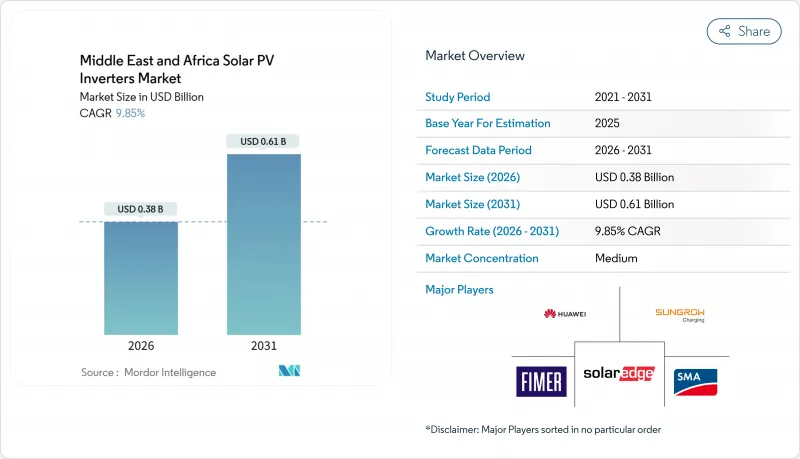
據 Mordor Intelligence 稱,中東和非洲的太陽能光伏逆變器市場在 2026 年的估值為 3.8 億美元,預計在預測期(2026-2031 年)內將以 9.85% 的複合年成長率成長,到 2031 年將達到 6.1 億美元。
本報告按逆變器類型(集中式、組串式、微型逆變器、混合/電池相容型)、相數(單相/三相)、連接類型(併網/離網)、應用(住宅、商業/工業、公用事業規模)和地區(阿拉伯聯合大公國、沙烏地阿拉伯、伊朗、南非、埃及、奈及利亞、摩洛哥以及其他中東和非洲國家)進行分類。
中東及非洲太陽能光電逆變器市場趨勢及分析
海灣合作理事會-北非太陽能發電競標計畫儲備
到2025年,政府主導的太陽能發電競標的已公佈裝置容量將超過25吉瓦。這主要得益於沙烏地阿拉伯公共投資基金(PIF)承諾向與ACWA Power Masdar合作的15吉瓦計畫投資83億美元。杜拜水電局(DEWA)於2024年下半年中標的2吉瓦太陽能發電和儲能聯合項目,以及阿布達比的Zarraf和Khazna項目(各1.5吉瓦),都印證了市場對公用事業級集中式逆變器的穩定預期需求。合約結構擴大將營運、維護和現場組裝在一起,這擠壓了僅提供硬體的供應商的利潤空間,同時也提高了整合供應商的市場滲透率。科威特1.1吉瓦的Al Dibudiba電廠(計畫於2024年投入商業營運)和埃及1.2吉瓦的Infinity Power電廠的資金籌措輪次,凸顯了多個國家對併網設備日益成長的需求。隨著採購前景越來越有保障,電力開發商越來越優先考慮那些擁有銀行融資產品保固和主權級服務網路的供應商。
以色列和南非的淨計量和屋頂光伏安裝獎勵
在以色列,一項涵蓋50千瓦以下系統的上網電價補貼(FIT)淨計量政策,使符合條件的住宅屋頂太陽能發電裝置數量加倍,到2025年將比2023年達到8%。南非的一項市政計畫使商業機構能夠抵消Eskom電力公司2020年至2025年間每年12%的電價漲幅。此外,2024年《電力監管法》的修訂將1兆瓦以下太陽能發電系統的併網核准週期從18個月縮短至6個月。這些措施正在推動對串列型逆變器和微型逆變器的需求,因為這些模組化架構可以解決常見的屋頂限制,例如遮蔭和朝向問題。據融資方和安裝商稱,系統平衡(BOS)成本的下降使得住宅和購物中心能夠在五年內收回投資,從而顯著擴大分散式逆變器的整體潛在市場。
半導體供應鏈的波動
2025年初,絕緣柵雙極型電晶體(IGBT)和碳化矽MOSFET的前置作業時間延長至8-12週,導致專案運作延遲,並增加了對營運資金的需求。 SMA Solar Technology透露,晶片短缺導致其2024年上半年出貨量下降了15%。華為透過簽訂多年晶圓合約解決了這個問題,但規模較小的公司則面臨現貨市場價格飆升的困境,難以競標。
細分市場分析
到2025年,集中式逆變器將佔據中東和非洲太陽能光電逆變器市場61.8%的佔有率。這一主導地位主要歸功於沙烏地阿拉伯和阿拉伯聯合大公國的兆瓦級項目,在這些國家,每瓦安裝成本的降低是首要考慮因素。組串式逆變器正被應用於商業和工業光伏陣列,在這些專案中,模組化比微小的成本節約更為重要。而微型逆變器則由於以色列和南非屋頂光電安裝的日益普及而實現了兩位數的成長。混合式和電池儲能型逆變器在奈及利亞和埃及也展現出價值,這兩個國家計畫性的停電措施正在加速儲能系統的普及。雙面組件和2000V系統結構的普及進一步強化了採購趨勢,促使市場轉向能夠處理更高輸入電壓的組串式和集中式平台。
集中式逆變器簡化了併網勘測,但由於其存在單點故障,因此在太陽輻射不穩定的地區,對多路MPPT組串式逆變器的需求日益成長。微型逆變器價格昂貴,但能夠實現組件級最佳化並提高安全性,不過其複雜性限制了其在公用事業規模部署中的應用前景。混合型逆變器彌合了併網和離網系統需求之間的差距,並與鼓勵套利的分時收費系統相輔相成。隨著雙面和高壓技術的發展趨勢日益成熟,傳統的1000V設備正逐漸被淘汰,這刺激了中東和非洲地區太陽能光電逆變器市場的更新換代需求。
到2025年,三相機組將佔出貨量的80.1%,反映出商業、工業和電力公司等領域對均衡負載分配的需求日益成長。單相產品(通常功率低於10kW)預計將以10.2%的複合年成長率成長,因為屋頂太陽能發電在以色列、南非和埃及等中等收入住宅中越來越普及。
成本績效實惠的即插即用型單相套件正吸引住宅DIY用戶,而三相設備則必須滿足更嚴格的諧波限制,例如沙烏地阿拉伯電力公司設定的5%總諧波失真(THD)上限。因此,三相設備供應商正加大對主動濾波和併網同步演算法的投入,這提高了准入門檻,同時也增強了中東和非洲地區太陽能光電逆變器產業對併網相容性的信心。
其他好處:
- Excel格式的市場預測(ME)表
- 3個月的分析師支持
目錄
第1章:引言
- 研究假設和市場定義
- 調查範圍
第2章:調查方法
第3章執行摘要
第4章 市場狀況
- 市場概覽
- 市場促進因素
- 海灣合作理事會和北非地區計劃進行太陽能發電競標項目
- 以色列和南非對淨計量和屋頂太陽能發電的激勵措施
- 強制安裝智慧逆變器的併網法規(例如,沙烏地阿拉伯 2024 年併網法規)
- 透過高溫粉末固化設計降低運作維護成本。
- 來自電網脆弱地區/離網地區的混合逆變器需求
- 市場限制因素
- 半導體供應鏈的波動性
- 售後服務和認證體系分散
- 遠端存取相關的網路安全問題
- 供應鏈分析
- 監理情勢
- 技術展望
- 波特五力模型
第5章 市場規模與成長預測
- 逆變器類型
- 中央逆變器
- 串列型逆變器
- 微型逆變器
- 混合動力/電池相容型逆變器
- 階段
- 單相
- 三相
- 按連線類型
- 併網
- 離網
- 透過使用
- 住宅
- 商業和工業用途
- 公用事業規模
- 按地區
- 阿拉伯聯合大公國
- 沙烏地阿拉伯
- 伊朗
- 南非
- 埃及
- 奈及利亞
- 摩洛哥
- 其他中東和非洲國家
第6章 競爭情勢
- 市場集中度
- 策略趨勢(併購、聯盟、購電協議)
- 市場佔有率分析(主要公司的市場排名和佔有率)
- 公司簡介
- Huawei Technologies Co. Ltd
- Sungrow Power Supply Co. Ltd
- SMA Solar Technology AG
- SolarEdge Technologies Inc.
- FIMER SpA
- GoodWe Technologies Co. Ltd
- Delta Electronics Inc.
- Omron Corporation
- Mitsubishi Electric Corporation
- Schneider Electric SE
- Siemens AG
- Enphase Energy Inc.
- Fronius International GmbH
- Growatt New Energy
- Ginlong Technologies(Solis)
- Power Electronics SL
- Ingeteam SA
- TBEA Sunoasis Co. Ltd
- KSTAR New Energy
- Sineng Electric Co. Ltd
第7章 市場機會與未來展望
According to Mordor Intelligence, the Middle East and Africa solar PV inverters market size is estimated at USD 0.38 billion in 2026, and is expected to reach USD 0.61 billion by 2031, at a CAGR of 9.85% during the forecast period (2026-2031).
This report is Segmented by Inverter Type (Central, String, Microinverters, and Hybrid/Battery-Ready), Phase (Single-Phase and Three-Phase), Connection Type (On-Grid and Off-Grid), Application (Residential, Commercial and Industrial, and Utility-Scale), and Geography (United Arab Emirates, Saudi Arabia, Iran, South Africa, Egypt, Nigeria, Morocco, and Rest of Middle East and Africa).
Middle East And Africa Solar PV Inverters Market Trends and Insights
Solar-Tender Pipeline Across GCC and North Africa
Government-backed solar solicitations topped 25 GW of announced capacity during 2025, anchored by Saudi Arabia's Public Investment Fund pledge of USD 8.3 billion for 15 GW of projects with ACWA Power and Masdar partners. A 2 GW solar-plus-storage award from Dubai Electricity and Water Authority in late 2024 and Abu Dhabi's Zarraf and Khazna projects, each at 1.5 GW, reinforce predictable utility-scale demand for central inverters. Contract structures increasingly bundle operations, maintenance, and local assembly, trimming margins for pure-play hardware vendors yet deepening market stickiness for integrated suppliers. Kuwait's 1.1 GW Al Dibdibah plant entering commercial service in 2024 and Egypt's 1.2 GW Infinity Power financing round magnify the multi-country pull for grid-connected equipment. The resulting procurement certainty underpins utility developers' preference for suppliers with bankable product warranties and sovereign-grade service footprints.
Net-Metering and Rooftop Incentives in Israel and South Africa
Israel's feed-in tariff and net-metering rules covering systems up to 50 kW lifted residential solar penetration to 8% of eligible rooftops in 2025, doubling the 2023 level. South Africa's municipal programs allow commercial sites to offset Eskom tariff hikes that averaged 12% annually during 2020-2025, while 2024 Electricity Regulation Act amendments cut grid-connection approvals for sub-1 MW arrays from 18 months to 6 months. These measures steer demand toward string and microinverters, whose modular architectures cope with shading and orientation constraints common on rooftops. Financiers and installers report that falling balance-of-system costs have brought five-year paybacks within reach for households and malls, substantially widening the total addressable market for distributed inverters.
Semiconductor Supply-Chain Volatility
Insulated-gate bipolar transistors and silicon-carbide MOSFET lead times stretched to 8-12 weeks in early 2025, deferring project commissioning and inflating working-capital requirements. SMA Solar Technology disclosed a 15% shipment shortfall in 1H 2024 owing to chip shortages. Huawei countered by securing multi-year wafer contracts, but smaller firms lacking scale endured spot-market price spikes that complicated fixed-price EPC bids.
Other drivers and restraints analyzed in the detailed report include:
- Mandatory Smart-Inverter Grid Codes
- High-Temperature, Dust-Hardened Designs Lowering O&M Costs
- Fragmented After-Sales and Certification Ecosystem
For complete list of drivers and restraints, kindly check the Table Of Contents.
Segment Analysis
Central inverters captured 61.8% of the Middle East and Africa solar PV inverters market in 2025, a dominance linked to megawatt-scale projects in Saudi Arabia and the UAE that prioritize low installed cost per watt. String inverters serve commercial and industrial arrays where modularity outweighs minimal cost savings, while microinverters secured double-digit growth thanks to rooftop uptake in Israel and South Africa. Hybrid and battery-ready models add value in Nigeria and Egypt, where load-shedding propels storage integration. The shift toward bifacial modules and 2,000-V system architectures further tilts procurement toward string and central platforms engineered for higher input voltages.
Central inverters simplify interconnection studies yet represent single points of failure, creating openings for multi-MPPT string units in terrains with variable irradiance. Microinverters, though costlier, deliver module-level optimization and enhanced safety, but their complexity limits utility-scale prospects. Hybrid units bridge the gap between on-grid and off-grid needs, dovetailing with tariff structures that reward time-of-use arbitrage. As bifacial and high-voltage trends mature, legacy 1,000-V equipment faces obsolescence, stimulating replacement sales across the Middle East and Africa solar PV inverters market.
Three-phase units comprised 80.1% of 2025 shipments, mirroring the prevalence of commercial, industrial, and utility installations requiring balanced load distribution. Single-phase products, typically under 10 kW, will climb at a 10.2% CAGR as rooftop solar permeates middle-income housing in Israel, South Africa, and Egypt.
Cost-effective plug-and-play single-phase kits entice residential do-it-yourself segments, while three-phase devices must meet stricter harmonic limits, such as the Saudi Electricity Company's 5% THD cap. Consequently, three-phase vendors invest in active filtering and grid-synchronization algorithms, raising entry barriers but enhancing grid compliance credentials in the Middle East and Africa solar PV inverters industry.
Complete Report Scope:
- By Inverter Type
- Central Inverters
- String Inverters
- Microinverters
- Hybrid/Battery-Ready Inverters
- By Phase
- Single-Phase
- Three-Phase
- By Connection Type
- On-Grid
- Off-Grid
- By Application
- Residential
- Commercial and Industrial
- Utility-Scale
- By Geography
- United Arab Emirates
- Saudi Arabia
- Iran
- South Africa
- Egypt
- Nigeria
- Morocco
- Rest of Middle East and Africa
List of Companies Covered in this Report:
- Huawei Technologies Co. Ltd
- Sungrow Power Supply Co. Ltd
- SMA Solar Technology AG
- SolarEdge Technologies Inc.
- FIMER SpA
- GoodWe Technologies Co. Ltd
- Delta Electronics Inc.
- Omron Corporation
- Mitsubishi Electric Corporation
- Schneider Electric SE
- Siemens AG
- Enphase Energy Inc.
- Fronius International GmbH
- Growatt New Energy
- Ginlong Technologies (Solis)
- Power Electronics S.L.
- Ingeteam S.A.
- TBEA Sunoasis Co. Ltd
- KSTAR New Energy
- Sineng Electric Co. Ltd
Additional Benefits:
- The market estimate (ME) sheet in Excel format
- 3 months of analyst support
TABLE OF CONTENTS
1 Introduction
- 1.1 Study Assumptions & Market Definition
- 1.2 Scope of the Study
2 Research Methodology
3 Executive Summary
4 Market Landscape
- 4.1 Market Overview
- 4.2 Market Drivers
- 4.2.1 Solar-tender pipeline across GCC & North Africa
- 4.2.2 Net-metering & rooftop incentives in Israel, South Africa
- 4.2.3 Mandatory smart-inverter grid codes (e.g., Saudi Grid Code 2024)
- 4.2.4 High-temperature, dust-hardening designs lowering O&M costs
- 4.2.5 Hybrid-inverter demand from weak-grid/off-grid sites
- 4.3 Market Restraints
- 4.3.1 Semiconductor supply-chain volatility
- 4.3.2 Fragmented after-sales & certification ecosystem
- 4.3.3 Cyber-security concerns over remote access
- 4.4 Supply-Chain Analysis
- 4.5 Regulatory Landscape
- 4.6 Technological Outlook
- 4.7 Porter's Five Forces
- 4.7.1 Bargaining Power of Suppliers
- 4.7.2 Bargaining Power of Consumers
- 4.7.3 Threat of New Entrants
- 4.7.4 Threat of Substitutes
- 4.7.5 Intensity of Competitive Rivalry
5 Market Size & Growth Forecasts
- 5.1 By Inverter Type
- 5.1.1 Central Inverters
- 5.1.2 String Inverters
- 5.1.3 Microinverters
- 5.1.4 Hybrid/Battery-Ready Inverters
- 5.2 By Phase
- 5.2.1 Single-Phase
- 5.2.2 Three-Phase
- 5.3 By Connection Type
- 5.3.1 On-Grid
- 5.3.2 Off-Grid
- 5.4 By Application
- 5.4.1 Residential
- 5.4.2 Commercial and Industrial
- 5.4.3 Utility-Scale
- 5.5 By Geography
- 5.5.1 United Arab Emirates
- 5.5.2 Saudi Arabia
- 5.5.3 Iran
- 5.5.4 South Africa
- 5.5.5 Egypt
- 5.5.6 Nigeria
- 5.5.7 Morocco
- 5.5.8 Rest of Middle East and Africa
6 Competitive Landscape
- 6.1 Market Concentration
- 6.2 Strategic Moves (M&A, Partnerships, PPAs)
- 6.3 Market Share Analysis (Market Rank/Share for key companies)
- 6.4 Company Profiles (includes Global level Overview, Market level overview, Core Segments, Financials as available, Strategic Information, Products & Services, and Recent Developments)
- 6.4.1 Huawei Technologies Co. Ltd
- 6.4.2 Sungrow Power Supply Co. Ltd
- 6.4.3 SMA Solar Technology AG
- 6.4.4 SolarEdge Technologies Inc.
- 6.4.5 FIMER SpA
- 6.4.6 GoodWe Technologies Co. Ltd
- 6.4.7 Delta Electronics Inc.
- 6.4.8 Omron Corporation
- 6.4.9 Mitsubishi Electric Corporation
- 6.4.10 Schneider Electric SE
- 6.4.11 Siemens AG
- 6.4.12 Enphase Energy Inc.
- 6.4.13 Fronius International GmbH
- 6.4.14 Growatt New Energy
- 6.4.15 Ginlong Technologies (Solis)
- 6.4.16 Power Electronics S.L.
- 6.4.17 Ingeteam S.A.
- 6.4.18 TBEA Sunoasis Co. Ltd
- 6.4.19 KSTAR New Energy
- 6.4.20 Sineng Electric Co. Ltd
7 Market Opportunities & Future Outlook
- 7.1 White-Space & Unmet-Need Assessment

 2026-2034年全球太陽能發電微型逆變器市場規模、佔有率、趨勢和成長分析報告
 印度太陽能逆變器用電池:市場佔有率分析、行業趨勢和統計數據以及成長預測(2026-2031 年)太陽能逆變器用電池:市場佔有率分析、行業趨勢和統計數據以及成長預測(2026-2031 年)印度太陽能逆變器:市場佔有率分析、產業趨勢與統計及成長預測(2026-2031)歐洲太陽能逆變器:市場佔有率分析、產業趨勢與統計及成長預測(2026-2031 年)
 太陽能逆變器市場規模及預測(2021-2034),全球及區域佔有率、趨勢和成長機會分析報告:按產品類型、相數、連接方式、最終用戶、容量和地區分類太陽能逆變器市場規模、佔有率、成長、全球產業分析、區域趨勢及2026年至2034年預測。
 智慧逆變器市場預測至2034年-按逆變器類型、相數、電壓等級、通訊技術、最終用戶和地區分類的全球分析
 太陽能逆變器市場-2026-2032年全球市場預測太陽能逆變器:市場佔有率分析、產業趨勢與統計及成長預測(2026-2031)