


 |
市場調查報告書
商品編碼
2116769
歐洲太陽能逆變器:市場佔有率分析、產業趨勢與統計及成長預測(2026-2031 年)Europe Solar Inverter - Market Share Analysis, Industry Trends & Statistics, Growth Forecasts (2026 - 2031) |
||||||

※ 本網頁內容可能與最新版本有所差異。詳細情況請與我們聯繫。
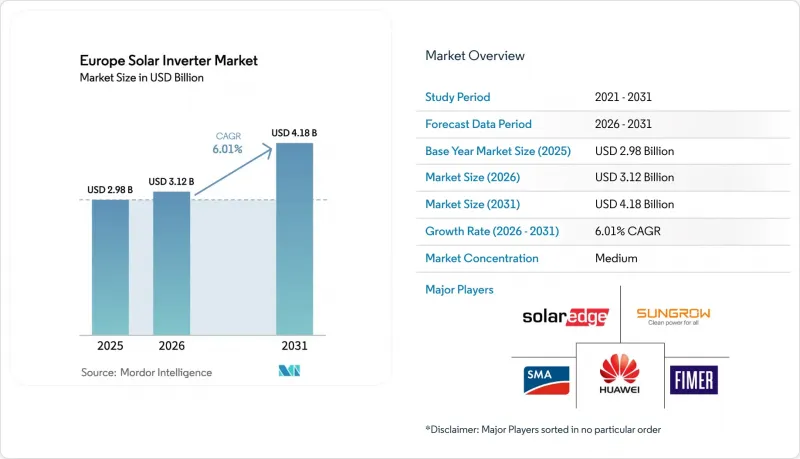
根據 Mordor Intelligence 預測,歐洲太陽能逆變器市場規模將從 2025 年的 29.8 億美元成長到 2026 年的 31.2 億美元,到 2031 年將達到 41.8 億美元,2026 年至 2031 年的複合年預計將達到 6.01%。
本報告按逆變器類型(集中式逆變器、組串式逆變器、微型逆變器和混合/電池相容逆變器)、相數(單相和三相)、連接方式(併網和離網)、應用(住宅、商業/工業和公用事業規模)以及地區(德國、英國、西班牙、義大利、法國、北歐國家、荷蘭住宅、俄羅斯和其他國家)進行分類。
歐洲太陽能逆變器市場趨勢與分析
歐盟「適合55歲」和「REPowerEU」實施目標
在具有法律約束力的法規要求可再生能源佔比達到42.5%以及歐盟太陽能戰略的推動下,預計年均新增裝置容量將達到60-70吉瓦,是2019-2023年增速的兩倍以上。歐盟理事會第2022/2577號條例簡化了屋頂光電站的核准程序,將許可證獲取時間縮短至三個月,從而推動了對串列型逆變器和微型逆變器的需求。該政策的早期效果已顯現,預計到2024年,德國將新增14.6吉瓦,義大利將新增5.3吉瓦。伊比利半島的計畫主要集中在太陽輻射量高且購電協議(PPA)供應充足的地區。這些因素綜合起來,預計歐洲太陽能逆變器市場的複合年成長率將達到6.01%。
屋頂自用電的蓬勃發展是由零售電費的。
預計到2025年,歐盟家庭平均電費將達到每千瓦時0.28歐元,比2021年之前的水平高出約40%,這意味著太陽能發電和儲能系統的投資回收期將保持在7年以內。德國每千瓦時0.32歐元的零售電價推動了屋頂光電系統的蓬勃發展,這些系統採用混合逆變器,利用電池實現價格套利。在荷蘭,2025年淨計量政策的逐步取消加速了電池的普及。微型逆變器能夠緩解人口密集都市區屋頂遮陰的影響,因此備受關注;而動態定價等軟體功能也成為關鍵的差異化因素。住宅市場的強勁表現解釋了為什麼歐洲太陽能逆變器市場正在向具有先進功能和豐富軟體的高級產品轉型。
IGBT和SiC MOSFET的半導體供應瓶頸
2025年,1200V碳化矽元件的前置作業時間為26-32週,是疫情前水準的兩倍。這主要是由於電動車對晶圓的激烈需求。 SMA在其2024年的文件中報告稱,總合1.5GW的交付延遲。使用低規格的IGBT取代碳化矽元件會降低效率並增加熱損耗,從而對專案獲利能力構成壓力。雖然英飛凌和Wolfspeed新工廠的運作預計將從2027年開始緩解供不應求,但短期供應緊張的局面仍將持續,這將抑制歐洲太陽能逆變器市場的預期成長率。
細分市場分析
2025年,集中式逆變器的銷售額佔比達48.6%。這主要是因為在西班牙和葡萄牙,電力公司在專案中採用1-5兆瓦的單體模組配置,最大限度地降低了系統平衡(BOS)成本。組串式逆變器約佔35%的市場佔有率,其需求在商業屋頂太陽能電站以及地形複雜、需要更精細最大功率點追蹤(MPPT)控制的專案中不斷成長。混合式逆變器的市佔率也因產消者對儲能需求的增加而擴大。微型逆變器的市佔率略低於10%,但預計到2031年,年複合成長率(CAGR)將達到7.3%,超過其他所有類型,因為在德國和荷蘭的屋頂光電系統中,組件級最佳化更受青睞。
法規進一步凸顯了產品差異化的重要性。超過1兆瓦的強制性併網要求對缺乏虛擬同步功能的傳統集中式設計構成威脅,促使開發人員轉向符合法規要求的群組串式產品和新一代集中式架構。微型逆變器由於體積小巧,目前仍不受法規約束,但受益於更嚴格的安全標準,例如快速關閉和電弧故障檢測。因此,能夠同時提供具有成本競爭力的集中式設備和配備先進韌體的高階微型逆變器及混合產品線的供應商,在歐洲太陽能逆變器市場佔據了優勢。
到2025年,三相設備將佔銷售額的73.4%,並廣泛應用於工商業屋頂和公用事業規模的太陽能電站,這些電站對負載平衡至關重要。模組化的20-100千瓦三相組串使工廠能夠在不增加設備設計負擔的情況下擴展發電能力。隨著住宅市場的成長,預計10千瓦以下單相設備的年複合成長率將達到6.4%。義大利2024年5.3吉瓦的屋頂光電裝置容量也支撐了單相設備的成長動能。
合規性是產品藍圖的主要驅動力。諸如 VDE-AR-N 4105 等國內標準強制要求韌體更新,而小規模供應商可能難以跟上。配備電池連接埠和斷電保護功能的混合式單相逆變器正在加強供應商在家庭用戶層面的鎖定作用,並提高歐洲太陽能逆變器市場的客戶留存率。
其他好處:
- Excel格式的市場預測(ME)表
- 3個月的分析師支持
目錄
第1章:引言
- 研究假設和市場定義
- 調查範圍
第2章:調查方法
第3章執行摘要
第4章 市場狀況
- 市場概覽
- 市場促進因素
- 歐盟「適合55歲」和「REPowerEU」實施目標
- 在零售電費飆漲的背景下,屋頂自用電正成為一種趨勢。
- 組串式和混合式逆變器的每瓦成本較低
- 在西班牙、葡萄牙和希臘,公用事業規模的購電協議正在加速達成。
- 關於強制使用具有併網功能的「智慧逆變器」的規定(NC RfG 2026 更新)
- IPCEI將歐洲逆變器製造帶回本土的舉措
- 市場限制因素
- IGBT和SiC MOSFET的半導體供應瓶頸
- 德國、荷蘭和義大利面臨電網連接延遲和電力供應減少的風險
- 進口逆變器的網路安全審查(ENISA 指南)
- 主要市場淨計量激勵措施終止
- 供應鏈分析
- 監理情勢
- 技術展望
- 波特五力模型
第5章 市場規模與成長預測
- 按逆變器類型分類
- 集中式逆變器
- 組串式逆變器
- 微型逆變器
- 混合/電池相容型逆變器
- 按階段
- 單相
- 三相
- 按連線類型
- 併網
- 離網
- 透過使用
- 住宅
- 商業和工業用途
- 公用事業規模
- 地區
- 德國
- 英國
- 西班牙
- 義大利
- 法國
- 北歐國家
- 荷蘭
- 俄羅斯
- 其他歐洲國家
第6章 競爭情勢
- 市場集中度
- 策略趨勢(併購、聯盟、購電協議)
- 市場佔有率分析(主要公司的市場排名和佔有率)
- 公司簡介
- SMA Solar Technology AG
- Huawei Technologies Co. Ltd.
- Sungrow Power Supply Co. Ltd.
- SolarEdge Technologies Inc.
- FIMER SpA
- Fronius International GmbH
- Schneider Electric SE
- Siemens AG
- Delta Energy Systems Inc.
- GoodWe Power Supply Co. Ltd.
- Growatt New Energy
- Enphase Energy Inc.
- KACO new energy GmbH
- Power Electronics Espana
- Ingeteam SA
- Omron Corporation
- General Electric Company
- Victron Energy BV
- Ginlong Technologies(Solis)
- Mitsubishi Electric Corporation
第7章 市場機會與未來展望
According to Mordor Intelligence, the Europe solar inverter market size is expected to increase from USD 2.98 billion in 2025 to USD 3.12 billion in 2026 and reach USD 4.18 billion by 2031, growing at a CAGR of 6.01% over 2026-2031.
This report is Segmented by Inverter Type (Central Inverters, String Inverters, Microinverters, and Hybrid/Battery-Ready Inverters), Phase (Single-Phase and Three-Phase), Connection Type (On-Grid and Off-Grid), Application (Residential, Commercial and Industrial, and Utility-Scale), and Geography (Germany, United Kingdom, Spain, Italy, France, NORDIC Countries, Netherlands, Russia, and Rest of Europe).
Europe Solar Inverter Market Trends and Insights
EU Fit-for-55 & REPowerEU Deployment Targets
Binding 42.5% renewable-energy legislation and the EU Solar Strategy lift average annual installations to 60-70 GW, more than double the 2019-2023 pace. Faster rooftop approvals under Council Regulation 2022/2577 compressed permitting to three months, steering demand toward string and microinverters. Germany added 14.6 GW and Italy 5.3 GW in 2024, underscoring early policy traction. The Iberian pipeline illustrates geographic concentration where high irradiance and PPAs intersect. Collectively, these factors underpin the 6.01% CAGR projected for the European solar inverters market.
Rooftop Self-Consumption Boom Amid High Retail Electricity Prices
EU household tariffs averaged EUR 0.28 per kWh in 2025, about 40% above pre-2021 levels, sustaining sub-7-year payback for solar-plus-storage. Germany's EUR 0.32 per kWh retail price drove a rooftop wave that relied on hybrid inverters capable of battery arbitrage. The Netherlands accelerated battery adoption by phasing out net metering in 2025. Microinverters benefited from shade mitigation in dense urban roofs, while software features such as dynamic tariff response became key differentiators. The residential up-trend explains why the European solar inverters market is tilting toward premium, software-rich products.
Semiconductor Supply Bottlenecks for IGBTs & SiC MOSFETs
Lead times for 1200 V SiC devices averaged 26-32 weeks in 2025, double pre-pandemic norms, as electric-vehicle demand competed for wafers. SMA reported shipment delays totalling 1.5 GW in its 2024 filings. Substituting lower-spec IGBTs reduces efficiency and raises thermal losses, squeezing project margins. New fabs from Infineon and Wolfspeed will ease scarcity after 2027, but short-term friction persists, trimming expected growth in the European solar inverters market.
Other drivers and restraints analyzed in the detailed report include:
- Declining $/W of String & Hybrid Inverters
- Utility-Scale PPA Pipeline Acceleration Across Spain, Portugal & Greece
- Grid-Connection Delays & Curtailment Risks in DE/NL/IT
For complete list of drivers and restraints, kindly check the Table Of Contents.
Segment Analysis
Central units controlled 48.6% of 2025 revenue, riding Spain's and Portugal's utility pipelines where single 1-5 MW blocks minimize balance-of-system expense. String designs, at roughly 35% share, gained in commercial rooftops and terrain-complex solar fields that need finer MPPT granularity. Hybrid variants lifted their slice amid rising prosumer storage demand. Microinverters held just under 10% but will outpace all others at a 7.3% CAGR through 2031 as rooftops in Germany and the Netherlands favor module-level optimization.
Regulation magnifies differentiation. Grid-forming mandates above 1 MW threaten legacy central designs that lack virtual-synchronous capability, steering developers toward compliant string products or next-generation central architectures. Microinverters remain exempt due to small unit size, yet benefit from heightened safety codes that require rapid shutdown and arc-fault detection. Consequently, the European solar inverters market rewards suppliers able to juggle cost-competitive central units and premium micro or hybrid lines with advanced firmware.
Three-phase equipment represented 73.4% of revenue in 2025, omnipresent in C&I rooftops and utility arrays where balanced load flow is mandatory. Modular 20-100 kW three-phase strings allow factories to scale generation without oversizing. Single-phase devices, linked to systems below 10 kW, are set for a 6.4% CAGR in line with residential growth. Italy's 5.3 GW 2024 rooftop tally underlines single-phase momentum.
Compliance drives product roadmaps: national codes such as VDE-AR-N 4105 require firmware updates that smaller suppliers sometimes lag. Hybrid single-phase inverters with battery ports and blackout protection strengthen supplier lock-in at the household level, adding stickiness to the European solar inverters market.
Complete Report Scope:
- By Inverter Type
- Central Inverters
- String Inverters
- Microinverters
- Hybrid/Battery-Ready Inverters
- By Phase
- Single-Phase
- Three-Phase
- By Connection Type
- On-Grid
- Off-Grid
- By Application
- Residential
- Commercial and Industrial
- Utility-Scale
- Geography
- Germany
- United Kingdom
- Spain
- Italy
- France
- NORDIC Countries
- Netherlands
- Russia
- Rest of Europe
List of Companies Covered in this Report:
- SMA Solar Technology AG
- Huawei Technologies Co. Ltd.
- Sungrow Power Supply Co. Ltd.
- SolarEdge Technologies Inc.
- FIMER SpA
- Fronius International GmbH
- Schneider Electric SE
- Siemens AG
- Delta Energy Systems Inc.
- GoodWe Power Supply Co. Ltd.
- Growatt New Energy
- Enphase Energy Inc.
- KACO new energy GmbH
- Power Electronics Espana
- Ingeteam S.A.
- Omron Corporation
- General Electric Company
- Victron Energy B.V.
- Ginlong Technologies (Solis)
- Mitsubishi Electric Corporation
Additional Benefits:
- The market estimate (ME) sheet in Excel format
- 3 months of analyst support
TABLE OF CONTENTS
1 Introduction
- 1.1 Study Assumptions & Market Definition
- 1.2 Scope of the Study
2 Research Methodology
3 Executive Summary
4 Market Landscape
- 4.1 Market Overview
- 4.2 Market Drivers
- 4.2.1 EU Fit-for-55 & REPowerEU deployment targets
- 4.2.2 Rooftop self-consumption boom amid high retail electricity prices
- 4.2.3 Declining $/W of string & hybrid inverters
- 4.2.4 Utility-scale PPA pipeline acceleration across Spain, Portugal & Greece
- 4.2.5 Mandatory grid-forming "smart inverter" codes (NC RfG 2026 update)
- 4.2.6 IPCEI-backed reshoring of European inverter manufacturing
- 4.3 Market Restraints
- 4.3.1 Semiconductor supply bottlenecks for IGBTs & SiC MOSFETs
- 4.3.2 Grid-connection delays & curtailment risks in DE/NL/IT
- 4.3.3 Cyber-security scrutiny on imported inverters (ENISA guidelines)
- 4.3.4 Sunset of net-metering incentives in key markets
- 4.4 Supply-Chain Analysis
- 4.5 Regulatory Landscape
- 4.6 Technological Outlook
- 4.7 Porter's Five Forces
- 4.7.1 Bargaining Power of Suppliers
- 4.7.2 Bargaining Power of Buyers
- 4.7.3 Threat of New Entrants
- 4.7.4 Threat of Substitutes
- 4.7.5 Competitive Rivalry
5 Market Size & Growth Forecasts
- 5.1 By Inverter Type
- 5.1.1 Central Inverters
- 5.1.2 String Inverters
- 5.1.3 Microinverters
- 5.1.4 Hybrid/Battery-Ready Inverters
- 5.2 By Phase
- 5.2.1 Single-Phase
- 5.2.2 Three-Phase
- 5.3 By Connection Type
- 5.3.1 On-Grid
- 5.3.2 Off-Grid
- 5.4 By Application
- 5.4.1 Residential
- 5.4.2 Commercial and Industrial
- 5.4.3 Utility-Scale
- 5.5 Geography
- 5.5.1 Germany
- 5.5.2 United Kingdom
- 5.5.3 Spain
- 5.5.4 Italy
- 5.5.5 France
- 5.5.6 NORDIC Countries
- 5.5.7 Netherlands
- 5.5.8 Russia
- 5.5.9 Rest of Europe
6 Competitive Landscape
- 6.1 Market Concentration
- 6.2 Strategic Moves (M&A, Partnerships, PPAs)
- 6.3 Market Share Analysis (Market Rank/Share for key companies)
- 6.4 Company Profiles (includes Global level Overview, Market level overview, Core Segments, Financials as available, Strategic Information, Products & Services, and Recent Developments)
- 6.4.1 SMA Solar Technology AG
- 6.4.2 Huawei Technologies Co. Ltd.
- 6.4.3 Sungrow Power Supply Co. Ltd.
- 6.4.4 SolarEdge Technologies Inc.
- 6.4.5 FIMER SpA
- 6.4.6 Fronius International GmbH
- 6.4.7 Schneider Electric SE
- 6.4.8 Siemens AG
- 6.4.9 Delta Energy Systems Inc.
- 6.4.10 GoodWe Power Supply Co. Ltd.
- 6.4.11 Growatt New Energy
- 6.4.12 Enphase Energy Inc.
- 6.4.13 KACO new energy GmbH
- 6.4.14 Power Electronics Espana
- 6.4.15 Ingeteam S.A.
- 6.4.16 Omron Corporation
- 6.4.17 General Electric Company
- 6.4.18 Victron Energy B.V.
- 6.4.19 Ginlong Technologies (Solis)
- 6.4.20 Mitsubishi Electric Corporation
7 Market Opportunities & Future Outlook
- 7.1 White-space & Unmet-Need Assessment

 2026-2034年全球太陽能發電微型逆變器市場規模、佔有率、趨勢和成長分析報告
 印度太陽能逆變器用電池:市場佔有率分析、行業趨勢和統計數據以及成長預測(2026-2031 年)太陽能逆變器用電池:市場佔有率分析、行業趨勢和統計數據以及成長預測(2026-2031 年)中東和非洲太陽能光電逆變器:市場佔有率分析、行業趨勢和統計數據以及成長預測(2026-2031 年)印度太陽能逆變器:市場佔有率分析、產業趨勢與統計及成長預測(2026-2031)
 太陽能逆變器市場規模及預測(2021-2034),全球及區域佔有率、趨勢和成長機會分析報告:按產品類型、相數、連接方式、最終用戶、容量和地區分類太陽能逆變器市場規模、佔有率、成長、全球產業分析、區域趨勢及2026年至2034年預測。
 智慧逆變器市場預測至2034年-按逆變器類型、相數、電壓等級、通訊技術、最終用戶和地區分類的全球分析
 太陽能逆變器市場-2026-2032年全球市場預測太陽能逆變器:市場佔有率分析、產業趨勢與統計及成長預測(2026-2031)