


 |
市場調查報告書
商品編碼
2116766
印度太陽能逆變器:市場佔有率分析、產業趨勢與統計及成長預測(2026-2031)India Solar Inverter - Market Share Analysis, Industry Trends & Statistics, Growth Forecasts (2026 - 2031) |
||||||

※ 本網頁內容可能與最新版本有所差異。詳細情況請與我們聯繫。
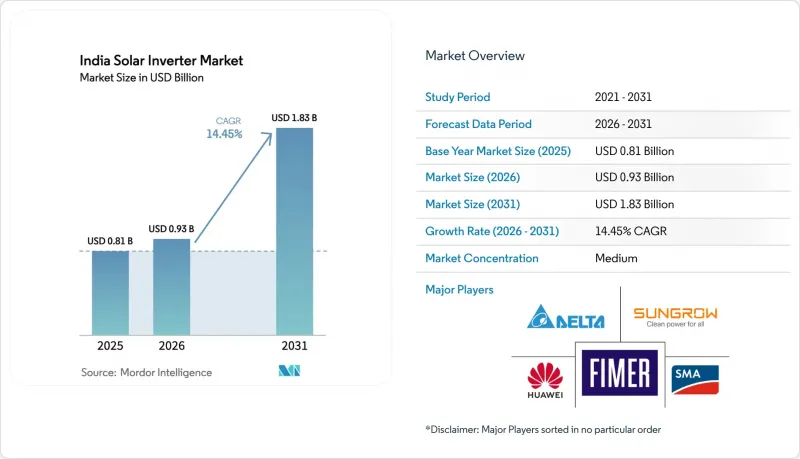
根據 Mordor Intelligence 預測,印度太陽能逆變器市場規模預計將從 2025 年的 8.1 億美元成長到 2026 年的 9.3 億美元,到 2031 年達到 18.3 億美元,2026 年至 2031 年的複合年成長率預計為 14.45%。
本報告按逆變器類型(集中式逆變器、組串式逆變器、微型逆變器、混合/電池相容型逆變器)、相數(單相和三相)、連接方式(併網和離網)以及應用領域(住宅、商業/工業和公用事業規模)進行分類。市場規模和預測均以美元計價。
印度太陽能逆變器市場趨勢與洞察
太陽能發電組件價格的急劇下降將徹底改變成本結構。
光伏組件價格從去年的每瓦0.15美元降至2025年初的每瓦0.11美元,將使高太陽輻射地區公用事業規模太陽能發電的平準化發電成本降至每千瓦時低於幾印度盧比。組件價格的下降使得逆變器在系統總預算中的相對比例從6%提高到9%,促使開發人員選擇加權效率超過98.5%的型號,以確保專案盈利。因此,拉賈斯坦邦最近的競標結果清楚地表明,在超過100兆瓦的項目中,1500伏集中式平台更受青睞。在拉賈斯坦邦,為了降低佈線和挖溝成本,採用了單體模組而非分散式組串。因此,設備供應商正在重新設計採用碳化矽元件的功率模組,以最大限度地減少在印度西部常見的45攝氏度以上環境溫度下的熱損失。相應地,供應鏈正在轉向能夠在八週內交付兆瓦級單元的國內組裝。這為市場提供了一個物流差異化因素,因為在市場中,各公司都在競相趕在財政年度電價週期結束前運作其發電能力。
有利的淨計量政策促進了分散式發電。
目前,印度28個邦和聯邦屬地已實施淨計量電價,部分地區(包括德里和特倫甘納邦)允許跨多個地點的虛擬電價積分。這對連鎖商店和住宅協會來說是一項重要的獎勵。特倫甘納邦已將每戶用戶的上限從1兆瓦提高到10兆瓦(2024年),這為需要具備電壓維持功能的三相逆變器的大型工廠提供了更多屋頂發電的機會。商業系統的投資回收期現已縮短至不到五年,這推動了符合IEEE 1547-2018標準且可提供無功功率以穩定饋線的智慧逆變器的普及。喀拉拉邦等邦規定,如果屋頂發電產生的電力在城市範圍內使用,則免除輸電費用,這進一步縮短了中小企業的盈虧平衡點。由於安裝商將數位化診斷功能作為競標的決定性因素,供應商現在將遠端監控平台和韌體升級打包提供。
進口貨物的BIS認證瓶頸
2024年品管條例規定,所有功率超過10kW的系統互連用逆變器都必須貼有BIS標誌,但目前只有12家國內實驗室獲得認證,可以進行必要的IS 61683和IS 62116測試。海外製造商面臨3-6個月的等待時間,這佔用了他們的流動資金,並延誤了向安得拉邦和泰米爾納德邦項目的出貨。中小進口商面臨的困難最大,缺乏足夠的庫存,也難以獲得優先測試名額。因此,規避風險的開發商擴大轉向使用已經獲得認證的本地組裝型號。商務和工業部已表示有可能與獲得ISO/IEC 17025認證的海外實驗室簽訂互認協議,但預計要到2026年下半年才能全面實施。在此之前,採購計畫仍將十分緊張,開發商已將認證所需的前置作業時間計入競標利潤率。
細分市場分析
預計2026年至2031年間,集中式逆變器的複合年成長率將達到17.3%,成為印度太陽能逆變器市場中成長最快的產品。這主要是由於開發商在超過100兆瓦的專案中越來越傾向於採用單體電站。這一趨勢正在擴大印度集中式平台太陽能逆變器的市場規模,尤其是在拉賈斯坦邦和古吉拉突邦的千兆瓦級電站,規模經濟在這些地區至關重要。額定輸出功率為1兆瓦至5兆瓦的集中式逆變器透過減少直流電纜和溝槽的長度,降低了系統平衡(BOS)成本。各供應商都在整合碳化矽(SiC)開關和液冷技術,以超過印度能源效率局(BEE)將於2026年生效的「97.5%加權效率」要求。
即使到了2025年,串列型逆變器仍將佔據印度太陽能逆變器市場42.7%的佔有率,憑藉其模組化擴充性和易於維護的特點,在住宅屋頂和中型工業電站領域佔據主導地位。微型逆變器的滲透率不足5%,對於陰涼的住宅屋頂來說頗具吸引力,因為在這些屋頂上,組件間的輸出不匹配很容易導致發電量下降,但微型逆變器的高成本限制了其普及。隨著印度中央能源管理局(CEA)設定目標,到2029-2030年實現336吉瓦時的儲能容量,混合型和電池型產品正在迅速湧現,促使開發商採用雙向電子設備,從而利用輔助服務帶來的收入來源。
到2025年,三相產品將佔出貨量的67.4%,預計到2031年將以14.9%的複合年成長率成長。這是因為大多數商業設施和電力公司的安裝都連接到11千伏或33千伏的饋線,這些饋線需要平衡負載。因此,隨著淨計量法規的擴展(提高了工廠屋頂安裝的限制),印度的三相太陽能逆變器市場也在擴張。修訂後的併網法規要求超過100千瓦的太陽能發電系統必須在超前/滯後相位範圍內提供0.9的無功功率。這對三相系統來說很容易滿足,但對單相系統來說比較困難。
在「總理太陽能之家」(PM Surya Ghar)計畫下,對於安裝1千瓦至5千瓦太陽能發電系統的家庭而言,單相系統仍然不可或缺。由於中國進口產品售價低於每台5000印度盧比,市場競爭日益激烈,但國內組裝製造商透過提供5年保固和BIS認證的安全功能,維持了其市場佔有率。隨著分時電價機制的不斷擴展,整合電池連接埠的混合式單相設計有望透過降低家庭用電高峰負荷,從而保持獲利能力。
其他好處:
- Excel格式的市場預測(ME)表
- 3個月的分析師支持
目錄
第1章:引言
- 研究假設和市場定義
- 調查範圍
第2章:調查方法
第3章執行摘要
第4章 市場狀況
- 市場概覽
- 市場促進因素
- 太陽能發電組件的價格大幅下降。
- 有利的淨計量法規
- 屋頂安裝設備在中小企業中越來越普遍。
- 與綠色氫能相關的太陽能發電專案競標正在加速進行。
- 市場限制因素
- 進口過程中的BIS認證瓶頸
- 大型太陽能發電廠用地徵用延誤
- 供應鏈分析
- 監理情勢
- 技術展望
- 波特五力模型
- PESTLE分析
第5章 市場規模與成長預測
- 按逆變器類型分類
- 集中式逆變器
- 組串式逆變器
- 微型逆變器
- 混合/電池相容型逆變器
- 按階段
- 單相
- 三相
- 按連線類型
- 併網
- 離網
- 透過使用
- 住宅
- 商業和工業用途
- 公用事業規模
第6章 競爭情勢
- 市場集中度
- 策略趨勢(併購、聯盟、購電協議)
- 市場佔有率分析(主要公司的市場排名和佔有率)
- 公司簡介
- Sungrow Power Supply Co., Ltd.
- Huawei Technologies Co., Ltd.
- SMA Solar Technology AG
- FIMER SpA
- Delta Electronics, Inc.
- TMEIC Industrial Systems India Pvt Ltd
- Schneider Electric SE
- Fronius International GmbH
- Growatt New Energy
- GoodWe Power Supply
- Ginlong Solis
- Power Electronics
- Hitachi Hi-Rel Power Electronics
- REFU Elektronik GmbH
- Bonfiglioli Riduttori SpA
- Kehua Tech
- Panasonic Life Solutions India
- Victron Energy
- Enphase Energy
- Microtek International
第7章 市場機會與未來展望
According to Mordor Intelligence, the India solar inverter market size is expected to increase from USD 0.81 billion in 2025 to USD 0.93 billion in 2026 and reach USD 1.83 billion by 2031, growing at a CAGR of 14.45% over 2026-2031.
This report is Segmented by Inverter Type (Central Inverters, String Inverters, Microinverters, and Hybrid/Battery-Ready Inverters), Phase (Single-Phase and Three-Phase), Connection Type (On-Grid and Off-Grid), and Application (Residential, Commercial and Industrial, and Utility-Scale). The Market Sizes and Forecasts are Provided in Terms of Value (USD).
India Solar Inverter Market Trends and Insights
Rapid Decline in PV Module Prices Reshapes Cost Economics
PV module prices dropped to USD 0.11 per watt in early 2025, down from USD 0.15 per watt the previous year, cutting utility-scale solar levelized costs below INR 2.00 per kilowatt-hour in high-irradiance states. Cheaper modules raise the relative share of inverters in total system budgets from 6% to 9%, motivating developers to select models with weighted efficiencies above 98.5% to protect project returns. The resulting preference for 1,500 V central platforms in projects greater than 100 MW is clear in Rajasthan's latest tender awards, where single-station blocks replaced distributed strings to reduce cabling and trenching costs. Equipment vendors are therefore redesigning power blocks with silicon-carbide devices that minimize thermal losses in ambient temperatures above 45 °C, typical of western India. In turn, the supply chain is shifting toward domestic assembly lines that can deliver megawatt-scale units in under eight weeks, a logistics-based differentiator in a market racing to commission capacity before fiscal-year tariff deadlines.
Favorable Net-Metering Regulations Unlock Distributed Generation
Twenty-eight Indian states and union territories now offer net-metering, and several, including Delhi and Telangana, permit virtual crediting across multiple premises, a crucial incentive for chains and housing societies. Telangana raised its per-consumer cap from 1 MW to 10 MW in 2024, opening rooftop opportunities for large factories that require three-phase inverters with voltage-ride-through features. Payback periods for commercial systems have fallen below five years, driving procurement of smart inverters compliant with IEEE 1547-2018 and capable of reactive-power export to stabilize feeders. States such as Kerala also exempt rooftop exports from wheeling charges when generation is consumed within municipal limits, further shortening the break-even horizon for small enterprises. Vendors now bundle remote monitoring platforms and firmware upgrades because installers cite digital diagnostics as a deciding parameter for tender awards.
BIS Certification Bottlenecks for Imports
The 2024 Quality Control Order demands that every grid-connected inverter above 10 kW carry a BIS mark, yet only 12 domestic labs are accredited to run the required IS 61683 and IS 62116 tests. Foreign manufacturers face 3- to 6-month queues, tying up working capital and delaying shipments for projects in Andhra Pradesh and Tamil Nadu. Smaller importers struggle the most because they lack buffer inventory and cannot negotiate priority slots, causing risk-averse developers to switch to locally assembled models that already hold certifications. The Ministry of Commerce has signaled mutual recognition agreements with ISO/IEC 17025-accredited overseas labs, but full implementation is unlikely before late 2026. Until then, procurement schedules will remain tight, and developers are factoring certification lead times into bid margins.
Other drivers and restraints analyzed in the detailed report include:
- Rising Rooftop Adoption Among SMEs Drives Segment Diversification
- Accelerated Green-Hydrogen Linked Solar Tenders Create New Demand Vectors
- Land-Acquisition Delays for Large Solar Parks
For complete list of drivers and restraints, kindly check the Table Of Contents.
Segment Analysis
Central inverters are projected to grow at a 17.3% CAGR between 2026 and 2031, the fastest within the India solar inverter market, as developers increasingly prefer single-station blocks for projects above 100 MW. This preference lifts the India solar inverter market size associated with central platforms, especially in Rajasthan's and Gujarat's multi-gigawatt parks, where economies of scale matter. Central units rated 1 MW-5 MW cut balance-of-system costs by trimming DC cabling and trench lengths. Vendors are integrating silicon-carbide switches and liquid cooling to surpass the Bureau of Energy Efficiency's 97.5% weighted-efficiency mandate effective 2026.
String inverters still held 42.7% of the India solar inverter market share in 2025, dominating rooftops and mid-size industrial arrays thanks to modular scalability and simple maintenance regimes. Microinverters, with less than 5% penetration, appeal to shaded residential roofs where module-level mismatch erodes energy yields, though higher unit costs limit uptake. Hybrid and battery-ready products are rising fast because the CEA targets 336 GWh of storage by 2029-30, pushing developers toward bidirectional electronics that can tap ancillary-service revenue streams.
Three-phase products secured 67.4% of shipments in 2025 and will expand at a 14.9% CAGR through 2031 as most commercial and utility installations tie into 11 kV or 33 kV feeders that demand balanced loads. In turn, the India solar inverter market size for three-phase units increases with each net-metering expansion that elevates rooftop caps for factories. Revised grid codes require reactive-power support within a 0.9 leading-lagging band for arrays above 100 kW, an easy requirement for three-phase blocks but difficult for single-phase alternatives.
Single-phase systems remain vital for homes installing 1 kW-5 kW arrays under the PM Surya Ghar scheme. Price competition is intense because Chinese imports start below INR 5,000 per unit, but domestic assemblers retain share by bundling five-year service warranties and BIS-approved safety features. As time-of-day tariffs widen, hybrid single-phase designs with embedded battery ports should defend margins by enabling peak-shaving for households.
Complete Report Scope:
- By Inverter Type
- Central Inverters
- String Inverters
- Microinverters
- Hybrid/Battery-Ready Inverters
- By Phase
- Single-phase
- Three-phase
- By Connection Type
- On-Grid
- Off-Grid
- By Application
- Residential
- Commercial and Industrial
- Utility-Scale
List of Companies Covered in this Report:
- Sungrow Power Supply Co., Ltd.
- Huawei Technologies Co., Ltd.
- SMA Solar Technology AG
- FIMER S.p.A.
- Delta Electronics, Inc.
- TMEIC Industrial Systems India Pvt Ltd
- Schneider Electric SE
- Fronius International GmbH
- Growatt New Energy
- GoodWe Power Supply
- Ginlong Solis
- Power Electronics
- Hitachi Hi-Rel Power Electronics
- REFU Elektronik GmbH
- Bonfiglioli Riduttori S.p.A.
- Kehua Tech
- Panasonic Life Solutions India
- Victron Energy
- Enphase Energy
- Microtek International
Additional Benefits:
- The market estimate (ME) sheet in Excel format
- 3 months of analyst support
TABLE OF CONTENTS
1 Introduction
- 1.1 Study Assumptions & Market Definition
- 1.2 Scope of the Study
2 Research Methodology
3 Executive Summary
4 Market Landscape
- 4.1 Market Overview
- 4.2 Market Drivers
- 4.2.1 Rapid decline in PV module prices
- 4.2.2 Favorable net-metering regulations
- 4.2.3 Rising rooftop adoption among SMEs
- 4.2.4 Accelerated green-hydrogen linked solar tenders
- 4.3 Market Restraints
- 4.3.1 BIS certification bottle-necks for imports
- 4.3.2 Land-acquisition delays for large solar parks
- 4.4 Supply-Chain Analysis
- 4.5 Regulatory Landscape
- 4.6 Technological Outlook
- 4.7 Porter's Five Forces
- 4.7.1 Threat of New Entrants
- 4.7.2 Bargaining Power of Suppliers
- 4.7.3 Bargaining Power of Buyers
- 4.7.4 Threat of Substitutes
- 4.7.5 Competitive Rivalry
- 4.8 PESTLE Analysis
5 Market Size & Growth Forecasts
- 5.1 By Inverter Type
- 5.1.1 Central Inverters
- 5.1.2 String Inverters
- 5.1.3 Microinverters
- 5.1.4 Hybrid/Battery-Ready Inverters
- 5.2 By Phase
- 5.2.1 Single-phase
- 5.2.2 Three-phase
- 5.3 By Connection Type
- 5.3.1 On-Grid
- 5.3.2 Off-Grid
- 5.4 By Application
- 5.4.1 Residential
- 5.4.2 Commercial and Industrial
- 5.4.3 Utility-Scale
6 Competitive Landscape
- 6.1 Market Concentration
- 6.2 Strategic Moves (M&A, Partnerships, PPAs)
- 6.3 Market Share Analysis (Market Rank/Share for key companies)
- 6.4 Company Profiles (includes Global level Overview, Market level overview, Core Segments, Financials as available, Strategic Information, Products & Services, and Recent Developments)
- 6.4.1 Sungrow Power Supply Co., Ltd.
- 6.4.2 Huawei Technologies Co., Ltd.
- 6.4.3 SMA Solar Technology AG
- 6.4.4 FIMER S.p.A.
- 6.4.5 Delta Electronics, Inc.
- 6.4.6 TMEIC Industrial Systems India Pvt Ltd
- 6.4.7 Schneider Electric SE
- 6.4.8 Fronius International GmbH
- 6.4.9 Growatt New Energy
- 6.4.10 GoodWe Power Supply
- 6.4.11 Ginlong Solis
- 6.4.12 Power Electronics
- 6.4.13 Hitachi Hi-Rel Power Electronics
- 6.4.14 REFU Elektronik GmbH
- 6.4.15 Bonfiglioli Riduttori S.p.A.
- 6.4.16 Kehua Tech
- 6.4.17 Panasonic Life Solutions India
- 6.4.18 Victron Energy
- 6.4.19 Enphase Energy
- 6.4.20 Microtek International
7 Market Opportunities & Future Outlook
- 7.1 White-space & Unmet-Need Assessment

 2026-2034年全球太陽能發電微型逆變器市場規模、佔有率、趨勢和成長分析報告
 印度太陽能逆變器用電池:市場佔有率分析、行業趨勢和統計數據以及成長預測(2026-2031 年)太陽能逆變器用電池:市場佔有率分析、行業趨勢和統計數據以及成長預測(2026-2031 年)中東和非洲太陽能光電逆變器:市場佔有率分析、行業趨勢和統計數據以及成長預測(2026-2031 年)歐洲太陽能逆變器:市場佔有率分析、產業趨勢與統計及成長預測(2026-2031 年)
 太陽能逆變器市場規模及預測(2021-2034),全球及區域佔有率、趨勢和成長機會分析報告:按產品類型、相數、連接方式、最終用戶、容量和地區分類太陽能逆變器市場規模、佔有率、成長、全球產業分析、區域趨勢及2026年至2034年預測。
 智慧逆變器市場預測至2034年-按逆變器類型、相數、電壓等級、通訊技術、最終用戶和地區分類的全球分析
 太陽能逆變器市場-2026-2032年全球市場預測太陽能逆變器:市場佔有率分析、產業趨勢與統計及成長預測(2026-2031)