


 |
市場調查報告書
商品編碼
2125301
低壓馬達驅動:市場佔有率分析、產業趨勢與統計、成長預測(2026-2031年)Low Voltage Electric Drives - Market Share Analysis, Industry Trends & Statistics, Growth Forecasts (2026 - 2031) |
||||||

※ 本網頁內容可能與最新版本有所差異。詳細情況請與我們聯繫。
根據 Mordor Intelligence 預測,低壓電動驅動市場預計將從 2025 年的 163.5 億美元成長到 2026 年的 171.3 億美元,到 2031 年達到 215.4 億美元,2026 年至 2031 年的複合年成長率為 4.69%。
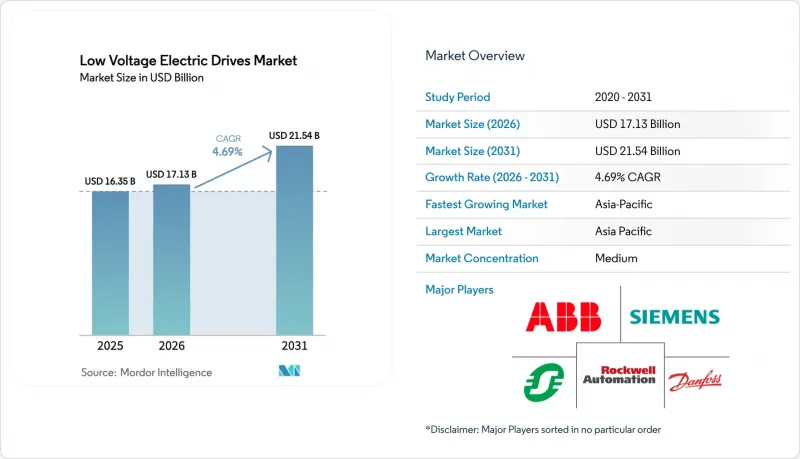
本報告按驅動系統(交流驅動、直流驅動、伺服驅動)、額定輸出功率(5 kW 以下、5-50 kW、50-200 kW、200 kW 以上)、終端用戶行業(汽車/電動汽車製造、石油天然氣、化學/石化、食品飲料、用水和污水處理、發電、金屬和採礦等)以及地區進行分類。市場預測以美元計價。
全球低壓電機驅動市場趨勢與洞察
工業馬達強制性能效法規
IEC 60034-30-1:2025 中新增的 IE5 分類以及 IEC 61800-9-2 中的系統級額定值,正顯著加速老舊 IE2 馬達的替換。隨著歐盟生態設計法規 2021/341 和中國 GB 18613-2020 的實施,低能效馬達實際上正在被淘汰,導致維修需求激增。此類維修可顯著節省成本;例如,一台 100 kW 的電機,每年運行 6,000 小時,每年可運作約 2,400 美元。此外,已獲得 ISO 50001 認證的機構,如果繼續運作不符合法規的設備,則在審核期間將面臨處罰。歐盟分類法也將綠色債券的發行要求與驅動系統實現的節能效果直接掛鉤,凸顯了遵守這些法規和標準所帶來的重大經濟影響。
離散製造和包裝生產線的快速自動化
在亞太地區,伺服系統的需求正顯著成長,這主要得益於各行業對更高精度和更高速度的日益成長的需求。目前,電子、紡織和食品包裝工廠需要精確度達到±0.01毫米、循環時間小於200毫秒的系統,這是推動伺服系統廣泛應用的主要因素。伺服市場的領導企業安川馬達報告稱,2025會計年度其對華伺服出貨量較上年增加了23%。這些出貨量中很大一部分用於智慧型手機製造和電池模組組裝等應用,凸顯了伺服系統在先進生產流程中日益成長的重要性。工業乙太網協定的整合大幅縮短了試運行時間(縮短了40%),進一步提高了營運效率。這項技術進步簡化了流程,並提高了各行業的生產效率。此外,基於績效的租賃模式的引入,使中小企業能夠在無需高額初始投資的情況下採用伺服系統。這些按產量付費的模式有效地降低了採用先進自動化解決方案的經濟門檻,促進了先進自動化解決方案的廣泛應用。
低諧波優質驅動器的初始成本較高
主動前端和多電平設計在將總諧波失真降低到5%以下方面非常有效。然而,這些先進設計的成本顯著更高,比六脈衝系統高出40%到60%。如此龐大的成本溢價是一個重大挑戰,尤其對於資金和預算緊張的電力公司和地方政府水質淨化廠而言更是如此。儘管這些設計具有技術優勢,但其高昂的初始投資往往使各機構猶豫不決。雖然租賃方案可以減輕初始資金負擔,但其普及速度仍相對緩慢。在電力品質法規和執行力度不足或不一致的地區,這種緩慢的普及速度尤其明顯,進一步阻礙了這些先進設計的廣泛應用。因此,許多機構仍然依賴更便宜的替代方案,即使這些方案無法提供同等的性能或效率。
細分市場分析
儘管預計到2025年交流驅動器將佔據71.23%的銷售佔有率,但伺服驅動器正成為低壓馬達驅動市場中成長最快的細分市場,預計2026年至2031年將以8.41%的複合年成長率成長。交流架構在泵浦和輸送機領域具有成本效益,而伺服平台憑藉著0.01度的解析度和1毫秒的回應時間,能夠滿足智慧型手機和穿戴式裝置組裝以及電池模組組裝線等對精度要求極高的應用的需求。這些特性使得伺服驅動器在需要高精度和快速響應的行業中不可或缺,並進一步推動了其在廣泛應用領域的普及。
安川馬達的「Sigma-7」系列產品,憑藉其全新整合的AI驅動振動抑制功能,可將機械共振降低50%,在中國蓬勃發展的電子產業中心中國,其市場佔有率正穩步成長。這項創新技術提高了運作效率,最大限度地減少了停機時間,使其成為競爭激烈的市場中製造商的理想選擇。整合馬達和驅動器理念的吸引力毋庸置疑。尼得科的IMD伺服因其機殼安裝空間減少40%,吸引了包裝和紡織設備OEM廠商的注意。這種節省空間的設計不僅最佳化了工廠佈局,還降低了安裝成本,進一步提升了其吸引力。與日本和歐洲的競爭對手相比,創新給競爭對手帶來了高達30%的降價壓力,但老字型大小企業正透過增強軟體產品和提供全面的生命週期服務來應對這項挑戰,從而保護利潤率。這些策略使老牌企業能夠在動態的市場環境中保持競爭優勢,同時滿足不斷變化的客戶需求。
區域分析
到2025年,亞太地區將佔低壓馬達驅動市場47.41%的佔有率,預計到2031年將以7.11%的複合年成長率成長。中國的「碳排放達峰、碳中和」政策要求功率超過0.75千瓦的馬達達到IE3能源效率標準,目標是到2025年將能源強度降低13.5%,這推動了每年約80萬台馬達的維修。印度的「生產連結獎勵計畫計畫(PLI)」已向電子製造業投資7,380億印度盧比(約89億美元),帶動了表面黏著技術線對伺服的需求。日本和韓國出口高精度伺服電機,而澳洲則依靠變頻器(VFD)來實現採礦業的電氣化。
到2025年,歐洲將佔全球銷售額的25%。歐盟生態設計法規2021/341強制要求變頻器與IE3馬達配合使用,而歐盟指令2024/1275則強制要求對超過15千瓦的建築物的暖通空調(HVAC)系統維修。德國正在升級其汽車工廠的動力傳動系統,以實現其能源轉型(Energiewende)目標;英國供水事業補貼與變頻器的節水效果掛鉤。西班牙正在崛起為電動車零件中心,吸引了大量用於新型電池生產線的伺服訂單。
到2025年,北美將佔全球22%的佔有率。美國的《通貨膨脹控制法案》(IIJA)正在資助聯邦政府建築的暖通空調和供水系統進行變頻驅動(VFD)維修,而《晶片法案》(CHIPS Act)則在推廣半導體製造廠的低諧波裝置。加拿大正在推進油砂開採的電氣化,墨西哥則受益於近海電動車的生產能力。中東地區正致力於海水淡化和區域冷卻,而南非和奈及利亞則正在維修礦場和水泥廠,使用柴油動力車輛,以減少對柴油的依賴。
其他好處:
- Excel格式的市場預測(ME)表
- 3個月的分析師支持
目錄
第1章:引言
- 研究假設和市場定義
- 調查範圍
第2章:調查方法
第3章執行摘要
第4章 市場狀況
- 市場概覽
- 市場促進因素
- 工業馬達強制性能效法規
- 單一生產和包裝線的快速自動化
- 擴大建築物空調系統維修,以實現脫碳。
- 緊湊型整合式馬達驅動(IMD)架構的興起
- 採用 SiC/GaN 功率模組可以實現低壓 (LV) 驅動的微型化。
- 計量收費的「駕駛即服務」經營模式的興起
- 市場限制因素
- 低諧波優質驅動裝置的初始成本較高
- 全球半導體短缺限制了產能。
- 變扭矩應用中變頻器調節方面的技能差距
- 工業物聯網互聯車輛中日益成長的網路安全合規成本。
- 產業價值鏈分析
- 監理情勢
- 技術展望
- 波特五力分析
第5章 市場規模與成長預測
- 透過驅動系統
- 交流電源
- 直流驅動器
- 伺服驅動器
- 額定功率
- 5千瓦或以下
- 5~50 kW
- 50~200 kW
- 超過200千瓦
- 按最終用戶行業分類
- 汽車和電動汽車製造
- 石油和天然氣
- 化工/石油化工
- 食品/飲料
- 水和污水處理
- 發電
- 金屬和採礦
- 紙漿和造紙
- 暖通空調及建築設備
- 各行業(電子、包裝、紡織)
- 按地區
- 北美洲
- 美國
- 加拿大
- 墨西哥
- 南美洲
- 巴西
- 阿根廷
- 其他南美國家
- 歐洲
- 德國
- 英國
- 法國
- 義大利
- 西班牙
- 其他歐洲國家
- 亞太地區
- 中國
- 日本
- 韓國
- 印度
- 澳洲
- 紐西蘭
- 其他亞太國家
- 中東和非洲
- 中東
- 阿拉伯聯合大公國
- 沙烏地阿拉伯
- 土耳其
- 其他中東國家
- 非洲
- 南非
- 奈及利亞
- 肯亞
- 其他非洲國家
- 中東
- 北美洲
第6章 競爭情勢
- 市場集中度
- 策略趨勢
- 市佔率分析
- 公司簡介
- ABB Ltd.
- Siemens AG
- Schneider Electric SE
- Danfoss A/S
- Rockwell Automation, Inc.
- Mitsubishi Electric Corp.
- Hitachi Ltd.
- Yaskawa Electric Corp.
- Nidec Corp.
- Fuji Electric Co. Ltd.
- Eaton Corp. plc
- Parker Hannifin Corp.
- Delta Electronics Inc.
- Lenze SE
- SEW-Eurodrive GmbH
- WEG SA
- CG Power and Industrial Solutions Ltd.
- Johnson Controls Intl. plc
- Beckhoff Automation GmbH
- Hiconics Eco-Energy Technology Co.
- Bonfiglioli Riduttori SpA
- Inovance Technology Co.
第7章 市場機會與未來展望
According to Mordor Intelligence, the low voltage electric drives market size is expected to increase from USD 16.35 billion in 2025 to USD 17.13 billion in 2026 and reach USD 21.54 billion by 2031, growing at a CAGR of 4.69% over 2026-2031.
This report is Segmented by Drive Type (AC Drives, DC Drives, and Servo Drives), Power Rating (Up To 5 KW, 5-50 KW, 50-200 KW, and Above 200 KW), End-User Industry (Automotive and EV Manufacturing, Oil and Gas, Chemical and Petrochemical, Food and Beverage, Water and Wastewater, Power Generation, Metals and Mining, and More), and Geography. Market Forecasts are Provided in Terms of Value (USD).
Global Low Voltage Electric Drives Market Trends and Insights
Mandatory Energy-Efficiency Regulations for Industrial Motors
New IE5 classifications in IEC 60034-30-1:2025 and system-level ratings in IEC 61800-9-2 are significantly driving the replacement of older IE2 motors. The EU's Ecodesign Regulation 2021/341 and China's GB 18613-2020 have effectively rendered inefficient motors obsolete, creating a surge in retrofit demand. These retrofits can result in substantial cost savings, with approximately USD 2,400 saved annually on a 100 kW machine operating for 6,000 hours. Additionally, sites certified under ISO 50001 are at risk of facing audit penalties if they continue to operate non-compliant assets. Furthermore, the EU Taxonomy directly links green-bond eligibility to documented energy savings achieved through drive systems, emphasizing the critical financial implications of adhering to these regulations and standards.
Rapid Automation in Discrete Manufacturing and Packaging Lines
In the Asia-Pacific region, the demand for servo systems is experiencing significant growth, primarily driven by the increasing need for high precision and speed in various industries. Electronics, textiles, and food-packaging plants now require systems capable of achieving +-0.01 mm accuracy and sub-200 millisecond cycles, which has been a major factor contributing to the rising adoption of servo systems. Yaskawa, a prominent player in the servo market, reported a notable 23% year-on-year increase in servo shipments to China during fiscal 2025. A substantial portion of these shipments was utilized in applications such as smartphone manufacturing and battery-module assembly, highlighting the growing importance of servo systems in advanced production processes. The adoption of converging industrial-Ethernet protocols has further enhanced operational efficiency by significantly reducing commissioning time, achieving a 40% decrease. This technological advancement has streamlined processes and improved productivity across industries. Moreover, the introduction of outcome-based leasing models has provided smaller firms with an opportunity to adopt servo systems without the burden of high upfront capital investment. These models allow companies to pay based on output units, effectively lowering the financial barriers to entry and enabling broader adoption of advanced automation solutions.
High Upfront Cost of Low-Harmonic Premium Drives
Active-front-end or multi-level designs are highly effective in reducing total harmonic distortion to below 5%. However, these advanced designs come with a significantly higher price tag, costing 40%-60% more than their six-pulse counterparts. This substantial cost premium creates a notable challenge for utilities and municipal water plants, particularly those operating under constrained financial conditions and tight budgets. The high initial investment required for these designs often deters organizations from adopting them, despite their technical advantages. Although leasing programs are available to alleviate the upfront financial burden, their adoption has been relatively slow. This slow uptake is especially evident in regions where power-quality regulations and enforcement remain weak or inconsistent, further hindering the widespread implementation of these advanced designs. As a result, many organizations continue to rely on less expensive alternatives, even if they do not offer the same level of performance or efficiency.
Other drivers and restraints analyzed in the detailed report include:
- Expansion of HVAC Retrofits for Building Decarbonisation
- Rise of Compact Integrated-Motor-Drive Architectures
- Escalating Cybersecurity-Compliance Costs for IIoT-Connected Drives
For complete list of drivers and restraints, kindly check the Table Of Contents.
Segment Analysis
Despite AC drives commanding a dominant 71.23% of the revenue in 2025, servo units emerged as the fastest-growing segment in the low voltage electric drives market, boasting a projected CAGR of 8.41% from 2026 to 2031. While AC architectures prove cost-effective for pumps and conveyors, servo platforms, with their 0.01-degree resolution and 1-millisecond settling times, cater to the precise demands of smartphone and wearable devices, as well as battery-module assembly lines. These features make servo units indispensable in industries requiring high precision and rapid response times, further driving their adoption across various applications.
Yaskawa's Sigma-7 series, now featuring AI-driven vibration suppression that reduces mechanical resonance by 50%, is making inroads into China's bustling electronics hubs. This innovation enhances operational efficiency and minimizes downtime, making it a preferred choice for manufacturers in competitive markets. The allure of the integrated-motor-drive concept is undeniable: Nidec's IMD servo, by cutting cabinet space requirements by 40%, has caught the attention of packaging and textile OEMs. This space-saving design not only optimizes factory layouts but also reduces installation costs, adding to its appeal. While Inovance exerts pricing pressure by slashing prices up to 30% compared to Japanese and European competitors, established players counterbalance this challenge, safeguarding their margins through enhanced software offerings and comprehensive lifecycle services. These strategies enable incumbents to maintain their competitive edge while addressing evolving customer needs in a dynamic market environment.
Complete Report Scope:
- By Drive Type
- AC Drives
- DC Drives
- Servo Drives
- By Power Rating
- Up to 5 kW
- 5 - 50 kW
- 50 - 200 kW
- Above 200 kW
- By End-User Industry
- Automotive and EV Manufacturing
- Oil and Gas
- Chemical and Petrochemical
- Food and Beverage
- Water and Wastewater
- Power Generation
- Metals and Mining
- Pulp and Paper
- HVAC and Building Services
- Discrete Industries (Electronics, Packaging, Textiles)
- By Geography
- North America
- United States
- Canada
- Mexico
- South America
- Brazil
- Argentina
- Rest of South America
- Europe
- Germany
- United Kingdom
- France
- Italy
- Spain
- Rest of Europe
- Asia Pacific
- China
- Japan
- South Korea
- India
- Australia
- New Zealand
- Rest of Asia-Pacific
- Middle East and Africa
- Middle East
- United Arab Emirates
- Saudi Arabia
- Turkey
- Rest of Middle East
- Africa
- South Africa
- Nigeria
- Kenya
- Rest of Africa
- Middle East
- North America
Geography Analysis
Asia-Pacific owned 47.41% of the low voltage electric drives market in 2025 and is projected to expand at 7.11% CAGR through 2031. China's dual-carbon policy enforces IE3 motor efficiency above 0.75 kW and targets a 13.5% energy-intensity cut by 2025, stimulating about 800,000 annual drive retrofits. India's Production-Linked Incentive program funnels INR 738 billion (USD 8.9 billion) into electronics manufacturing, driving servo demand in surface-mount lines. Japan and South Korea supply high-precision servo exports, while Australia leans on VFDs for mining electrification.
Europe contributed 25% of 2025 revenue. The Ecodesign Regulation 2021/341 mandates VFD pairing with IE3 motors, and Directive 2024/1275 forces HVAC retrofits in buildings above 15 kW. Germany upgrades drives in automotive plants to meet Energiewende goals; the United Kingdom's Ofwat links water-utility allowances to VFD-driven savings. Spain is emerging as an EV-component hub, drawing servo orders for new battery lines.
North America represented 22% in 2025. The U.S. IIJA funds HVAC and water VFD retrofits in federal buildings, while the CHIPS Act drives premium low-harmonic units for semiconductor fabs. Canada electrifies oil-sands operations, and Mexico benefits from nearshored EV capacity. The Middle East focuses on desalination and district cooling, whereas South Africa and Nigeria retrofit mining and cement plants with drives to curb diesel reliance.
- ABB Ltd.
- Siemens AG
- Schneider Electric SE
- Danfoss A/S
- Rockwell Automation, Inc.
- Mitsubishi Electric Corp.
- Hitachi Ltd.
- Yaskawa Electric Corp.
- Nidec Corp.
- Fuji Electric Co. Ltd.
- Eaton Corp. plc
- Parker Hannifin Corp.
- Delta Electronics Inc.
- Lenze SE
- SEW-Eurodrive GmbH
- WEG SA
- CG Power and Industrial Solutions Ltd.
- Johnson Controls Intl. plc
- Beckhoff Automation GmbH
- Hiconics Eco-Energy Technology Co.
- Bonfiglioli Riduttori SpA
- Inovance Technology Co.
Additional Benefits:
- The market estimate (ME) sheet in Excel format
- 3 months of analyst support
TABLE OF CONTENTS
1 INTRODUCTION
- 1.1 Study Assumptions and Market Definition
- 1.2 Scope of the Study
2 RESEARCH METHODOLOGY
3 EXECUTIVE SUMMARY
4 MARKET LANDSCAPE
- 4.1 Market Overview
- 4.2 Market Drivers
- 4.2.1 Mandatory Energy-Efficiency Regulations for Industrial Motors
- 4.2.2 Rapid Automation in Discrete Manufacturing and Packaging Lines
- 4.2.3 Expansion of HVAC Retrofits for Building Decarbonisation
- 4.2.4 Rise of Compact Integrated-Motor-Drive (IMD) Architectures
- 4.2.5 Adoption of SiC/GaN Power Modules Enabling Smaller LV Drives
- 4.2.6 Emergence of Pay-per-Use "Drive-as-a-Service" Business Models
- 4.3 Market Restraints
- 4.3.1 High Upfront Cost of Low-Harmonic Premium Drives
- 4.3.2 Global Semiconductor Shortages Constraining Drive Production
- 4.3.3 Skill Gap in Tuning VFDs for Variable-Torque Applications
- 4.3.4 Escalating Cybersecurity-Compliance Costs for IIoT-Connected Drives
- 4.4 Industry Value-Chain Analysis
- 4.5 Regulatory Landscape
- 4.6 Technological Outlook
- 4.7 Porter's Five Forces Analysis
- 4.7.1 Bargaining Power of Buyers
- 4.7.2 Bargaining Power of Suppliers
- 4.7.3 Threat of New Entrants
- 4.7.4 Threat of Substitutes
- 4.7.5 Competitive Rivalry
5 MARKET SIZE AND GROWTH FORECASTS (VALUE)
- 5.1 By Drive Type
- 5.1.1 AC Drives
- 5.1.2 DC Drives
- 5.1.3 Servo Drives
- 5.2 By Power Rating
- 5.2.1 Up to 5 kW
- 5.2.2 5 - 50 kW
- 5.2.3 50 - 200 kW
- 5.2.4 Above 200 kW
- 5.3 By End-User Industry
- 5.3.1 Automotive and EV Manufacturing
- 5.3.2 Oil and Gas
- 5.3.3 Chemical and Petrochemical
- 5.3.4 Food and Beverage
- 5.3.5 Water and Wastewater
- 5.3.6 Power Generation
- 5.3.7 Metals and Mining
- 5.3.8 Pulp and Paper
- 5.3.9 HVAC and Building Services
- 5.3.10 Discrete Industries (Electronics, Packaging, Textiles)
- 5.4 By Geography
- 5.4.1 North America
- 5.4.1.1 United States
- 5.4.1.2 Canada
- 5.4.1.3 Mexico
- 5.4.2 South America
- 5.4.2.1 Brazil
- 5.4.2.2 Argentina
- 5.4.2.3 Rest of South America
- 5.4.3 Europe
- 5.4.3.1 Germany
- 5.4.3.2 United Kingdom
- 5.4.3.3 France
- 5.4.3.4 Italy
- 5.4.3.5 Spain
- 5.4.3.6 Rest of Europe
- 5.4.4 Asia Pacific
- 5.4.4.1 China
- 5.4.4.2 Japan
- 5.4.4.3 South Korea
- 5.4.4.4 India
- 5.4.4.5 Australia
- 5.4.4.6 New Zealand
- 5.4.4.7 Rest of Asia-Pacific
- 5.4.5 Middle East and Africa
- 5.4.5.1 Middle East
- 5.4.5.1.1 United Arab Emirates
- 5.4.5.1.2 Saudi Arabia
- 5.4.5.1.3 Turkey
- 5.4.5.1.4 Rest of Middle East
- 5.4.5.2 Africa
- 5.4.5.2.1 South Africa
- 5.4.5.2.2 Nigeria
- 5.4.5.2.3 Kenya
- 5.4.5.2.4 Rest of Africa
- 5.4.5.1 Middle East
- 5.4.1 North America
6 COMPETITIVE LANDSCAPE
- 6.1 Market Concentration
- 6.2 Strategic Moves
- 6.3 Market Share Analysis
- 6.4 Company Profiles (includes Global Level Overview, Market Level Overview, Core Segments, Financials as available, Strategic Information, Market Rank/Share, Products and Services, Recent Developments)
- 6.4.1 ABB Ltd.
- 6.4.2 Siemens AG
- 6.4.3 Schneider Electric SE
- 6.4.4 Danfoss A/S
- 6.4.5 Rockwell Automation, Inc.
- 6.4.6 Mitsubishi Electric Corp.
- 6.4.7 Hitachi Ltd.
- 6.4.8 Yaskawa Electric Corp.
- 6.4.9 Nidec Corp.
- 6.4.10 Fuji Electric Co. Ltd.
- 6.4.11 Eaton Corp. plc
- 6.4.12 Parker Hannifin Corp.
- 6.4.13 Delta Electronics Inc.
- 6.4.14 Lenze SE
- 6.4.15 SEW-Eurodrive GmbH
- 6.4.16 WEG SA
- 6.4.17 CG Power and Industrial Solutions Ltd.
- 6.4.18 Johnson Controls Intl. plc
- 6.4.19 Beckhoff Automation GmbH
- 6.4.20 Hiconics Eco-Energy Technology Co.
- 6.4.21 Bonfiglioli Riduttori SpA
- 6.4.22 Inovance Technology Co.
7 MARKET OPPORTUNITIES AND FUTURE OUTLOOK
- 7.1 White-Space and Unmet-Need Assessment

 亞太地區電動驅動市場:市場佔有率分析、產業趨勢與統計及成長預測(2026-2031)交流電驅動:市場佔有率分析、產業趨勢與統計資料、成長預測(2026-2031 年)電動驅動:市場佔有率分析、產業趨勢與統計、成長預測(2026-2031)
 2034年全球電動驅動單元市場預測-按組件、驅動系統、電壓架構、推進方式、架構類型、銷售管道和地區分類的分析
 電動裝置市場規模、佔有率和成長分析:按組件、驅動系統配置、系統電壓配置、終端用戶產業和地區分類-2026-2033年產業預測
 OEM電動驅動單元市場機會、成長要素、產業趨勢分析及2026-2035年預測
 電氣和機械驅動裝置市場:2026-2032年全球市場預測(按驅動系統、額定功率、速度範圍、最終用戶產業、應用和控制系統分類)
 BEV電動裝置的全球市場中東和非洲的電動式驅動:市場佔有率分析、產業趨勢和成長預測(2025-2030)全球直流 (DC) 電力驅動市場:市場佔有率分析、產業趨勢與統計、成長預測(2025-2030 年)