


 |
市場調查報告書
商品編碼
2125273
亞太地區電動驅動市場:市場佔有率分析、產業趨勢與統計及成長預測(2026-2031)Asia-Pacific Electric Drives - Market Share Analysis, Industry Trends & Statistics, Growth Forecasts (2026 - 2031) |
||||||

※ 本網頁內容可能與最新版本有所差異。詳細情況請與我們聯繫。
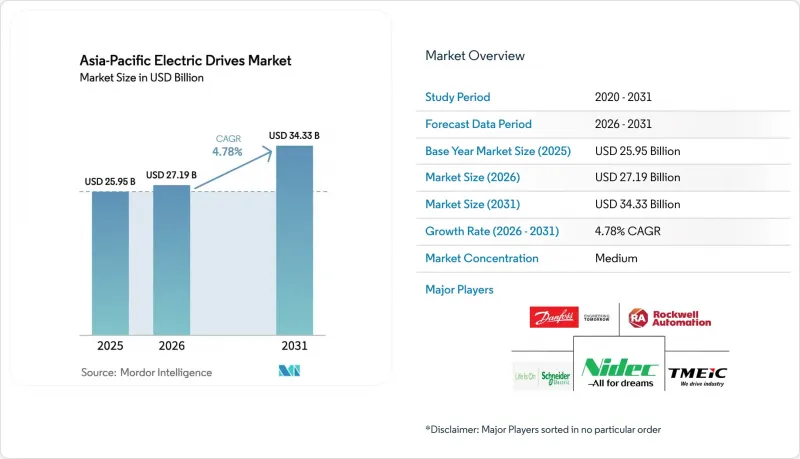
據 Mordor Intelligence 稱,亞太地區電動驅動市場在 2025 年的價值為 259.5 億美元,預計到 2031 年將達到 343.3 億美元,而 2026 年為 271.9 億美元,預測期(2026-2031 年)的複合年成長率為 4.78%。
本報告按驅動類型(交流變頻器、直流驅動、伺服驅動、永磁驅動)、電壓等級(低壓、中壓、高壓)、額定功率(微型、低功率、中功率、高功率)、終端用戶行業(石油天然氣、化工和石化、食品飲料、水和污水處理、其他)以及國家/地區進行細分。市場預測以美元(USD)計價。
亞太地區電動驅動市場趨勢與洞察
離散製造業和流程行業的快速自動化
尤其是在中國沿海地區、韓國和日本部分地區,勞動力短缺正在加速對全自動「無人值守」工廠的投資,這些工廠採用高速伺服系統進行取放、碼垛和品質檢測等操作。日本西部半導體工廠的擴張和台灣先進封裝生產線的建設需要奈米級的定位精度,這推動了對具有吉赫級控制迴路的數位連網伺服驅動器的需求。化學和石化行業的加工廠正在用變頻驅動器 (VFD) 取代老舊的感應馬達啟動器,從而降低高達 30% 的能耗,鑑於利潤率持續微薄,這是一項至關重要的措施。印度蓬勃發展的化肥產業採用變速泵控制技術,顯示即使在現有設施中,無需進行大規模的土木工程,也能迅速降低電力成本。儘管由於庫存調整,日本供應商在 2024 年下半年的出貨量有所放緩,但隨後來自東協家電製造商的訂單已使訂單出貨比穩定在 1.05 以上,表明對資本設備的需求依然強勁。
監管壓力促使對 IE4+ 馬達和驅動器維修。
一系列關於最低能源效率標準的法規正在收緊全部區域現有馬達的相關規定。日本的「頂級運轉者計畫」(Top Runner Program)要求到2027年配電變壓器的效率提高11.4%,這迫使設施管理人員將IE4馬達與能夠進行同步磁阻控制或永磁控制的新型驅動器配合使用。越南和泰國的出口型製造商已積極遵守歐洲針對75-200kW馬達的IE4法規,以避免重新認證的成本,因此高效驅動器對於維持市場進入至關重要。澳洲和紐西蘭的最低能源效率標準(MEPS)計畫將於2025年更新,這將推動採購效率超過98%標準的碳化矽驅動器的趨勢。
中壓驅動裝置的高資本投資和整合成本
6.6kV、2MW變頻器的總安裝成本,若包含開關設備、降壓變壓器和諧波濾波器,可能比設備本身的價格高出50%。通常,利潤率較低的亞洲中小型製造商會將此類升級推遲到設備使用壽命超過20年後。印尼和馬來西亞外匯的波動推高了進口中壓設備的資金籌措成本,迫使買家與供應商協商長期信貸額度。羅克韋爾自動化的同步傳輸技術透過使單一驅動器控制多個電機,部分抵消了高價帶來的衝擊,並將資本投資降低了約50%。然而,認證工程師的短缺阻礙了許多營運商進行複雜的維修,這抑制了亞太地區電力驅動市場該細分領域的銷售成長。
細分市場分析
到2025年,交流變頻器將佔總銷售額的72.70%,並將繼續作為泵浦、風扇和輸送機領域的旗艦產品,在這些領域,成本和可靠性比高精度更為重要。過去五年價格的下降使平均售價比2019年水平低了近18%,這有助於亞太地區電動驅動器市場向中小企業用戶的滲透。伺服驅動器雖然絕對規模較小,但預計到2031年將維持7.80%的小規模,主要得益於取放機器人、電子組裝和3D列印生產線等需要亞毫秒響應速度的應用。這個細分市場受益於與EtherCAT和時間敏感網路(TSN)的整合,而這些功能通常並非散裝搬運應用所必需。
伺服的普及也反映了機器智慧化的不斷提升。高回饋導向編碼器可將即時位置資料傳輸至數位孿生模型,將新機器人單元的試運行時間縮短30%。同時,永磁驅動器憑藉其高扭矩密度,在電梯提昇機和商用暖通空調(HVAC)領域不斷擴大市場佔有率,但供應鏈的脆弱性限制了其快速更新換代。總體而言,儘管通用向量控制面臨價格壓力,但精密運動控制領域仍是亞太地區馬達驅動市場創新發展的驅動力。
到2025年,1kV以下低壓驅動器將佔總銷量的65.40%,反映出亞洲工廠對380-415V商用電源的廣泛應用。通用暖通空調和水處理設備佔據了大部分銷量,這主要得益於標準化的IP55防護等級外殼和即插即用的現場匯流排適配器,這些都降低了安裝成本。隨著礦場、煉油廠和液化天然氣廠追求兆瓦級節能,亞太地區中壓(1-36kV)電機驅動市場預計將以6.68%的複合年成長率成長。
製造商正在縮小功能上的差距。整合式電池堆架構無需外部濾波器即可將諧波失真降低至 2.3% 以下(THDi),使中壓驅動器成為現有設備棕地維修的理想選擇。同時,2kW 以下的微型硬碟採用單晶片逆變器 IC,減少了 40% 的印刷電路基板(PCB) 數量,並實現了食品加工生產線所需的無風扇冷卻,從而滿足了衛生清潔的要求。半導體製造廠正在將配電電壓從 415V 升級到 690V 以降低銅損,低壓平台的額定功率也逐漸提高。這模糊了傳統電壓等級之間的界限,同時也擴大了亞太地區馬達驅動市場的規模。
其他好處
- Excel格式的市場預測(ME)表
- 3個月的分析師支持
目錄
第1章:引言
- 研究假設和市場定義
- 調查範圍
第2章:調查方法
第3章執行摘要
第4章 市場狀況
- 市場概覽
- 市場促進因素
- 離散製造業和流程行業的快速自動化
- 監管壓力促使對 IE4+ 馬達和驅動器維修。
- 商業地產中暖通空調系統的快速普及
- 精密驅動是擴大綠色氫電解設備應用所必需的。
- 東協對伺服驅動包裝線的補貼
- 一座採用變頻驅動器進行需量反應的併網建築。
- 市場限制因素
- 中壓驅動裝置的高資本投資和整合成本
- 試運行和維護工作中技術純熟勞工短缺
- CLMV國家電網持續存在的電壓品質問題
- 與永久磁鐵驅動器用稀土元素磁體相關的貿易政策風險
- 價值鏈分析
- 監理情勢
- 技術展望
- 波特五力分析
- 市場宏觀經濟趨勢的評估
第5章 市場規模與成長預測
- 透過驅動系統
- 交流變頻器
- 直流驅動器
- 伺服驅動器
- 永磁驅動
- 電壓等級
- 低電壓(低於1千伏特)
- 中壓(1-36kV)
- 高壓(超過36千伏特)
- 按類型分類的額定輸出
- 微波爐(小於5千瓦)
- 低功率(5-200kW)
- 中功率(200千瓦至1兆瓦)
- 高功率(超過1兆瓦)
- 按最終用戶行業分類
- 石油和天然氣
- 化工/石油化工
- 飲食
- 水和污水處理
- 發電
- 金屬和採礦
- 紙漿和造紙
- 暖通空調及建築設備
- 離散製造
- 其他
- 國家
- 中國
- 印度
- 日本
- 韓國
- 澳洲和紐西蘭
- 亞太其他地區
第6章 競爭情勢
- 市場集中度
- 策略趨勢
- 市佔率分析
- 公司簡介
- ABB Ltd.
- Siemens AG
- Schneider Electric SE
- Danfoss A/S
- Rockwell Automation Inc.
- Mitsubishi Electric Corporation
- Yaskawa Electric Corporation
- Hitachi Industrial Equipment Systems Co. Ltd.
- TMEIC Corporation
- Toshiba International Corporation
- Fuji Electric Co. Ltd.
- Nidec Corporation
- Delta Electronics Inc.
- Inovance Technology
- Wolong Electric Group Co. Ltd.
- WEG SA
- CG Power and Industrial Solutions Ltd.
- LS Electric Co. Ltd.
- Bonfiglioli Riduttori SpA
- Emerson Electric Co.
第7章 市場機會與未來展望
According to Mordor Intelligence, the APAC electric drives market size was valued at USD 25.95 billion in 2025 and estimated to grow from USD 27.19 billion in 2026 to reach USD 34.33 billion by 2031, at a CAGR of 4.78% during the forecast period (2026-2031).
This report is Segmented by Drive Type (AC Drives, DC Drives, Servo Drives, and Permanent-Magnet Drives), Voltage Class (Low Voltage, Medium Voltage, and High Voltage), Power Rating (Micro, Low, Medium, and High), End-User Industry (Oil and Gas, Chemical and Petrochemical, Food and Beverage, Water and Wastewater, and More), and Country. The Market Forecasts are Provided in Terms of Value (USD).
Asia-Pacific Electric Drives Market Trends and Insights
Rapid Automation Across Discrete and Process Industries
Tight labor markets, especially in coastal China, South Korea, and parts of Japan, are accelerating investment in fully automated "lights-out" facilities that rely on high-speed servo systems for pick-and-place, palletizing and quality-inspection tasks. Semiconductor plant expansions in western Japan and advanced packaging lines in Taiwan require nanometer-level positioning accuracy, fueling demand for digitally networked servo drives with gigahertz-class control loops. Process plants in chemicals and petrochemicals are modernizing older induction-motor starters with variable-frequency drives (VFDs) that trim energy use by up to 30%, an imperative as commodity margins stay thin. Variable-speed pump control in India's growing fertilizer industry illustrates how even legacy facilities can capture quick wins on electricity cost without major civil work. Although inventory corrections dampened Japanese vendor shipments in late 2024, purchase orders from ASEAN producers of consumer electronics have since stabilized the book-to-bill ratio at above 1.05, signaling continued capital-equipment momentum.
Regulatory Pressure for IE4+ Motors and Drive Retrofits
Successive rounds of minimum-efficiency legislation tighten the screws on installed motors across the region. Japan's Top Runner Program demands 11.4% efficiency gains in distribution transformers by 2027, pushing facility managers to pair IE4 motors with new drives capable of synchronous-reluctance or permanent-magnet control. Export-oriented manufacturers in Vietnam and Thailand pre-emptively comply with European IE4 mandates on 75-200 kW motors to avoid re-certification costs, making high-efficiency drives a ticket to retain market access. Australia and New Zealand's MEPS program, refreshed in 2025, tips purchasing models toward silicon-carbide-based drives that breach the 98% efficiency threshold.
High Capex and Integration Cost for Medium-Voltage Drives
Total installed cost for a 6.6 kV, 2 MW VFD can exceed equipment price by 50% once switchgear, step-down transformers and harmonic filters are added. Small and mid-size Asian manufacturers, often operating on thin margins, defer such upgrades until asset lifetimes stretch beyond twenty years. Exchange-rate volatility in Indonesia and Malaysia balloons financing costs for imported medium-voltage hardware, forcing buyers to negotiate long-tenor supplier credit lines. Rockwell Automation's sync-transfer technology partially offsets sticker shock by letting one drive control multiple motors, slashing capex by roughly 50%. Still, scarcity of certified engineers makes many operators hesitant to embark on complex retrofits, restraining volume growth in this slice of the APAC electric drives market.
Other drivers and restraints analyzed in the detailed report include:
- Surging HVAC Adoption in Commercial Real-Estate
- Green-Hydrogen Electrolyzer Build-Out Needs Precision Drives
- Skilled-Labour Shortages for Commissioning and Maintenance
For complete list of drivers and restraints, kindly check the Table Of Contents.
Segment Analysis
AC drives generated 72.70% of 2025 revenue and remain the workhorse across pumps, fans and conveyors where cost and reliability trump pinpoint accuracy. Price erosion over the past five years keeps average selling prices nearly 18% below 2019 levels, helping the APAC electric drives market penetrate SME users. Servo drives, although smaller in absolute dollars, will clock a 7.80% CAGR through 2031 on the back of pick-and-place robotics, electronic assembly and 3-D printing lines that demand sub-millisecond speed response. This micro-segment benefits from integration with EtherCAT and Time-Sensitive Networking, features not generally required by bulk-handling applications.
Servo uptake also reflects growing on-machine intelligence: feedback-rich encoders feed real-time position data to digital twins, slashing commissioning time by 30% in new robotic cells. Meanwhile, permanent-magnet drives exploit high torque density to gain share in elevator hoists and commercial HVAC, although supply-chain vulnerability constrains faster substitution. Collectively, precision motion segments keep the APAC electric drives market on a technology-innovation footing despite price pressures in commodity vector control.
Low-voltage drives below 1 kV captured 65.40% revenue in 2025, reflecting the ubiquity of 380-415 V utility feeds across Asian factories. Commodity HVAC and water-treatment installations account for most volume, aided by standardized IP55 enclosures and plug-and-play fieldbus adapters that trim installation cost. The APAC electric drives market size for medium-voltage (1-36 kV) equipment is forecast to expand at 6.68% CAGR as miners, refiners and LNG liquefaction plants seek megawatt-class energy savings.
Manufacturers are narrowing the feature gap: integrated cell-stack architectures reduce harmonic distortion to below 2.3% THDi without external filters, making MV drives attractive even for brownfield retrofits. At the opposite end, micro-drives under 2 kW adopt single-chip inverter ICs, shaving PCB count by 40% and enabling fan-less cooling for food-processing lines with sanitary washdown requirements. As semiconductor fabs upgrade from 415 V to 690 V power distribution to cut copper losses, low-voltage platforms inch upward in rating, muddying traditional voltage-class boundaries while enlarging the addressable APAC electric drives market.
Complete Report Scope:
- By Drive Type
- AC Drives
- DC Drives
- Servo Drives
- Permanent-Magnet Drives
- By Voltage Class
- Low Voltage (<1 kV)
- Medium Voltage (1-36 kV)
- High Voltage (>36 kV)
- By Power Rating
- Micro (<5 kW)
- Low (5-200 kW)
- Medium (200 kW-1 MW)
- High (>1 MW)
- By End-user Industry
- Oil and Gas
- Chemical and Petrochemical
- Food and Beverage
- Water and Wastewater
- Power Generation
- Metals and Mining
- Pulp and Paper
- HVAC and Building Services
- Discrete Manufacturing
- Other Industries
- By Country
- China
- India
- Japan
- South Korea
- Australia and New Zealand
- Rest of Asia-Pacific
List of Companies Covered in this Report:
- ABB Ltd.
- Siemens AG
- Schneider Electric SE
- Danfoss A/S
- Rockwell Automation Inc.
- Mitsubishi Electric Corporation
- Yaskawa Electric Corporation
- Hitachi Industrial Equipment Systems Co. Ltd.
- TMEIC Corporation
- Toshiba International Corporation
- Fuji Electric Co. Ltd.
- Nidec Corporation
- Delta Electronics Inc.
- Inovance Technology
- Wolong Electric Group Co. Ltd.
- WEG S.A.
- CG Power and Industrial Solutions Ltd.
- LS Electric Co. Ltd.
- Bonfiglioli Riduttori S.p.A.
- Emerson Electric Co.
Additional Benefits:
- The market estimate (ME) sheet in Excel format
- 3 months of analyst support
TABLE OF CONTENTS
1 INTRODUCTION
- 1.1 Study Assumptions and Market Definition
- 1.2 Scope of the Study
2 RESEARCH METHODOLOGY
3 EXECUTIVE SUMMARY
4 MARKET LANDSCAPE
- 4.1 Market Overview
- 4.2 Market Drivers
- 4.2.1 Rapid automation across discrete and process industries
- 4.2.2 Regulatory pressure for IE4 + motors and drive retrofits
- 4.2.3 Surging HVAC adoption in commercial real-estate
- 4.2.4 Green hydrogen electrolyzer build-out needs precision drives
- 4.2.5 ASEAN state subsidies for servo-driven packaging lines
- 4.2.6 Grid-interactive buildings deploying VFD-based demand response
- 4.3 Market Restraints
- 4.3.1 High capex and integration cost for medium-voltage drives
- 4.3.2 Skilled-labour shortages for commissioning and maintenance
- 4.3.3 Persistent voltage-quality issues in CLMV* grids
- 4.3.4 Trade-policy risk on rare-earth magnets for PM drives
- 4.4 Value Chain Analysis
- 4.5 Regulatory Landscape
- 4.6 Technological Outlook
- 4.7 Porter's Five Forces Analysis
- 4.7.1 Bargaining Power of Suppliers
- 4.7.2 Bargaining Power of Buyers
- 4.7.3 Threat of New Entrants
- 4.7.4 Threat of Substitutes
- 4.7.5 Intensity of Competitive Rivalry
- 4.8 Assessment of Macro Economic Trends on the Market
5 MARKET SIZE AND GROWTH FORECASTS (VALUES)
- 5.1 By Drive Type
- 5.1.1 AC Drives
- 5.1.2 DC Drives
- 5.1.3 Servo Drives
- 5.1.4 Permanent-Magnet Drives
- 5.2 By Voltage Class
- 5.2.1 Low Voltage (<1 kV)
- 5.2.2 Medium Voltage (1-36 kV)
- 5.2.3 High Voltage (>36 kV)
- 5.3 By Power Rating
- 5.3.1 Micro (<5 kW)
- 5.3.2 Low (5-200 kW)
- 5.3.3 Medium (200 kW-1 MW)
- 5.3.4 High (>1 MW)
- 5.4 By End-user Industry
- 5.4.1 Oil and Gas
- 5.4.2 Chemical and Petrochemical
- 5.4.3 Food and Beverage
- 5.4.4 Water and Wastewater
- 5.4.5 Power Generation
- 5.4.6 Metals and Mining
- 5.4.7 Pulp and Paper
- 5.4.8 HVAC and Building Services
- 5.4.9 Discrete Manufacturing
- 5.4.10 Other Industries
- 5.5 By Country
- 5.5.1 China
- 5.5.2 India
- 5.5.3 Japan
- 5.5.4 South Korea
- 5.5.5 Australia and New Zealand
- 5.5.6 Rest of Asia-Pacific
6 COMPETITIVE LANDSCAPE
- 6.1 Market Concentration
- 6.2 Strategic Moves
- 6.3 Market Share Analysis
- 6.4 Company Profiles (includes Global level Overview, Market level overview, Core Segments, Financials as available, Strategic Information, Market Rank/Share for key companies, Products and Services, and Recent Developments)
- 6.4.1 ABB Ltd.
- 6.4.2 Siemens AG
- 6.4.3 Schneider Electric SE
- 6.4.4 Danfoss A/S
- 6.4.5 Rockwell Automation Inc.
- 6.4.6 Mitsubishi Electric Corporation
- 6.4.7 Yaskawa Electric Corporation
- 6.4.8 Hitachi Industrial Equipment Systems Co. Ltd.
- 6.4.9 TMEIC Corporation
- 6.4.10 Toshiba International Corporation
- 6.4.11 Fuji Electric Co. Ltd.
- 6.4.12 Nidec Corporation
- 6.4.13 Delta Electronics Inc.
- 6.4.14 Inovance Technology
- 6.4.15 Wolong Electric Group Co. Ltd.
- 6.4.16 WEG S.A.
- 6.4.17 CG Power and Industrial Solutions Ltd.
- 6.4.18 LS Electric Co. Ltd.
- 6.4.19 Bonfiglioli Riduttori S.p.A.
- 6.4.20 Emerson Electric Co.
7 MARKET OPPORTUNITIES AND FUTURE OUTLOOK
- 7.1 White-space and Unmet-need Assessment

 交流電驅動:市場佔有率分析、產業趨勢與統計資料、成長預測(2026-2031 年)低壓馬達驅動:市場佔有率分析、產業趨勢與統計、成長預測(2026-2031年)電動驅動:市場佔有率分析、產業趨勢與統計、成長預測(2026-2031)
 2034年全球電動驅動單元市場預測-按組件、驅動系統、電壓架構、推進方式、架構類型、銷售管道和地區分類的分析
 電動裝置市場規模、佔有率和成長分析:按組件、驅動系統配置、系統電壓配置、終端用戶產業和地區分類-2026-2033年產業預測
 OEM電動驅動單元市場機會、成長要素、產業趨勢分析及2026-2035年預測
 電氣和機械驅動裝置市場:2026-2032年全球市場預測(按驅動系統、額定功率、速度範圍、最終用戶產業、應用和控制系統分類)
 BEV電動裝置的全球市場中東和非洲的電動式驅動:市場佔有率分析、產業趨勢和成長預測(2025-2030)全球直流 (DC) 電力驅動市場:市場佔有率分析、產業趨勢與統計、成長預測(2025-2030 年)