


 |
市場調查報告書
商品編碼
2125257
亞太地區人力資源管理軟體:市場佔有率分析、產業趨勢與統計及成長預測(2026-2031)Asia-Pacific Human Capital Management Software - Market Share Analysis, Industry Trends & Statistics, Growth Forecasts (2026 - 2031) |
||||||

※ 本網頁內容可能與最新版本有所差異。詳細情況請與我們聯繫。
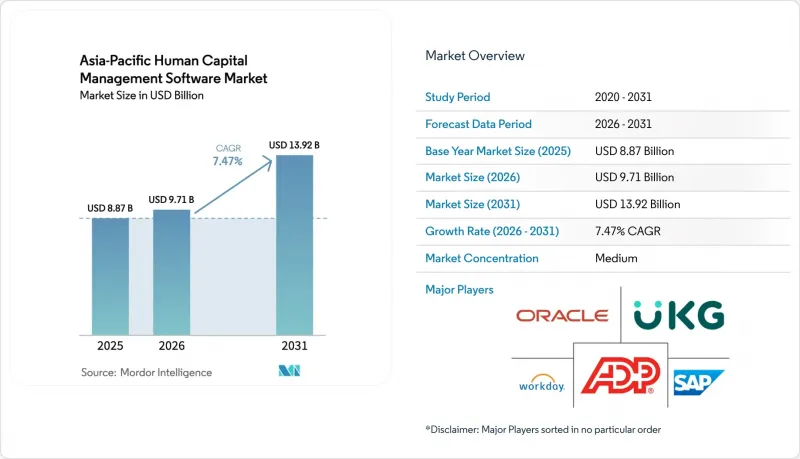
根據 Mordor Intelligence 預測,亞太地區人才管理軟體市場規模將從 2025 年的 88.7 億美元成長到 2026 年的 97.1 億美元,然後在 2031 年達到 139.2 億美元,2026 年至 2031 年的複合年成長率為 7.47%。
本報告按部署類型(雲端部署與本地部署)、應用領域(核心人力資源、薪資管理及其他)、組織規模(中小企業與大型企業)、產品類型(軟體和服務)、最終用戶產業(IT與電信、零售與電子商務及其他)以及地區進行細分。市場預測以美元計價。
亞太地區人力資源管理軟體市場趨勢與洞察。
加速亞太地區企業採用雲端運算
企業正以基於訂閱的雲端套件取代資本密集的本地系統,以降低整體擁有成本 (TCO) 並加快創新週期。在雪梨、新加坡、東京和孟買等地擴建區域資料中心,使供應商能夠提供現代化的微服務架構,從而縮短發布週期,同時滿足嚴格的資料居住法規。中型企業是雲端採用的最大受益者,因為它無需配備專門的 IT 人員和伺服器機房,並支援可隨員工人數成長而擴展的模式。即使是曾經需要空氣間隙環境的受監管產業,現在也開始試行混合架構,將敏感的主資料保留在本地,同時在雲端運行分析處理。能夠在私有雲端雲和公共雲端之間切換工作負載而無需重建平台,是關鍵的選擇標準,這使得提供容器化服務和無狀態整合閘道器的供應商具有優勢。
關於遵守數位薪資核算的監理義務
從印尼的CORETAX系統到越南的電子社會保險帳簿,法律法規的快速變化要求薪資核算引擎提供季度更新內容包,而非年度升級。擁有內部合規團隊和針對特定國家/地區藍圖的供應商,能夠提供「即時可用」的解決方案,在政府修訂稅級、福利或繳款公式時迅速回應,從而脫穎而出。香港的電子強積金(eMPF)平台就是一個典型的例子,該平台將分階段推出,直到2025年。供應商必須整合繳款提交API和投資組合轉換工作流程;否則,他們將面臨客戶流失的風險。隨著越來越多的稅務機關要求即時薪資核算報告,支援微批量提交和審計級資料追蹤的雲端架構正日益普及。
與傳統ERP系統整合的複雜性。
許多銀行和製造商經營著高度客製化的 SAP ECC 和 Oracle E-Business Suite 系統,這些系統無法在一夜之間被完全淘汰。將組織層級、成本中心和客製化的薪資核算邏輯與下一代雲端套件同步,通常需要中間件、資料清理以及長達 18 個月或更久的階段性部署。雖然 Workday 和 SAP SuccessFactors 提供入門級連接器,但一些特定的本地薪資核算引擎和政府申報入口網站仍然需要客製化 API,這進一步擴大了專案範圍。過度依賴諮詢服務的專案會推高整體擁有成本 (TCO),疏遠預算有限的客戶,並減緩整個市場的轉型進程。儘管提供遷移加速器和預先映射資料模型的供應商可以緩解這些摩擦,但舊有系統的複雜性仍然是部署速度的最大障礙。
細分市場分析
至2025年,基於雲端的解決方案將佔亞太地區人才管理軟體市場收入佔有率的78.03%,預計到2031年,該細分市場將以7.51%的複合年成長率成長。為了滿足資料居住法規的要求,供應商正在增加特定國家/地區的雲端區域,從而消除了以往迫使敏感產業只能在本地部署的障礙。雖然大型銀行仍在受監管的資料中心內維護某些薪資核算引擎,但它們擴大將這些核心系統與雲端分析相結合,以近乎即時地模擬薪酬方案。本機部署和混合式環境仍然很重要,但它們的藍圖正在轉向支援分階段遷移的API閘道器,而不是全端升級。
中型企業從訂閱式定價模式中獲益最多,因為它將固定硬體成本轉化為可變營運支出,使它們能夠將預算分配給分析和學習模組。 Zoho 在海灣合作理事會 (GCC) 國家的擴張以及 Darwinbox 在東南亞的模板驅動部署表明,預先配置的波灣合作理事會堆疊可以在幾週內而不是幾個季度內投入運作。為受嚴格監管的企業提供單一租戶選項,同時為其他用戶保留多租戶核心功能的供應商,可以在單一程式碼庫中滿足不同的買家偏好。預計到 2031 年,這項策略將使它們在亞太地區的雲端人力資源管理軟體市場佔據超過 80% 的佔有率。
由於所有實施方案均以員工主文件和合規工作流程為基礎,核心人力資源功能預計到 2025 年將占我們收入的 29.77%。受職位網格轉向技能圖譜的推動,績效和人才管理預計將成為成長最快的應用領域,複合年成長率 (CAGR) 將達到 7.84%。基於 Workday Skills Cloud 和 SAP Opportunity Marketplace 建構的人才市場使財務長能夠將工程師重新部署到高優先級專案中,而無需承擔外部招聘成本,從而縮短投資回收期。
儘管薪資核算仍然是監管要求的職能,但差異化的重點正轉向相關的分析能力,以預測加班激增和薪資差距。人力資源管理模組整合了零售業的排班和POS數據,而學習平台現在也加入了微證書功能,以檢驗技能發展的投資報酬率。隨著這些曾經各自獨立的應用程式被整合到通用資料模型中,亞太地區人才管理軟體市場中分配給最佳組合解決方案的市場佔有率預計將會縮小,而支出將集中在整合套件上。
其他好處
- Excel格式的市場預測(ME)表
- 3個月的分析師支持
目錄
第1章:引言
- 研究假設和市場定義
- 調查範圍
第2章:調查方法
第3章執行摘要
第4章 市場狀況
- 市場概覽
- 市場促進因素
- 對行動HCM應用程式的需求不斷成長
- 對勞動力流動性的需求日益成長
- 加速亞太地區企業採用雲端運算
- 關於遵守數位薪資核算的監理義務
- 中型企業的AI驅動型多語言人力資源聊天機器人的在地化
- 跨境零工平台整合
- 市場限制因素
- 隱私和安全問題
- 與傳統ERP系統整合的複雜性。
- 亞太地區勞動法的差異
- 人力資源分析人員短缺
- 產業價值鏈分析
- 監理情勢
- 技術展望
- 波特五力分析
- 宏觀經濟因素對市場的影響
第5章 市場規模與成長預測
- 不同的發展
- 基於雲端的
- 現場
- 透過使用
- 核心人力資源
- 薪資管理
- 薪資管理
- 人力資源管理
- 績效與人力資源管理
- 數位學習和電子招聘
- 企業級 GRC(eGRC)
- 按組織規模
- 中小企業
- 大公司
- 透過提供
- 軟體
- 主要平台
- 點解決方案和附加元件
- 服務
- 實施與整合
- 支援和維護
- 軟體
- 按最終用戶行業分類
- 銀行、金融服務和保險(BFSI)
- 資訊科技/通訊
- 零售與電子商務
- 製造業
- 醫療保健和生命科學
- 政府/公共部門
- 其他
- 按地區
- 中國
- 日本
- 印度
- 韓國
- 澳洲
- 新加坡
- 印尼
- 馬來西亞
- 亞太其他地區
第6章 競爭情勢
- 市場集中度
- 策略趨勢
- 市佔率分析
- 公司簡介
- Workday Inc.
- SAP SE
- Oracle Corporation
- Automatic Data Processing, Inc.(ADP)
- UKG Inc.
- Cornerstone OnDemand, Inc.
- PeopleStrong Technologies Pvt. Ltd.
- Infor, Inc.
- Darwinbox Digital Solutions Pvt. Ltd.
- Ceridian HCM Holding Inc.(Dayforce)
- Ramco Systems Limited
- Zoho Corporation Pvt. Ltd.
- The Sage Group plc(Sage People)
- Beisen Cloud Computing Co., Ltd.
- SumTotal Systems LLC
- HiBob Inc.
- WorkForce Software, LLC
- Rippling People Center Inc.
- SmartHR, Inc.
第7章 市場機會與未來展望
According to Mordor Intelligence, the Asia-Pacific human capital management software market size is expected to grow from USD 8.87 billion in 2025 to USD 9.71 billion in 2026 and is forecast to reach USD 13.92 billion by 2031 at 7.47% CAGR over 2026-2031.
This report is Segmented by Deployment (Cloud-Based, and On-Premise), Application (Core HR, Payroll Management, and More), Organization Size (Small and Medium-Sized Enterprises, and Large Enterprises), Offering (Software, and Services), End-User Industry (IT and Telecom, Retail and E-Commerce, and More), and Geography. The Market Forecasts are Provided in Terms of Value (USD).
Asia-Pacific Human Capital Management Software Market Trends and Insights
Accelerated Cloud Adoption Across Asia-Pacific Enterprises
Enterprises are replacing capital-intensive on-premise systems with subscription-priced cloud suites to reduce total cost of ownership and accelerate innovation cycles. Regional data-center expansions in Sydney, Singapore, Tokyo, and Mumbai allow vendors to address strict residency rules while offering modern micro-services architectures that shorten release cadences. Mid-market buyers benefit most because cloud deployments remove the need for dedicated IT staff and server rooms, supporting scale-as-you-grow head-count models. Even regulated industries that once demanded air-gapped environments now pilot hybrid stacks that pin sensitive master data on-premise but run analytics in the cloud. The ability to toggle workloads between private and public clouds without re-platforming has become a key selection criterion, favoring vendors with containerized services and stateless integration gateways.
Regulatory Mandates for Digital Payroll Compliance
Rapid-fire statutory changes, from Indonesia's CORETAX rollout to Vietnam's electronic social-insurance books, require payroll engines that ship quarterly content packs rather than annual upgrades. Vendors with in-house compliance teams and country-specific roadmaps differentiate by offering "day-one readiness" whenever governments revise brackets, allowances, or contribution formulas. Hong Kong's eMPF platform, launching in phases through 2025, is a case in point: providers must embed contribution-submission APIs and portfolio-switch workflows or risk client attrition. As more tax authorities demand real-time payroll reporting, cloud architectures that support micro-batch submissions and audit-quality data trails gain further momentum.
Integration Complexity with Legacy ERP Stacks
Many banks and manufacturers run heavily customized SAP ECC or Oracle E-Business Suite instances that cannot be retired overnight. Synchronizing organizational hierarchies, cost centers, and custom payroll logic with a next-generation cloud suite often requires middleware, data-clean-up, and staged rollouts that stretch beyond 18 months. While Workday and SAP SuccessFactors publish starter connectors, niche local payroll engines and government submission portals still demand bespoke APIs, inflating project scope. Consulting-heavy engagements raise the total cost of ownership, deterring budget-constrained clients and slowing overall market conversion. Vendors that bundle migration accelerators and pre-mapped data models reduce this friction, but legacy complexity remains the single biggest drag on implementation velocity.
Other drivers and restraints analyzed in the detailed report include:
- Localization of AI-Driven Multilingual HR Chatbots for Mid-Market Firms
- Integration of Cross-Border Gig-Workforce Platforms
- Privacy and Security Concerns
For complete list of drivers and restraints, kindly check the Table Of Contents.
Segment Analysis
Cloud-based solutions held 78.03% revenue share of the Asia-Pacific human capital management software market in 2025, and the segment is expanding at 7.51% CAGR through 2031. Vendors are adding sovereign cloud regions to satisfy residency laws, which removes the historical barrier that once forced sensitive industries to remain on-premise. Large banks still keep certain payroll engines inside regulated data centers, yet they increasingly pair this core with cloud analytics to model compensation scenarios in near real time. On-premise and hybrid footprints remain relevant, but their road-maps now emphasize API gateways that allow phased migration rather than full-stack upgrades.
Mid-market firms are the biggest beneficiaries because subscription pricing converts fixed hardware cost into variable operating expense, freeing budget for analytics and learning modules. Zoho's expansion across the Gulf Cooperation Council and Darwinbox's template-driven roll-outs in Southeast Asia demonstrate that pre-configured cloud stacks can go live in weeks instead of quarters. Vendors that offer single-tenant options for highly regulated entities while keeping a multi-tenant core for everyone else capture divergent buyer preferences within one code base, a strategy expected to propel cloud's Asia-Pacific human capital management software market share beyond 80% by 2031.
Core HR generated 29.77% of 2025 application revenue as every deployment begins with an employee master file and compliance workflows. Performance and talent management is set to be the fastest-growing application at 7.84% CAGR, driven by the pivot from job grids to skills graphs. Internal talent marketplaces built on Workday Skills Cloud or SAP Opportunity Marketplace let CFOs redeploy engineers to high-priority projects without external hiring fees, accelerating pay-back periods.
Payroll remains a regulatory must-have, but differentiation is shifting to adjacent analytics that predict overtime spikes or pay-equity gaps. Workforce-management modules integrate scheduling with point-of-sale data in retail, while learning stacks now embed micro-credentialing to verify upskilling ROI. As these formerly siloed applications converge on a common data model, the Asia-Pacific human capital management software market size allocated to best-of-breed point solutions is expected to shrink, consolidating spend inside unified suites.
Complete Report Scope:
- By Deployment
- Cloud-Based
- On-Premise
- By Application
- Core HR
- Payroll Management
- Compensation Management
- Workforce Management
- Performance and Talent Management
- E-Learning and E-Recruiting
- Enterprise GRC (eGRC)
- By Organization Size
- Small and Medium-Sized Enterprises (SMEs)
- Large Enterprises
- By Offering
- Software
- Core Platforms
- Point Solutions and Add-Ons
- Services
- Implementation and Integration
- Support and Maintenance
- Software
- By End-User Industry
- Banking, Financial Services, and Insurance (BFSI)
- IT and Telecom
- Retail and E-Commerce
- Manufacturing
- Healthcare and Life-Sciences
- Government and Public Sector
- Other End-User Industries
- By Geography
- China
- Japan
- India
- South Korea
- Australia
- Singapore
- Indonesia
- Malaysia
- Rest of Asia-Pacific
List of Companies Covered in this Report:
- Workday Inc.
- SAP SE
- Oracle Corporation
- Automatic Data Processing, Inc. (ADP)
- UKG Inc.
- Cornerstone OnDemand, Inc.
- PeopleStrong Technologies Pvt. Ltd.
- Infor, Inc.
- Darwinbox Digital Solutions Pvt. Ltd.
- Ceridian HCM Holding Inc. (Dayforce)
- Ramco Systems Limited
- Zoho Corporation Pvt. Ltd.
- The Sage Group plc (Sage People)
- Beisen Cloud Computing Co., Ltd.
- SumTotal Systems LLC
- HiBob Inc.
- WorkForce Software, LLC
- Rippling People Center Inc.
- SmartHR, Inc.
Additional Benefits:
- The market estimate (ME) sheet in Excel format
- 3 months of analyst support
TABLE OF CONTENTS
1 INTRODUCTION
- 1.1 Study Assumptions and Market Definition
- 1.2 Scope of the Study
2 RESEARCH METHODOLOGY
3 EXECUTIVE SUMMARY
4 MARKET LANDSCAPE
- 4.1 Market Overview
- 4.2 Market Drivers
- 4.2.1 Growing Demand for Mobile HCM Applications
- 4.2.2 Increase in Demand for Talent Mobility
- 4.2.3 Accelerated Cloud Adoption Across Asia-Pacific Enterprises
- 4.2.4 Regulatory Mandates for Digital Payroll Compliance
- 4.2.5 Localization of AI-Driven Multilingual HR Chatbots for Mid-Market Firms
- 4.2.6 Integration of Cross-Border Gig-Workforce Platforms
- 4.3 Market Restraints
- 4.3.1 Privacy and Security Concerns
- 4.3.2 Integration Complexity with Legacy ERP Stacks
- 4.3.3 Fragmented Asia-Pacific Labor-Law Landscape
- 4.3.4 Scarcity of HR-Analytics Talent Pool
- 4.4 Industry Value Chain Analysis
- 4.5 Regulatory Landscape
- 4.6 Technological Outlook
- 4.7 Porter's Five Forces Analysis
- 4.7.1 Threat of New Entrants
- 4.7.2 Bargaining Power of Buyers
- 4.7.3 Bargaining Power of Suppliers
- 4.7.4 Threat of Substitutes
- 4.7.5 Intensity of Competitive Rivalry
- 4.8 Impact of Macroeconomic Factors on the Market
5 MARKET SIZE AND GROWTH FORECASTS (VALUE)
- 5.1 By Deployment
- 5.1.1 Cloud-Based
- 5.1.2 On-Premise
- 5.2 By Application
- 5.2.1 Core HR
- 5.2.2 Payroll Management
- 5.2.3 Compensation Management
- 5.2.4 Workforce Management
- 5.2.5 Performance and Talent Management
- 5.2.6 E-Learning and E-Recruiting
- 5.2.7 Enterprise GRC (eGRC)
- 5.3 By Organization Size
- 5.3.1 Small and Medium-Sized Enterprises (SMEs)
- 5.3.2 Large Enterprises
- 5.4 By Offering
- 5.4.1 Software
- 5.4.1.1 Core Platforms
- 5.4.1.2 Point Solutions and Add-Ons
- 5.4.2 Services
- 5.4.2.1 Implementation and Integration
- 5.4.2.2 Support and Maintenance
- 5.4.1 Software
- 5.5 By End-User Industry
- 5.5.1 Banking, Financial Services, and Insurance (BFSI)
- 5.5.2 IT and Telecom
- 5.5.3 Retail and E-Commerce
- 5.5.4 Manufacturing
- 5.5.5 Healthcare and Life-Sciences
- 5.5.6 Government and Public Sector
- 5.5.7 Other End-User Industries
- 5.6 By Geography
- 5.6.1 China
- 5.6.2 Japan
- 5.6.3 India
- 5.6.4 South Korea
- 5.6.5 Australia
- 5.6.6 Singapore
- 5.6.7 Indonesia
- 5.6.8 Malaysia
- 5.6.9 Rest of Asia-Pacific
6 COMPETITIVE LANDSCAPE
- 6.1 Market Concentration
- 6.2 Strategic Moves
- 6.3 Market Share Analysis
- 6.4 Company Profiles (includes Global Level Overview, Market Level Overview, Core Segments, Financials as available, Strategic Information, Market Rank/Share, Products and Services, Recent Developments)
- 6.4.1 Workday Inc.
- 6.4.2 SAP SE
- 6.4.3 Oracle Corporation
- 6.4.4 Automatic Data Processing, Inc. (ADP)
- 6.4.5 UKG Inc.
- 6.4.6 Cornerstone OnDemand, Inc.
- 6.4.7 PeopleStrong Technologies Pvt. Ltd.
- 6.4.8 Infor, Inc.
- 6.4.9 Darwinbox Digital Solutions Pvt. Ltd.
- 6.4.10 Ceridian HCM Holding Inc. (Dayforce)
- 6.4.11 Ramco Systems Limited
- 6.4.12 Zoho Corporation Pvt. Ltd.
- 6.4.13 The Sage Group plc (Sage People)
- 6.4.14 Beisen Cloud Computing Co., Ltd.
- 6.4.15 SumTotal Systems LLC
- 6.4.16 HiBob Inc.
- 6.4.17 WorkForce Software, LLC
- 6.4.18 Rippling People Center Inc.
- 6.4.19 SmartHR, Inc.
7 MARKET OPPORTUNITIES AND FUTURE OUTLOOK
- 7.1 White-Space and Unmet-Need Assessment

 人力資本管理(HCM)軟體:市場佔有率分析、產業趨勢與統計及成長預測(2026-2031)亞太地區人才管理軟體:市場佔有率分析、產業趨勢與統計及成長預測(2026-2031)北美人力資源管理軟體:市場佔有率分析、產業趨勢與統計及成長預測(2026-2031 年)印度人才管理軟體:市場佔有率分析、產業趨勢與統計及成長預測(2026-2031)歐洲人才管理軟體:市場佔有率分析、產業趨勢與統計及成長預測(2026-2031)IT與電信業的人力資源管理:市場佔有率分析、產業趨勢與統計、成長預測(2026-2031年)
 OKR軟體市場:依元件類型、公司類型、部署方式、產業和地區分類
 目標與關鍵成果軟體市場:規模、佔有率、成長率、按類型、應用和地區分類的全球產業分析,以及2026年至2034年的預測
 2026年全球人力資本管理軟體市場報告2026年全球人才管理軟體市場報告