


 |
市場調查報告書
商品編碼
2122640
人力資本管理(HCM)軟體:市場佔有率分析、產業趨勢與統計及成長預測(2026-2031)Human Capital Management Software - Market Share Analysis, Industry Trends & Statistics, Growth Forecasts (2026 - 2031) |
||||||

※ 本網頁內容可能與最新版本有所差異。詳細情況請與我們聯繫。
根據 Mordor Intelligence 預測,人力資本管理 (HCM) 軟體市場將從 2025 年的 426.1 億美元成長到 2026 年的 469.2 億美元,然後在 2031 年達到 711.1 億美元,2026 年至 2031 年的複合年成長率為 8.67%。
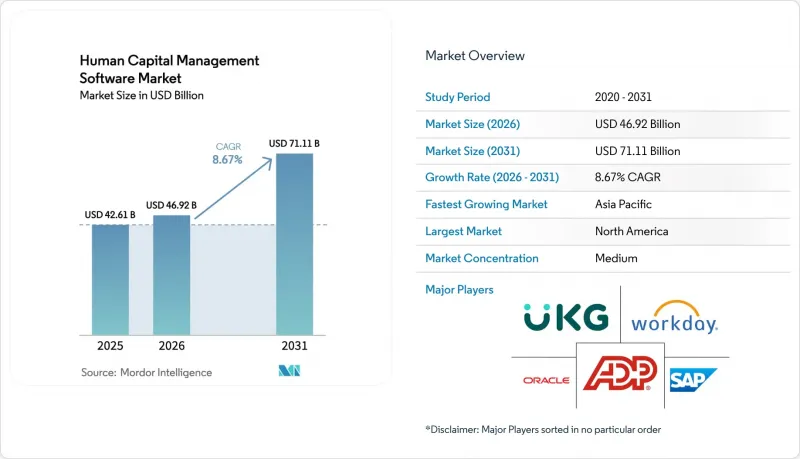
本報告按解決方案(薪資管理、人才管理等)、部署方式(本地部署、雲端部署)、組織規模(大型企業、中小企業)、產業(IT與電信、製造業、零售與電子商務、政府與公共部門等)以及地區進行細分。市場預測以美元計價。
全球人力資本管理 (HCM) 軟體市場趨勢與洞察
遷移到雲端原生 HCM 平台
雲端原生架構透過分離運算層、儲存層和應用層,使供應商能夠每週發布功能更新,並加速創新週期。 Workday Data Cloud 於 2025 年 9 月發布,它透過開放 API 即時傳輸員工、財務和營運數據,無需批量 ETL 流程,並支援跨職能分析。企業能夠將人力資源能力與需求預測相匹配,提高決策速度,並降低整合成本。根據德勤 2025 年轉型調查,68% 的企業選擇加速創新而非成本節約作為採用雲端技術的主要促進因素。安全性仍然至關重要,ISO 27001 和 SOC 2 II 型認證已直接整合到採購工作流程中,以縮短風險審查時間。這些因素共同推動人力資本管理 (HCM) 軟體市場持續成長,降低技術債務並加快價值實現速度。
整合的人才和薪資管理套件正在加速普及。
為了消除對帳延遲(每個薪資核算週期可能耗費財務部門 15 到 20 小時),各公司正在將多個獨立解決方案整合到一個整合套件中。 ADP Workforce Suite 於 2025 年 11 月發布,它整合了薪資核算、考勤、福利和人才管理模組,適用於員工人數少於 1000 人的公司,並將部署時間從幾個季度縮短到幾週。 Deel 在全球 150 個國家處理 220 億美元的薪資核算,透過自動處理季度社保和稅務申報變更,充分展現了資料流整合在合規性方面的優勢。該整合平台還支援預測分析,將薪酬變化與員工流失風險聯繫起來——麥肯錫公司認為,這項功能對於留住優秀人才至關重要。透過解決營運挑戰並提供策略洞察,該整合套件正在顯著擴大其目標用戶群。
網路安全和資料隱私問題
由於人力資本管理 (HCM) 平台儲存著高度敏感的個人資訊和薪酬訊息,因此它們是勒索軟體的主要攻擊目標。 2024 年 12 月發生的 Cleo 資料外洩事件揭露了多家跨國公司的薪資記錄,並凸顯了第三方檔案傳輸工具的漏洞。根據 GDPR 和 CCPA 的規定,罰款金額可能高達數億歐元,例如 Meta 公司在 2023 年被處以 12 億歐元(14.1 億美元)的罰款。這促使買家更加嚴格地審查供應商的控制措施。如今,企業已將零信任架構、多因素身份驗證以及靜態和傳輸中資料加密作為基本要求,這增加了小規模供應商的開發成本,並延長了採購週期。
細分市場分析
到2025年,薪資管理佔總收入的43.78%,佔最大佔有率。日益複雜的稅法、社會保險義務以及即時報告要求支撐了這一地位。 Deel每年在150個國家/地區實現220億美元的薪資核算自動化,這充分說明了企業為何優先選擇能夠大規模整合本地法規和貨幣轉換的平台。薪資核算在人力資本管理(HCM)軟體市場中的佔有率反映了薪資核算不準確所帶來的直接經濟損失。同時,學習與發展領域的複合年成長率(CAGR)達到9.72%,在所有解決方案細分領域中成長最高。這與麥肯錫的一項調查結果相符,該調查顯示87%的高階主管面臨嚴重的技能短缺問題。 Workday於2025年11月以11億美元收購Sana,整合了人工智慧驅動的知識管理,從而能夠提供根據員工技能等級即時調整的技能提昇路徑。
這種融合趨勢正在模糊傳統解決方案的界線。目前,人才管理模組利用薪資數據分析薪資波動與員工離職風險之間的相關性,而勞動力管理引擎則整合學習記錄以檢驗是否符合培訓要求。 ADP Workforce Suite 透過將薪資核算、考勤管理和福利整合到單一訂閱中,消除了對帳延遲,並降低了中型企業買家的整體擁有成本 (TCO)。隨著供應商將先前獨立的功能整合到整合的工作流程中,買家現在評估產品不再以模組數量為標準,而是以產品所整合的智慧廣度為標準。預計到 2031 年,這一趨勢將推動人力資本管理 (HCM) 軟體市場繼續以超過 GDP 成長速度的速度成長。
到2025年,本地部署仍將佔支出的55.83%,這主要受銀行、金融和保險(BFSI)行業以及政府機構的推動,他們強調資料主權和審計追蹤的要求。然而,隨著ISO 27001和SOC 2 II型認證在受監管行業中建立信任,預計到2031年,雲端訂閱將以9.11%的複合年成長率成長。 Workday Data Cloud的即時API存取消除了傳統ETL流程中常見的批次延遲,使財務、供應鏈和人力資源團隊能夠處理通用資料集,而無需本機伺服器。根據德勤2025年的調查,68%的雲端採用者優先考慮每週的創新週期而非成本節約,這表明遷移的原因具有戰略意義,而不僅僅是經濟因素。
混合模式提供了一條遷移路徑,使企業能夠在保留法定薪資核算的同時,將人才管理和學習模組遷移到雲端。供應商正在將資料中心在地化以符合 GDPR 和 CCPA 法規,但這些擴張會使基礎設施成本增加 20-30%。隨著合規引擎和 AI 輔助駕駛工具「雲端優先」發布,與本地環境的差距正在擴大,促使落後的企業重新評估風險回報權衡。這些趨勢正在推動人力資本管理 (HCM) 軟體市場向基於訂閱的收入模式進行長期轉型。
區域分析
預計到2025年,北美將佔全球收入的37.62%,這主要得益於高昂的人事費用、SaaS的高滲透率以及鼓勵平台持續升級的積極監管環境。該地區的買家率先採用人工智慧輔助駕駛系統,以減輕人工人力資源工作的負擔並加速洞察的產生。歐洲緊隨其後,但基於GDPR的資料本地化義務迫使供應商營運區域資料中心並投資於先進的加密技術,導致總體擁有成本(TCO)上升。將於2024年8月生效的歐盟人工智慧法將進一步加劇市場差異,並透過強制進行偏見審計和提交可解釋性報告,提高新進入者的進入門檻。
亞太地區預計將成為市場成長的主要驅動力,到2031年將維持9.61%的強勁複合年成長率。推動這一快速成長的因素包括印度商品和服務稅(GST)的數位化、中國省級社會保險制度的引入以及日本新的加班限制,所有這些因素都增加了薪資核算的複雜性。像Ramco Systems這樣的當地企業正在利用這些趨勢,以滿足超過45個國家的薪資核算法規要求。這種方法確保了在地化解決方案和合規性,使其成為該地區客戶的首選。
在中東和非洲,HCM軟體的實施主要集中在波灣合作理事會(GCC)成員國。這些國家在管理外籍勞工和實施在地化專案時,需要多幣種薪資核算和簽證追蹤功能。在南美洲,頻繁的外匯波動和稅收改革使得即時合規資訊至關重要。這些區域性因素共同推動了人力資本管理(HCM)軟體市場向傳統主要市場以外的地區擴張,並實現了收入來源的多元化。
其他好處:
- Excel格式的市場預測(ME)表
- 3個月的分析師支持
目錄
第1章:引言
- 研究假設和市場定義
- 調查範圍
第2章:調查方法
第3章執行摘要
第4章 市場狀況
- 市場概覽
- 市場促進因素
- 遷移到雲端原生 HCM 平台
- 人力資源管理和薪資核算的一體化解決方案正變得越來越受歡迎。
- 勞動力分析與人工智慧在策略性人力資源的應用
- 全球薪資核算和稅務合規要求
- 由生成式人工智慧驅動的副駕駛系統將加速人力資源服務的交付。
- 正在引入以技能為基礎的勞動力規劃模式,以取代以工作為中心的模式。
- 市場限制因素
- 網路安全和資料隱私問題
- 舊有系統遷移的成本和複雜性
- 終端用戶對複雜套件產品的接受度較低。
- 與演算法偏見相關的訴訟風險限制了其應用。
- 產業價值鏈分析
- 技術展望
- 波特五力分析
- 宏觀經濟因素對市場的影響
第5章 市場規模與成長預測
- 透過解決方案
- 薪資管理
- 人才管理
- 勞動力管理
- 核心人力資源管理
- 學習與技能發展
- 不同的發展
- 現場
- 雲
- 按組織規模
- 大公司
- 小型企業
- 按行業分類
- 資訊科技/通訊
- 銀行、金融服務和保險(BFSI)
- 製造業
- 衛生保健
- 零售與電子商務
- 政府/公共部門
- 其他工業部門
- 按地區
- 北美洲
- 美國
- 加拿大
- 墨西哥
- 歐洲
- 德國
- 英國
- 法國
- 俄羅斯
- 其他歐洲國家
- 亞太地區
- 中國
- 日本
- 印度
- 韓國
- 澳洲
- 其他亞太國家
- 中東和非洲
- 中東
- 沙烏地阿拉伯
- 阿拉伯聯合大公國
- 其他中東國家
- 非洲
- 南非
- 埃及
- 其他非洲國家
- 中東
- 南美洲
- 巴西
- 阿根廷
- 其他南美國家
- 北美洲
第6章 競爭情勢
- 市場集中度
- 策略舉措和趨勢
- 市佔率分析
- 公司簡介
- SAP SE
- Oracle Corporation
- Workday Inc.
- ADP LLC
- Ceridian HCM Holding Inc.
- Ultimate Kronos Group
- Infor Inc.
- Cornerstone OnDemand Inc.
- IBM Corporation
- Ramco Systems
- BambooHR LLC
- Zoho Corporation
- Namely Inc.
- Gusto Inc.
- Paycom Software Inc.
- Sage Group plc
- Epicor Software Corporation
- SumTotal Systems LLC
- PeopleFluent Inc.
- Cegid Group SA
- Talentia Software
- OrangeHRM Inc.
- Deel Inc.
第7章 市場機會與未來展望
According to Mordor Intelligence, the human capital management software market size is expected to grow from USD 42.61 billion in 2025 to USD 46.92 billion in 2026 and is forecast to reach USD 71.11 billion by 2031 at 8.67% CAGR over 2026-2031.
This report is Segmented by Solution (Payroll Management, Talent Management, and More), Deployment (On-Premise, and Cloud), Organization Size (Large Enterprises, and Small and Medium Enterprises), Industry Vertical (IT and Telecom, Manufacturing, Retail and E-Commerce, Government and Public Sector, and More), and Geography. The Market Forecasts are Provided in Terms of Value (USD).
Global Human Capital Management Software Market Trends and Insights
Shift to Cloud-Native HCM Platforms
Cloud-native architecture decouples the compute, storage, and application layers, enabling vendors to deliver weekly feature updates that accelerate innovation cycles. Workday Data Cloud, released in September 2025, streams real-time employee, financial, and operational data through open APIs, eliminating batch ETL and supporting cross-functional analytics. Enterprises gain the ability to align workforce capacity with demand forecasts, improving decision speed and reducing integration costs. Deloitte's 2025 migration survey showed that 68% of firms selected faster innovation over cost savings as the primary driver of cloud adoption. Security remains crucial, so ISO 27001 and SOC 2 Type II attestations are now embedded directly into procurement workflows to shorten risk reviews. Combined, these factors add durable lift to the human capital management software market by lowering technical debt and increasing time-to-value.
Integrated Talent and Payroll Suites Gain Traction
Organizations are collapsing multiple point solutions into unified suites to remove reconciliation delays that can consume 15-20 finance hours per pay cycle. ADP Workforce Suite, launched in November 2025, bundles payroll, time tracking, benefits, and talent modules for sub-1,000-employee firms, cutting implementation timelines from quarters to weeks. Deel processes USD 22 billion in global payroll across 150 countries, automating social-insurance and tax filings that shift quarterly, illustrating the compliance advantage of consolidated data flows. Unified platforms also enable predictive analytics that link compensation changes to attrition risk, a capability McKinsey identified as critical for retaining high performers. By resolving operational pain points and enabling strategic insights, integrated suites materially expand the addressable user base.
Cyber-Security and Data-Privacy Concerns
HCM platforms store sensitive personal and compensation information, making them prime targets for ransomware. The Cleo breach in December 2024 exposed payroll records at multinational employers and highlighted vulnerabilities in third-party file-transfer tools. GDPR and CCPA fines can reach hundreds of millions, exemplified by Meta's EUR 1.2 billion (USD 1.41 billion) penalty in 2023, increasing buyer scrutiny of vendor controls. Enterprises now demand zero-trust architectures, multifactor authentication, and encryption at rest and in transit as baseline requirements, raising development costs for smaller suppliers and slowing procurement cycles.
Other drivers and restraints analyzed in the detailed report include:
- Workforce Analytics and AI for Strategic HR
- Compliance Mandates for Global Payroll and Taxation
- Legacy Migration Cost and Complexity
For complete list of drivers and restraints, kindly check the Table Of Contents.
Segment Analysis
Payroll management accounted for the largest slice of 2025 revenue at 43.78%, a position underpinned by increasingly complex tax codes, social-insurance mandates, and real-time filing obligations. Deel's automation of USD 22 billion in annual payroll across 150 nations shows why enterprises prioritize platforms that embed local statutory logic and currency conversion at scale. The human capital management software market share of payroll reflects the direct financial penalties tied to pay inaccuracies. Meanwhile, learning and development advanced at a 9.72% CAGR, the quickest among solution segments, as McKinsey recorded 87% of executives facing critical skills shortages. Workday's USD 1.1 billion Sana acquisition in November 2025 integrated AI-driven knowledge management, enabling upskilling paths to adapt to employees' proficiency in real time.
The convergence trend blurs traditional solution lines. Talent modules now tap payroll data to correlate compensation shifts with attrition risk, while workforce management engines integrate learning records to verify compliance with training requirements. ADP Workforce Suite bundles payroll, time tracking, and benefits in a single subscription to eliminate reconciliation delays and lower the total cost of ownership for mid-market buyers. As vendors package once-discrete functions into cohesive workflows, buyers judge offerings by the breadth of embedded intelligence rather than module count, a dynamic that will keep the human capital management software market growing above GDP levels through 2031.
On-prem deployments still accounted for 55.83% of 2025 spending, chiefly in BFSI and government organizations that cite data-sovereignty and audit-trail mandates. Yet cloud subscriptions are projected to rise at a 9.11% CAGR through 2031 as ISO 27001 and SOC 2 Type II certifications foster trust across regulated sectors. Workday Data Cloud's real-time API access eliminates the batch latency of legacy ETL processes, enabling finance, supply chain, and HR teams to operate from a common dataset without local servers. Deloitte's 2025 survey revealed that 68% of cloud adopters valued weekly innovation cycles above cost savings, indicating a strategic, not merely economic, rationale for migration.
Hybrid models offer a transition path, with companies anchoring statutory payroll on-premises while shifting talent and learning modules to the cloud. Vendors are responding by localizing data centers to comply with GDPR and CCPA rules, even though such expansion increases infrastructure expenses by 20-30%. As compliance engines and AI copilots are released cloud-first, on-premises lag will widen, incentivizing late adopters to re-evaluate risk-reward trade-offs. These dynamics reinforce the long-term tilt toward subscription revenue streams in the human capital management software market.
Complete Report Scope:
- By Solution
- Payroll Management
- Talent Management
- Workforce Management
- Core HR Administration
- Learning and Development
- By Deployment
- On-Premise
- Cloud
- By Organization Size
- Large Enterprises
- Small and Medium Enterprises
- By Industry Vertical
- IT and Telecom
- Banking, Financial Services, and Insurance (BFSI)
- Manufacturing
- Healthcare
- Retail and E-Commerce
- Government and Public Sector
- Other Industry Verticals
- By Geography
- North America
- United States
- Canada
- Mexico
- Europe
- Germany
- United Kingdom
- France
- Russia
- Rest of Europe
- Asia-Pacific
- China
- Japan
- India
- South Korea
- Australia
- Rest of Asia-Pacific
- Middle East and Africa
- Middle East
- Saudi Arabia
- United Arab Emirates
- Rest of Middle East
- Africa
- South Africa
- Egypt
- Rest of Africa
- Middle East
- South America
- Brazil
- Argentina
- Rest of South America
- North America
Geography Analysis
North America accounted for 37.62% of 2025 revenue, driven by high labor costs, mature SaaS penetration, and an active regulatory landscape that fosters continuous platform upgrades. The region's buyers quickly embrace AI copilots to reduce manual HR workloads and speed insight generation. Europe follows closely, but GDPR-driven data-localization obligations force vendors to operate regional data centers and invest in advanced encryption, elevating the total cost of ownership. The EU AI Act, effective in August 2024, further distinguishes the market by requiring bias audits and explainability reports, thereby raising barriers to entry for newcomers.
Asia-Pacific is set to lead with a robust 9.61% CAGR growth rate through 2031. This surge is driven by India's push for GST digitization, the introduction of province-level social-insurance grids in China, and Japan's new overtime limits, all of which heighten payroll complexities. Local players like Ramco Systems are capitalizing on this trend, adapting indigenous payroll rules across over 45 countries. Their efforts ensure cultural resonance and compliance, making them a preferred choice for regional clients.
Middle East and Africa uptake clusters in Gulf Cooperation Council economies, where expatriate workforce management and nationalization programs require multi-currency payroll and visa-tracking features. South America faces currency volatility and frequent tax rule changes, making real-time compliance intelligence critical. Together, these regional catalysts push the human capital management software market beyond its historical strongholds and diversify revenue streams.
- SAP SE
- Oracle Corporation
- Workday Inc.
- ADP LLC
- Ceridian HCM Holding Inc.
- Ultimate Kronos Group
- Infor Inc.
- Cornerstone OnDemand Inc.
- IBM Corporation
- Ramco Systems
- BambooHR LLC
- Zoho Corporation
- Namely Inc.
- Gusto Inc.
- Paycom Software Inc.
- Sage Group plc
- Epicor Software Corporation
- SumTotal Systems LLC
- PeopleFluent Inc.
- Cegid Group SA
- Talentia Software
- OrangeHRM Inc.
- Deel Inc.
Additional Benefits:
- The market estimate (ME) sheet in Excel format
- 3 months of analyst support
TABLE OF CONTENTS
1 INTRODUCTION
- 1.1 Study Assumptions and Market Definition
- 1.2 Scope of the Study
2 RESEARCH METHODOLOGY
3 EXECUTIVE SUMMARY
4 MARKET LANDSCAPE
- 4.1 Market Overview
- 4.2 Market Drivers
- 4.2.1 Shift to Cloud-Native HCM Platforms
- 4.2.2 Integrated Talent and Payroll Suites Gain Traction
- 4.2.3 Workforce Analytics and AI for Strategic HR
- 4.2.4 Compliance Mandates for Global Payroll and Taxation
- 4.2.5 Generative-AI Co-Pilots Accelerate HR Service Delivery
- 4.2.6 Skills-Based Workforce Planning Models Replace Job-Centric Structures
- 4.3 Market Restraints
- 4.3.1 Cyber-Security and Data-Privacy Concerns
- 4.3.2 Legacy Migration Cost and Complexity
- 4.3.3 Low End-User Adoption of Complex Suites
- 4.3.4 Algorithmic Bias Litigation Risk Restricts Roll-outs
- 4.4 Industry Value Chain Analysis
- 4.5 Technological Outlook
- 4.6 Porter's Five Forces Analysis
- 4.6.1 Threat of New Entrants
- 4.6.2 Bargaining Power of Buyers
- 4.6.3 Bargaining Power of Suppliers
- 4.6.4 Threat of Substitutes
- 4.6.5 Intensity of Competitive Rivalry
- 4.7 Impact of Macroeconomic Factors on the Market
5 MARKET SIZE AND GROWTH FORECASTS (VALUE)
- 5.1 By Solution
- 5.1.1 Payroll Management
- 5.1.2 Talent Management
- 5.1.3 Workforce Management
- 5.1.4 Core HR Administration
- 5.1.5 Learning and Development
- 5.2 By Deployment
- 5.2.1 On-Premise
- 5.2.2 Cloud
- 5.3 By Organization Size
- 5.3.1 Large Enterprises
- 5.3.2 Small and Medium Enterprises
- 5.4 By Industry Vertical
- 5.4.1 IT and Telecom
- 5.4.2 Banking, Financial Services, and Insurance (BFSI)
- 5.4.3 Manufacturing
- 5.4.4 Healthcare
- 5.4.5 Retail and E-Commerce
- 5.4.6 Government and Public Sector
- 5.4.7 Other Industry Verticals
- 5.5 By Geography
- 5.5.1 North America
- 5.5.1.1 United States
- 5.5.1.2 Canada
- 5.5.1.3 Mexico
- 5.5.2 Europe
- 5.5.2.1 Germany
- 5.5.2.2 United Kingdom
- 5.5.2.3 France
- 5.5.2.4 Russia
- 5.5.2.5 Rest of Europe
- 5.5.3 Asia-Pacific
- 5.5.3.1 China
- 5.5.3.2 Japan
- 5.5.3.3 India
- 5.5.3.4 South Korea
- 5.5.3.5 Australia
- 5.5.3.6 Rest of Asia-Pacific
- 5.5.4 Middle East and Africa
- 5.5.4.1 Middle East
- 5.5.4.1.1 Saudi Arabia
- 5.5.4.1.2 United Arab Emirates
- 5.5.4.1.3 Rest of Middle East
- 5.5.4.2 Africa
- 5.5.4.2.1 South Africa
- 5.5.4.2.2 Egypt
- 5.5.4.2.3 Rest of Africa
- 5.5.4.1 Middle East
- 5.5.5 South America
- 5.5.5.1 Brazil
- 5.5.5.2 Argentina
- 5.5.5.3 Rest of South America
- 5.5.1 North America
6 COMPETITIVE LANDSCAPE
- 6.1 Market Concentration
- 6.2 Strategic Moves and Developments
- 6.3 Market Share Analysis
- 6.4 Company Profiles (includes Global Level Overview, Market Level Overview, Core Segments, Financials as Available, Strategic Information, Market Rank/Share for Key Companies, Products and Services, and Recent Developments)
- 6.4.1 SAP SE
- 6.4.2 Oracle Corporation
- 6.4.3 Workday Inc.
- 6.4.4 ADP LLC
- 6.4.5 Ceridian HCM Holding Inc.
- 6.4.6 Ultimate Kronos Group
- 6.4.7 Infor Inc.
- 6.4.8 Cornerstone OnDemand Inc.
- 6.4.9 IBM Corporation
- 6.4.10 Ramco Systems
- 6.4.11 BambooHR LLC
- 6.4.12 Zoho Corporation
- 6.4.13 Namely Inc.
- 6.4.14 Gusto Inc.
- 6.4.15 Paycom Software Inc.
- 6.4.16 Sage Group plc
- 6.4.17 Epicor Software Corporation
- 6.4.18 SumTotal Systems LLC
- 6.4.19 PeopleFluent Inc.
- 6.4.20 Cegid Group SA
- 6.4.21 Talentia Software
- 6.4.22 OrangeHRM Inc.
- 6.4.23 Deel Inc.
7 MARKET OPPORTUNITIES AND FUTURE OUTLOOK
- 7.1 White-Space and Unmet-Need Assessment

 亞太地區人力資源管理軟體:市場佔有率分析、產業趨勢與統計及成長預測(2026-2031)亞太地區人才管理軟體:市場佔有率分析、產業趨勢與統計及成長預測(2026-2031)北美人力資源管理軟體:市場佔有率分析、產業趨勢與統計及成長預測(2026-2031 年)印度人才管理軟體:市場佔有率分析、產業趨勢與統計及成長預測(2026-2031)歐洲人才管理軟體:市場佔有率分析、產業趨勢與統計及成長預測(2026-2031)IT與電信業的人力資源管理:市場佔有率分析、產業趨勢與統計、成長預測(2026-2031年)
 OKR軟體市場:依元件類型、公司類型、部署方式、產業和地區分類
 目標與關鍵成果軟體市場:規模、佔有率、成長率、按類型、應用和地區分類的全球產業分析,以及2026年至2034年的預測
 2026年全球人力資本管理軟體市場報告2026年全球人才管理軟體市場報告