


 |
市場調查報告書
商品編碼
2065529
IT與電信業的人力資源管理:市場佔有率分析、產業趨勢與統計、成長預測(2026-2031年)Talent Management In IT And Telecom - Market Share Analysis, Industry Trends & Statistics, Growth Forecasts (2026 - 2031) |
||||||

※ 本網頁內容可能與最新版本有所差異。詳細情況請與我們聯繫。
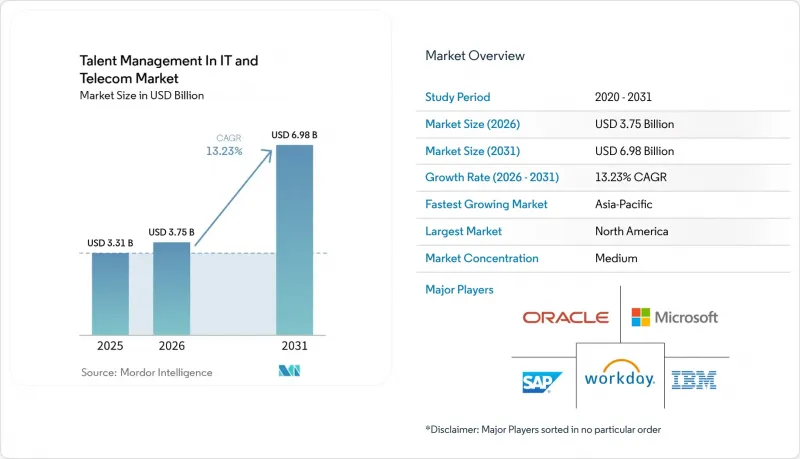
據 Mordor Intelligence 稱,2025 年 IT 和電信人才管理市場價值為 33.1 億美元,預計到 2031 年將從 2026 年的 37.5 億美元成長至 69.8 億美元,預測期(2026-2031 年)的複合年成長率為 13.23%。
本報告按元件(軟體、服務)、部署方式(本地部署、雲端部署)、企業規模(大型企業、中小企業)、應用領域(員工敬業度與職涯發展、學習與技能發展、繼任計畫、招募與人才取得等)以及地區進行細分。市場預測以美元計價。
全球IT與電信人力資源管理市場趨勢與分析
人工智慧招募機器人在技術崗位上的應用正在加速。
在IT和電信人才管理市場,自主招募正逐漸成為主流營運模式。這是因為雇主需要更快地選拔技術人才,同時減輕負責人的負擔。 Oracle和Oracle AI推出的新產品表明,供應商現在將基於代理商的面試和自動化招募流程定位為核心附加元件。在通訊業,這對於現場工程、雲端運算和網路安全等職位尤其重要,因為招聘延誤會導致服務交付和基礎設施開發專案的延誤。在IT和電信人才管理領域,優勢正逐漸轉移到能夠將人才搜尋、面試和技能數據與更廣泛的人才管理系統整合的平台。隨著自主代理商在招募過程中扮演越來越重要的角色,那些仍依賴分散的負責人工具的供應商將面臨被淘汰的風險。
雲端遷移浪潮正在推動SaaS人才管理套件的發展。
雲端遷移正在增強IT和電信公司的人才管理能力。這是因為買家需要一個能夠適應員工人數和專案配置波動的單一勞動力系統。 SAP SuccessFactors 2026年上半年版本新增了與AWS的雙向零拷貝資料共用功能,實現了SAP Cloud ERP、SAP Fieldglass和SAP SuccessFactors之間的規劃整合。這體現了向整合雲端架構發展的趨勢。 Workday 2026年春季版本也推出了Workday Data Lake,它採用開放標準,可與Databricks、Google Cloud和Snowflake等平台進行雙向存取。在IT和通訊業,招募和人員變動瞬息萬變,維持人才、財務和營運規劃的一致性至關重要。因此,雲端架構不僅僅是一種託管選項;它已成為IT和電信人才管理領域的關鍵要素,影響人才保留和營運效率。
與傳統人力資源資訊系統整合的複雜性。
對於IT和電信產業的人才管理而言,尤其是對於擁有跨國人力資源架構的大型通訊業者而言,整合複雜性仍然是短期內最明顯的瓶頸。許多電信集團經營PeopleSoft、本地部署的SAP HCM以及多年來透過合併建構的客製化薪資核算系統,這使得欄位映射和工作流程統一變得困難重重。這個問題不僅僅是技術性的;每個整合項目還需要就職位架構、薪酬項目和當地合規規則達成一致。由於數據分散在薪資核算、績效評估和人事管理系統中,人才分析結果需要很長時間才能用於實際的人員配置決策。雖然供應商正在透過提供更多開放的資料層和現成的連接器來解決這個問題,但在IT和電信行業的人才管理領域,由於舊有系統仍然佔據主導地位,實現價值所需的時間仍然很長。
細分市場分析
到2025年,軟體將佔據IT和電信人才管理市場68.26%的佔有率,平台層仍是買家支出的核心。這一主導地位得以維持,是因為雇主希望將招聘、分析、合規和工作流程自動化整合到單一的商業合約中,而不是將它們分散在不同的工具中。 IT和電信人才管理市場的軟體也受惠於SaaS交付模式,該模式允許供應商發布新的AI功能,而無需客戶更換硬體。因此,軟體在IT和電信人才管理中繼續佔據核心地位,尤其是在大型客戶中,標準化與功能豐富性同等重要。
在人工智慧主導的人力資源環境中,實施、變更管理和支援變得越來越具有挑戰性,預計2026年至2031年間,服務市場將以14.36%的複合年成長率成長。新的技能框架和內部調動管理系統都需要進行配置,以匹配本地流程和遺留數據,從而推動了對服務需求的成長。定期發布週期進一步刺激了這種需求,像Cornerstone和Workday這樣的供應商不斷推出頻繁的更新,這些更新可能會影響自訂工作流程。簡而言之,IT和電信人才管理持續為整合專家和託管服務合作夥伴創造業務。
截至2025年,雲端運算將佔據IT和電信人才管理市場74.24%的佔有率,預計到2031年將以14.21%的複合年成長率成長。在IT和電信人才管理市場,雲端運算仍然是首選模式,因為分散式工程團隊需要跨地區和部門即時存取資料。此外,採用雲端運算可以實現人工智慧的快速部署、更方便的合規性更新,並減少企業新增業務部門或承包商時的摩擦。 SAP和Workday都計劃在2026年擴展其在雲端的資料共用和規劃功能,這將推動「互聯員工」架構的轉型。
當員工資料必須保存在國家境內或嚴格控制的運作環境中時,本地部署系統仍然至關重要。因此,在海灣地區,由於適用國內資料法規,雲端技術並不能完全取代本地託管。儘管如此,IT和電信人才管理市場的支出趨勢仍然傾向於將規劃、招聘和技能數據整合到單一環境中的雲端平台。能夠在不影響分析深度的前提下滿足區域託管需求的供應商,預計將在下一輪週期中蓬勃發展。
區域分析
到2025年,北美將佔據IT和電信人才管理市場42.36%的佔有率,並繼續保持在該地區的領先地位。該地區受益於超大規模資料中心業者的集中佈局、成熟的人力資源技術生態系統以及企業對人工智慧驅動的人才管理工具的快速採用。在美國,加州關於人工智慧招聘的法規以及伊利諾伊州關於在就業中歧視性使用人工智慧的民權責任,正促使買家轉向可審計且符合管治的平台。此外,Workday平台擁有超過65%的財富500強企業用戶,這使得北美買家能夠快速獲得大規模平台部署和生態系統支援。這些因素共同作用,使得北美的IT和電信人才管理市場成為該地區最強勁的市場,無論是在大型企業的需求方面,還是在合規主導的產品開發方面,都表現出色。
歐洲仍是IT和電信人才管理市場的主要收入來源,這得益於其嚴格的資料管治和大規模的電信及IT服務基礎設施。 GDPR(一般資料保護規則)鼓勵採購公司將分散的人力資源資料整合到一個可審計的平台中,而不是管理分佈在不同國家的零散工具。德國電信的「成長中心」擁有20萬名員工,並榮獲國家級人力資源技術獎,這表明內部調動和技能管理平台在該地區已超越試點階段。歐盟人工智慧法規將於2026年8月到期,這加速了具有更清晰的管治、文件和人工智慧管理標準的系統的採用。
預計亞太地區在2026年至2031年間將以14.95%的複合年成長率成長,成為IT和電信人才管理領域成長最快的區域。這一成長主要得益於數位基礎設施的擴張、年輕勞動力的不斷壯大,以及印度、越南、印尼和菲律賓等二線科技中心的崛起。這些地區對人才管理流程的需求日益成長。印度電信業技能委員會的目標是每年培訓15萬名電信從業人員,愛立信的培訓夥伴關係已涵蓋100所教育機構。這充分體現了該地區持續的人才培育規模。在南美洲,價格敏感度依然很高,限制了中小型IT企業採用功能強大的分析套件。同時,海灣國家正在增加對符合政府規定的平台的投資,以滿足國家就業要求和當地數據法規。因此,預計亞太地區的 IT 和電信人力資源管理將出現快速的結構性成長,中東和非洲地區將出現由合規性主導的選擇性需求,而南美洲地區的採用曲線將較為平緩。
其他好處:
- Excel格式的市場預測(ME)表
- 3個月的分析師支持
目錄
第1章:引言
- 市場分析與定義的前提條件
- 分析範圍
第2章 分析方法
第3章執行摘要
第4章 市場狀況
- 市場概覽
- 市場促進因素
- 加速採用人工智慧招募機器人進行技術崗位招募。
- 雲端遷移浪潮正在推動SaaS人才解決方案的發展。
- 透過遠距和混合辦公模式擴展數位化績效管理
- 對標準化人力資源資料安全管理的需求源自於合規性議題。
- 與 5G 和網路虛擬化藍圖相關的技能分類系統
- 亞洲二線科技中心內部人才市場的發展
- 市場限制因素
- 與原有人力資源資訊系統整合的複雜性。
- 具有強大分析功能的平台每月收費較高
- 中東和非洲地區關於人類資料主權的規則
- 人們對演算法偏見的擔憂正在減緩人工智慧招聘工具的普及。
- 產業價值鏈分析
- 技術展望
- 監理情勢
- 波特五力分析
第5章:預測市場規模與成長率
- 按組件
- 軟體
- 服務
- 專業服務
- 支援和維護服務
- 透過部署方法
- 現場
- 雲
- 按公司規模
- 大公司
- 中小企業
- 透過使用
- 績效管理
- 學習與技能發展
- 繼任計劃
- 薪資管理
- 招募和人才獲取
- 人員規劃
- 員工敬業度與職涯發展
- 其他人力資源管理用途
- 按地區
- 北美洲
- 美國
- 加拿大
- 墨西哥
- 南美洲
- 巴西
- 阿根廷
- 其他南美國家
- 歐洲
- 德國
- 英國
- 法國
- 義大利
- 其他歐洲國家
- 亞太地區
- 中國
- 日本
- 印度
- 韓國
- 其他亞太國家
- 中東和非洲
- 中東
- 沙烏地阿拉伯
- 阿拉伯聯合大公國
- 土耳其
- 其他中東國家
- 非洲
- 南非
- 其他非洲國家
- 中東
- 北美洲
第6章 競爭情勢
- 市場集中度
- 策略趨勢
- 市佔率分析
- 公司簡介
- SAP SE
- Oracle Corporation
- Workday, Inc.
- Microsoft Corporation
- IBM Corporation
- ADP, Inc.
- Ceridian HCM Holding Inc.
- UKG Inc.
- Cornerstone OnDemand Inc.
- ServiceNow Inc.
- Zoho Corporation
- BambooHR LLC
- PeopleFluent(LTG plc)
- Infor, Inc.
- iCIMS, Inc.
- Eightfold AI Inc.
- SumTotal Systems, LLC
- Amdocs Limited
- Tata Consultancy Services Ltd.
第7章 市場機會與未來展望
According to Mordor Intelligence, the talent management in IT and telecom market size was valued at USD 3.31 billion in 2025 and estimated to grow from USD 3.75 billion in 2026 to reach USD 6.98 billion by 2031, at a CAGR of 13.23% during the forecast period (2026-2031).
This report is Segmented by Component (Software, and Services), Deployment Mode (On-Premise, and Cloud), Enterprise Size (Large Enterprises, and Small and Medium Enterprises), Application (Employee Engagement and Career Development, Learning and Development, Succession Planning, Recruitment and Talent Acquisition, and More), and Geography. The Market Forecasts are Provided in Terms of Value (USD).
Global Talent Management In IT And Telecom Market Trends and Insights
Accelerated Adoption Of AI-Powered Recruiter Bots For Tech Roles
Autonomous recruiting is becoming a defining operating model in the talent management in IT and telecom market, because employers need to screen technical talent faster and with less recruiter effort. Product launches from Oracle and Eightfold AI show that vendors now position agentic interviewing and automated hiring actions as core functions rather than optional add-ons. In telecom hiring, this matters most for field engineering, cloud, and cybersecurity roles, where delays can slow service delivery and infrastructure programs. In the talent management in IT and telecom market, the advantage is shifting toward platforms that connect sourcing, interviewing, and skills data with the wider workforce stack. Vendors that still rely on disconnected recruiter tools face a higher risk of being bypassed as autonomous agents take over larger parts of the hiring flow.
Cloud Migration Wave Boosting SaaS Talent Suites
Cloud migration is strengthening talent management in the IT and telecom markets because buyers want a single workforce system that can keep pace with changing headcounts and project mixes. SAP's SuccessFactors 1H 2026 release added bi-directional, zero-copy data sharing with AWS and linked planning across SAP Cloud ERP, SAP Fieldglass, and SAP SuccessFactors, reflecting this push toward a connected cloud architecture. Workday's spring 2026 release also introduced Workday Data Lake using open standards for bi-directional access with platforms such as Databricks, Google Cloud, and Snowflake. These moves matter in IT and telecom, because workforce, finance, and delivery planning need to stay aligned when hiring or redeployment changes quickly. That makes cloud architecture not just a hosting choice but also a retention and operating lever within talent management in the IT and telecom markets.
Integration Complexity With Legacy HRIS Stacks
Integration complexity remains the clearest near-term brake on the talent management in IT and telecom market, especially for large operators with multi-country HR estates. Many telecom groups still run a mix of PeopleSoft, SAP HCM on-premises, and custom payroll engines built through years of mergers, which makes field mapping and workflow harmonization difficult. The problem is not only technical, because each integration project also forces agreement on job architecture, compensation fields, and local compliance rules. When data stays split across payroll, performance, and headcount systems, workforce analytics arrive too late to guide live staffing decisions. Vendors are responding with more open data layers and prebuilt connectors, but the talent management in IT and telecom market still sees longer time-to-value where legacy stacks dominate.
Other drivers and restraints analyzed in the detailed report include:
- Remote and Hybrid Work Models Scaling Digital Performance Management
- Compliance-Driven Demand For Unified HR Data Security Controls
- High Subscription Cost Of Analytics-Rich Platforms
For complete list of drivers and restraints, kindly check the Table Of Contents.
Segment Analysis
Software accounted for 68.26% of the talent management market in the IT and telecom market in 2025, keeping the platform layer at the center of buyer spending. That lead persisted because employers wanted to bring recruiting, analytics, compliance, and workflow automation under one commercial relationship rather than across separate tools. In the talent management market for IT and telecom, software also benefits from SaaS delivery, as vendors can release new AI capabilities without customer-side hardware changes. That keeps software central to talent management in the IT and telecom markets, especially in large accounts where standardization matters as much as feature depth.
Services are projected to grow at a 14.36% CAGR from 2026 to 2031, as implementation, change management, and support work become harder in AI-led HR environments. The need for services is rising because every new skills framework or internal mobility layer has to be configured around local processes and legacy data. Regular release cycles add to this demand, with vendors like Cornerstone and Workday continuing to ship frequent updates that can affect custom workflows. That means talent management in the IT and telecom markets continues to create recurring work for integration specialists and managed service partners.
Cloud held 74.24% share of the talent management in IT and telecom market size in 2025 and is projected to grow at 14.21% CAGR through 2031. In the talent management in IT and telecom market, cloud remains the preferred model because distributed engineering teams need live data access across regions and functions. Cloud deployment also supports faster AI rollout, easier compliance updates, and lower friction when companies add new business units or contractors. SAP and Workday both expanded cloud data-sharing and planning capabilities in 2026, which supports this shift toward connected workforce architectures.
On-premises systems still matter where workforce data must stay inside national boundaries or within tightly controlled operator environments. That is why cloud adoption does not fully displace local hosting in Gulf markets governed by in-country data rules. Even so, the direction of spend in the talent management in IT and telecom market continues to favor cloud platforms that can combine planning, hiring, and skills data in one environment. Vendors that can support regional hosting without losing analytical depth are likely to hold the strongest position over the next cycle.
Geography Analysis
North America captured 42.36% of the talent management in IT and telecom market share in 2025, which kept the region in the lead. The region benefits from the concentration of hyperscalers, a mature HR-tech ecosystem, and faster enterprise adoption of AI-enabled workforce tools. In the United States, California's AI hiring rules and Illinois civil rights liability for discriminatory AI use in employment are pushing buyers toward auditable and governance-ready platforms. Workday's position with more than 65% of the Fortune 500 also gives North American buyers early access to scaled platform rollouts and ecosystem support. That combination keeps the talent management in IT and telecom market strongest in North America for both large-enterprise demand and compliance-led product development.
Europe remains a major revenue center in the talent management in IT and telecom market, supported by strict data governance and a large telecom and IT services base. GDPR has encouraged buyers to consolidate fragmented HR data into auditable platforms instead of managing scattered tools across countries. Deutsche Telekom's growth hub, which serves 200,000 employees and won a national HR Tech award, shows that internal mobility and skills platforms have moved beyond pilot status in the region. The EU AI Act compliance deadline in August 2026 is now accelerating procurement toward systems with clearer governance, documentation, and AI management standards.
Asia-Pacific is forecast to grow at 14.95% CAGR from 2026 to 2031, making it the fastest-growing regional block in the talent management in IT and telecom market. Growth comes from expanding digital infrastructure, younger labor pools, and the rise of Tier-2 tech hubs in India, Vietnam, Indonesia, and the Philippines that need more formal talent processes. India's Telecom Sector Skill Council is targeting placement of 150,000 trained telecom workers annually, while Ericsson's training partnership spans 100 institutes, which shows the scale of workforce development now underway. South America remains more price sensitive, which limits adoption of analytics-rich suites among smaller IT employers, while Gulf markets are investing in sovereign-compliant platforms to meet national employment mandates and local data rules. This leaves the talent management in IT and telecom market with fast structural upside in Asia-Pacific, selective compliance-led demand in the Middle East and Africa, and a more measured adoption curve in South America.
- SAP SE
- Oracle Corporation
- Workday, Inc.
- Microsoft Corporation
- IBM Corporation
- ADP, Inc.
- Ceridian HCM Holding Inc.
- UKG Inc.
- Cornerstone OnDemand Inc.
- ServiceNow Inc.
- Zoho Corporation
- BambooHR LLC
- PeopleFluent (LTG plc)
- Infor, Inc.
- iCIMS, Inc.
- Eightfold AI Inc.
- SumTotal Systems, LLC
- Amdocs Limited
- Tata Consultancy Services Ltd.
Additional Benefits:
- The market estimate (ME) sheet in Excel format
- 3 months of analyst support
TABLE OF CONTENTS
1 INTRODUCTION
- 1.1 Study Assumptions and Market Definition
- 1.2 Scope of the Study
2 RESEARCH METHODOLOGY
3 EXECUTIVE SUMMARY
4 MARKET LANDSCAPE
- 4.1 Market Overview
- 4.2 Market Drivers
- 4.2.1 Accelerated Adoption of AI-Powered Recruiter Bots for Tech Roles
- 4.2.2 Cloud Migration Wave Boosting Saas Talent Suites
- 4.2.3 Remote and Hybrid Work Models Scaling Digital Performance Management
- 4.2.4 Compliance-driven Demand for Unified HR Data Security Controls
- 4.2.5 Skills Taxonomies Linked To 5G and Network Virtualization Roadmaps
- 4.2.6 Growth of Internal Talent Marketplaces in Tier-2 Asian Tech Hubs
- 4.3 Market Restraints
- 4.3.1 Integration Complexity With Legacy HRIS Stacks
- 4.3.2 High Subscription Cost of Analytics-rich Platforms
- 4.3.3 Talent-data Sovereignty Rules in the Middle East and Africa
- 4.3.4 Algorithmic Bias Concerns Slowing AI Recruitment Tools
- 4.4 Industry Value Chain Analysis
- 4.5 Technological Outlook
- 4.6 Regulatory Landscape
- 4.7 Porter's Five Forces Analysis
- 4.7.1 Bargaining Power of Suppliers
- 4.7.2 Bargaining Power of Buyers
- 4.7.3 Threat of New Entrants
- 4.7.4 Threat of Substitutes
- 4.7.5 Competitive Rivalry
5 MARKET SIZE AND GROWTH FORECASTS (VALUE)
- 5.1 By Component
- 5.1.1 Software
- 5.1.2 Services
- 5.1.2.1 Professional Services
- 5.1.2.2 Support and Maintenance Services
- 5.2 By Deployment Mode
- 5.2.1 On-premises
- 5.2.2 Cloud
- 5.3 By End-Use Enterprise Size
- 5.3.1 Large Enterprises
- 5.3.2 Small and Medium Enterprises (SMEs)
- 5.4 By Application
- 5.4.1 Performance Management
- 5.4.2 Learning and Development
- 5.4.3 Succession Planning
- 5.4.4 Compensation Management
- 5.4.5 Recruitment and Talent Acquisition
- 5.4.6 Workforce Planning
- 5.4.7 Employee Engagement and Career Development
- 5.4.8 Other Talent Management Applications
- 5.5 By Geography
- 5.5.1 North America
- 5.5.1.1 United States
- 5.5.1.2 Canada
- 5.5.1.3 Mexico
- 5.5.2 South America
- 5.5.2.1 Brazil
- 5.5.2.2 Argentina
- 5.5.2.3 Rest of South America
- 5.5.3 Europe
- 5.5.3.1 Germany
- 5.5.3.2 United Kingdom
- 5.5.3.3 France
- 5.5.3.4 Italy
- 5.5.3.5 Rest of Europe
- 5.5.4 Asia-Pacific
- 5.5.4.1 China
- 5.5.4.2 Japan
- 5.5.4.3 India
- 5.5.4.4 South Korea
- 5.5.4.5 Rest of Asia-Pacific
- 5.5.5 Middle East and Africa
- 5.5.5.1 Middle East
- 5.5.5.1.1 Saudi Arabia
- 5.5.5.1.2 United Arab Emirates
- 5.5.5.1.3 Turkey
- 5.5.5.1.4 Rest of the Middle East
- 5.5.5.2 Africa
- 5.5.5.2.1 South Africa
- 5.5.5.2.2 Rest of Africa
- 5.5.5.1 Middle East
- 5.5.1 North America
6 COMPETITIVE LANDSCAPE
- 6.1 Market Concentration
- 6.2 Strategic Moves
- 6.3 Market Share Analysis
- 6.4 Company Profiles (includes Global level Overview, Market level overview, Core Segments, Financials as available, Strategic Information, Market Share for key companies, Products and Services, and Recent Developments)
- 6.4.1 SAP SE
- 6.4.2 Oracle Corporation
- 6.4.3 Workday, Inc.
- 6.4.4 Microsoft Corporation
- 6.4.5 IBM Corporation
- 6.4.6 ADP, Inc.
- 6.4.7 Ceridian HCM Holding Inc.
- 6.4.8 UKG Inc.
- 6.4.9 Cornerstone OnDemand Inc.
- 6.4.10 ServiceNow Inc.
- 6.4.11 Zoho Corporation
- 6.4.12 BambooHR LLC
- 6.4.13 PeopleFluent (LTG plc)
- 6.4.14 Infor, Inc.
- 6.4.15 iCIMS, Inc.
- 6.4.16 Eightfold AI Inc.
- 6.4.17 SumTotal Systems, LLC
- 6.4.18 Amdocs Limited
- 6.4.19 Tata Consultancy Services Ltd.
7 MARKET OPPORTUNITIES AND FUTURE OUTLOOK
- 7.1 White-Space and Unmet-Need Assessment

 亞太地區人力資源管理軟體:市場佔有率分析、產業趨勢與統計及成長預測(2026-2031)人力資本管理(HCM)軟體:市場佔有率分析、產業趨勢與統計及成長預測(2026-2031)亞太地區人才管理軟體:市場佔有率分析、產業趨勢與統計及成長預測(2026-2031)北美人力資源管理軟體:市場佔有率分析、產業趨勢與統計及成長預測(2026-2031 年)印度人才管理軟體:市場佔有率分析、產業趨勢與統計及成長預測(2026-2031)歐洲人才管理軟體:市場佔有率分析、產業趨勢與統計及成長預測(2026-2031)
 OKR軟體市場:依元件類型、公司類型、部署方式、產業和地區分類
 目標與關鍵成果軟體市場:規模、佔有率、成長率、按類型、應用和地區分類的全球產業分析,以及2026年至2034年的預測
 2026年全球人力資本管理軟體市場報告2026年全球人才管理軟體市場報告