


 |
市場調查報告書
商品編碼
2099077
歐洲人才管理軟體:市場佔有率分析、產業趨勢與統計及成長預測(2026-2031)Europe Talent Management Software - Market Share Analysis, Industry Trends & Statistics, Growth Forecasts (2026 - 2031) |
||||||

※ 本網頁內容可能與最新版本有所差異。詳細情況請與我們聯繫。
根據 Mordor Intelligence 預測,歐洲人才管理軟體市場規模預計將在 2025 年達到 24.9 億美元,到 2031 年達到 46.9 億美元,2026 年至 2031 年的複合年成長率為 11.21%。
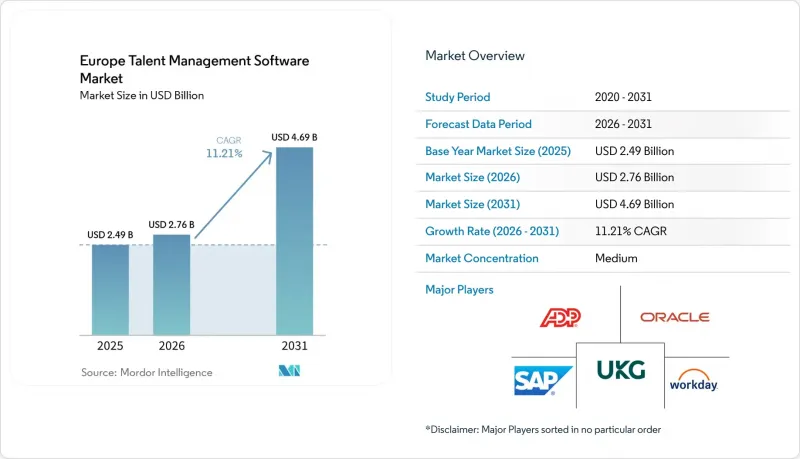
本報告按元件(軟體和服務)、應用程式(績效管理、繼任計畫等)、部署方式(本地部署和雲端部署)、最終用戶公司規模(大型企業和中小企業)、最終用戶行業(零售和電子商務、製造業等)以及地區進行細分。市場預測以價值(美元)表示。
歐洲人才管理軟體市場的趨勢與洞察
人工智慧驅動的內部人才市場的興起
在歐洲人才管理軟體市場,企業內部人才市場正成為提昇平台價值最有效的方式之一。這些工具利用經過檢驗的技能檔案和工作經歷,幫助雇主將員工與職職位、專案、導師指導和挑戰性任務進行配對。它們的吸引力不僅在於提高招募效率,還在於減少對外部招募的依賴,縮短招募週期,並幫助員工更清楚地了解自身的職涯發展路徑。 Workday 於 2025 年春季發布的版本在 Career Hub 和 Opportunity Marketplace 中新增了智慧職位推薦功能,展現了內部調動如何日益融入員工的日常工作流程。隨著企業更頻繁地使用這些系統,將累積更豐富的技能數據,從而支持人才規劃、繼任計畫和個人化學習。這不僅鞏固了企業內部人才市場作為獨立功能的地位,也使其成為歐洲人才管理軟體市場的核心營運階層。
轉向基於技能的招募模式正在加速。
在歐洲人才管理軟體市場,基於技能的招募正從有限的應用轉變為標準的招募實踐。 LinkedIn在2024年的報告中指出,73%的負責人優先考慮技能而非資歷,這凸顯了市場對能夠評估、儲存和匹配詳細技能資訊的軟體日益成長的需求。創建結構化的技能清單能夠幫助雇主及早發現能力差距,並將被動招募轉變為有計劃的人才發展。這對於薪酬透明度也至關重要,因為客觀的技能和能力框架能夠更清晰地解釋和論證職位的薪酬決策。歐盟委員會的技能議程和ESCO框架也在幫助跨國公司在跨國業務中使用更一致的術語,從而改善跨境人才匹配和內部調動。因此,技能架構正成為歐洲人才管理軟體市場的核心需求,而不僅僅是可選的附加功能。
整合傳統人力資源系統的複雜性
舊有系統碎片化仍然是歐洲人才管理軟體市場面臨的最大障礙之一。許多大型企業仍將權威的員工資料保留在過時的ERP環境中,這些環境並非為基於API的現代人才管理工具而設計,導致遷移和同步延遲,遠低於買家的預期。這個問題在製造業和公共部門尤為突出,因為這些部門的管治流程、與勞工委員會的諮詢以及冗長的核准週期進一步加劇了延誤。儘管供應商正努力透過更緊密的整合和平台增強來減輕這一負擔,但傳統資料結構與新工作流程之間的差距仍然使得每個大型專案都需要進行客製化工作。因此,實施週期往往遠遠超出軟體選用階段,導致模組部署延遲,並減緩後續的收入成長。儘管雲端運算的普及率不斷提高,但傳統架構仍然嚴重限制歐洲人才管理軟體市場的成長,因為整合風險仍然是買家在採購計畫中首先檢驗的問題之一。
細分市場分析
2025年,軟體仍將是歐洲人才管理軟體市場的主要收入來源,佔77.19%的市佔率。這一主導地位反映了市場對整合套件的需求,這些套件能夠將績效、繼任計劃、薪酬和招聘記錄整合到一個系統中。一旦套件整合到核心人力資源工作流程中,資料和存取的連續性就與新功能同等重要,從而降低了替換單一模組的吸引力。這使得領先的供應商能夠透過與現有客戶簽訂合約來提升合約價值,而不是僅僅依賴獲取新客戶。這也使得軟體層在採購討論中始終佔據核心地位,即便在實施過程中服務部分的重要性日益增加。
預計到2031年,服務業將以13.71%的複合年成長率成長,成為歐洲人才管理軟體市場成長最快的細分領域。人工智慧功能發布速度的加快,推動了對運作後設定、管治設計、培訓和實施支援的需求成長。企業開始意識到,只有在各個業務部門正確配置技能分類系統、評估週期和薪酬規則時,新工具才能真正發揮價值。隨著供應商不斷發布影響工作流程、權限和報告邏輯的更新,持續支援的重要性也日益凸顯。因此,服務需求的擴張並非源自於軟體重要性的下降,而是因為在整個歐洲人才管理軟體市場,買家需要更多幫助才能將軟體功能轉化為可複製的營運實務。
2025年,績效管理佔了最大的應用程式佔有率,達到23.01%,仍然是歐洲人才管理軟體市場中最成熟的應用情境之一。由於目標設定、績效考核週期、經理回饋和薪酬掛鉤等功能已整合到年度人力資源流程中,雇主通常會儘早採用這一領域。這為該領域奠定了堅實的基礎,尤其是在尋求跨國和業務部門標準化評估系統的大型企業中。此外,績效數據通常構成更廣泛的人才工作流程的基礎,包括繼任計畫和薪酬確定。績效管理的這一既定作用解釋了為何即使採購重點開始轉變,它仍然是最大的應用領域。
預計到2031年,學習與發展領域的複合年成長率將達到12.68%,成為歐洲人才管理軟體市場成長最快的應用領域。根據Cornerstone的Sapient Insights調查,大型企業受訪者分配給技能管理軟體的預算比例從2024年的6%幾乎加倍,達到2025年的11%,這顯示企業正從評估階段明顯轉向實際支出階段。人工智慧原生學習平台正日益受到關注,因為它們能夠個性化內容、追蹤技能提升,並更直接地與內部調動和繼任計畫相結合。基於技能的招募也有利於招募、員工敬業度和職涯發展模組,因為需要一個平台能夠持續管理從候選人配對到員工發展路徑的相同技能數據。因此,歐洲人才管理軟體市場正逐漸從流程導向市場轉向更重視能力發展和內部調動的市場。
其他好處:
- Excel格式的市場預測(ME)表
- 3個月的分析師支持
目錄
第1章:引言
- 研究假設和市場定義
- 調查範圍
第2章:調查方法
第3章執行摘要
第4章 市場狀況
- 市場概覽
- 市場促進因素
- 向技能型招募模式的轉變正在加速。
- 擴大雲端原生人力資源架構的應用
- 歐盟同工同酬法規和ESG法規帶來的合規壓力日益增大
- 人工智慧驅動的內部人才市場的興起
- 從學習體驗平台擴展到人才套件
- 供應商主導、以消費為基礎的定價創新
- 市場限制因素
- 整合傳統人力資源系統的複雜性
- 人們持續擔憂GDPR下的資料隱私問題。
- 中型企業缺乏分析能力
- 受宏觀經濟因素影響,主要產業出現招募凍結。
- 產業價值鏈分析
- 監理情勢
- 技術展望
- 波特五力分析
- 宏觀經濟因素對市場的影響
第5章 市場規模與成長預測
- 按組件
- 軟體
- 服務
- 專業服務
- 支援和維護服務
- 透過使用
- 績效管理
- 學習與技能發展
- 繼任計劃
- 薪資管理
- 招募和人才獲取
- 人員規劃
- 員工敬業度與職涯發展
- 其他人力資源管理應用
- 不同的發展
- 現場
- 雲
- 按公司規模
- 大公司
- 中小企業
- 按最終用途行業分類
- 資訊科技/通訊
- 銀行業、金融服務業及保險業
- 醫療保健和生命科學
- 零售與電子商務
- 製造業
- 政府/公共部門
- 其他終端用戶產業
- 按地區
- 英國
- 德國
- 法國
- 義大利
- 西班牙
- 俄羅斯
- 其他歐洲國家
第6章 競爭情勢
- 市場集中度
- 策略趨勢
- 市佔率分析
- 公司簡介
- SAP SE
- Oracle Corporation
- Workday Inc.
- Cornerstone OnDemand Inc.
- ADP Inc.
- UKG Inc.
- Ceridian HCM Holding Inc.
- Cegid SAS
- Talentsoft SAS
- PeopleFluent Holdings Corp.
- Saba Software Inc.
- IBM Corporation
- Infor Inc.
- Zoho Corporation Pvt. Ltd.
- BambooHR LLC
- Bullhorn Inc.
- Learning Technologies Group plc
- SumTotal Systems LLC
- Paycom Software Inc.
- ClearCompany Inc.
第7章 市場機會與未來展望
According to Mordor Intelligence, the Europe talent management software market size stood at USD 2.49 billion in 2025 and is forecast to reach USD 4.69 billion by 2031, growing at a CAGR of 11.21% from 2026 to 2031.
This report is Segmented by Component (Software, and Services), Application (Performance Management, Succession Planning, and More), Deployment (On-Premise, and Cloud), End-Use Enterprise Size (Large Enterprises, and Small and Medium Enterprises [SMEs]), End-Use Industry (Retail and E-Commerce, Manufacturing, and More), and Region. The Market Forecasts are Provided in Terms of Value (USD).
Europe Talent Management Software Market Trends and Insights
Emergence of AI-Driven Internal Talent Marketplaces
In the Europe talent management software market, internal talent marketplaces are becoming one of the clearest paths to higher platform value. These tools help employers match employees to open roles, projects, mentorships, and stretch assignments by using verified skill profiles and career histories. Their appeal goes beyond recruiting efficiency because they lower dependence on external hiring, reduce time-to-fill, and make career paths easier for employees to see. Workday's 2025 Spring Release added intelligent job recommendations inside Career Hub and Opportunity Marketplace, which showed how internal mobility functions are moving closer to daily employee workflows. As organizations use these systems more often, they also build richer skills data that can support workforce planning, succession, and personalized learning. That makes the internal marketplace less of a stand-alone feature and more of a central operating layer in the Europe talent management software market.
Accelerating Shift toward Skills-Based Hiring Models
In the Europe talent management software market, skills-based hiring is moving from selective use into standard recruiting practice. LinkedIn reported in 2024 that 73% of recruiting professionals prioritized skills over credentials, which supports stronger demand for software that can assess, store, and match detailed skill profiles. Once employers create structured skill inventories, they can identify capability gaps earlier and shift from reactive hiring toward planned development. This matters for pay transparency as well because objective skill and competency frameworks make compensation decisions easier to explain and defend across roles. The European Commission's skills agenda and ESCO framework are also helping multinational employers use more consistent terminology across borders, which improves cross-country talent matching and internal mobility. As a result, skills architecture is becoming a core requirement rather than an optional add-on in the Europe talent management software market.
Complexity in Integrating Legacy HR Systems
Legacy fragmentation remains one of the hardest brakes on the Europe talent management software market. Many large employers still keep authoritative employee data inside older ERP environments that were not designed for modern API-based talent tools, which makes migration and synchronization slower than buyers expect. The problem is most visible in manufacturing and public-sector settings, where governance procedures, works council consultation, and long approval cycles add another layer of delay. Vendors are trying to reduce the burden through tighter integrations and broader platform releases, but the gap between old data structures and new workflows still creates custom work during every major project. That means implementation time often stretches well beyond software selection, which delays module adoption and slows follow-on revenue. Even as cloud penetration rises, legacy architecture continues to weigh on growth in the Europe talent management software market because integration risk is still one of the first issues buyers test during procurement.
Other drivers and restraints analyzed in the detailed report include:
- Growing Adoption of Cloud-Native HR Architectures
- Rising Compliance Pressure from EU Equal Pay and ESG Rules
- Persistent Data Privacy Concerns under GDPR
For complete list of drivers and restraints, kindly check the Table Of Contents.
Segment Analysis
Software accounted for 77.19% of Europe talent management software market share in 2025 and remained the main revenue base of the Europe talent management software market. That lead reflected the preference for integrated suites that connect performance, succession, compensation, and recruiting records in one system. Once a suite is embedded in core HR workflows, replacing single modules becomes less attractive because continuity in data and permissions matters as much as new functionality. This has helped major vendors expand contract value inside existing accounts instead of depending only on new customer wins. It has also kept the software layer at the center of procurement discussions even when service intensity rises during implementation.
Services are projected to grow at 13.71% CAGR through 2031, making them the fastest-moving component in the Europe talent management software market. The pace of AI feature releases is creating more demand for configuration, governance design, training, and adoption support after go-live. Enterprises are finding that new tools only deliver value when skills taxonomies, review cycles, and compensation rules are set up correctly across business units. Ongoing support is also gaining importance because vendors continue to release updates that affect workflows, permissions, and reporting logic. As a result, services are rising not because software is losing relevance, but because buyers need more help turning software features into repeatable operating practice across the Europe talent management software market.
Performance management held the largest application share at 23.01% in 2025 and remained one of the most established use cases in the Europe talent management software market. Employers usually implement this area early because goal setting, review cycles, manager feedback, and compensation links are already embedded in annual HR operations. That gives the segment a durable installed base, especially in larger enterprises that want standardized review structures across countries and business units. It also means performance data often becomes the anchor for broader talent workflows, including succession and pay decisions. This installed role helps explain why performance management stayed the largest application even as buying priorities began to shift.
Learning and development is projected to grow at 12.68% CAGR through 2031, which makes it the fastest-rising application in the Europe talent management software market. Cornerstone's Sapient Insights survey showed that skills management software budget commitments nearly doubled among enterprise respondents from 6% in 2024 to 11% in 2025, which points to a clear move from evaluation to spending. AI-native learning platforms are gaining traction because they personalize content, track skill development, and connect more directly to internal mobility and succession plans. Recruitment, engagement, and career development modules are also benefiting because skills-based hiring requires platforms that can carry the same skill data from candidate matching into employee growth paths. This is gradually changing the Europe talent management software market from a process-first category into one that places more weight on capability development and internal mobility.
Complete Report Scope:
- By Component
- Software
- Services
- Professional Services
- Support and Maintenance Services
- By Application
- Performance Management
- Learning and Development
- Succession Planning
- Compensation Management
- Recruitment and Talent Acquisition
- Workforce Planning
- Employee Engagement and Career Development
- Other Talent Management Applications
- By Deployment
- On-Premise
- Cloud
- By End-Use Enterprise Size
- Large Enterprises
- Small and Medium Enterprises (SMEs)
- By End-Use Industry
- IT and Telecommunications
- Banking, Financial Services and Insurance
- Healthcare and Life Sciences
- Retail and E-Commerce
- Manufacturing
- Government and Public Sector
- Other End-Use Industries
- By Region
- United Kingdom
- Germany
- France
- Italy
- Spain
- Russia
- Rest of Europe
List of Companies Covered in this Report:
- SAP SE
- Oracle Corporation
- Workday Inc.
- Cornerstone OnDemand Inc.
- ADP Inc.
- UKG Inc.
- Ceridian HCM Holding Inc.
- Cegid SAS
- Talentsoft S.A.S.
- PeopleFluent Holdings Corp.
- Saba Software Inc.
- IBM Corporation
- Infor Inc.
- Zoho Corporation Pvt. Ltd.
- BambooHR LLC
- Bullhorn Inc.
- Learning Technologies Group plc
- SumTotal Systems LLC
- Paycom Software Inc.
- ClearCompany Inc.
Additional Benefits:
- The market estimate (ME) sheet in Excel format
- 3 months of analyst support
TABLE OF CONTENTS
1 INTRODUCTION
- 1.1 Study Assumptions and Market Definition
- 1.2 Scope of the Study
2 RESEARCH METHODOLOGY
3 EXECUTIVE SUMMARY
4 MARKET LANDSCAPE
- 4.1 Market Overview
- 4.2 Market Drivers
- 4.2.1 Accelerating Shift Toward Skills-Based Hiring Models
- 4.2.2 Growing Adoption of Cloud-Native HR Architectures
- 4.2.3 Rising Compliance Pressure From EU Equal Pay and ESG Rules
- 4.2.4 Emergence of AI-Driven Internal Talent Marketplaces
- 4.2.5 Expansion of Learning Experience Platforms Into Talent Suites
- 4.2.6 Vendor-Led Consumption-Based Pricing Innovation
- 4.3 Market Restraints
- 4.3.1 Complexity in Integrating Legacy HR Systems
- 4.3.2 Persistent Data Privacy Concerns Under GDPR
- 4.3.3 Limited Analytics Skills Inside Mid-Market Enterprises
- 4.3.4 Macroeconomic-Driven Hiring Freezes in Key Industries
- 4.4 Industry Value Chain Analysis
- 4.5 Regulatory Landscape
- 4.6 Technological Outlook
- 4.7 Porter's Five Forces Analysis
- 4.7.1 Threat of New Entrants
- 4.7.2 Bargaining Power of Buyers
- 4.7.3 Bargaining Power of Suppliers
- 4.7.4 Threat of Substitutes
- 4.7.5 Competitive Rivalry
- 4.8 Impact of Macroeconomic Factors on the Market
5 MARKET SIZE AND GROWTH FORECASTS (VALUE)
- 5.1 By Component
- 5.1.1 Software
- 5.1.2 Services
- 5.1.2.1 Professional Services
- 5.1.2.2 Support and Maintenance Services
- 5.2 By Application
- 5.2.1 Performance Management
- 5.2.2 Learning and Development
- 5.2.3 Succession Planning
- 5.2.4 Compensation Management
- 5.2.5 Recruitment and Talent Acquisition
- 5.2.6 Workforce Planning
- 5.2.7 Employee Engagement and Career Development
- 5.2.8 Other Talent Management Applications
- 5.3 By Deployment
- 5.3.1 On-Premise
- 5.3.2 Cloud
- 5.4 By End-Use Enterprise Size
- 5.4.1 Large Enterprises
- 5.4.2 Small and Medium Enterprises (SMEs)
- 5.5 By End-Use Industry
- 5.5.1 IT and Telecommunications
- 5.5.2 Banking, Financial Services and Insurance
- 5.5.3 Healthcare and Life Sciences
- 5.5.4 Retail and E-Commerce
- 5.5.5 Manufacturing
- 5.5.6 Government and Public Sector
- 5.5.7 Other End-Use Industries
- 5.6 By Region
- 5.6.1 United Kingdom
- 5.6.2 Germany
- 5.6.3 France
- 5.6.4 Italy
- 5.6.5 Spain
- 5.6.6 Russia
- 5.6.7 Rest of Europe
6 COMPETITIVE LANDSCAPE
- 6.1 Market Concentration
- 6.2 Strategic Moves
- 6.3 Market Share Analysis
- 6.4 Company Profiles (includes Global Level Overview, Market Level Overview, Core Segments, Financials as available, Strategic Information, Market Rank/Share, Products and Services, Recent Developments)
- 6.4.1 SAP SE
- 6.4.2 Oracle Corporation
- 6.4.3 Workday Inc.
- 6.4.4 Cornerstone OnDemand Inc.
- 6.4.5 ADP Inc.
- 6.4.6 UKG Inc.
- 6.4.7 Ceridian HCM Holding Inc.
- 6.4.8 Cegid SAS
- 6.4.9 Talentsoft S.A.S.
- 6.4.10 PeopleFluent Holdings Corp.
- 6.4.11 Saba Software Inc.
- 6.4.12 IBM Corporation
- 6.4.13 Infor Inc.
- 6.4.14 Zoho Corporation Pvt. Ltd.
- 6.4.15 BambooHR LLC
- 6.4.16 Bullhorn Inc.
- 6.4.17 Learning Technologies Group plc
- 6.4.18 SumTotal Systems LLC
- 6.4.19 Paycom Software Inc.
- 6.4.20 ClearCompany Inc.
7 MARKET OPPORTUNITIES AND FUTURE OUTLOOK
- 7.1 White-Space and Unmet-Need Assessment

 亞太地區人力資源管理軟體:市場佔有率分析、產業趨勢與統計及成長預測(2026-2031)人力資本管理(HCM)軟體:市場佔有率分析、產業趨勢與統計及成長預測(2026-2031)亞太地區人才管理軟體:市場佔有率分析、產業趨勢與統計及成長預測(2026-2031)北美人力資源管理軟體:市場佔有率分析、產業趨勢與統計及成長預測(2026-2031 年)印度人才管理軟體:市場佔有率分析、產業趨勢與統計及成長預測(2026-2031)IT與電信業的人力資源管理:市場佔有率分析、產業趨勢與統計、成長預測(2026-2031年)
 OKR軟體市場:依元件類型、公司類型、部署方式、產業和地區分類
 目標與關鍵成果軟體市場:規模、佔有率、成長率、按類型、應用和地區分類的全球產業分析,以及2026年至2034年的預測
 2026年全球人力資本管理軟體市場報告2026年全球人才管理軟體市場報告