


 |
市場調查報告書
商品編碼
2099076
北美人力資源管理軟體:市場佔有率分析、產業趨勢與統計及成長預測(2026-2031 年)North America Talent Management Software - Market Share Analysis, Industry Trends & Statistics, Growth Forecasts (2026 - 2031) |
||||||

※ 本網頁內容可能與最新版本有所差異。詳細情況請與我們聯繫。
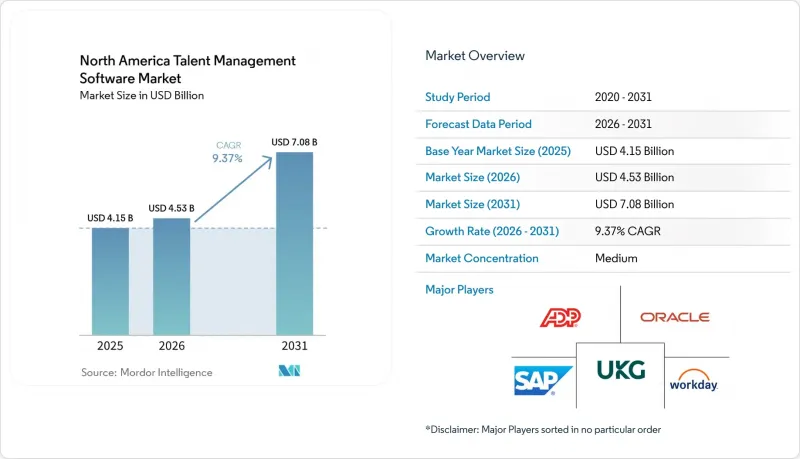
根據 Mordor Intelligence 預測,北美人力資源管理軟體市場規模將從 2025 年的 41.5 億美元和 2026 年的 45.3 億美元成長到 2031 年的 70.8 億美元,2026 年至 2031 年的年複合成長率(CAGR)為 9.37%。
本報告按組件(軟體和服務)、應用(績效管理、學習與發展等)、部署模式(本地部署和雲端部署)、組織規模(大型企業和中小企業)、最終用戶行業(零售和電子商務、製造業等)以及地區進行細分。市場預測以價值(美元)表示。
北美人力資源管理軟體市場趨勢與洞察
美國企業正加速轉型為技能型招募。
隨著基於技能的招募模式逐漸成為主流,北美地區對人才管理軟體的需求也正在改變。雇主從基於學歷的選拔方式轉向基於能力的選拔方式,需要結構化的技能分類系統、評估工具、評分卡以及內部調動功能,而這些是傳統系統無法滿足的。 Randstad USA在2026年指出,能力映射、結構化行為評估和標準化評估流程已成為有效開展基於技能的招募計畫的必要條件。隨著雇主推進這一轉型,軟體需求已從招聘擴展到學習、人才市場和持續的技能差距追蹤,從而擴大了全套解決方案供應商的市場佔有率。此外,缺乏完善技能本體的供應商可能會被專注於技能智慧和內部調動的專業供應商所取代,這將導致對產品品質的要求更高。
擴大人工智慧驅動的人才分析平台的應用
人工智慧驅動的分析正成為北美人才管理軟體市場最顯著的成長引擎之一。根據美國人力資源管理協會 (SHRM) 的報告,2025 年上半年,職場技術投資額達到 35 億美元,共達成 119 筆交易,較 2024 年上半年成長 60%。報告也指出,70% 的北美大型企業計劃在 18 個月內實施預測性離職率分析。市場需求集中在內部人才匹配、技能推論和勞動力情境規劃等特定應用場景,而非廣泛測試通用人工智慧工具。 TechWolf 在 2024 年 6 月獲得了 SAP、Workday Ventures 和 ServiceNow Ventures 的支持,融資 4280 萬美元,這表明投資者正在為那些能夠從數位營運訊號中推斷員工技能的系統提供資金,而不是僅僅依賴員工自我報告的個人資料。因此,先前銷售獨立績效管理或學習管理產品的供應商現在可以將預測分析功能整合到日常人力資源工作流程中,從而創造更強勁的提升銷售管道。
人們持續關注大型企業的資料隱私和資料居住問題
隱私權義務仍然是北美人才管理軟體市場面臨的主要障礙,尤其是在招募決策中使用人工智慧工具時。大型企業不僅審查自身實踐,也審查供應商平台的設計和管治管理。這一點至關重要,因為甄選模型、薪酬工具和離職預測引擎不再是邊緣功能,而是人才工作流程的核心組成部分,在採購過程中會受到嚴格審查。此外,在美國和加拿大營運的買家在面對資料儲存位置、審計準備或雲端合約中員工記錄的跨境處理等問題時,都採取了更為謹慎的態度。這增強了能夠承擔認證和合規文件成本的大型供應商的地位,而中型企業和風險敏感型買家的採用速度則最為緩慢。
細分市場分析
預計到2025年,軟體收入將佔總收入的78.29%,其中核心人力資本管理(HCM)、招聘、培訓、績效評估和薪酬管理等軟體授權仍將是供應商收入結構的核心。服務領域是成長最快的,預計到2031年將達到12.36%的複合年成長率(CAGR),這一差異清晰地展現了北美人力資源管理軟體市場的變革。買家不再僅僅為實施和維護付費;他們還需要人工智慧配置、模型校準、工作流程重組和合規性審計方面的支援。這使得實施和諮詢服務從短期專案週期轉向長期收入週期。因此,隨著軟體的適應性增強,並與決策過程的深度融合,北美人力資源管理軟體市場對售後服務的需求將進一步成長。
Workday 2025 年春季版包含超過 350 項功能和更新,例如人工智慧驅動的人才重現和個人化入職前準備,這表明產品格局正在以驚人的速度變化。 ADP 也在 2025 年 9 月的創新日上發布了一款人工智慧工具,該工具可以檢測薪資核算異常並提供客製化的人力資源分析。這預示著,未來對於那些繼續使用單一供應商產品組合的買家來說,一些重複性的諮詢任務將會自動化。然而,在多供應商環境下,人工主導的設置和流程協調仍然必不可少,這使得北美人才管理軟體市場的服務需求保持強勁。雖然支援服務預計將保持穩定,但大部分加值服務可能會從基礎故障排除轉向需要更高技能水平的高級諮詢服務。
預計到2025年,績效管理將以22.39%的市佔率穩居榜首,顯示它仍然是許多企業部署的核心模組。學習與發展領域預計到2031年將以11.15%的複合年成長率成長,成為北美人才管理軟體市場成長最快的應用領域,因為雇主正在加大對提升員工人工智慧素養和數位技能的投入。這一趨勢反映了一個簡單的購買邏輯:企業通常從與評估、薪酬和繼任計畫相關的績效管理流程入手,然後隨著需要進一步加強內部準備,擴展到學習領域。在北美人才管理軟體產業,隨著報告義務的增加,從文件記錄和審計支援的角度來看,績效數據的重要性也不斷提升。因此,即使學習、技能提升和自適應內容傳送領域的成長速度加快,績效管理仍扮演著重要角色。
2026年5月,SAP宣布其員工技能提升助理將透過協作工具和行動介面提供個人化微學習,顯示學習與工作流程的整合程度日益提高。 Paycom也在2026年3月發布了其自動化職業和繼任計畫工具,該工具將績效、學習記錄和九宮格映射整合到一個資料庫中。招募領域仍然是人工智慧應用快速成長的領域,iCIMS報告稱,每位負責人的招募量增加了十倍,而Eightfold則透過其人工智慧面試官及其後續的面試功能增強功能加速了面試工作流程。從更廣泛的角度來看,應用成長的趨勢正在從將學習、招募和內部調動視為獨立系統,轉向將它們整合在一起的產品。
其他好處:
- Excel格式的市場預測(ME)表
- 3個月的分析師支持
目錄
第1章:引言
- 研究假設和市場定義
- 調查範圍
第2章:調查方法
第3章執行摘要
第4章 市場狀況
- 市場概覽
- 市場促進因素
- 美國企業正加速轉型為技能型招募。
- 擴大人工智慧驅動的人才分析平台的應用
- 混合辦公模式下對整合雲端套件的需求日益成長
- 監管機構為提高薪酬透明度和多元化、公平和包容性 (DEI) 報告所做的努力
- 加拿大科技中心對數位人才的競爭
- 創業投資對人力資源科技新創企業的投資正在激增。
- 市場限制因素
- 大型企業仍然對資料隱私和資料居住感到擔憂。
- 與傳統人力資本管理系統整合的複雜性。
- 中型企業缺乏實施顧問
- 宏觀經濟導致的招聘凍結阻礙了許可證發放的擴張。
- 產業價值鏈分析
- 監理情勢
- 技術展望
- 波特五力分析
- 宏觀經濟因素對市場的影響
- 市場促進因素
第5章 市場規模與成長預測
- 按組件
- 軟體
- 服務
- 專業服務
- 支援和維護服務
- 透過使用
- 績效管理
- 學習與技能發展
- 繼任計劃
- 薪資管理
- 招募和人才獲取
- 人員規劃
- 員工敬業度與職涯發展
- 其他人力資源管理應用
- 不同的發展
- 現場
- 雲
- 按組織規模
- 大公司
- 中小企業
- 產業最終用途
- 資訊科技/通訊
- 銀行業、金融服務業及保險業
- 醫療保健和生命科學
- 零售與電子商務
- 製造業
- 政府/公共部門
- 其他終端用戶產業
- 按地區
- 美國
- 加拿大
- 墨西哥
第6章 競爭情勢
- 市場集中度
- 策略趨勢
- 市佔率分析
- 公司簡介
- Workday, Inc.
- Cornerstone OnDemand, Inc.
- Oracle Corporation
- SAP SE
- ADP, Inc.
- Ceridian HCM Holding Inc.
- UKG Inc.
- IBM Corporation
- Microsoft Corporation
- SumTotal Systems, LLC
- Eightfold AI, Inc.
- iCIMS, Inc.
- ClearCompany, Inc.
- Paycom Software, Inc.
- Paylocity Holding Corporation
- BambooHR LLC
- Saba Software LLC
- Gloat, Inc.
- Lever, Inc.
- PeopleFluent, Inc.
- Jobvite, Inc.
- Visier, Inc.
- Greenhouse Software, Inc.
- Lattice, Inc.
- PageUp People Holdings Pty Ltd
第7章 市場機會與未來展望
According to Mordor Intelligence, the North America talent management software market size is projected to expand from USD 4.15 billion in 2025 and USD 4.53 billion in 2026 to USD 7.08 billion by 2031, registering a CAGR of 9.37% between 2026 and 2031.
This report is Segmented by Component (Software, and Services), Application (Performance Management, Learning and Development, and More), Deployment (On-Premise, and Cloud), Organization Size (Large Enterprises, and Small and Medium Enterprises), End-Use Industry (Retail and E-Commerce, Manufacturing, and More), and Geography. The Market Forecasts are Provided in Terms of Value (USD).
North America Talent Management Software Market Trends and Insights
Accelerating Shift toward Skills-Based Hiring in United States Enterprises
Skills-based hiring has moved into the mainstream, changing what buyers expect from the North America talent management software market. Employers that shift from degree filters to capability-based screening need structured skills taxonomies, assessment tools, scorecards, and internal mobility functions that older systems were not built to handle. In 2026, Randstad USA stated that competency mapping, structured behavioral assessment, and standardized evaluation processes had become core requirements for effective skills-based hiring programs. As employers make this transition, software demand moves beyond recruiting into learning, talent marketplaces, and continuous gap tracking, which expands wallet share for full-suite vendors. This also raises the bar for product quality, since vendors without strong skills ontologies can be displaced by specialist providers that focus on skills intelligence and internal redeployment.
Rising Adoption of AI-Driven Talent Analytics Platforms
AI-driven analytics has become one of the clearest growth engines in the North America talent management software market. SHRM reported that workplace technology investment reached USD 3.5 billion across 119 deals in H1 2025, up 60% from H1 2024, and it also noted that 70% of large North American companies planned to deploy predictive attrition analytics within 18 months. Demand is focusing on specific use cases, such as internal talent matching, skills inference, and workforce scenario planning, rather than broad experimentation with general AI tools. TechWolf raised USD 42.8 million in June 2024, backed by SAP, Workday Ventures, and ServiceNow Ventures, demonstrating that investors were funding systems that infer employee skills from digital work signals rather than relying solely on self-reported profiles. As a result, vendors that once sold standalone performance or learning products now have a stronger upsell path when they embed predictive analytics into everyday HR workflows.
Persistent Data Privacy and Residency Concerns among Large Employers
Privacy obligations remain a major brake on the North America talent management software market, especially when AI tools are used in employment decisions. Large employers are scrutinizing not only their own practices, but also the design and governance controls inside vendor platforms. That matters because screening models, compensation tools, and attrition engines are no longer peripheral features; they now sit at the core of talent workflows and are closely reviewed during procurement. Buyers with operations in both the United States and Canada are also more cautious when cloud contracts raise questions about data residency, audit readiness, or cross-border handling of employee records. This slows adoption most for mid-market and risk-sensitive buyers, even while it strengthens the position of larger vendors that can absorb the cost of certifications and compliance documentation.
Other drivers and restraints analyzed in the detailed report include:
- Demand for Unified Cloud Suites amid Hybrid Work Models
- Regulatory Push for Pay Transparency and DEI Reporting
- Integration Complexities with Legacy Human Capital Management Systems
For complete list of drivers and restraints, kindly check the Table Of Contents.
Segment Analysis
Software accounted for 78.29% of revenue in 2025, which kept licenses for core HCM, recruiting, learning, performance, and compensation at the center of supplier economics. The services segment is the fastest-growing component, with a 12.36% CAGR through 2031, and that gap says a lot about how the North America talent management software market is changing. Buyers are no longer paying only for installation and maintenance; they also need help with AI configuration, model calibration, workflow redesign, and compliance review. This pushes implementation and advisory work into a longer revenue cycle instead of a short project cycle. The North America talent management software market is therefore generating greater post-sale service demand as software becomes more adaptive and more deeply integrated into decision-making.
Workday's Spring 2025 release included more than 350 features and updates, including AI-powered talent rediscovery and personalized preboarding, which shows how quickly product environments are changing for customers. ADP also used its September 2025 Innovation Day to showcase AI tools that can flag payroll anomalies and deliver tailored HR analytics, pointing to a future where some repetitive consulting work can be automated for buyers who stay within one vendor stack. Even so, multi-vendor environments still need human-led configuration and process alignment, which keeps service demand strong in the North America talent management software market. Support work should remain stable, but more of the value is likely to shift toward higher-skill advisory services rather than basic troubleshooting.
Performance management led with a 22.39% share in 2025, which shows that it remains the anchor module for many enterprise deployments. Learning and development is set to grow at a 11.15% CAGR through 2031, making it the fastest-growing application in the North America talent management software market as employers raise spending on AI literacy and digital skill-building. This pattern reflects a simple buying logic: companies often start with performance processes already tied to reviews, compensation, and succession, then expand into learning once they need better internal readiness. In the North America talent management software industry, performance data is also becoming more important for documentation and audit support as reporting obligations widen. That gives performance management a durable role even as faster growth shifts toward learning, reskilling, and adaptive content delivery.
SAP announced in May 2026 that its Workforce Upskilling Assistant would provide personalized micro-learning through collaboration tools and mobile interfaces, which shows how learning is moving closer to the flow of work. Paycom also released its Automated Career and Succession Planning tool in March 2026, linking performance, learning records, and 9-box mapping in a single database. Recruitment remains another active area for AI deployment, with iCIMS reporting up to 10x more hires per recruiter and Eightfold promoting faster interviewing workflows through its AI Interviewer and later interview expansion releases. The wider implication is that application growth is shifting toward products that connect learning, recruiting, and internal mobility rather than keeping them as separate systems.
Complete Report Scope:
- By Component
- Software
- Services
- Professional Services
- Support and Maintenance Services
- By Application
- Performance Management
- Learning and Development
- Succession Planning
- Compensation Management
- Recruitment and Talent Acquisition
- Workforce Planning
- Employee Engagement and Career Development
- Other Talent Management Applications
- By Deployment
- On-Premise
- Cloud
- By Organization Size
- Large Enterprises
- Small and Medium Enterprises (SMEs)
- By End-Use Industry
- IT and Telecommunications
- Banking, Financial Services and Insurance
- Healthcare and Life Sciences
- Retail and E-Commerce
- Manufacturing
- Government and Public Sector
- Other End-Use Industries
- By Region
- United States
- Canada
- Mexico
List of Companies Covered in this Report:
- Workday, Inc.
- Cornerstone OnDemand, Inc.
- Oracle Corporation
- SAP SE
- ADP, Inc.
- Ceridian HCM Holding Inc.
- UKG Inc.
- IBM Corporation
- Microsoft Corporation
- SumTotal Systems, LLC
- Eightfold AI, Inc.
- iCIMS, Inc.
- ClearCompany, Inc.
- Paycom Software, Inc.
- Paylocity Holding Corporation
- BambooHR LLC
- Saba Software LLC
- Gloat, Inc.
- Lever, Inc.
- PeopleFluent, Inc.
- Jobvite, Inc.
- Visier, Inc.
- Greenhouse Software, Inc.
- Lattice, Inc.
- PageUp People Holdings Pty Ltd
Additional Benefits:
- The market estimate (ME) sheet in Excel format
- 3 months of analyst support
TABLE OF CONTENTS
1 INTRODUCTION
- 1.1 Study Assumptions and Market Definition
- 1.2 Scope of the Study
2 RESEARCH METHODOLOGY
3 EXECUTIVE SUMMARY
4 MARKET LANDSCAPE
- 4.1 Market Overview
- 4.1.1 Market Drivers
- 4.1.1.1 Accelerating Shift Toward Skills-Based Hiring in United States Enterprises
- 4.1.1.2 Rising Adoption of AI-Driven Talent Analytics Platforms
- 4.1.1.3 Demand for Unified Cloud Suites Amid Hybrid Work Models
- 4.1.1.4 Regulatory Push for Pay Transparency and DEI Reporting
- 4.1.1.5 Competition for Digital Talent in Canada's Tech Hubs
- 4.1.1.6 Venture Capital Funding Surge for HR Tech Startups
- 4.1.2 Market Restraints
- 4.1.2.1 Persistent Data Privacy and Residency Concerns Among Large Employers
- 4.1.2.2 Integration Complexities with Legacy Human Capital Management Systems
- 4.1.2.3 Shortage of Implementation Consultants for Mid-Market Firms
- 4.1.2.4 Macroeconomic Hiring Freezes Curtailing License Expansions
- 4.1.3 Industry Value Chain Analysis
- 4.1.4 Regulatory Landscape
- 4.1.5 Technological Outlook
- 4.1.6 Porter's Five Forces Analysis
- 4.1.6.1 Threat of New Entrants
- 4.1.6.2 Bargaining Power of Buyers
- 4.1.6.3 Bargaining Power of Suppliers
- 4.1.6.4 Threat of Substitutes
- 4.1.6.5 Competitive Rivalry
- 4.1.7 Impact of Macroeconomic Factors on the Market
- 4.1.1 Market Drivers
5 MARKET SIZE AND GROWTH FORECASTS (VALUE)
- 5.1 By Component
- 5.1.1 Software
- 5.1.2 Services
- 5.1.2.1 Professional Services
- 5.1.2.2 Support and Maintenance Services
- 5.2 By Application
- 5.2.1 Performance Management
- 5.2.2 Learning and Development
- 5.2.3 Succession Planning
- 5.2.4 Compensation Management
- 5.2.5 Recruitment and Talent Acquisition
- 5.2.6 Workforce Planning
- 5.2.7 Employee Engagement and Career Development
- 5.2.8 Other Talent Management Applications
- 5.3 By Deployment
- 5.3.1 On-Premise
- 5.3.2 Cloud
- 5.4 By Organization Size
- 5.4.1 Large Enterprises
- 5.4.2 Small and Medium Enterprises (SMEs)
- 5.5 By End-Use Industry
- 5.5.1 IT and Telecommunications
- 5.5.2 Banking, Financial Services and Insurance
- 5.5.3 Healthcare and Life Sciences
- 5.5.4 Retail and E-Commerce
- 5.5.5 Manufacturing
- 5.5.6 Government and Public Sector
- 5.5.7 Other End-Use Industries
- 5.6 By Region
- 5.6.1 United States
- 5.6.2 Canada
- 5.6.3 Mexico
6 COMPETITIVE LANDSCAPE
- 6.1 Market Concentration
- 6.2 Strategic Moves
- 6.3 Market Share Analysis
- 6.4 Company Profiles (includes Global Level Overview, Market Level Overview, Core Segments, Financials as available, Strategic Information, Market Rank/Share, Products and Services, Recent Developments)
- 6.4.1 Workday, Inc.
- 6.4.2 Cornerstone OnDemand, Inc.
- 6.4.3 Oracle Corporation
- 6.4.4 SAP SE
- 6.4.5 ADP, Inc.
- 6.4.6 Ceridian HCM Holding Inc.
- 6.4.7 UKG Inc.
- 6.4.8 IBM Corporation
- 6.4.9 Microsoft Corporation
- 6.4.10 SumTotal Systems, LLC
- 6.4.11 Eightfold AI, Inc.
- 6.4.12 iCIMS, Inc.
- 6.4.13 ClearCompany, Inc.
- 6.4.14 Paycom Software, Inc.
- 6.4.15 Paylocity Holding Corporation
- 6.4.16 BambooHR LLC
- 6.4.17 Saba Software LLC
- 6.4.18 Gloat, Inc.
- 6.4.19 Lever, Inc.
- 6.4.20 PeopleFluent, Inc.
- 6.4.21 Jobvite, Inc.
- 6.4.22 Visier, Inc.
- 6.4.23 Greenhouse Software, Inc.
- 6.4.24 Lattice, Inc.
- 6.4.25 PageUp People Holdings Pty Ltd
7 MARKET OPPORTUNITIES AND FUTURE OUTLOOK
- 7.1 White-Space and Unmet-Need Assessment

 亞太地區人力資源管理軟體:市場佔有率分析、產業趨勢與統計及成長預測(2026-2031)人力資本管理(HCM)軟體:市場佔有率分析、產業趨勢與統計及成長預測(2026-2031)亞太地區人才管理軟體:市場佔有率分析、產業趨勢與統計及成長預測(2026-2031)印度人才管理軟體:市場佔有率分析、產業趨勢與統計及成長預測(2026-2031)歐洲人才管理軟體:市場佔有率分析、產業趨勢與統計及成長預測(2026-2031)IT與電信業的人力資源管理:市場佔有率分析、產業趨勢與統計、成長預測(2026-2031年)
 OKR軟體市場:依元件類型、公司類型、部署方式、產業和地區分類
 目標與關鍵成果軟體市場:規模、佔有率、成長率、按類型、應用和地區分類的全球產業分析,以及2026年至2034年的預測
 2026年全球人力資本管理軟體市場報告2026年全球人才管理軟體市場報告