


 |
市場調查報告書
商品編碼
2099079
印度人才管理軟體:市場佔有率分析、產業趨勢與統計及成長預測(2026-2031)India Talent Management Software - Market Share Analysis, Industry Trends & Statistics, Growth Forecasts (2026 - 2031) |
||||||

※ 本網頁內容可能與最新版本有所差異。詳細情況請與我們聯繫。
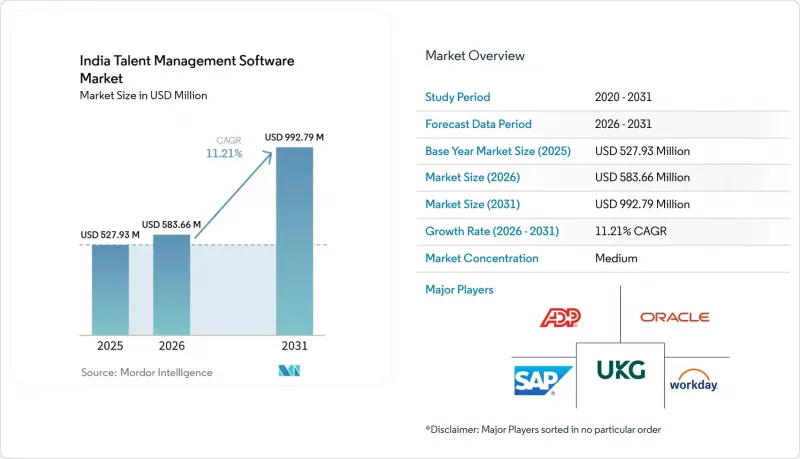
據 Mordor Intelligence 稱,印度人才管理軟體市場預計將從 2025 年的 5.2793 億美元成長到 2026 年的 5.8366 億美元,到 2031 年達到 9.9279 億美元,2026 年至 2031 年的複合成長率為 11.21%。
本報告按元件(軟體和服務[專業服務、支援和維護服務])、應用程式(績效管理、繼任計畫等)、部署方式(本地部署、雲端部署)、組織規模(大型企業等)和最終用戶產業(零售、電子商務等)進行細分。市場預測以美元計價。
印度人才管理軟體市場趨勢及洞察。
印度公司雲端採用率激增
雲端運算的普及正在重新評估印度人才管理軟體市場的企業軟體優先順序。 2026-2027會計年度聯邦預算透過「印度人工智慧使命」(IndiaAI Mission)和「數位印度公司」(Digital India Corporation)的相關撥款支持數位基礎設施建設,從而促進公共和私營項目中更廣泛的雲端服務交付。此外,海灣合作理事會(GCC)的擴張也催生了對全球人力資本管理(HCM)堆疊、共用管理能力以及能夠與跨境報告機制整合的人才管理系統的需求。這自然有利於雲端原生架構的發展。這也是為什麼儘管本地部署在2025年仍佔據更大的市場佔有率,但雲端運算仍然是印度人才管理軟體市場成長最快的採用模式之一。 Workday透過從2025年12月起向新客戶提供其在亞馬遜雲端服務(AWS)上的印度區域資料中心,解決了與本地託管和管治相關的關鍵採購障礙。因此,企業採購活動正從單純的成本討論轉向更廣泛的架構討論,包括互通性、審計合規性和資料管理。
政府主導的數位技能舉措促進了人力資源技術支出。
政府支持的技能發展計畫正在擴大學習和勞動力管理系統在印度人才管理軟體市場中的作用。 2025-2026會計年度聯邦預算撥款50億印度盧比(約5,970萬美元)用於建立一個人工智慧(AI)教育卓越中心,並宣布與全球組織合作建立五個國家技能發展卓越中心。此外,2025年,技能發展與創業部透過SOAR計畫推廣人工智慧相關技能發展,向雇主發出更強烈的政策訊號,強調系統化的數位化學習和技能追蹤的重要性。這些計劃正在提升能夠以標準化格式記錄能力、認證、學習完成狀態和就業準備情況的系統的價值。總理實習計畫的目標是到2028-2029年透過500家頂尖公司為1,000名年輕人提供實習機會,目前已啟動試點項目,名額達125萬人。該計劃推動了對大規模入職、培訓和職業發展流程的需求日益成長。因此,在印度大部分的人才管理軟體市場中,學習模組正從輔助採購項目轉變為核心預算項目。
對資料居住和主權的持續擔憂
資料駐留問題仍是印度人才管理軟體市場面臨的最大障礙之一。 2025年11月13日頒布的《2025年資料保護與隱私規則》(DPDP規則2025)引進了印度首個針對處理員工和求職者資料的組織的全面資料保護架構。這進一步強調了在人力資源軟體採購中,同意管理、資料外洩應對、記錄保存和本地管治的重要性。 Workday運作於2025年下半年在印度設立專屬資料中心,這表明本地託管和國內支援對於企業採購決策至關重要。因此,在這個監管嚴格的行業中,負責人在簽署合約前會花更多時間審查供應商、安全架構和資料流。這種漫長的實質審查可能會延遲決策,尤其是對於那些仍需證明其符合印度特定法規的全球平台。
細分市場分析
到2025年,軟體將佔印度人才管理軟體市場75.19%的佔有率,並繼續保持其在印度人才管理軟體市場的主導地位。這一主導地位反映了平台許可在集中管理招聘、培訓、績效評估、薪酬和規劃等方面發揮的核心作用,這些管理工作都集中在共用系統中。然而,預計到2031年,服務業的複合年成長率將達到16.59%,這表明買家越來越重視實施和整合成果的品質。 IBM的AskHR環境,在WatsonX Orchestrate的增強下,能夠自動執行80多項人力資源任務,每年處理超過210萬次員工互動,這表明工作流程設計和整合能夠帶來超越基本許可的價值。在印度人才管理軟體市場,這一趨勢正促使供應商在其核心平台之外,提供諮詢、整合和最佳化服務。
該服務的加速成長也得益於許多印度公司在實施過程中面臨的組織和監管方面的複雜性。多模組部署通常需要進行策略映射、資料遷移、管理培訓、授權設計以及上運作後的調整,才能確保部署在各個業務部門穩定運作。這正是印度人才管理軟體產業轉向混合收入模式的原因之一,該模式將訂閱與持續服務支援相結合。部署後仍繼續參與的供應商更有利於獲得與合規性更新、工作流程重新設計、人工智慧功能啟動以及營運模式變更相關的後續工作。因此,一個更成熟的部署生態系統正在形成,在這個生態系統中,服務不僅與平台共存,而且越來越決定平台能否在日常人力資源運作中創造可衡量的價值。
到2025年,績效管理將佔印度人才管理軟體市場22.67%的佔有率,成為最大的應用領域。大型企業仍然依賴正式的評估流程,因為薪酬確定、繼任計畫和管理問責制仍然透過結構化的評估系統來實現。預計到2031年,學習與發展領域的複合年成長率將達到15.83%,凸顯了技能培養在平台預算中迅速佔據核心地位。 SOAR計畫和政府主導的各項技能發展措施正鼓勵雇主以更正式的數位化形式記錄員工的能力和學習進度。因此,在整個印度人才管理軟體市場中,學習模組與角色映射、職業規劃和內部調動之間的聯繫日益緊密。
近期發布的產品表明,整個產品組合的應用邊界正朝著更靈活的方向發展。 2026年5月,Cornerstone發表了Galaxy AI和Cornerstone Transform,這兩款產品透過技能為基礎的智慧層將學習、職涯發展路徑、人才規劃和招募連結起來。 SAP SuccessFactors在2026年上半年發布了Learning Compliance Agent和Succession Planning Agent,這顯示企業越來越傾向於整合的工作流程,而非孤立的工具。 Oracle在2026年發布的HR代理應用程式新增了人才評估與經理工作區工具,進一步印證了績效主導工作流程在企業套件中的重要性。因此,印度人才管理軟體市場正從單一模組購買轉向以學習驅動成長、績效管理為核心的產品組合模式。
其他好處:
- Excel格式的市場預測(ME)表
- 3個月的分析師支持
目錄
第1章:引言
- 研究假設和市場定義
- 調查範圍
第2章:調查方法
第3章執行摘要
第4章 市場狀況
- 市場概覽
- 市場促進因素
- 印度公司雲端採用率激增
- 政府主導的數位技能發展計畫正在促進人力資源技術方面的支出。
- 混合辦公模式的加速推廣催生了對彈性人才解決方案的需求。
- 印度IT服務公司併購活動的活性化,催生了對提升銷售的需求。
- 為需要無縫人才管理的零工工作者拓展平台。
- 人工智慧驅動的學習體驗平台提高了員工留存率。
- 市場限制因素
- 人們仍然對資料儲存位置和資料主權問題感到擔憂。
- 分散的傳統人力資源資訊系統生態系統阻礙了整合。
- 傳統製造業中小企業的預算限制
- 二級企業缺乏變革管理的專業知識
- 產業價值鏈分析
- 監理情勢
- 技術展望
- 波特五力分析
- 宏觀經濟因素對市場的影響
第5章 市場規模與成長預測
- 按組件
- 軟體
- 服務
- 專業服務
- 支援和維護服務
- 透過使用
- 績效管理
- 學習與技能發展
- 繼任計劃
- 薪資管理
- 招募和人才獲取
- 人員規劃
- 員工敬業度與體驗
- 其他人力資源管理應用
- 不同的發展
- 現場
- 雲
- 按組織規模
- 大公司
- 中小企業
- 產業最終用途
- 資訊科技/通訊
- 銀行、金融服務和保險(BFSI)
- 醫療保健和生命科學
- 零售與電子商務
- 製造業
- 政府/公共部門
- 其他終端用戶產業
第6章 競爭情勢
- 市場集中度
- 策略趨勢
- 市佔率分析
- 公司簡介
- Oracle Corporation
- SAP SE
- Workday, Inc.
- Cornerstone OnDemand, Inc.
- SumTotal Systems, LLC
- ADP, Inc.
- Ceridian HCM Holding Inc.
- UKG Inc.
- PeopleStrong HR Services Pvt. Ltd.
- Zoho Corporation Pvt. Ltd.
- Darwinbox Digital Solutions Pvt. Ltd.
- Ramco Systems Limited
- IBM Corporation
- BambooHR LLC
- Cegid SA(Talentsoft)
- Infor, Inc.
- The Sage Group plc
- Paycom Software, Inc.
- 3i Infotech Limited
- Freshworks Inc.
第7章 市場機會與未來展望
According to Mordor Intelligence, the India talent management software market size is expected to increase from USD 527.93 million in 2025 to USD 583.66 million in 2026 and reach USD 992.79 million by 2031, growing at a CAGR of 11.21% over 2026-2031.
This report is Segmented by Component (Software, and Services [Professional Services, and Support and Maintenance Services]), Application (Performance Management, Succession Planning, and More), Deployment (On-Premise, and Cloud), Organization Size (Large Enterprises, and More), and End-Use Industry (Retail and E-Commerce, and More). The Market Forecasts are Provided in Terms of Value (USD).
India Talent Management Software Market Trends and Insights
Surging Cloud Adoption among Indian Enterprises
Surging cloud adoption is reshaping enterprise software priorities across the India talent management software market. The Union Budget 2026-27 backed digital infrastructure through allocations tied to the IndiaAI Mission and the Digital India Corporation, which supports broader cloud-based service delivery across public and private programs. GCC expansion is also creating a demand tier that needs talent systems able to connect with global HCM stacks, shared controls, and cross-border reporting structures, which naturally favors cloud-native architecture. That is one reason cloud is the fastest-growing deployment route inside the India talent management software market, even though on-premise still held the larger installed base in 2025. Workday made its India-region data center on Amazon Web Services available for new customers from December 2025, directly addressing a key procurement barrier around local hosting and governance. As a result, enterprise buying is moving away from a narrow cost discussion and toward a broader architecture discussion that includes interoperability, audit readiness, and data control.
Government-Led Digital Skills Initiatives Boosting HR Tech Spend
Government-backed skilling programs are widening the role of learning and workforce systems in the India talent management software market. The Union Budget 2025-26 allocated INR 500 crore (approximately USD 59.7 million) for a Center of Excellence in Artificial Intelligence for education, and also announced 5 National Centers of Excellence for Skilling with global partners. The Ministry of Skill Development and Entrepreneurship also pushed AI-linked skilling through the SOAR program in 2025, which provided employers with a stronger policy signal on structured digital learning and skill tracking. These programs increase the value of systems that can record competencies, certifications, learning completion, and role readiness in a standard format. The PM Internship Scheme, which targets 1 crore youth through 500 top companies by 2028-29 and has already activated 1.25 lakh pilot placements, widens the need for onboarding, training, and progression workflows at scale. This is helping learning modules move from a secondary purchase to a core budget line across much of the India talent management software market.
Persistent Data Residency and Sovereignty Concerns
Data residency remains one of the clearest friction points in the India talent management software market. The DPDP Rules, 2025, notified on November 13, 2025, made India's first comprehensive data protection framework operational for organizations that process employee and candidate data. This underscores the importance of consent management, breach response, recordkeeping, and local governance in HR software procurement. Workday's rollout of an India-region data center in late 2025 shows how central local hosting and in-country readiness have become to enterprise buying decisions. Buyers in regulated sectors are therefore spending more time on vendor reviews, security architecture, and data flow questions before signing contracts. That longer diligence cycle can delay decisions, especially for global platforms that still need to prove India-specific compliance depth.
Other drivers and restraints analyzed in the detailed report include:
- Accelerated Hybrid-Work Policies Requiring Agile Talent Solutions
- Growing M&A Activity Among Indian IT Services Firms Creating Upsell Demand
- Fragmented Legacy HRIS Ecosystems Limiting Integrations
For complete list of drivers and restraints, kindly check the Table Of Contents.
Segment Analysis
Software accounted for 75.19% of the market in 2025 and remained the largest component across the India talent management software market. That lead reflects the central role of platform licenses in unifying recruitment, learning, performance, compensation, and planning within a shared system. Even so, services are forecast to grow at a 16.59% CAGR through 2031, indicating that buyers are placing greater weight on implementation quality and integration outcomes. IBM's AskHR environment, enhanced with watsonx Orchestrate, automates more than 80 HR tasks and handles more than 2.1 million employee conversations each year, illustrating how workflow design and integration can multiply value beyond the base license. In the India talent management software market, that pattern is encouraging vendors to package consulting, integration, and optimization services alongside the core platform.
The faster growth of services also reflects the organizational and regulatory complexity that many Indian enterprises face during rollout. Multi-module implementations often require policy mapping, data migration, manager training, permissions design, and post-go-live tuning before adoption stabilizes across business units. This is one reason the India talent management software industry is moving toward blended revenue models that combine subscriptions with ongoing services support. Vendors that stay involved after deployment are better positioned to capture recurring work from compliance updates, workflow redesigns, AI feature activations, and operating model changes. The outcome is a more mature implementation ecosystem in which services no longer sit alongside the platform but increasingly determine whether the platform delivers measurable value in day-to-day HR operations.
Performance management accounted for 22.67% of the India talent management software market in 2025, making it the largest application area. Large employers still depend on formal review cycles because pay decisions, succession choices, and manager accountability continue to flow through structured assessment systems. Learning and development is set to expand at a 15.83% CAGR through 2031, underscoring how quickly skill-building is moving to the center of platform budgets. The SOAR program and the wider government skilling push are encouraging employers to document competencies and learning progress in more formal digital formats. That makes learning modules more closely tied to role mapping, career planning, and internal mobility across the India talent management software market.
Recent product launches also show that application boundaries are becoming less rigid across the portfolio. Cornerstone launched Galaxy AI and Cornerstone Transform in May 2026 to connect learning, career pathing, workforce planning, and recruitment through a skills-based intelligence layer. SAP's 1H 2026 SuccessFactors release included a Learning Compliance Agent and a Succession Planning Agent, signaling that enterprises increasingly want linked workflows instead of isolated tools. Oracle's 2026 HR agentic applications added talent calibration and manager workspace tools, reinforcing the continued relevance of performance-led workflows within enterprise suites. As a result, the India talent management software market is shifting away from single-module buying and toward portfolios in which performance management remains the anchor while learning increasingly drives expansion.
Complete Report Scope:
- By Component
- Software
- Services
- Professional Services
- Support and Maintenance Services
- By Application
- Performance Management
- Learning and Development
- Succession Planning
- Compensation Management
- Recruitment and Talent Acquisition
- Workforce Planning
- Employee Engagement and Experience
- Other Talent Management Applications
- By Deployment
- On-Premise
- Cloud
- By Organization Size
- Large Enterprises
- Small and Medium Enterprises (SMEs)
- By End-Use Industry
- IT and Telecommunications
- Banking, Financial Services and Insurance (BFSI)
- Healthcare and Life Sciences
- Retail and E-Commerce
- Manufacturing
- Government and Public Sector
- Other End-Use Industries
List of Companies Covered in this Report:
- Oracle Corporation
- SAP SE
- Workday, Inc.
- Cornerstone OnDemand, Inc.
- SumTotal Systems, LLC
- ADP, Inc.
- Ceridian HCM Holding Inc.
- UKG Inc.
- PeopleStrong HR Services Pvt. Ltd.
- Zoho Corporation Pvt. Ltd.
- Darwinbox Digital Solutions Pvt. Ltd.
- Ramco Systems Limited
- IBM Corporation
- BambooHR LLC
- Cegid SA (Talentsoft)
- Infor, Inc.
- The Sage Group plc
- Paycom Software, Inc.
- 3i Infotech Limited
- Freshworks Inc.
Additional Benefits:
- The market estimate (ME) sheet in Excel format
- 3 months of analyst support
TABLE OF CONTENTS
1 INTRODUCTION
- 1.1 Study Assumptions and Market Definition
- 1.2 Scope of the Study
2 RESEARCH METHODOLOGY
3 EXECUTIVE SUMMARY
4 MARKET LANDSCAPE
- 4.1 Market Overview
- 4.2 Market Drivers
- 4.2.1 Surging Cloud Adoption Among Indian Enterprises
- 4.2.2 Government-Led Digital Skills Initiatives Boosting HR Tech Spend
- 4.2.3 Accelerated Hybrid-Work Policies Requiring Agile Talent Solutions
- 4.2.4 Growing M&A Activity Among Indian IT Services Firms Creating Upsell Demand
- 4.2.5 Expansion of Gig Workforce Platforms Requiring Seamless Talent Orchestration
- 4.2.6 AI-Driven Learning Experience Platforms Enhancing Employee Retention
- 4.3 Market Restraints
- 4.3.1 Persistent Data Residency and Sovereignty Concerns
- 4.3.2 Fragmented Legacy HRIS Ecosystems Limiting Integrations
- 4.3.3 Budget Constraints Within Traditional Manufacturing SMEs
- 4.3.4 Shortage of Change-Management Expertise in Tier-2 Enterprises
- 4.4 Industry Value Chain Analysis
- 4.5 Regulatory Landscape
- 4.6 Technological Outlook
- 4.7 Porter's Five Forces Analysis
- 4.7.1 Bargaining Power of Suppliers
- 4.7.2 Bargaining Power of Buyers
- 4.7.3 Threat of Substitutes
- 4.7.4 Threat of New Entrants
- 4.7.5 Competitive Rivalry
- 4.8 Impact of Macroeconomic Factors on the Market
5 MARKET SIZE AND GROWTH FORECASTS (VALUE)
- 5.1 By Component
- 5.1.1 Software
- 5.1.2 Services
- 5.1.2.1 Professional Services
- 5.1.2.2 Support and Maintenance Services
- 5.2 By Application
- 5.2.1 Performance Management
- 5.2.2 Learning and Development
- 5.2.3 Succession Planning
- 5.2.4 Compensation Management
- 5.2.5 Recruitment and Talent Acquisition
- 5.2.6 Workforce Planning
- 5.2.7 Employee Engagement and Experience
- 5.2.8 Other Talent Management Applications
- 5.3 By Deployment
- 5.3.1 On-Premise
- 5.3.2 Cloud
- 5.4 By Organization Size
- 5.4.1 Large Enterprises
- 5.4.2 Small and Medium Enterprises (SMEs)
- 5.5 By End-Use Industry
- 5.5.1 IT and Telecommunications
- 5.5.2 Banking, Financial Services and Insurance (BFSI)
- 5.5.3 Healthcare and Life Sciences
- 5.5.4 Retail and E-Commerce
- 5.5.5 Manufacturing
- 5.5.6 Government and Public Sector
- 5.5.7 Other End-Use Industries
6 COMPETITIVE LANDSCAPE
- 6.1 Market Concentration
- 6.2 Strategic Moves
- 6.3 Market Share Analysis
- 6.4 Company Profiles (includes Global Level Overview, Market Level Overview, Core Segments, Financials as available, Strategic Information, Market Rank/Share, Products and Services, Recent Developments)
- 6.4.1 Oracle Corporation
- 6.4.2 SAP SE
- 6.4.3 Workday, Inc.
- 6.4.4 Cornerstone OnDemand, Inc.
- 6.4.5 SumTotal Systems, LLC
- 6.4.6 ADP, Inc.
- 6.4.7 Ceridian HCM Holding Inc.
- 6.4.8 UKG Inc.
- 6.4.9 PeopleStrong HR Services Pvt. Ltd.
- 6.4.10 Zoho Corporation Pvt. Ltd.
- 6.4.11 Darwinbox Digital Solutions Pvt. Ltd.
- 6.4.12 Ramco Systems Limited
- 6.4.13 IBM Corporation
- 6.4.14 BambooHR LLC
- 6.4.15 Cegid SA (Talentsoft)
- 6.4.16 Infor, Inc.
- 6.4.17 The Sage Group plc
- 6.4.18 Paycom Software, Inc.
- 6.4.19 3i Infotech Limited
- 6.4.20 Freshworks Inc.
7 MARKET OPPORTUNITIES AND FUTURE OUTLOOK
- 7.1 White-Space and Unmet-Need Assessment

 亞太地區人力資源管理軟體:市場佔有率分析、產業趨勢與統計及成長預測(2026-2031)人力資本管理(HCM)軟體:市場佔有率分析、產業趨勢與統計及成長預測(2026-2031)亞太地區人才管理軟體:市場佔有率分析、產業趨勢與統計及成長預測(2026-2031)北美人力資源管理軟體:市場佔有率分析、產業趨勢與統計及成長預測(2026-2031 年)歐洲人才管理軟體:市場佔有率分析、產業趨勢與統計及成長預測(2026-2031)IT與電信業的人力資源管理:市場佔有率分析、產業趨勢與統計、成長預測(2026-2031年)
 OKR軟體市場:依元件類型、公司類型、部署方式、產業和地區分類
 目標與關鍵成果軟體市場:規模、佔有率、成長率、按類型、應用和地區分類的全球產業分析,以及2026年至2034年的預測
 2026年全球人力資本管理軟體市場報告2026年全球人才管理軟體市場報告