


 |
市場調查報告書
商品編碼
2124662
亞太地區玻璃瓶和容器:市場佔有率分析、行業趨勢和統計數據以及成長預測(2026-2031 年)Asia-Pacific Glass Bottles And Containers - Market Share Analysis, Industry Trends & Statistics, Growth Forecasts (2026 - 2031) |
||||||

※ 本網頁內容可能與最新版本有所差異。詳細情況請與我們聯繫。
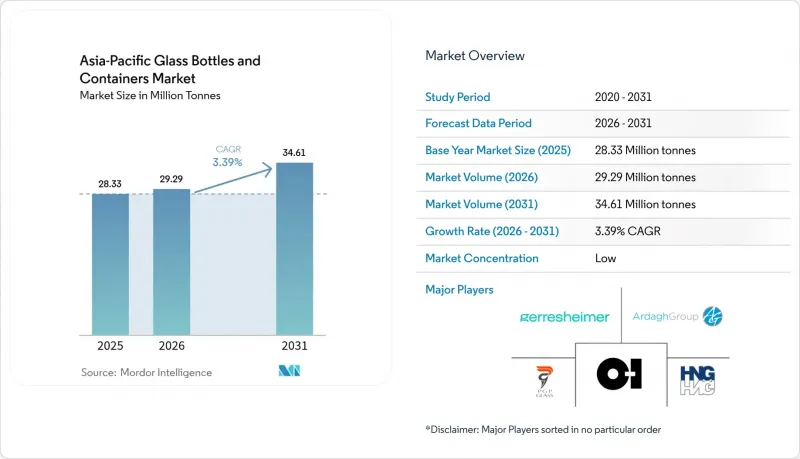
據 Mordor Intelligence 稱,亞太地區玻璃瓶和容器市場在 2025 年的價值為 2833 萬噸,預計到 2031 年將達到 3461 萬噸,而 2026 年為 2929 萬噸,預測期(2026-2031 年)的複合年成長率為 3.39%。
本報告按最終用戶(飲料[酒精飲料(啤酒、葡萄酒、烈酒等)和非酒精飲料(碳酸飲料(CSD)、乳製品飲料等)]、食品[果醬和果凍、調味品和醬料等]、化妝品和個人護理用品、其他)、顏色(燧石色、琥珀色、其他)和國家/地區進行細分。市場預測以數量(噸)為單位。
亞太地區玻璃瓶及容器市場趨勢及洞察。
中國和印度擴大了玻璃容器的出口。
中國憑藉著數十年來累積的大規模熔爐產能和成本最佳化的物流網路,向依賴進口的鄰近東協市場供應產品。而印度則利用其低廉的人事費用和符合國際品質標準的先進設備。 PGP Glass在印度和斯里蘭卡的日產能達1,600噸,其出口導向模式正逐步蠶食東南亞小規模生產商的市佔率。這項優勢能否持續,取決於能否維持能源成本優勢,並能以具競爭力的價格獲得玻璃屑玻璃。兩國之間的出口成長勢頭,總合提高兩國熔爐運轉率和降低海外運輸的單位成本,推動全部區域複合年成長率提升約0.8個百分點。
玻璃製造技術的進步
混合式熔爐,其中80%的能源運作可再生能源,20%來自燃氣燃燒,已從試點階段過渡到商業化規模,尤其是在Gellesheimer和Ardague等公司營運的工廠。 Veralia在干邑白蘭地推出的全電熔爐證明了100%電氣化的可行性,為大幅減少範圍1排放鋪平了道路。結合工業4.0驅動的控制、預測性維護、數位化品質檢測和即時能源最佳化,這些創新技術可將每噸玻璃的能耗降低高達30%,從而直接提高亞太地區容器玻璃市場的利潤率和監管合規性。
玻璃製造過程中的高能耗
熔爐運作耗能佔工廠總能耗的60%至70%,使製造商面臨電費飆漲和天然氣價格波動的風險。中國冬季電力發行措施以及印度電網可靠性面臨的挑戰,正造成迫在眉睫的成本壓力,迫使營運商加快玻璃屑的使用,並探索生物液化天然氣和綠色氫等替代燃料。 OI公司在其哈洛工廠進行的100%生質燃料測試表明,玻璃屑利用率達到88%,二氧化碳排放量顯著降低,這表明減排之路切實可行,儘管原料供應仍面臨挑戰。
細分市場分析
預計化妝品和個人護理品類將超越其他所有品類,而飲料品類在2025年仍將佔據亞太地區玻璃容器市場62.12%的佔有率,並以4.63%的複合年成長率成長。香水瓶的單位利潤率最高,由於市場對複雜形狀、壓花和彩色玻璃的需求較高,其平均售價遠高於一般飲料容器。
此外,頂級烈酒和精釀啤酒通常會指定使用與品牌故事相符的客製化燧石玻璃或琥珀色玻璃瓶,這進一步豐富了亞太地區容器玻璃市場的收入來源。儘管醫藥行業對管瓶和安瓿瓶以外的玻璃製品需求保持穩定,但監管完整性要求確保玻璃仍然是主要材料,為業務提供了可靠的基礎。
其他好處:
- Excel格式的市場預測(ME)表
- 3個月的分析師支持
目錄
第1章:引言
- 研究假設和市場定義
- 調查範圍
第2章:調查方法
第3章執行摘要
第4章 市場狀況
- 市場概覽
- 市場促進因素
- 中國和印度正在擴大玻璃容器的出口。
- 玻璃製造技術的進步
- 支持回收的政府法規
- 食品和飲料行業的需求增加
- 消費者偏好優質且永續的包裝
- 亞太地區已開發國家擴大回收基礎設施
- 市場限制因素
- 玻璃製造過程中的高能耗
- 原物料價格波動
- 新興市場的基礎建設限制因素
- 來自塑膠和金屬替代品的競爭壓力
- 產業供應鏈分析
- 亞太地區容器玻璃熔爐的生產能力和位置
- 工廠位置及投產年份
- 生產能力
- 爐子的種類
- 玻璃的顏色
- 貨櫃玻璃的進出口資料-涵蓋主要進出口目的地。
- 2021年至2024年進口量及進口額
- 2021年至2024年出口量及出口額
- 波特五力分析
- 原料分析
- 玻璃包裝回收趨勢
- 玻璃包裝供需分析
第5章 市場規模與成長預測
- 最終用戶
- 飲料
- 酒精飲料
- 啤酒
- 葡萄酒
- 烈酒
- 其他酒精飲料(蘋果酒和其他發酵飲料)
- 非酒精性
- 汁
- 碳酸飲料(CSD)
- 乳製品飲料
- 其他非酒精飲料
- 酒精飲料
- 食品(果醬、果凍、橘子醬、蜂蜜、香腸和調味品、食用油、醃菜)
- 化妝品和個人護理
- 藥品(不包括管瓶和安瓿)
- 香水
- 飲料
- 按顏色
- 綠色的
- 琥珀色
- 燧石
- 其他顏色
- 國家
- 中國
- 印度
- 日本
- 泰國
- 澳洲和紐西蘭
- 韓國
- 越南
- 其他亞太國家
第6章 競爭情勢
- 市場集中度
- 策略舉措和趨勢
- 各公司企業市場占有率分析(基於最新產能)
- 公司簡介
- OI Glass, Inc.
- Ardagh Group SA
- Verallia SA
- PGP Glass Private Limited
- Hindusthan National Glass & Industries Ltd.
- Feemio Glass Co., Ltd.
- Toyo Glass Co., Ltd.
- Nihon Yamamura Glass Co., Ltd.
- Gerresheimer AG
- Saverglass SAS
- Vitro SAB de CV
- BA Glass Portugal, SA
- Stoelzle Glass Group GmbH
- Heinz-Glas GmbH & Co. KGaA
- Vetropack Holding AG
- Zignago Vetro SpA
- Park Cam Sanayi ve Ticaret AS
- Orora Limited
- Koa Glass Co., Ltd.
- Bormioli Luigi SpA
第7章 市場機會與未來展望
According to Mordor Intelligence, the Asia-Pacific glass bottles and Containers Market size was valued at 28.33 million tonnes in 2025 and estimated to grow from 29.29 million tonnes in 2026 to reach 34.61 million tonnes by 2031, at a CAGR of 3.39% during the forecast period (2026-2031).
This report is Segmented by End-User (Beverages [Alcoholic {Beer, Wine, Spirits, and More}, and Non-Alcoholic {Carbonated Drinks (CSDs), Dairy Product Based Drinks, and More}], Food [Jam and Jelly, Condiments and Sauces, and More], Cosmetics and Personal Care, and More), Color (Flint, Amber, and More) and Country. The Market Forecasts are Provided in Terms of Volume (Tonnes).
Asia-Pacific Glass Bottles And Containers Market Trends and Insights
China and India Ramping Up Glass Container Exports
China leverages decades of large-scale furnace capacity and cost-optimized logistics to serve neighboring import-dependent ASEAN markets, while India capitalizes on lower labor costs and newer assets tailored for global quality standards. PGP Glass's 1,600 tons-per-day capacity across India and Sri Lanka illustrates an export-oriented model that has begun diverting share away from smaller Southeast Asian producers, although the permanence of these gains hinges on maintaining energy-cost advantages and access to cullet at competitive prices. Such bilateral export momentum collectively adds roughly 0.8 percentage points to the regional CAGR by improving furnace utilization in both countries and narrowing unit costs for overseas shipments.
Technological Advancements in Glass Manufacturing
Hybrid furnaces operating on 80% renewable electricity and 20% gas combustion have moved from pilot to commercial scale, notably at facilities operated by Gerresheimer and Ardagh. Verallia's fully electric furnace in Cognac demonstrates the feasibility of 100% electrification, signaling a path toward drastically lower Scope 1 emissions. Coupled with Industry 4.0 controls, predictive maintenance, digital quality inspection, and real-time energy optimization, these innovations can lower energy consumption per ton by up to 30%, directly lifting margins and regulatory compliance readiness across the Asia-Pacific container glass market.
High Energy Consumption in Glass Production
Furnace operations can consume 60-70% of total plant energy, exposing manufacturers to elevated electricity tariffs and gas price volatility. China's winter power-rationing episodes and India's grid reliability challenges add immediate cost pressure, compelling operators to accelerate cullet utilization and experiment with alternative fuels such as bio-LNG and green hydrogen. O-I's 100% biofuel trial at its Harlow plant demonstrated an 88% cullet rate and sizable CO2 reductions, hinting at a realistic mitigation pathway even though feedstock availability remains a hurdle.
Other drivers and restraints analyzed in the detailed report include:
- Government Regulations Supporting Recycling
- Rising Demand from Food and Beverage Sector
- Volatility in Raw Material Prices
For complete list of drivers and restraints, kindly check the Table Of Contents.
Segment Analysis
The cosmetics and personal care segment is projected to outpace all others at a 4.63% CAGR, even though beverages still commanded 62.12% of the Asia-Pacific container glass market share in 2025. Perfumery bottles yield the highest unit margins and often require complex shapes, embossing, and colored glass, pushing average selling prices well above commodity beverage containers.
Premium spirits and craft beer also specify custom flint and amber bottles that align with brand storytelling, further diversifying revenue streams within the Asia-Pacific container glass market. Although pharmaceutical demand outside vials and ampoules remains stable, regulatory integrity requirements keep glass as the substrate of choice, preserving a dependable baseline business.
Complete Report Scope:
- By End-user
- Beverages
- Alcoholic
- Beer
- Wine
- Spirits
- Other Alcoholic Beverages (Cider and Other Fermented Drinks)
- Non-Alcoholic
- Juices
- Carbonated Drinks (CSDs)
- Dairy Product Based Drinks
- Other Non-Alcoholic Beverages
- Alcoholic
- Food (Jam, Jelly, Marmalades, Honey, Sausages and Condiments, Oil, Pickles)
- Cosmetics and Personal Care
- Pharmaceuticals (excluding Vials and Ampoules)
- Perfumery
- Beverages
- By Color
- Green
- Amber
- Flint
- Other Colors
- By Country
- China
- India
- Japan
- Thailand
- Australia and New Zealand
- South Korea
- Vietnam
- Rest of Asia-Pacific
List of Companies Covered in this Report:
- O-I Glass, Inc.
- Ardagh Group S.A.
- Verallia S.A.
- PGP Glass Private Limited
- Hindusthan National Glass & Industries Ltd.
- Feemio Glass Co., Ltd.
- Toyo Glass Co., Ltd.
- Nihon Yamamura Glass Co., Ltd.
- Gerresheimer AG
- Saverglass SAS
- Vitro S.A.B. de C.V.
- BA Glass Portugal, S.A.
- Stoelzle Glass Group GmbH
- Heinz-Glas GmbH & Co. KGaA
- Vetropack Holding AG
- Zignago Vetro S.p.A.
- Park Cam Sanayi ve Ticaret A.S.
- Orora Limited
- Koa Glass Co., Ltd.
- Bormioli Luigi S.p.A.
Additional Benefits:
- The market estimate (ME) sheet in Excel format
- 3 months of analyst support
TABLE OF CONTENTS
1 INTRODUCTION
- 1.1 Study Assumptions and Market Definition
- 1.2 Scope of the Study
2 RESEARCH METHODOLOGY
3 EXECUTIVE SUMMARY
4 MARKET LANDSCAPE
- 4.1 Market Overview
- 4.2 Market Drivers
- 4.2.1 China and India ramping up glass container exports
- 4.2.2 Technological Advancements in Glass Manufacturing
- 4.2.3 Government Regulations Supporting Recycling
- 4.2.4 Rising Demand from Food and Beverage Sector
- 4.2.5 Consumer Preference for Premium and Sustainable Packaging
- 4.2.6 Expansion of Recycling Infrastructure in Developed Asia-Pacific Countries
- 4.3 Market Restraints
- 4.3.1 High Energy Consumption in Glass Production
- 4.3.2 Volatility in Raw Material Prices
- 4.3.3 Infrastructure Limitations in Emerging Markets
- 4.3.4 Competitive Pressure from Plastic and Metal Alternatives
- 4.4 Industry Supply-Chain Analysis
- 4.5 Container Glass Furnace Capacity and Locations in Asia-Pacific
- 4.5.1 Plant Locations and Year of Commencement
- 4.5.2 Production Capacities
- 4.5.3 Types of Furnaces
- 4.5.4 Color of Glass Produced
- 4.6 Export-Import Data of Container Glass - Covering Key Import and Export Destinations
- 4.6.1 Import Volume and Value, 2021-2024
- 4.6.2 Export Volume and Value, 2021-2024
- 4.7 Porter's Five Forces Analysis
- 4.7.1 Threat of New Entrants
- 4.7.2 Bargaining Power of Suppliers
- 4.7.3 Bargaining Power of Buyers
- 4.7.4 Threat of Substitutes
- 4.7.5 Competitive Rivalry
- 4.8 Raw Material Analysis
- 4.9 Recycling Trends for Glass Packaging
- 4.10 Demand vs Supply Analysis for Glass Packaging
5 MARKET SIZE AND GROWTH FORECASTS (VOLUME)
- 5.1 By End-user
- 5.1.1 Beverages
- 5.1.1.1 Alcoholic
- 5.1.1.1.1 Beer
- 5.1.1.1.2 Wine
- 5.1.1.1.3 Spirits
- 5.1.1.1.4 Other Alcoholic Beverages (Cider and Other Fermented Drinks)
- 5.1.1.2 Non-Alcoholic
- 5.1.1.2.1 Juices
- 5.1.1.2.2 Carbonated Drinks (CSDs)
- 5.1.1.2.3 Dairy Product Based Drinks
- 5.1.1.2.4 Other Non-Alcoholic Beverages
- 5.1.1.1 Alcoholic
- 5.1.2 Food (Jam, Jelly, Marmalades, Honey, Sausages and Condiments, Oil, Pickles)
- 5.1.3 Cosmetics and Personal Care
- 5.1.4 Pharmaceuticals (excluding Vials and Ampoules)
- 5.1.5 Perfumery
- 5.1.1 Beverages
- 5.2 By Color
- 5.2.1 Green
- 5.2.2 Amber
- 5.2.3 Flint
- 5.2.4 Other Colors
- 5.3 By Country
- 5.3.1 China
- 5.3.2 India
- 5.3.3 Japan
- 5.3.4 Thailand
- 5.3.5 Australia and New Zealand
- 5.3.6 South Korea
- 5.3.7 Vietnam
- 5.3.8 Rest of Asia-Pacific
6 COMPETITIVE LANDSCAPE
- 6.1 Market Concentration
- 6.2 Strategic Moves and Developments
- 6.3 Company Market Share Analysis, (Based on Latest Production Capacity)
- 6.4 Company Profiles (includes Global level Overview, Market level overview, Core Segments, Financials as available, Strategic Information, Market Rank/Share for key companies, Products and Services, and Recent Developments)
- 6.4.1 O-I Glass, Inc.
- 6.4.2 Ardagh Group S.A.
- 6.4.3 Verallia S.A.
- 6.4.4 PGP Glass Private Limited
- 6.4.5 Hindusthan National Glass & Industries Ltd.
- 6.4.6 Feemio Glass Co., Ltd.
- 6.4.7 Toyo Glass Co., Ltd.
- 6.4.8 Nihon Yamamura Glass Co., Ltd.
- 6.4.9 Gerresheimer AG
- 6.4.10 Saverglass SAS
- 6.4.11 Vitro S.A.B. de C.V.
- 6.4.12 BA Glass Portugal, S.A.
- 6.4.13 Stoelzle Glass Group GmbH
- 6.4.14 Heinz-Glas GmbH & Co. KGaA
- 6.4.15 Vetropack Holding AG
- 6.4.16 Zignago Vetro S.p.A.
- 6.4.17 Park Cam Sanayi ve Ticaret A.S.
- 6.4.18 Orora Limited
- 6.4.19 Koa Glass Co., Ltd.
- 6.4.20 Bormioli Luigi S.p.A.
7 MARKET OPPORTUNITIES AND FUTURE OUTLOOK
- 7.1 White-space and Unmet-Need Assessment

 非洲玻璃瓶與容器:市場佔有率分析、產業趨勢與統計、成長預測(2026-2031 年)玻璃瓶和容器:市場佔有率分析、行業趨勢和統計數據、成長預測(2026-2031)歐洲玻璃瓶和容器:市場佔有率分析、行業趨勢和統計數據以及成長預測(2026-2031 年)北美玻璃瓶和容器:市場佔有率分析、行業趨勢和統計數據以及成長預測(2026-2031 年)
 玻璃瓶和容器市場規模、佔有率和成長分析(按產品、應用、顏色、最終用途產業和地區分類)—產業預測(2026-2033 年)
 2025-2029年全球玻璃瓶與容器市場英國玻璃瓶和容器:市場佔有率分析、行業趨勢和成長預測(2025-2030 年)中東和非洲玻璃瓶和容器市場佔有率分析、行業趨勢、統計數據和成長預測(2025-2030)拉丁美洲玻璃瓶和容器:市場佔有率分析、行業趨勢和成長預測(2025-2030)
 玻璃瓶及容器市場機會、成長動力、產業趨勢分析及 2025 - 2034 年預測