


 |
市場調查報告書
商品編碼
2121705
歐洲玻璃瓶和容器:市場佔有率分析、行業趨勢和統計數據以及成長預測(2026-2031 年)Europe Glass Bottles And Containers - Market Share Analysis, Industry Trends & Statistics, Growth Forecasts (2026 - 2031) |
||||||

※ 本網頁內容可能與最新版本有所差異。詳細情況請與我們聯繫。
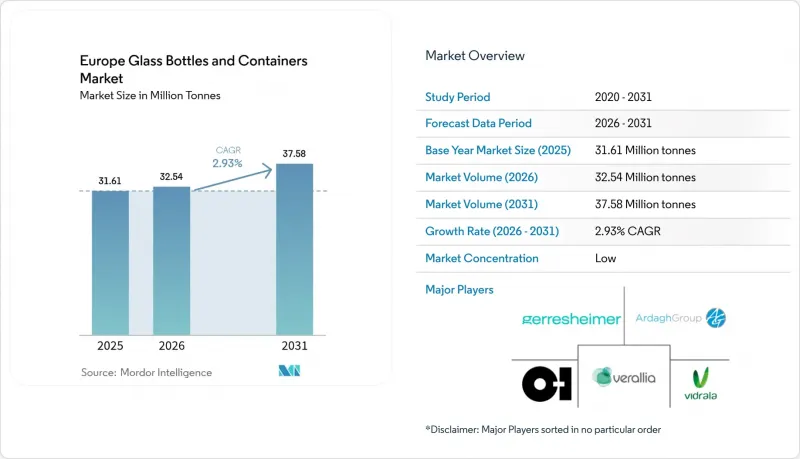
根據 Mordor Intelligence 預測,歐洲玻璃瓶和容器市場將從 2025 年的 3,161 萬噸成長到 2026 年的 3,254 萬噸,然後在 2031 年達到 3,758 萬噸,2026 年至 2031 年的複合年成長率為 2.93%。
本報告按最終用戶(飲料[酒精飲料(啤酒、葡萄酒、烈酒和其他酒精飲料)和非酒精飲料(碳酸飲料、乳製品飲料等)]、食品[果醬和果凍、調味品和醬料等]、化妝品和個人護理用品等]以及顏色(燧石色、琥珀色、綠色等)進行細分。市場預測以噸為單位。
歐洲玻璃瓶和容器市場的趨勢和洞察
出口導向玻璃包裝產品為歐盟GDP貢獻數十億。
即使國內消費放緩,葡萄酒、啤酒和藥品的強勁出口也支撐著歐洲玻璃瓶和容器市場的穩定需求。 2024年,德國啤酒出口量達14.5億公升,義大利葡萄酒出口額達到81.36億歐元,年增5.5%,這印證了玻璃在全球分銷管道中作為品質標誌的地位。歐盟的標籤法規和地理標示體系保護了高級產品,保障了歐洲玻璃瓶和容器市場的供應穩定。飲料出口商願意承擔更高的包裝成本,因為玻璃能夠確保產品質量,並有助於在成熟市場和新興市場中建立品牌故事。這種出口導向緩解了區域需求的週期性波動,並促使熔爐升級以滿足高規格包裝的需求。獲得大規模出口合約的生產商通常會簽訂長期供應協議,從而提高產能運轉率和現金流狀況。
透過循環經濟和碳中和目標促進反應器現代化
歐盟碳排放交易體系的壓力正在加速歐洲玻璃瓶和容器市場對100%純電和混合動力熔爐的投資。 Verallia的干邑白蘭地工廠完全運作可再生能源,二氧化碳排放量減少了60%。同時,Ardagh位於奧本基興的NextGen生產線結合了80%的綠色電力和20%的天然氣,碳足跡減少了64%。 OI已投資6,500萬美元對其沃什工廠進行電氣化改造,顯示在當前的維修週期中,脫碳比單純的產能擴張更為重要。混合動力設計即使在電網波動的情況下也能保持熔煉穩定性,從而降低營運風險,並使企業能夠對沖天然氣和電力價格波動帶來的風險。包括提案的「碳邊境調節機制」在內的長期碳成本將為早期採用者提供永續的成本優勢。儘管資本投資負擔沉重,但歐盟的創新津貼透過綠色債券進行的聯合資金籌措將減輕資產負債表的壓力。
能源價格上漲對熔爐獲利能力和利潤率的影響
天然氣價格已飆升至近40歐元/兆瓦時(是危機前水準的四倍),燃料成本已成為許多歐洲熔爐的最大支出項目。 OI、Ardagh和Verallia在2024-2025年的獲利預測中均指出,EBITDA面臨壓力,導致部分工廠暫時停產並裁員。由於燃料消耗強度高,企業被迫積極進行對沖,但電力價格的波動使混合生產線的風險管理更加複雜。短期內,合理化產能將有助於控制價格,但也可能削弱規模經濟。小規模家族式工廠面臨融資流緊張的困境,加速了產業重組。預計在可再生能源購電協議到期和電網升級改造取得進展之前,能源通膨將繼續對歐洲玻璃瓶和容器市場構成壓力。
細分市場分析
飲料業仍是歐洲玻璃瓶和容器市場的基石,預計到2025年將佔總產量的63.35%,這得益於其在葡萄酒、啤酒和烈酒領域的深厚傳統。在法國,由於2024年葡萄收成下降了18%,葡萄酒產量波動導致瓶子訂單放緩。然而,義大利140億歐元的葡萄酒銷售額和強勁的出口勢頭使南部玻璃工廠保持滿載運作。在德國,儘管啤酒銷量有所下降,但精釀啤酒和非酒精飲料的擴張維持了對高階瓶子的需求,尤其是由押金制度支持的可回收容器。烈酒品牌提高了其旗艦產品的平均玻璃重量,以強調其純正品質,同時還引入了低碳熔爐以保持其ESG評分。除飲料業外,化妝品和個人護理行業預計到2031年將以3.52%的複合年成長率實現最快成長,這主要得益於可回收包裝的推廣以及玻璃瓶在高利潤護膚品系列中的觸感吸引力。
醫藥容器的成長與飲料市場的穩定相輔相成。 I型管瓶的生產每噸利潤率高,有助於緩解經濟波動的影響。肖特製藥在匈牙利新建的生產線旨在滿足注射劑的需求,兼顧ISO 15378標準和出口級品質標準。食品應用領域仍以醬料、果醬和嬰幼兒食品為主,但輕質PET材料在大眾市場餐飲解決方案的應用也日益廣泛。總而言之,這些趨勢凸顯了歐洲玻璃瓶和容器市場如何在傳統飲料領域的產量與新興的高價值細分市場之間取得平衡。這有助於維持熔爐的運轉率,並推動對電熔爐和混合熔爐的計劃性資本投資。
其他好處
- Excel格式的市場預測(ME)表
- 3個月的分析師支持
目錄
第1章:引言
- 調查假設和市場定義
- 調查範圍
第2章:調查方法
第3章執行摘要
第4章 市場狀況
- 市場概覽
- 市場促進因素
- 出口導向玻璃包裝產品為歐盟GDP貢獻數十億。
- 透過循環經濟和碳中和目標促進反應器現代化
- 消費者對可回收和美觀包裝的偏好推動了玻璃容器的成長。
- 由於藥品出口擴大,對 I 型和 III 型管瓶的需求增加。
- 食品飲料和化妝品行業的優質化正在推動對玻璃的需求。
- 由於永續發展計劃和禁止使用塑膠的運動,玻璃包裝的普及速度正在加快。
- 市場限制因素
- 能源價格上漲對熔爐獲利能力和利潤率的影響
- 塑膠和金屬等替代包裝材料的興起,導致玻璃在大眾市場產品中的市場佔有率下降。
- 長途物流中物流成本和損壞風險導致成本增加。
- 東歐和南歐不完善的玻璃廢棄物收集系統限制了回收率。
- 工業供應鏈分析
- 歐洲容器用玻璃熔爐的生產能力和位置
- 工廠位置及投產年份
- 生產能力
- 爐型
- 玻璃的顏色
- 玻璃容器進出口資料-涵蓋主要進出口目的地。
- 2021年至2024年進口量及進口額
- 2021年至2024年出口量及出口額
- 波特五力分析
- 原料分析
- 玻璃包裝回收趨勢
- 玻璃包裝供需分析
第5章 市場規模與成長預測
- 最終用戶
- 飲料
- 酒精飲料
- 啤酒
- 葡萄酒
- 烈酒
- 其他酒精飲料(蘋果酒和其他發酵飲料)
- 不含酒精的飲料
- 汁
- 碳酸飲料(CSD)
- 乳製品飲料
- 其他非酒精飲料
- 酒精飲料
- 食品(果醬、果凍、橘子醬、蜂蜜、香腸和調味品、食用油、醃菜)
- 化妝品和個人護理
- 藥品(不含管瓶和安瓿瓶)
- 香水
- 飲料
- 按顏色
- 綠色的
- 琥珀色
- 燧石
- 其他顏色
- 國家
- 英國
- 德國
- 法國
- 義大利
- 波蘭
- 荷蘭
- 西班牙
- 俄羅斯
- 奧地利
- 瑞士
- 其他歐洲國家
第6章 競爭情勢
- 市場集中度
- 策略趨勢與發展
- 按公司分類的市佔率分析(基於最新產能)
- 公司簡介
- Verallia Group
- BA Glass Group
- OI Glass, Inc.
- Vidrala, SA
- Verescence SA
- Gerresheimer AG
- Saverglass Group
- ALGLASS SA
- Quadpack Industries SA
- Berlin Packaging
- Wiegand-Glas Holding GmbH
- Ardagh Group SA
- Heinz-Glas GmbH & Co.
- Zignago Vetro SpA
- Beatson Clark
- Stoelzle Oberglas GmbH
- Vetropack Austria GmbH
- CP Glass SA
第7章 市場機會與未來展望
According to Mordor Intelligence, the Europe glass bottles and Containers market size is expected to grow from 31.61 million tonnes in 2025 to 32.54 million tonnes in 2026 and is forecast to reach 37.58 million tonnes by 2031 at 2.93% CAGR over 2026-2031.
This report is Segmented by End-User (Beverages [Alcoholic {Beer, Wine, Spirits, Other Alcoholic Beverages}, and Non-Alcoholic {Carbonated Drinks (CSDs), Dairy Product Based Drinks, and More}], Food [Jam and Jelly, Condiments and Sauces, and More], Cosmetics and Personal Care, and More), Color (Flint, Amber, Green, and More). The Market Forecasts are Provided in Terms of Volume (Tonnes).
Europe Glass Bottles And Containers Market Trends and Insights
Export-oriented glass-packaged goods add billions to EU GDP
Strong outbound trade in wine, beer, and pharmaceuticals underpins steady offtake for the European glass bottles and containers market, even when domestic consumption cools. Germany shipped 1.45 billion liters of beer in 2024, and Italy's wine exports rose 5.5% to EUR 8.136 billion, reinforcing glass as a quality signal in global channels. EU labelling rules and geographical indications protect premium products, sustaining volume stability for the European glass bottles and containers market. Beverage exporters accept higher packaging costs because glass ensures product integrity and supports brand storytelling in mature and emerging markets alike. This export orientation mitigates cyclical dips in regional demand and encourages furnace upgrades tailored to high-spec packaging. Producers that win large export contracts often lock in long-term supply agreements, enhancing utilization rates and cash-flow visibility.
Circular economy and carbon-neutral goals fuel furnace modernization
EU emissions trading pressures have propelled investments in 100% electric and hybrid furnaces across the European glass bottles and containers market. Verallia's Cognac unit runs entirely on renewable power and cuts CO2 by 60%, while Ardagh's Obernkirchen NextGen line blends 80% green electricity with 20% gas for a 64% footprint reduction. O-I allocated USD 65 million to electrify its Veauche plant, illustrating how retrofit cycles now prioritize decarbonization over simple capacity additions. Hybrid designs lower operational risk by preserving melt stability during grid fluctuations, and they let companies hedge against volatile gas and electricity prices. Long-run carbon costs, including the proposed Carbon Border Adjustment Mechanism, give early adopters a durable cost advantage. Capital-expenditure intensity is high, yet co-funding from EU innovation grants and green bonds eases balance-sheet strain.
Rising energy prices threaten furnace economics and profit margins
Natural-gas quotes near EUR 40/MWh, quadruple pre-crisis norms, have turned fuel into the dominant cost line for many European furnaces. O-I, Ardagh, and Verallia all flagged EBITDA pressure in 2024-2025 earnings updates, triggering temporary shutdowns and job cuts. High fuel intensity forces companies to hedge aggressively, yet volatile electricity prices complicate risk management for hybrid lines. In the short term, capacity rationalization supports pricing discipline but can also erode economies of scale. Smaller family-owned plants face liquidity strain, accelerating industry consolidation. Until renewable-power purchase agreements mature and grid upgrades progress, energy inflation remains a drag on the European glass bottles and containers market.
Other drivers and restraints analyzed in the detailed report include:
- Consumer preference for recyclable and aesthetic packaging favors glass
- Pharmaceutical export growth spurs demand for Type I and III glass vials
- Plastic and metal packaging alternatives erode glass share in mass SKUs
For complete list of drivers and restraints, kindly check the Table Of Contents.
Segment Analysis
Beverages continued to anchor the European glass bottles and containers market, absorbing 63.35% of 2025 volume and leveraging entrenched wine, beer, and spirits traditions. Wine output volatility in France, where harvests fell 18% in 2024, tempered bottle orders, yet Italy's EUR 14 billion wine turnover and resilient exports kept southern furnaces busy.Beer volumes slid in Germany, but specialty craft and no-alcohol extensions preserved premium bottle demand, especially for returnable formats backed by deposit schemes. Spirits brands raised average glass weight for flagship expressions, signaling authenticity while adopting lower-carbon furnaces to protect ESG scores. Outside beverages, cosmetics, and personal care are rising fastest at a 3.52% CAGR to 2031, prompted by recyclable-pack commitments and the tactile appeal of glass jars for high-margin skin-care lines.
Growth in pharmaceutical containers complements beverage stability, as Type I vial production commands higher per-ton margins and buffers cyclicality. SCHOTT Pharma's new Hungary line targets injectable drug demand, pairing ISO 15378 compliance with export-grade quality benchmarks. Food applications remain a staple for sauces, jams, and baby food, though mass-market meal solutions increasingly trial lightweight PET. Collectively, these trends underscore how the European glass bottles and containers market balances heritage beverage volumes with emerging high-value niches, sustaining furnace utilization and underpinning calculated CAPEX in electrification and hybrid melts.
Complete Report Scope:
- By End-user
- Beverages
- Alcoholic
- Beer
- Wine
- Spirits
- Other Alcoholic Beverages (Cider and Other Fermented Drinks)
- Non-Alcoholic
- Juices
- Carbonated Drinks (CSDs)
- Dairy Product Based Drinks
- Other Non-Alcoholic Beverages
- Alcoholic
- Food (Jam, Jelly, Marmalades, Honey, Sausages and Condiments, Oil, Pickles)
- Cosmetics and Personal Care
- Pharmaceuticals (excluding Vials and Ampoules)
- Perfumery
- Beverages
- By Color
- Green
- Amber
- Flint
- Other Colors
- By Country
- United Kingdom
- Germany
- France
- Italy
- Poland
- Netherlands
- Spain
- Russia
- Austria
- Switzerland
- Rest of Europe
List of Companies Covered in this Report:
- Verallia Group
- BA Glass Group
- O-I Glass, Inc.
- Vidrala, S.A.
- Verescence S.A.
- Gerresheimer AG
- Saverglass Group
- ALGLASS SA
- Quadpack Industries SA
- Berlin Packaging
- Wiegand-Glas Holding GmbH
- Ardagh Group S.A.
- Heinz-Glas GmbH & Co.
- Zignago Vetro S.p.A.
- Beatson Clark
- Stoelzle Oberglas GmbH
- Vetropack Austria GmbH
- CP Glass S.A.
Additional Benefits:
- The market estimate (ME) sheet in Excel format
- 3 months of analyst support
TABLE OF CONTENTS
1 INTRODUCTION
- 1.1 Study Assumptions and Market Definition
- 1.2 Scope of the Study
2 RESEARCH METHODOLOGY
3 EXECUTIVE SUMMARY
4 MARKET LANDSCAPE
- 4.1 Market Overview
- 4.2 Market Drivers
- 4.2.1 Export-Oriented Glass-Packaged Goods Add Billions to EU GDP
- 4.2.2 Circular Economy and Carbon-Neutral Goals Fuel Furnace Modernization
- 4.2.3 Consumer Preference for Recyclable and Aesthetic Packaging Favors Glass
- 4.2.4 Pharmaceutical Export Growth Spurs Demand for Type I and III Glass Vials
- 4.2.5 Premiumization in Food, Beverage, and Cosmetics Boosts Glass Demand
- 4.2.6 Sustainability Push and Plastic Bans Accelerate Glass Packaging Adoption
- 4.3 Market Restraints
- 4.3.1 Rising Energy Prices Threaten Furnace Economics and Profit Margins
- 4.3.2 Plastic and Metal Packaging Alternatives Erode Glass Share in Mass SKUs
- 4.3.3 Logistics and Breakage Risks Add Cost in Long-Haul Distribution
- 4.3.4 Cullet Collection Gaps in Eastern and Southern Europe Limit Recycled Content
- 4.4 Industry Supply-Chain Analysis
- 4.5 Container Glass Furnace Capacity and Locations in Europe
- 4.5.1 Plant Locations and Year of Commencement
- 4.5.2 Production Capacities
- 4.5.3 Types of Furnaces
- 4.5.4 Color of Glass Produced
- 4.6 Export-Import Data of Container Glass - Covering Key Import and Export Destinations
- 4.6.1 Import Volume and Value, 2021-2024
- 4.6.2 Export Volume and Value, 2021-2024
- 4.7 Porter's Five Forces Analysis
- 4.7.1 Threat of New Entrants
- 4.7.2 Bargaining Power of Suppliers
- 4.7.3 Bargaining Power of Buyers
- 4.7.4 Threat of Substitutes
- 4.7.5 Competitive Rivalry
- 4.8 Raw Material Analysis
- 4.9 Recycling Trends for Glass Packaging
- 4.10 Demand vs Supply Analysis for Glass Packaging
5 MARKET SIZE AND GROWTH FORECASTS (VOLUME)
- 5.1 By End-user
- 5.1.1 Beverages
- 5.1.1.1 Alcoholic
- 5.1.1.1.1 Beer
- 5.1.1.1.2 Wine
- 5.1.1.1.3 Spirits
- 5.1.1.1.4 Other Alcoholic Beverages (Cider and Other Fermented Drinks)
- 5.1.1.2 Non-Alcoholic
- 5.1.1.2.1 Juices
- 5.1.1.2.2 Carbonated Drinks (CSDs)
- 5.1.1.2.3 Dairy Product Based Drinks
- 5.1.1.2.4 Other Non-Alcoholic Beverages
- 5.1.1.1 Alcoholic
- 5.1.2 Food (Jam, Jelly, Marmalades, Honey, Sausages and Condiments, Oil, Pickles)
- 5.1.3 Cosmetics and Personal Care
- 5.1.4 Pharmaceuticals (excluding Vials and Ampoules)
- 5.1.5 Perfumery
- 5.1.1 Beverages
- 5.2 By Color
- 5.2.1 Green
- 5.2.2 Amber
- 5.2.3 Flint
- 5.2.4 Other Colors
- 5.3 By Country
- 5.3.1 United Kingdom
- 5.3.2 Germany
- 5.3.3 France
- 5.3.4 Italy
- 5.3.5 Poland
- 5.3.6 Netherlands
- 5.3.7 Spain
- 5.3.8 Russia
- 5.3.9 Austria
- 5.3.10 Switzerland
- 5.3.11 Rest of Europe
6 COMPETITIVE LANDSCAPE
- 6.1 Market Concentration
- 6.2 Strategic Moves and Developments
- 6.3 Company Market Share Analysis, (Based on Latest Production Capacity)
- 6.4 Company Profiles (includes Global level Overview, Market level overview, Core Segments, Financials as available, Strategic Information, Market Rank/Share for key companies, Products and Services, and Recent Developments)
- 6.4.1 Verallia Group
- 6.4.2 BA Glass Group
- 6.4.3 O-I Glass, Inc.
- 6.4.4 Vidrala, S.A.
- 6.4.5 Verescence S.A.
- 6.4.6 Gerresheimer AG
- 6.4.7 Saverglass Group
- 6.4.8 ALGLASS SA
- 6.4.9 Quadpack Industries SA
- 6.4.10 Berlin Packaging
- 6.4.11 Wiegand-Glas Holding GmbH
- 6.4.12 Ardagh Group S.A.
- 6.4.13 Heinz-Glas GmbH & Co.
- 6.4.14 Zignago Vetro S.p.A.
- 6.4.15 Beatson Clark
- 6.4.16 Stoelzle Oberglas GmbH
- 6.4.17 Vetropack Austria GmbH
- 6.4.18 CP Glass S.A.
7 MARKET OPPORTUNITIES AND FUTURE OUTLOOK
- 7.1 White-space and Unmet-Need Assessment

 亞太地區玻璃瓶和容器:市場佔有率分析、行業趨勢和統計數據以及成長預測(2026-2031 年)非洲玻璃瓶與容器:市場佔有率分析、產業趨勢與統計、成長預測(2026-2031 年)玻璃瓶和容器:市場佔有率分析、行業趨勢和統計數據、成長預測(2026-2031)北美玻璃瓶和容器:市場佔有率分析、行業趨勢和統計數據以及成長預測(2026-2031 年)
 玻璃瓶和容器市場規模、佔有率和成長分析(按產品、應用、顏色、最終用途產業和地區分類)—產業預測(2026-2033 年)
 2025-2029年全球玻璃瓶與容器市場英國玻璃瓶和容器:市場佔有率分析、行業趨勢和成長預測(2025-2030 年)中東和非洲玻璃瓶和容器市場佔有率分析、行業趨勢、統計數據和成長預測(2025-2030)拉丁美洲玻璃瓶和容器:市場佔有率分析、行業趨勢和成長預測(2025-2030)
 玻璃瓶及容器市場機會、成長動力、產業趨勢分析及 2025 - 2034 年預測