

 |
市場調查報告書
商品編碼
2124455
英國商業智慧:市場佔有率分析、產業趨勢與統計、成長預測(2026-2031)United Kingdom Business Intelligence - Market Share Analysis, Industry Trends & Statistics, Growth Forecasts (2026 - 2031) |
||||||

※ 本網頁內容可能與最新版本有所差異。詳細情況請與我們聯繫。
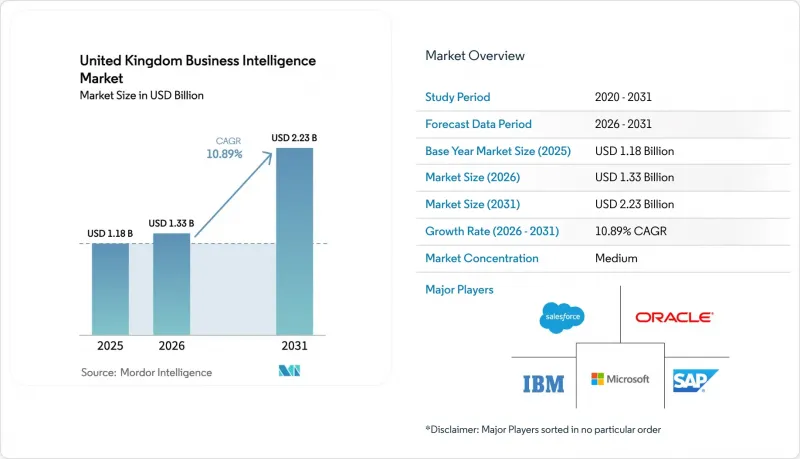
根據 Mordor Intelligence 預測,英國商業智慧市場規模將從 2025 年的 11.8 億美元成長到 2026 年的 13.3 億美元,然後在 2031 年達到 22.3 億美元,2026 年至 2031 年的複合年成長率為 10.89%。
本報告按元件(軟體和服務)、部署模式(本地部署、雲端部署、混合部署)、組織規模(中小企業和大型企業)、功能(報表、資料探勘、績效管理、儀錶板)、最終用戶產業(銀行、金融服務和保險 (BFSI)、IT 和電信、零售、製造等)以及地區進行細分。市場預測以美元 (USD) 為單位。
英國商業智慧市場的趨勢與洞察
英國中小企業的「雲端優先」政策
佔英國企業總數99.9%的中小型企業(SME)正在轉向基於SaaS(軟體即服務)的分析解決方案,以避免前期資本投資。英國稅務海關總署(英國 Revenue and Customs)預測,2024年至2025年間,這些企業的採用率將成長34%,商業智慧將成為繼電子郵件和會計之後第三大最受歡迎的工具。按需付費的付費使用制意味著營運成本與收入週期掛鉤,而政府津貼降低了進入門檻。供應商現在提供行業特定的模板,將實施時間從數月縮短至數週。儘管發展勢頭強勁,但仍有42%的中小型企業認為資料主權和供應商鎖定是阻礙因素,這導致他們轉向混合架構,在本地管理敏感帳簿。
利用世代人工智慧的分析平台
由大規模語言模型驅動的自然語言介面正使數據分析更加便捷。微軟的 Power BI Copilot 和 Salesforce 的 Tableau Einstein GPT 均於 2025 年發布,它們使財務和行銷團隊能夠透過簡單的英文提示產生儀表板。雖然早期試點部署將儀表板創建時間縮短了 60%,但由於出現了誤導性洞察,管治的挑戰也隨之而來。資訊專員辦公室於 2025 年 9 月發布了指導意見,重申資料控制者負有課責,這導致對可解釋性功能和審計追蹤的需求日益成長。
高技能分析人員短缺
根據Tech Nation報道,到2025年,美國將出現17.8萬名技術專業人才的缺口,這一缺口直接阻礙了商業智慧的普及應用。大型企業通常會透過聘請顧問公司來填補這一缺口,但中型企業卻沒有相應的預算。大學正在增加資料科學的學生人數,但畢業生往往最終從事高薪技術工作或移民海外。 「學徒稅」規定,大型企業需將總薪資的0.5%用於培訓,但雇主認為,為期六個月的密集培訓只能培養出中級技術人員,而無法培養出能夠定義業務挑戰的策略家。
細分市場分析
2025年,軟體支出將佔英國商業智慧市場的72%,鞏固Power BI、SAP Analytics Cloud和Tableau等平台的市場主導地位。然而,隨著企業將過時的報表套件遷移到雲端並將人工智慧模型整合到儀表板中,實施專案變得越來越複雜。系統整合商現在統籌資料品質改進、使用者驗收測試和多重雲端管治,這個過程可能耗時18個月,成本超過500萬英鎊(630萬美元)。
因此,業務收益正以每年 15.20% 的速度成長。供應商透過將預先配置的儀錶板、培訓和託管資料管道與許可證捆綁銷售,縮短了中小企業 (SME) 的引進週期。顧問公司也提供「分析即服務」訂閱,其中部分利用了資料科學家和 DevOps 工程師的服務。這形成了一個良性循環:日益成長的技術複雜性刺激了對專業知識的需求,而這些專業知識又放大了軟體投資的價值,從而擴大了英國商業智慧(BI) 市場的總收入。
到2025年,雲端運算將佔英國商業智慧市場佔有率的64.00%,凸顯了政府「雲端優先」政策的有效性,該政策敦促公共機構優先採用託管解決方案。其吸引力顯而易見:自動升級、按需收費以及面向全球混合辦公團隊的訪問。即使是風險規避型銀行也開始使用雲端沙箱進行開發和測試工作負載,同時將敏感帳簿保留在本地。
在英國商業智慧市場,受英國法律管轄下超大規模資料中心業者營運的主權雲端區域的推動,雲端驅動型市場規模預計將以17.80%的複合年成長率成長。製造業和醫療保健系統正擴大採用混合模式,透過將對延遲敏感的資料保留在本地,同時將分析工作負載擴展到公共雲端,從而確保可擴展性。雖然在英國商業智慧(BI) 市場的一些領域,由於嚴格的資料居住和空氣間隙要求,本地部署仍將繼續,但兼顧可管理性和可擴展性的混合架構正逐漸成為標準。
其他好處:
- Excel格式的市場預測(ME)表
- 3個月的分析師支持
目錄
第1章:引言
- 研究假設和市場定義
- 調查範圍
第2章:調查方法
第3章執行摘要
第4章 市場狀況
- 市場概覽
- 市場促進因素
- 物聯網資料流的激增
- 英國中小企業的「雲端優先」政策
- 金融領域對即時決策智慧的需求
- 政府的智慧城市計畫正在推動對基礎智慧(BI)的需求。
- 嵌入式 BI 在商業應用的興起
- 利用生成式人工智慧的分析平台
- 市場限制因素
- 缺乏具備高階分析技能的人員
- 英國脫歐後的數據居住和主權問題引發擔憂
- 最新數據平台對中小企業來說高成本
- 整合遺留IT系統所帶來的複雜性。
- 產業價值鏈分析
- 監理情勢
- 技術展望
- 波特五力分析
第5章 市場規模及成長預測(以金額為準,2025 年基準年)
- 按組件
- 軟體
- 服務
- 部署模式
- 現場
- 雲
- 混合
- 按組織規模
- 小型企業
- 大公司
- 按最終用戶行業分類
- 銀行業、金融服務業及保險業
- IT/通訊
- 零售和消費品
- 製造/物流
- 醫療保健和生命科學
- 其他終端用戶產業
第6章 競爭情勢
- 市場集中度
- 策略趨勢
- 市佔率分析
- 公司簡介
- Microsoft Corporation
- SAP SE
- Salesforce Inc.(Tableau)
- IBM Corporation
- SAS Institute Inc.
- Oracle Corporation
- Tibco Software Inc.
- QlikTech International AB
- MicroStrategy Incorporated
- Google LLC(Looker)
- Zoho Corporation Pvt. Ltd.
- Sisense Inc.
- Domo Inc.
- Board International SA
- Yellowfin International Pty Ltd
- ThoughtSpot Inc.
- Pyramid Analytics BV
- Infor Inc.
- Information Builders Inc.
第7章 市場機會與未來展望
According to Mordor Intelligence, the United Kingdom business intelligence market size is expected to grow from USD 1.18 billion in 2025 to USD 1.33 billion in 2026 and is forecast to reach USD 2.23 billion by 2031 at 10.89% CAGR over 2026-2031.
This report is Segmented by Component (Software, and Services), Deployment Mode (On-Premise, Cloud, and Hybrid), Organization Size (SMEs, and Large Enterprises), Functionality (Reporting, Data Mining, Performance Management, and Dashboard), End-User Vertical (BFSI, IT and Telecom, Retail, Manufacturing, and More), and Geography. The Market Forecasts are in Provided in Terms of Value (USD).
United Kingdom Business Intelligence Market Trends and Insights
Cloud-first Policy Among UK SMEs
Small and medium enterprises comprise 99.9% of UK businesses and are pivoting to software-as-a-service analytics that avoid upfront capital expenditure. Adoption among these firms rose 34% between 2024 and 2025 according to HM Revenue and Customs, placing business intelligence behind only email and accounting workloads in popularity. Consumption-based pricing aligns operating costs with revenue cycles, while government grants lower entry barriers. Vendors are now shipping industry templates that cut implementation times from months to weeks. Despite the momentum, 42% of SMEs still flag data-sovereignty and vendor lock-in as obstacles, prompting hybrid architectures that keep sensitive ledgers on-premises.
Generative-AI-Augmented Analytics Platforms
Natural-language interfaces powered by large language models are democratizing analytics access. Microsoft Copilot for Power BI and Salesforce Einstein GPT for Tableau both debuted in 2025, letting finance or marketing teams generate dashboards through plain-English prompts. Early pilots reduced dashboard-creation time by 60% yet raised governance challenges when hallucinated insights surfaced. The Information Commissioner's Office issued guidance in September 2025 reminding enterprises that accountability remains with data controllers, spurring demand for explainability features and audit trails.
Shortage of Advanced Analytics Talent
Tech Nation tallied a deficit of 178,000 technology professionals in 2025, a gap that directly constrains business intelligence rollouts. Large firms often backfill with consultancies, but mid-market companies lack comparable budgets. While universities expand data-science cohorts, graduates frequently gravitate to higher-paying technology roles or emigrate. The Apprenticeship Levy redirects 0.5% of large-company payrolls into training, yet employers argue that six-month boot camps create mid-level technicians rather than strategists capable of framing business questions.
Other drivers and restraints analyzed in the detailed report include:
- Proliferation of IoT-enabled Data Streams
- Need for Real-time Decision Intelligence in Finance
- Data-Residency and Sovereignty Concerns Post-Brexit
For complete list of drivers and restraints, kindly check the Table Of Contents.
Segment Analysis
Spending on software commanded a 72.00% share of the United Kingdom business intelligence market in 2025, underscoring the entrenched position of platforms such as Power BI, SAP Analytics Cloud, and Tableau. Implementation projects, however, are growing more intricate as enterprises migrate aging reporting suites to the cloud and embed AI models into dashboards. System integrators now oversee data-quality remediation, user-acceptance testing, and multi-cloud governance that can span 18 months and exceed GBP 5 million (USD 6.3 million).
Service revenue is consequently rising at a 15.20% annual clip. Vendors package licenses with pre-configured dashboards, training, and managed data pipelines, compressing deployment cycles for SMEs. Consulting firms also market analytics-as-a-service subscriptions that give clients fractional access to data scientists and DevOps engineers. The result is a virtuous loop: rising technical complexity fuels demand for expertise, and that expertise amplifies the value derived from software investments, thereby enlarging overall United Kingdom business intelligence market / UK BI market revenue.
Cloud deployments captured 64.00% of the United Kingdom business intelligence market share in 2025, validating the government's Cloud First policy that requires public bodies to favor hosted solutions. The appeal is clear: automatic upgrades, usage-based billing, and global access for hybrid workforces. Even risk-averse banks are adopting cloud sandboxes for development and test workloads while keeping sensitive ledgers on-premises.
The United Kingdom business intelligence market size attributable to cloud is projected to expand at a 17.80% CAGR, aided by sovereign-cloud regions operated by hyperscalers under British legal jurisdiction. Manufacturers and healthcare systems increasingly adopt hybrid patterns, retaining latency-sensitive data locally and bursting analytical workloads to the public cloud for scale. On-premises deployments in the UK business intelligence (BI) market will persist in pockets with extreme residency or air-gap mandates, yet hybrid architectures that balance control and elasticity are becoming the default.
Complete Report Scope:
- By Component
- Software
- Services
- By Deployment Mode
- On-premises
- Cloud
- Hybrid
- By Organization Size
- Small and Medium Enterprises
- Large Enterprises
- By End-user Vertical
- Banking, Financial Services and Insurance
- Information Technology and Telecom
- Retail and Consumer Goods
- Manufacturing and Logistics
- Healthcare and Life Sciences
- Other End-user Verticals
List of Companies Covered in this Report:
- Microsoft Corporation
- SAP SE
- Salesforce Inc. (Tableau)
- IBM Corporation
- SAS Institute Inc.
- Oracle Corporation
- Tibco Software Inc.
- QlikTech International AB
- MicroStrategy Incorporated
- Google LLC (Looker)
- Zoho Corporation Pvt. Ltd.
- Sisense Inc.
- Domo Inc.
- Board International SA
- Yellowfin International Pty Ltd
- ThoughtSpot Inc.
- Pyramid Analytics BV
- Infor Inc.
- Information Builders Inc.
Additional Benefits:
- The market estimate (ME) sheet in Excel format
- 3 months of analyst support
TABLE OF CONTENTS
1 INTRODUCTION
- 1.1 Study Assumptions and Market Definition
- 1.2 Scope of the Study
2 RESEARCH METHODOLOGY
3 EXECUTIVE SUMMARY
4 MARKET LANDSCAPE
- 4.1 Market Overview
- 4.2 Market Drivers
- 4.2.1 Proliferation of IoT-enabled Data Streams
- 4.2.2 Cloud-first Policy Among UK SMEs
- 4.2.3 Need for Real-time Decision Intelligence in Finance
- 4.2.4 Government Smart-City Initiatives Driving BI Demand
- 4.2.5 Rise of Embedded BI in Operational Apps
- 4.2.6 Generative-AI Augmented Analytics Platforms
- 4.3 Market Restraints
- 4.3.1 Shortage of Advanced Analytics Talent
- 4.3.2 Data-Residency and Sovereignty Concerns Post-Brexit
- 4.3.3 High Cost of Modern Data Platforms for SMEs
- 4.3.4 Legacy IT Integration Complexities
- 4.4 Industry Value Chain Analysis
- 4.5 Regulatory Landscape
- 4.6 Technological Outlook
- 4.7 Porter's Five Forces Analysis
- 4.7.1 Bargaining Power of Suppliers
- 4.7.2 Bargaining Power of Buyers
- 4.7.3 Threat of New Entrants
- 4.7.4 Threat of Substitutes
- 4.7.5 Intensity of Competitive Rivalry
5 MARKET SIZE AND GROWTH FORECASTS (VALUE, 2025 BASE YEAR)
- 5.1 By Component
- 5.1.1 Software
- 5.1.2 Services
- 5.2 By Deployment Mode
- 5.2.1 On-premises
- 5.2.2 Cloud
- 5.2.3 Hybrid
- 5.3 By Organization Size
- 5.3.1 Small and Medium Enterprises
- 5.3.2 Large Enterprises
- 5.4 By End-user Vertical
- 5.4.1 Banking, Financial Services and Insurance
- 5.4.2 Information Technology and Telecom
- 5.4.3 Retail and Consumer Goods
- 5.4.4 Manufacturing and Logistics
- 5.4.5 Healthcare and Life Sciences
- 5.4.6 Other End-user Verticals
6 COMPETITIVE LANDSCAPE
- 6.1 Market Concentration
- 6.2 Strategic Moves
- 6.3 Market Share Analysis
- 6.4 Company Profiles (includes Global Level Overview, Market Level Overview, Core Segments, Financials as available, Strategic Information, Market Rank/Share, Products and Services, Recent Developments)
- 6.4.1 Microsoft Corporation
- 6.4.2 SAP SE
- 6.4.3 Salesforce Inc. (Tableau)
- 6.4.4 IBM Corporation
- 6.4.5 SAS Institute Inc.
- 6.4.6 Oracle Corporation
- 6.4.7 Tibco Software Inc.
- 6.4.8 QlikTech International AB
- 6.4.9 MicroStrategy Incorporated
- 6.4.10 Google LLC (Looker)
- 6.4.11 Zoho Corporation Pvt. Ltd.
- 6.4.12 Sisense Inc.
- 6.4.13 Domo Inc.
- 6.4.14 Board International SA
- 6.4.15 Yellowfin International Pty Ltd
- 6.4.16 ThoughtSpot Inc.
- 6.4.17 Pyramid Analytics BV
- 6.4.18 Infor Inc.
- 6.4.19 Information Builders Inc.
7 MARKET OPPORTUNITIES AND FUTURE OUTLOOK
- 7.1 White-Space and Unmet-Need Assessment

 競爭資訊服務:市場佔有率分析、產業趨勢與統計、成長預測(2026-2031 年)行動商業情報:市場佔有率分析、產業趨勢與統計、成長預測(2026-2031)商業智慧(BI):市場佔有率分析、產業趨勢與統計、成長預測(2026-2031 年)醫療保健商業智慧:市場佔有率分析、行業趨勢和統計數據、成長預測(2026-2031 年)
 商業情報市場-2026-2032年全球市場預測
 2026年全球即時商業智慧市場報告
 全球行動商業情報(BI)市場
 2026-2030年全球醫療保健產業商業智慧市場
 銀行業、金融服務業和保險業 (BFSI) 的客戶體驗成長機會:2025-2026 年
 2026-2030年全球商業智慧(BI)市場