


 |
市場調查報告書
商品編碼
2113704
醫療保健商業智慧:市場佔有率分析、行業趨勢和統計數據、成長預測(2026-2031 年)Healthcare BI - Market Share Analysis, Industry Trends & Statistics, Growth Forecasts (2026 - 2031) |
||||||

※ 本網頁內容可能與最新版本有所差異。詳細情況請與我們聯繫。
據 Mordor Intelligence 稱,醫療保健商業智慧市場預計到 2026 年價值 132.9 億美元,高於 2025 年的 116.4 億美元,預計到 2031 年將達到 257.9 億美元。
預計 2026 年至 2031 年的複合年成長率為 14.18%。
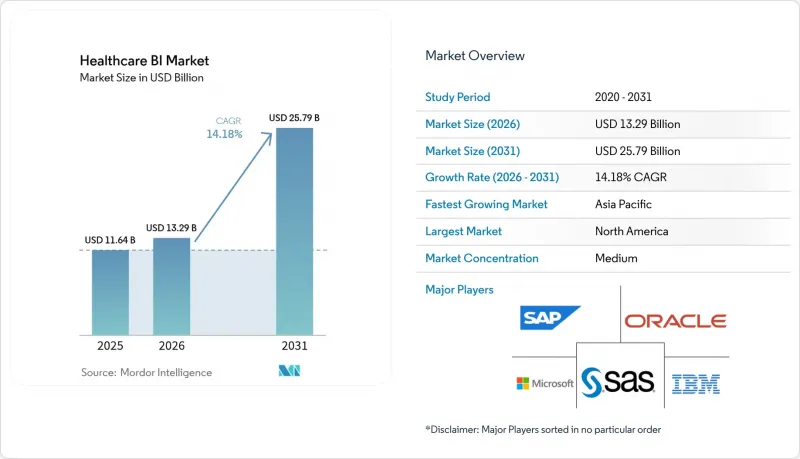
本報告按組件(軟體、服務)、交付方式(本地部署、混合部署、雲端部署)、應用程式(金融分析、臨床數據分析等)、最終用戶(保險公司、醫療保健提供者、其他最終用戶)和地區(北美、歐洲等)對產業進行細分。市場預測以美元計價。
全球醫療保健商業智慧市場趨勢與洞察
監管促進基於價值的贖回
將支付與結果掛鉤的政策如今已成為主流。美國醫療保險和醫療補助服務中心 (CMS) 的目標是到 2030 年將所有聯邦醫療保險受益人納入責任醫療關係體系,而這一目標也正擴展到私人保險公司。各機構需要近乎即時的分析工具,將臨床、財務和社會決定因素數據整合起來,以便管理高風險患者群體,並在複雜的合約下預測績效。像 Carle Health 這樣的醫療保健系統透過將計費資料、電子健康記錄 (EHR) 和社會風險資料整合到其商業智慧 (BI) 系統中,在提高醫療品質的同時降低了可避免的成本。由於風險存在於每種支付模式中,因此對能夠實現持續測量和預測建模的平台的需求只會不斷成長。
電子健康記錄資料量增加和強制性互通性
Epic 的 Cosmos 目前匯總了 2.46 億人的匿名記錄,展現了醫療保健數據前所未有的規模。儘管《21 世紀治癒法案》和《醫療支出和合規法案》(TEFCA)強制要求醫療服務提供者之間共用信息,但數據碎片化意味著只有不到 60% 的數據可用於決策。快速醫療互通性資源(FHIR)的引入實現了近乎即時的資料流,為進階分析提供了技術基礎。隨著數據量的爆炸性成長,數據品質、標準化和管治的努力仍然至關重要。
舊有系統造成的資料孤島和互通性差距
儘管有FHIR和「21世紀療法」等規範,但系統間的脫節仍導致醫療延誤和成本飆升。許多醫院仍在努力應對專有資料格式和過時的架構,阻礙了企業級分析的發展。競爭壓力和隱私法規進一步延緩了跨組織的資料共用。打破資料孤島需要持續投資於整合引擎、主資料管理和文化轉型。
細分市場分析
在2025年的醫療保健商業智慧市場中,軟體佔最大佔有率,達到35.02%,這主要得益於分析套件、視覺化儀表板和嵌入式人工智慧服務。然而,涵蓋整合、培訓和託管分析的服務正以14.52%的複合年成長率快速成長,超過了平台銷售的成長速度。這種差異表明,價值不僅在於擁有工具,更在於如何在複雜的臨床工作流程中運用這些工具。
各機構依賴外部專家來遷移遺留資料、客製化儀錶板並培訓使用者。數據素養高的臨床醫生嚴重短缺,推動了對這些服務的需求。 Epic 進軍企業資源規劃 (ERP) 領域,清楚地展現了領先的平台供應商如何將諮詢服務打包,以加速系統部署。隨著系統的成熟,服務合作夥伴將扮演關鍵角色,透過管理持續的資料管治、效能調優和演算法檢驗,在實現分析投資報酬率 (ROI) 方面發揮重要作用。
到2025年,OLAP和視覺化將佔總收入的40.88%,為日常財務、品質和合規性監控提供直覺的儀表板。然而,隨著醫療服務提供者越來越重視預防性護理,進階分析和預測分析預計將以每年15.01%的速度成長。
Health Catalyst 的客戶透過早期檢測演算法和風險分層模型節省了數百萬美元的成本。生成式人工智慧透過自動化特徵工程和場景測試,進一步降低了高階建模的門檻。微軟的人工智慧相關收入已達 130 億美元,這表明市場對將機器學習整合到分析平台中的軟體包框架有著旺盛的需求。隨著演算法的日益成熟,各組織機構將從被動報告轉向主動干預規劃,從而更好地管理人群健康和精準醫療。
區域分析
在2025年的醫療保健商業智慧市場中,北美以45.97%的市佔率佔據領先地位。這主要得益於電子健康記錄(EHR)的日益普及、互通性以及基於價值的醫療保健模式的早期應用。 Epic公司擁有超過3.25億份病患記錄,鞏固了對區域資料流的影響力。監管政策的明確和強大的雲端基礎設施正在加速企業分析的普及。預計推出的商業支援政策可能會增加私募股權活動,並加劇商業智慧工具領域的競爭和創新。
亞太地區預計將成為成長最快的地區,到2031年複合年成長率將達到16.61%,反映出各國積極推動數位化健康計畫以及醫療保健支出不斷成長。印度的保險資助模式需要深入了解全體人口的健康狀況,而新加坡正在整合物聯網設備進行預防性監測。中國、澳洲和泰國政府正在資助人工智慧試點項目,以減輕老年社會慢性病帶來的負擔。即使是發展中市場也在透過採用雲端原生平台來超越舊有系統,這為可擴展的商業智慧供應商創造了巨大的機會。
在歐洲,GDPR 推動了合規資料管治和互通性投資的穩定成長。諸如歐洲健康資料空間 (European Health Data Space) 等項目正在促進成員國之間的標準化分析,並為供應商拓展業務機會。中東和非洲地區雖然基礎較弱,但正在大力投資電子健康記錄 (EHR) 和遠端醫療,尤其是在波灣合作理事會(GCC) 成員國。現代化措施與衡量醫療保健品質結果的需求一致,顯示商業智慧 (BI) 的應用正在逐步增加。
其他好處:
- Excel格式的市場預測(ME)表
- 三個月的分析師支持
目錄
第1章:引言
- 研究假設和市場定義
- 調查範圍
第2章:調查方法
第3章執行摘要
第4章 市場狀況
- 市場概覽
- 市場促進因素
- 監管促進基於價值的贖回
- 電子健康記錄資料量增加和強制性互通性
- 雲端運算的成本效益使得大規模分析成為可能。
- AI驅動的自動化洞察生成(Gen-AI)
- 基於FHIR的即時資料流的實現
- 合成醫學資料集的可用性
- 市場限制因素
- 舊有系統之間的資料孤島與互通性挑戰
- 企業級商業智慧整體擁有成本高昂
- 缺乏具備數據素養的臨床人員
- 跨境資料傳輸與人工智慧管治的風險
- 監理情勢
- 技術展望
- 波特五力模型
第5章 市場規模與成長預測
- 按組件
- 平台
- 軟體
- 服務
- 按功能
- OLAP 和視覺化
- 績效管理
- 查詢和報告
- 進階分析和預測分析
- 透過使用
- 臨床分析
- 團體健康管理
- 精準醫療支持
- 品質和結果改進
- 財務分析
- 收入周期管理
- 詐欺偵測和風險調整
- 營運分析
- 供應鍊和庫存最佳化
- 最佳化人員配置與工作流程
- 策略規劃與標竿分析
- 臨床分析
- 最終用戶
- 醫療服務提供方
- 醫院和醫療保健系統
- 門診手術中心
- 專科診所
- 付款人
- 公共支付方
- 自費者
- 生命科學公司
- 政府和公共衛生機構
- 其他最終用戶(ACO、CRO)
- 醫療服務提供方
- 按地區
- 北美洲
- 美國
- 加拿大
- 墨西哥
- 南美洲
- 巴西
- 阿根廷
- 其他南美國家
- 歐洲
- 德國
- 英國
- 法國
- 義大利
- 西班牙
- 俄羅斯
- 其他歐洲國家
- 亞太地區
- 中國
- 日本
- 印度
- 韓國
- 澳洲
- 其他亞太國家
- 中東和非洲
- GCC
- 南非
- 中東和非洲其他地區
- 北美洲
第6章 競爭情勢
- 市場集中度
- Competitive Benchmarking
- 市佔率分析
- 公司簡介
- Microsoft
- IBM
- Oracle(incl. Cerner)
- SAP SE
- Optum
- Qlik
- Salesforce(Tableau)
- SAS Institute
- Health Catalyst
- Dimensional Insight
- McKesson
- Epic Systems
- Inovalon
- MedeAnalytics
- Veradigm(Allscripts)
- IQVIA
- AWS(HealthLake)
- Google Cloud Healthcare
- Snowflake
- Innovaccer
- Clarify Health
- Arcadia
第7章 市場機會與未來展望
According to Mordor Intelligence, Healthcare business intelligence market size in 2026 is estimated at USD 13.29 billion, growing from 2025 value of USD 11.64 billion with 2031 projections showing USD 25.79 billion, growing at 14.18% CAGR over 2026-2031.
This report Segments the Industry Into by Component (Software, Services), by Mode of Delivery (On-Premise Model, Hybrid Model, Cloud-Based Model), by Application (Financial Analysis, Clinical Data Analysis and More), by End User (Payers, Healthcare Providers, Other End Users), and Geography (North America, Europe, and More). The Market Forecasts are Provided in Terms of Value (USD).
Global Healthcare BI Market Trends and Insights
Regulatory Push for Value-Based Reimbursement
Policies linking payments to outcomes are now mainstream. The Centers for Medicare & Medicaid Services intends to place all Medicare beneficiaries in accountable care relationships by 2030, a goal echoing across commercial payers. Organizations require near real-time analytics that synthesize clinical, financial, and social-determinant data to manage at-risk populations and predict performance under complex contracts. Health systems such as Carle Health have cut avoidable costs while boosting quality by integrating claims, EHR, and social-risk data in their BI stack. As every payment model embeds risk, demand for platforms capable of continuous measurement and predictive modeling will intensify.
Rising EHR Data Volume & Interoperability Mandates
Epic's Cosmos now aggregates de-identified records from 246 million individuals, illustrating the unprecedented scale of healthcare data. The 21st Century Cures Act and TEFCA oblige providers to share information, yet less than 60% of available data informs decision-making because of fragmentation. Adoption of Fast Healthcare Interoperability Resources (FHIR) streams data in near real time, laying a technical foundation for advanced analytics. Tackling data quality, standardization, and governance remains essential as volumes soar.
Data Silos & Legacy Interoperability Gaps
Disconnected systems delay care and inflate costs despite FHIR and Cures Act mandates. Many hospitals still grapple with proprietary data formats and aging architectures that block enterprise-wide analytics. Competitive concerns and privacy rules further slow data-sharing outside organizational walls. Overcoming silos will require continued investment in integration engines, master-data management, and cultural change.
Other drivers and restraints analyzed in the detailed report include:
- Cloud Cost-Efficiencies Enabling Analytics at Scale
- AI-Led Automated Insight Generation (Gen-AI)
- High Total Cost of Ownership for Enterprise BI
For complete list of drivers and restraints, kindly check the Table Of Contents.
Segment Analysis
Software held the largest 35.02% share of the healthcare business intelligence market in 2025, anchored by analytics suites, visualization dashboards, and embedded AI services. However, services-covering integration, training, and managed analytics-are expanding at a 14.52% CAGR, outpacing platform sales. This divergence signals that value lies not just in owning tools but in operationalizing them within complex clinical workflows.
Organizations rely on external experts to migrate legacy data, customize dashboards, and coach users. The acute shortage of data-literate clinicians sustains services demand. Epic's move into enterprise resource planning underscores that large platform vendors now package consulting to accelerate adoption. As systems mature, services partners will manage ongoing data governance, performance tuning, and algorithm validation, reinforcing their role as critical enablers of analytic ROI.
OLAP & visualization accounted for 40.88% of 2025 revenue, offering intuitive dashboards for day-to-day monitoring across finance, quality, and compliance. Yet advanced & predictive analytics is projected to grow 15.01% annually as providers pursue proactive care.
Health Catalyst clients have saved millions through early detection algorithms and risk stratification models. Generative AI further lowers the barrier to sophisticated modeling by automating feature engineering and scenario testing. Microsoft's USD 13 billion AI run rate illustrates demand for packaged frameworks that embed machine learning into the analytic fabric. As algorithms mature, organizations will transition from retrospective reporting toward prospective intervention planning in population health and precision medicine.
Complete Report Scope:
- By Component
- Platforms
- Software
- Services
- By Function
- OLAP & Visualisation
- Performance Management
- Query & Reporting
- Advanced & Predictive Analytics
- By Application
- Clinical Analytics
- Population Health Management
- Precision Medicine Support
- Quality & Outcome Improvement
- Financial Analytics
- Revenue Cycle Management
- Fraud Detection & Risk Adjustment
- Operational Analytics
- Supply-Chain & Inventory Optimisation
- Staffing & Workflow Optimisation
- Strategic Planning & Benchmarking
- Clinical Analytics
- By End User
- Healthcare Providers
- Hospitals & Health Systems
- Ambulatory Surgical Centres
- Specialty Clinics
- Payers
- Public Payers
- Private Payers
- Life-Science Companies
- Government & Public-Health Agencies
- Other End Users (ACOs, CROs)
- Healthcare Providers
- By Region
- North America
- United States
- Canada
- Mexico
- South America
- Brazil
- Argentina
- Rest of South America
- Europe
- Germany
- United Kingdom
- France
- Italy
- Spain
- Russia
- Rest of Europe
- Asia-Pacific
- China
- Japan
- India
- South Korea
- Australia
- Rest of Asia-Pacific
- Middle East and Africa
- GCC
- South Africa
- Rest of Middel East and Africa
- North America
Geography Analysis
North America led with a 45.97% share of the healthcare business intelligence market in 2025, fueled by mature EHR penetration, mandated interoperability, and early adoption of value-based care. Epic's base of more than 325 million patient records entrenches its influence on regional data flows. Legislative clarity, coupled with robust cloud infrastructure, speeds enterprise analytics rollouts. Anticipated pro-business policies may accelerate private-equity activity, intensifying competition and innovation in BI tooling.
Asia-Pacific is the fastest-growing region at a 16.61% CAGR to 2031, reflecting aggressive national digital-health plans and rising healthcare spending. India's insurance-funded models demand population-health insights, while Singapore integrates IoT devices for preventive monitoring. Governments in China, Australia, and Thailand fund AI pilots to manage chronic-disease burdens amid aging populations. Even developing markets are leapfrogging legacy systems by adopting cloud-native platforms, creating outsized opportunities for scalable BI vendors.
Europe shows steady expansion as GDPR drives investment in compliant data governance and cross-border interoperability. Programs like the European Health Data Space encourage standardized analytics across member states, boosting vendor opportunities. Middle East and Africa, though starting from lower bases, invest heavily in EHRs and telemedicine, especially in Gulf Cooperation Council nations. Modernization initiatives align with the need to benchmark quality outcomes, suggesting a gradual rise in BI penetration.
- Microsoft
- IBM
- Oracle (incl. Cerner)
- SAP
- Optum
- Qlik
- Salesforce (Tableau)
- SAS Institute
- Health Catalyst
- Dimensional Insight
- Mckesson
- Epic Systems
- Inovalon
- MedeAnalytics
- Veradigm (Allscripts)
- IQVIA
- AWS (HealthLake)
- Google Cloud Healthcare
- Snowflake
- Innovaccer
- Clarify Health
- Arcadia
Additional Benefits:
- The market estimate (ME) sheet in Excel format
- 3 months of analyst support
TABLE OF CONTENTS
1 Introduction
- 1.1 Study Assumptions & Market Definition
- 1.2 Scope of the Study
2 Research Methodology
3 Executive Summary
4 Market Landscape
- 4.1 Market Overview
- 4.2 Market Drivers
- 4.2.1 Regulatory push for value-based reimbursement
- 4.2.2 Rising EHR data volume & interoperability mandates
- 4.2.3 Cloud cost-efficiencies enabling analytics at scale
- 4.2.4 AI-led automated insight generation (Gen-AI)
- 4.2.5 FHIR-based real-time data streaming adoption
- 4.2.6 Availability of synthetic healthcare data sets
- 4.3 Market Restraints
- 4.3.1 Data silos & legacy interoperability gaps
- 4.3.2 High total cost of ownership for enterprise BI
- 4.3.3 Shortage of data-literate clinical staff
- 4.3.4 Cross-border data-transfer & AI-governance risks
- 4.4 Regulatory Landscape
- 4.5 Technological Outlook
- 4.6 Porter's Five Forces
- 4.6.1 Threat of New Entrants
- 4.6.2 Bargaining Power of Suppliers
- 4.6.3 Bargaining Power of Buyers
- 4.6.4 Threat of Substitutes
- 4.6.5 Competitive Rivalry
5 Market Size & Growth Forecasts (Value, USD Billion)
- 5.1 By Component
- 5.1.1 Platforms
- 5.1.2 Software
- 5.1.3 Services
- 5.2 By Function
- 5.2.1 OLAP & Visualisation
- 5.2.2 Performance Management
- 5.2.3 Query & Reporting
- 5.2.4 Advanced & Predictive Analytics
- 5.3 By Application
- 5.3.1 Clinical Analytics
- 5.3.1.1 Population Health Management
- 5.3.1.2 Precision Medicine Support
- 5.3.1.3 Quality & Outcome Improvement
- 5.3.2 Financial Analytics
- 5.3.2.1 Revenue Cycle Management
- 5.3.2.2 Fraud Detection & Risk Adjustment
- 5.3.3 Operational Analytics
- 5.3.3.1 Supply-Chain & Inventory Optimisation
- 5.3.3.2 Staffing & Workflow Optimisation
- 5.3.4 Strategic Planning & Benchmarking
- 5.3.1 Clinical Analytics
- 5.4 By End User
- 5.4.1 Healthcare Providers
- 5.4.1.1 Hospitals & Health Systems
- 5.4.1.2 Ambulatory Surgical Centres
- 5.4.1.3 Specialty Clinics
- 5.4.2 Payers
- 5.4.2.1 Public Payers
- 5.4.2.2 Private Payers
- 5.4.3 Life-Science Companies
- 5.4.4 Government & Public-Health Agencies
- 5.4.5 Other End Users (ACOs, CROs)
- 5.4.1 Healthcare Providers
- 5.5 By Region
- 5.5.1 North America
- 5.5.1.1 United States
- 5.5.1.2 Canada
- 5.5.1.3 Mexico
- 5.5.2 South America
- 5.5.2.1 Brazil
- 5.5.2.2 Argentina
- 5.5.2.3 Rest of South America
- 5.5.3 Europe
- 5.5.3.1 Germany
- 5.5.3.2 United Kingdom
- 5.5.3.3 France
- 5.5.3.4 Italy
- 5.5.3.5 Spain
- 5.5.3.6 Russia
- 5.5.3.7 Rest of Europe
- 5.5.4 Asia-Pacific
- 5.5.4.1 China
- 5.5.4.2 Japan
- 5.5.4.3 India
- 5.5.4.4 South Korea
- 5.5.4.5 Australia
- 5.5.4.6 Rest of Asia-Pacific
- 5.5.5 Middle East and Africa
- 5.5.5.1 GCC
- 5.5.5.2 South Africa
- 5.5.5.3 Rest of Middel East and Africa
- 5.5.1 North America
6 Competitive Landscape
- 6.1 Market Concentration
- 6.2 Competitive Benchmarking
- 6.3 Market Share Analysis
- 6.4 Company Profiles (includes Global level Overview, Market level overview, Core Segments, Financials as available, Strategic Information, Market Rank/Share for key companies, Products & Services, and Recent Developments)
- 6.4.1 Microsoft
- 6.4.2 IBM
- 6.4.3 Oracle (incl. Cerner)
- 6.4.4 SAP SE
- 6.4.5 Optum
- 6.4.6 Qlik
- 6.4.7 Salesforce (Tableau)
- 6.4.8 SAS Institute
- 6.4.9 Health Catalyst
- 6.4.10 Dimensional Insight
- 6.4.11 McKesson
- 6.4.12 Epic Systems
- 6.4.13 Inovalon
- 6.4.14 MedeAnalytics
- 6.4.15 Veradigm (Allscripts)
- 6.4.16 IQVIA
- 6.4.17 AWS (HealthLake)
- 6.4.18 Google Cloud Healthcare
- 6.4.19 Snowflake
- 6.4.20 Innovaccer
- 6.4.21 Clarify Health
- 6.4.22 Arcadia
7 Market Opportunities & Future Outlook
- 7.1 White-Space & Unmet-Need Assessment

 英國商業智慧:市場佔有率分析、產業趨勢與統計、成長預測(2026-2031)競爭資訊服務:市場佔有率分析、產業趨勢與統計、成長預測(2026-2031 年)行動商業情報:市場佔有率分析、產業趨勢與統計、成長預測(2026-2031)商業智慧(BI):市場佔有率分析、產業趨勢與統計、成長預測(2026-2031 年)
 商業情報市場-2026-2032年全球市場預測
 全球行動商業情報(BI)市場
 2026-2030年全球醫療保健產業商業智慧市場
 2026年全球行動商業智慧(BI)市場報告2026年全球商業智慧(BI)市場報告
 行動商業智慧(BI) 市場報告:按解決方案、部署模式、企業規模、應用、最終用戶產業和地區分類,2026-2034 年