


 |
市場調查報告書
商品編碼
2119001
競爭資訊服務:市場佔有率分析、產業趨勢與統計、成長預測(2026-2031 年)Competitive Intelligence Services - Market Share Analysis, Industry Trends & Statistics, Growth Forecasts (2026 - 2031) |
||||||

※ 本網頁內容可能與最新版本有所差異。詳細情況請與我們聯繫。
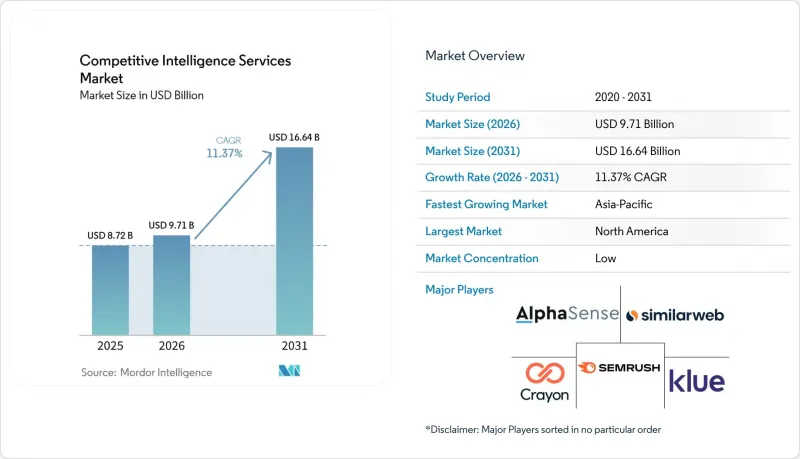
根據 Mordor Intelligence 預測,競爭性資訊服務市場規模將從 2025 年的 87.2 億美元和 2026 年的 97.1 億美元成長到 2031 年的 166.4 億美元,2026 年至 2031 年的年複合成長率(CAGR)為 11.37%。
本報告按服務類型(資料收集與分析、市場監控與預警、報告創建與視覺化、策略制定與諮詢、其他)、部署模式(雲端、混合、本地部署)、最終用戶產業(銀行、金融服務和保險、零售和電子商務、媒體和娛樂、其他)以及地區進行細分。市場預測以美元計價。
全球競爭資訊服務市場趨勢與洞察
對即時競爭對手監控的需求日益成長
企業正從週期性的競爭對手評估轉向持續監控,以應對有關產品、定價、領導力和通訊的訊號。實施正式的競爭情報計劃,能夠使研究活動與銷售業績、經營團隊重點以及各團隊所需應對措施更加緊密地結合起來。這使得商業案例更具可操作性,因為團隊可以將競爭對手的變化與交易、客戶帳戶、產品決策或客戶互動聯繫起來。競爭情報服務市場受益於警報被推送至客戶關係管理 (CRM) 系統以及銷售團隊工作中使用的其他工具。這種推送模式還可以縮短市場事件發生與負責客戶和產品決策的員工做出反應之間的延遲。 Crayon 的 2026 年報告支援可重複監控流程的有效性,並將結構化計劃的成熟度和經營團隊支援與更強大的競爭優勢聯繫起來。
擴展人工智慧驅動的智慧工作流程
生成式人工智慧和自主代理的設計正在改變服務收集、審查、分類和匯總來自各種資訊來源的大量資訊的方式。競爭情報服務市場正朝著能夠完成多階段調查、比較調查結果並隨著新事件的發生而更新輸出的系統轉型。在發布支援持續調查工作流程的 SuperAnalyst 之後,AlphaSense 報告稱,其年度經常性收入 (ARR) 在 2026 年 6 月突破了 6 億美元。該公司還宣布完成了一輪 3.5 億美元的資金籌措,估值達到 75 億美元,顯示其對企業調查工具的持續投入。 2026 年 6 月,Accenture宣布對 AlphaSense 進行策略性投資並與其建立合作夥伴關係,旨在為企業提供基於代理的情報工作流程。基本的監控功能比可信任資訊來源的全面性更容易被模仿,因此服務提供者仍然需要引人入勝的內容庫、精心挑選的資訊來源以及強大的資料管理能力。
資料隱私、知情同意和倫理檢驗
網路抓取仍然是一種重要的資料收集方法,但在個人資料保護法適用的關鍵地區,監管機構正對其進行更嚴格的審查。歐洲資料保護委員會於2026年發布的最終指南針對用於生成式人工智慧的自動化抓取,並概述了涉及個人資料時適用的GDPR條件。服務提供者必須在其資料收集過程中考慮法律依據、資料最小化、透明度和敏感資料處理。這些要求增加了法律、營運和技術負擔,尤其對於缺乏大規模合規團隊或正式資料管治職能的中小型企業而言更是如此。這種影響在競爭激烈的資訊服務市場中各不相同,因為大規模平台能夠承擔更多此類固定成本,並更一致地記錄其流程。對於需要可靠資料管理的企業客戶而言,能夠維護記錄在案的資料資訊來源取得實務將增強其市場地位。
細分市場分析
2025年,「資料收集與分析」在競爭性資訊服務市場中佔據32.35%的佔有率。這是因為它提供的資訊可用於後續的監控、視覺化、諮詢和合規運作。它仍然是收集市場訊號並將其傳遞給決策者的基礎服務。 「市場監控與預警」已成為一個成熟的類別,因為用戶越來越期望獲得及時更新而非偶爾發布的報告。 「報告與視覺化」也依然重要,因為團隊需要以支持內部溝通的方式呈現調查結果。這些核心功能支撐著穩定的需求,因為企業希望整體銷售、產品和策略活動等方面全面了解競爭對手的情況。
「風險與合規情報」預計在2026年至2031年間將以14.16%的複合年成長率成長,成為所列服務類別中成長最快的領域。製藥、金融服務和能源產業的企業正將其情報業務從臨時調查轉向常規風險監控。 「銷售賦能與交易/損失情報」也在不斷發展,平台將競爭對手資訊與客戶關係管理(CRM)的交易階段、競爭分析和交易後評估結合。 「策略制定與諮詢」仍然是支援大型企業和管理諮詢的關鍵領域,即便自動化服務正在加速發展。其他服務,例如數位流量和搜尋引擎最佳化(SEO)情報、企業和交易情報以及整合監控平台,都反映出一種趨勢,即把以前各自獨立的情報活動整合到共用系統中。
區域分析
到2025年,北美仍將是最大的區域貢獻者,佔據競爭資訊服務市場36.38%的佔有率。該地區聚集了許多成熟的技術、金融服務和軟體即服務(SaaS)公司。這些產業的許多企業並非將競爭資訊視為獨立的研究活動,而是將其視為營收活動、產品規劃和交易週期的重要參考。這促使企業投資於能夠將市場訊號與銷售和產品決策連結起來的平台,使用戶能夠更清晰地了解競爭對手的動態。此外,該地區還擁有大規模的企業基本客群,能夠支援與現有客戶關係管理(CRM)和協作系統的整合。
以德國、英國和法國為首的歐洲是第二大區域市場。 GDPR(一般資料保護規則)和歐盟人工智慧法案的實施,使得企業對能夠經受監管審查、擁有透明管理結構和審計追蹤的資料收集方法的需求日益成長。這可能會推動企業採用具有更強大管治功能的專用服務,尤其是那些持有敏感資料並面臨正式合規義務的組織。歐洲企業也在戰略規劃過程中運用情報,以滿足持續的研究需求。預計亞太地區在2026年至2031年間的複合年成長率將達到13.81%,在競爭激烈的資訊服務市場中位居區域成長率之首。儘管中國在2025年仍將是亞太地區最大的市場,但隨著中型企業率先採用軟體即服務(SaaS)工具,印度和東南亞的需求也不斷成長。
南美洲正在拓展其區域成長機遇,巴西和阿根廷已成為金融服務和零售業的關鍵應用中心。金融科技領域日益激烈的競爭以及對及時外部資訊需求的不斷成長,推動了競爭性資訊服務市場的發展,而雲端工具的廣泛應用更是加劇了這一趨勢。中東和非洲市場雖然規模相對較小,但正透過企業數位轉型、外商投資、跨國公司擴張以及本土金融科技活動而蓬勃發展。阿拉伯聯合大公國和沙烏地阿拉伯正透過數位轉型以及科技和金融服務業的成長,為中東地區的需求提供支援。南非、埃及和奈及利亞正在推動非洲地區的發展,因為對競爭格局的監控對於成長型當地企業企業和跨國企業變得日益重要。
其他好處:
- Excel格式的市場預測(ME)表
- 3個月的分析師支持
目錄
第1章:引言
- 研究假設和市場定義
- 調查範圍
第2章:調查方法
第3章執行摘要
第4章 市場狀況
- 市場概覽
- 市場促進因素
- 即時競爭監控的需求日益成長
- 擴展人工智慧驅動的智慧工作流程
- 跨職能實施,涉及銷售、產品和策略團隊。
- 對受監管行業和風險相關資訊的需求日益成長
- 混合連續智慧模型的發展
- 利用暗數據和內部知識圖譜
- 市場限制因素
- 資料隱私、知情同意和倫理檢驗
- 總擁有成本高以及貨架損耗風險
- 生成式人工智慧工作流程中的錯覺與檢驗負擔
- 分散的採購地點和薄弱的資訊管治
- 宏觀經濟因素對市場的影響
- 產業價值鏈分析
- 科技趨勢
- 監理情勢
- 波特五力分析
第5章 市場規模與成長預測
- 按服務類型
- 資料收集與分析
- 市場監測與預警
- 報告創建和可視化
- 策略制定與諮詢服務
- 風險與合規情報
- 銷售賦能與成敗情報
- 其他服務類型(競爭和市場監控平台、數位、流量、SEO 和行銷競爭情報、媒體、社交、消費者和品牌情報,以及企業、金融、私募市場和交易情報)
- 部署模式
- 基於雲端的
- 混合
- 現場
- 按最終用戶行業分類
- BFSI
- 零售與電子商務
- 媒體與娛樂
- 醫療保健和生命科學
- 旅遊與飯店
- 消費品
- 其他終端用戶產業(教育、汽車、IT/電信等)
- 按地區
- 北美洲
- 美國
- 加拿大
- 墨西哥
- 南美洲
- 巴西
- 阿根廷
- 智利
- 其他南美國家
- 歐洲
- 德國
- 英國
- 法國
- 義大利
- 西班牙
- 其他歐洲國家
- 亞太地區
- 中國
- 日本
- 印度
- 韓國
- 澳洲
- 其他亞太國家
- 中東
- 阿拉伯聯合大公國
- 沙烏地阿拉伯
- 卡達
- 其他中東國家
- 非洲
- 南非
- 埃及
- 奈及利亞
- 其他非洲國家
- 北美洲
第6章 競爭情勢
- 市場集中度
- 策略趨勢
- 市佔率分析
- 公司簡介
- AlphaSense, Inc.
- Similarweb Ltd.
- Crayon AS
- Klue Labs Inc.
- Contify
- Comintelli AB
- Cision Ltd.
- Meltwater NV
- Semrush Holdings, Inc.
- Sprout Social, Inc.
- Cipher/Knowledge360
- Quid
- Fuld+Company, LLC
- Proactive Worldwide, LLC
- Evalueserve Ltd.
- CB Insights, Inc.
- Crunchbase, Inc.
- Valona Intelligence
- ZoomInfo Technologies LLC
- S&P Global Inc.
第7章 市場機會與未來展望
According to Mordor Intelligence, the competitive intelligence services market size is projected to expand from USD 8.72 billion in 2025 and USD 9.71 billion in 2026 to USD 16.64 billion by 2031, registering a CAGR of 11.37% between 2026 and 2031.
This report is Segmented by Service Type (Data Collection and Analysis, Market Monitoring and Alerts, Reporting and Visualization, Strategy Development and Advisory, and More), Deployment Mode (Cloud-Based, Hybrid, and On-Premises), End User Industry (BFSI, Retail and E-Commerce, Media and Entertainment, and More), and Geography. The Market Forecasts are Provided in Terms of Value (USD).
Global Competitive Intelligence Services Market Trends and Insights
Rising Demand for Real-Time Competitor Monitoring
Organizations have moved from periodic competitor reviews toward continuous monitoring that responds to product, pricing, leadership, and messaging signals. Formal competitive intelligence programs can tie research activity more closely to sales outcomes, executive priorities, and the responses required from specific teams. This makes the business case more practical by enabling teams to connect a competitor change to a deal, account, product decision, or customer conversation. The Competitive Intelligence Services Market benefits when alerts are delivered in customer relationship management systems and other tools used by sales teams during active work. This delivery model can also reduce the delay between a market event and a response from the employee responsible for a customer or product decision. Crayon's 2026 report linked structured program maturity and executive sponsorship with stronger competitive outcomes, supporting the case for repeatable monitoring processes.
Expansion of AI-Powered Intelligence Workflows
Generative AI and autonomous agent designs are changing how services collect, review, classify, and summarize large volumes of information from different sources. The Competitive Intelligence Services Market is moving toward systems that can complete multi-step research, compare findings, and update outputs as new events occur. AlphaSense reported surpassing USD 600 million in annual recurring revenue in June 2026, following the launch of SuperAnalyst for continuous research workflows. The company also reported a USD 350 million funding round at a USD 7.5 billion valuation, indicating continued investment in enterprise research tools. Accenture announced a strategic investment and partnership with AlphaSense in June 2026 to bring agentic intelligence workflows to enterprises. Providers still need defensible content libraries, careful source selection, and strong data controls because basic monitoring functions can be copied more easily than trusted source coverage.
Data Privacy, Consent, and Ethical Scrutiny
Web scraping remains an important data collection method, but it is under closer scrutiny from regulators in major regions where personal data protection laws apply. The final 2026 European Data Protection Board guidelines address automated scraping for generative AI and outline the GDPR conditions that apply when personal data is involved. Providers must consider lawful basis, data minimization, transparency, and the treatment of sensitive data in their collection processes. These requirements add legal, operational, and engineering work, especially for smaller companies without large compliance teams or formal data governance functions. The Competitive Intelligence Services Market faces uneven effects because larger platforms can absorb more of these fixed costs and document their processes more consistently. Their ability to maintain documented sourcing practices can strengthen their position with enterprise buyers that need reliable data controls.
Other drivers and restraints analyzed in the detailed report include:
- Cross-Functional Adoption Across Sales, Product, and Strategy Teams
- Rising Need for Regulated-Industry and Risk-Linked Intelligence
- High Total Cost of Ownership and Shelfware Risk
For complete list of drivers and restraints, kindly check the Table Of Contents.
Segment Analysis
Data Collection and Analysis accounted for 32.35% of the Competitive Intelligence Services Market in 2025, as it provides the information used for subsequent monitoring, visualization, advisory, and compliance work. It remains the foundation for services that collect market signals and make them available to decision makers. Market Monitoring and Alerts is an established category because users increasingly expect timely updates rather than occasional reports. Reporting and Visualization also remain important because teams need findings in formats that support internal communication. These core functions support steady demand as enterprises seek a consistent view of competitors across sales, product, and strategy activities.
Risk and Compliance Intelligence is projected to record a 14.16% CAGR from 2026 to 2031, the fastest growth among the listed service types. Pharmaceutical, financial services, and energy organizations are moving more intelligence work from discretionary research to recurring risk monitoring. Sales Enablement and Win-Loss Intelligence is also developing as platforms connect competitor information to customer relationship management deal stages, battlecards, and post-deal reviews. Strategy Development and Advisory remains relevant for large enterprises and management consulting support, even where automated services grow faster. Other services, including digital traffic and search engine optimization intelligence, company and deal intelligence, and unified monitoring platforms, reflect the combination of formerly separate intelligence activities into shared systems.
Complete Report Scope:
- By Service Type
- Data Collection and Analysis
- Market Monitoring and Alerts
- Reporting and Visualization
- Strategy Development and Advisory
- Risk and Compliance Intelligence
- Sales Enablement and Win-Loss Intelligence
- Other Service Types (Competitive and Market Monitoring Platforms, Digital, Traffic, SEO, and Marketing Competitive Intelligence, Media, Social, Consumer, and Brand Intelligence, and Company, Financial, Private Market, and Deal Intelligence)
- By Deployment Mode
- Cloud-Based
- Hybrid
- On-Premises
- By End User Industry
- BFSI
- Retail and E-commerce
- Media and Entertainment
- Healthcare and Life Sciences
- Travel and Hospitality
- Consumer Goods
- Other End User Industries (Education, Automotive, and IT and Telecom amongst Others)
- By Geography
- North America
- United States
- Canada
- Mexico
- South America
- Brazil
- Argentina
- Chile
- Rest of South America
- Europe
- Germany
- United Kingdom
- France
- Italy
- Spain
- Rest of Europe
- Asia-Pacific
- China
- Japan
- India
- South Korea
- Australia
- Rest of Asia-Pacific
- Middle East
- United Arab Emirates
- Saudi Arabia
- Qatar
- Rest of Middle East
- Africa
- South Africa
- Egypt
- Nigeria
- Rest of Africa
- North America
Geography Analysis
North America accounted for 36.38% of the Competitive Intelligence Services Market in 2025 and remained the largest regional contributor. The region has a high concentration of technology, financial services, and software-as-a-service companies with mature commercial operations. Many organizations in these sectors treat competitive intelligence as an input to revenue operations, product planning, and deal cycles rather than as a separate research exercise. This supports spending on platforms that can link market signals to sales and product decisions, while giving users a clearer view of competitor actions. The region also has a large base of enterprise buyers that can support integration with established customer relationship management and collaboration systems.
Europe was the second-largest regional market, led by Germany, the United Kingdom, and France. The GDPR and EU AI Act have increased the need for data sourcing practices, transparent controls, and audit trails that can withstand regulatory review. This can support the adoption of purpose-built services with stronger governance features, particularly for organizations with sensitive data and formal compliance obligations. European organizations also use intelligence in connection with strategic planning processes, which can support recurring research requirements. Asia-Pacific is projected to grow at a 13.81% CAGR from 2026 to 2031, the fastest regional rate in the Competitive Intelligence Services Market. China remained the largest Asia-Pacific country market in 2025, while India and Southeast Asia are gaining demand as mid-market organizations adopt software-as-a-service tools for the first time.
South America is developing as a regional opportunity, with Brazil and Argentina serving as major centers for financial services and retail adoption. The Competitive Intelligence Services Market is supported by the broader use of cloud tools as fintech competition increases and businesses need timely external information. The Middle East and Africa remain smaller contributors but are developing through enterprise digitization, foreign investment, multinational expansion, and domestic fintech activity. The UAE and Saudi Arabia support Middle East demand through digital transformation and the growth of technological and financial services. South Africa, Egypt, and Nigeria lead African development as competitive monitoring becomes more relevant to expanding local and multinational businesses.
- AlphaSense, Inc.
- Similarweb Ltd.
- Crayon AS
- Klue Labs Inc.
- Contify
- Comintelli AB
- Cision Ltd.
- Meltwater N.V.
- Semrush Holdings, Inc.
- Sprout Social, Inc.
- Cipher / Knowledge360
- Quid
- Fuld + Company, LLC
- Proactive Worldwide, LLC
- Evalueserve Ltd.
- CB Insights, Inc.
- Crunchbase, Inc.
- Valona Intelligence
- ZoomInfo Technologies LLC
- S&P Global Inc.
Additional Benefits:
- The market estimate (ME) sheet in Excel format
- 3 months of analyst support
TABLE OF CONTENTS
1 INTRODUCTION
- 1.1 Study Assumptions and Market Definition
- 1.2 Scope of the Study
2 RESEARCH METHODOLOGY
3 EXECUTIVE SUMMARY
4 MARKET LANDSCAPE
- 4.1 Market Overview
- 4.2 Market Drivers
- 4.2.1 Rising Demand for Real-Time Competitor Monitoring
- 4.2.2 Expansion of AI-Powered Intelligence Workflows
- 4.2.3 Cross-Functional Adoption Across Sales, Product, and Strategy Teams
- 4.2.4 Rising Need for Regulated-Industry and Risk-Linked Intelligence
- 4.2.5 Growth of Hybrid Continuous Intelligence Models
- 4.2.6 Dark Data and Internal Knowledge Graph Utilization
- 4.3 Market Restraints
- 4.3.1 Data Privacy, Consent, and Ethical Scrutiny
- 4.3.2 High Total Cost of Ownership and Shelfware Risk
- 4.3.3 Hallucination and Verification Burden in Generative AI Workflows
- 4.3.4 Fragmented Buying Centers and Weak Intelligence Governance
- 4.4 Impact of Macroeconomic Factors on the Market
- 4.5 Industry Value-Chain Analysis
- 4.6 Technology Outlook
- 4.7 Regulatory Landscape
- 4.8 Porter's Five Forces Analysis
- 4.8.1 Threat of New Entrants
- 4.8.2 Bargaining Power of Suppliers
- 4.8.3 Bargaining Power of Buyers
- 4.8.4 Threat of Substitutes
- 4.8.5 Intensity of Competitive Rivalry
5 MARKET SIZE AND GROWTH FORECASTS (VALUE)
- 5.1 By Service Type
- 5.1.1 Data Collection and Analysis
- 5.1.2 Market Monitoring and Alerts
- 5.1.3 Reporting and Visualization
- 5.1.4 Strategy Development and Advisory
- 5.1.5 Risk and Compliance Intelligence
- 5.1.6 Sales Enablement and Win-Loss Intelligence
- 5.1.7 Other Service Types (Competitive and Market Monitoring Platforms, Digital, Traffic, SEO, and Marketing Competitive Intelligence, Media, Social, Consumer, and Brand Intelligence, and Company, Financial, Private Market, and Deal Intelligence)
- 5.2 By Deployment Mode
- 5.2.1 Cloud-Based
- 5.2.2 Hybrid
- 5.2.3 On-Premises
- 5.3 By End User Industry
- 5.3.1 BFSI
- 5.3.2 Retail and E-commerce
- 5.3.3 Media and Entertainment
- 5.3.4 Healthcare and Life Sciences
- 5.3.5 Travel and Hospitality
- 5.3.6 Consumer Goods
- 5.3.7 Other End User Industries (Education, Automotive, and IT and Telecom amongst Others)
- 5.4 By Geography
- 5.4.1 North America
- 5.4.1.1 United States
- 5.4.1.2 Canada
- 5.4.1.3 Mexico
- 5.4.2 South America
- 5.4.2.1 Brazil
- 5.4.2.2 Argentina
- 5.4.2.3 Chile
- 5.4.2.4 Rest of South America
- 5.4.3 Europe
- 5.4.3.1 Germany
- 5.4.3.2 United Kingdom
- 5.4.3.3 France
- 5.4.3.4 Italy
- 5.4.3.5 Spain
- 5.4.3.6 Rest of Europe
- 5.4.4 Asia-Pacific
- 5.4.4.1 China
- 5.4.4.2 Japan
- 5.4.4.3 India
- 5.4.4.4 South Korea
- 5.4.4.5 Australia
- 5.4.4.6 Rest of Asia-Pacific
- 5.4.5 Middle East
- 5.4.5.1 United Arab Emirates
- 5.4.5.2 Saudi Arabia
- 5.4.5.3 Qatar
- 5.4.5.4 Rest of Middle East
- 5.4.6 Africa
- 5.4.6.1 South Africa
- 5.4.6.2 Egypt
- 5.4.6.3 Nigeria
- 5.4.6.4 Rest of Africa
- 5.4.1 North America
6 COMPETITIVE LANDSCAPE
- 6.1 Market Concentration
- 6.2 Strategic Moves
- 6.3 Market Share Analysis
- 6.4 Company Profiles (includes Global Level Overview, Market Level Overview, Core Segments, Financials as available, Strategic Information, Market Rank/Share, Products and Services, Recent Developments)
- 6.4.1 AlphaSense, Inc.
- 6.4.2 Similarweb Ltd.
- 6.4.3 Crayon AS
- 6.4.4 Klue Labs Inc.
- 6.4.5 Contify
- 6.4.6 Comintelli AB
- 6.4.7 Cision Ltd.
- 6.4.8 Meltwater N.V.
- 6.4.9 Semrush Holdings, Inc.
- 6.4.10 Sprout Social, Inc.
- 6.4.11 Cipher / Knowledge360
- 6.4.12 Quid
- 6.4.13 Fuld + Company, LLC
- 6.4.14 Proactive Worldwide, LLC
- 6.4.15 Evalueserve Ltd.
- 6.4.16 CB Insights, Inc.
- 6.4.17 Crunchbase, Inc.
- 6.4.18 Valona Intelligence
- 6.4.19 ZoomInfo Technologies LLC
- 6.4.20 S&P Global Inc.
7 MARKET OPPORTUNITIES AND FUTURE OUTLOOK
- 7.1 White-Space and Unmet-Need Assessment

 英國商業智慧:市場佔有率分析、產業趨勢與統計、成長預測(2026-2031)行動商業情報:市場佔有率分析、產業趨勢與統計、成長預測(2026-2031)商業智慧(BI):市場佔有率分析、產業趨勢與統計、成長預測(2026-2031 年)醫療保健商業智慧:市場佔有率分析、行業趨勢和統計數據、成長預測(2026-2031 年)
 商業情報市場-2026-2032年全球市場預測
 全球行動商業情報(BI)市場
 2026-2030年全球醫療保健產業商業智慧市場
 2026年全球行動商業智慧(BI)市場報告2026年全球商業智慧(BI)市場報告
 行動商業智慧(BI) 市場報告:按解決方案、部署模式、企業規模、應用、最終用戶產業和地區分類,2026-2034 年