


 |
市場調查報告書
商品編碼
2124419
歐洲醫藥物流:市場佔有率分析、產業趨勢與統計及成長預測(2026-2031)Europe Pharmaceutical Logistics - Market Share Analysis, Industry Trends & Statistics, Growth Forecasts (2026 - 2031) |
||||||

※ 本網頁內容可能與最新版本有所差異。詳細情況請與我們聯繫。
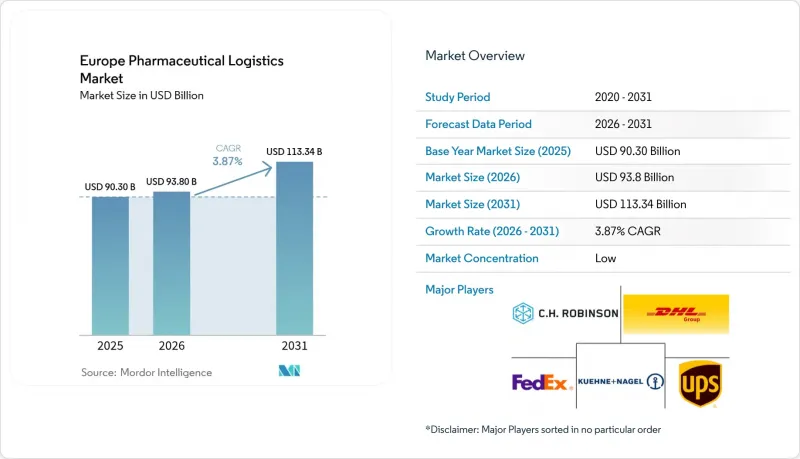
據 Mordor Intelligence 稱,歐洲醫藥物流市場預計到 2026 年價值 938 億美元,高於 2025 年的 903 億美元,預計到 2031 年將達到 1,133.4 億美元。
預計從 2026 年到 2031 年,其複合年成長率將達到 3.87%。
本報告按服務類型(運輸、倉儲和儲存、附加價值服務)、營運模式(冷鏈物流、非冷鏈物流)、產品類型(處方藥、成藥、生技藥品和生物相似藥、疫苗和血液製品等)以及地區(德國、英國等)進行細分。市場預測以美元計價。
歐洲醫藥物流市場趨勢與洞察
生物製藥和溫度敏感藥物的成長
生物製藥、細胞療法和基因療法的發展速度超過了整個生命科學領域,其中生物製藥的銷售量呈現兩位數成長,預計到2022年,冷藏保管藥品將佔藥品總銷售額的35%。北歐製造商如諾和諾德和FUJIFILM迪奧辛已投資超過700億丹麥克朗(約103.6億美元)用於擴大產能,從而催生了對符合GDP認證的儲存設施和-80 度C低溫運輸路線的新需求。為了緩解成本和排放壓力,只要前置作業時間和產品風險允許,托運人就會從空運轉向海運。目前,先進治療藥物(ATMP)正在推動低溫包裝的創新,而計劃於2024年在瑞典開展的146例CAR-T療法也顯示了個人化醫療工作流程的不斷擴展。
電子商務/OTC(非處方藥)履約量激增。
隨著德國、英國和法國實施電子處方箋網路和人工智慧驅動的訂單路由,預計到2028年,歐洲線上藥局產業將成長65%。對時效性強、溫控的最後一公里配送日益成長的需求,正在推動老齡化社會中居家醫療服務的發展。像Eurotranspharma這樣的物流專家已部署專用車隊進行長途和城市配送,以確保從頭到尾符合良好儲存和運輸(GDP)標準,直至送達患者家門口。儘管假冒仿冒品產品的風險以及管制藥品監管的碎片化仍然限制著跨境貨物的數量,但統一的數據共用平台正在減輕合規負擔。
冷鏈資產的能源和冷媒成本不斷上漲
歐盟的氟化氣體配額規定以及R452A冷媒價格的急劇上漲(自2014年以來漲幅高達1000%)正在推高冷藏車的營運成本。開利運輸冷凍等原始設備製造商(OEM)自2025年1月起開始徵收附加費,並計劃在年底前推出全球暖化潛勢(GWP)更低的冷媒調配槍枝。儘管液化天然氣(LNG)進口量保持穩定,但電力價格的波動持續擠壓利潤空間,促使企業投資建造太陽能配送中心和使用碳氫化合物。
細分市場分析
到2025年,運輸服務將佔歐洲醫藥物流市場佔有率的59.32%,凸顯了該產業對公路、航空、海運和鐵路運輸能力的依賴。儘管目前規模仍然較小,但預計到2031年,附加價值服務將為歐洲醫藥物流市場貢獻147.9億美元,年複合成長率達4.88%,這主要得益於托運人對批次級追蹤、監管文件和配套支援的需求不斷成長。雖然陸路運輸仍佔醫藥運輸的大部分,但歐盟基於二氧化碳排放等級的不斷上漲的通行費正在擠壓利潤空間,並加速向電池式電動車和氫動力系統的轉型。航空貨運業者正在改造其單元貨載設備,以滿足「ReFuelEU」計畫自2025年起使用2%永續航空燃料的要求,而航運公司則利用「FuelEU Maritime」法規提案低碳溫控貨櫃。
自動化和數位化定義了未來倉儲營運的價值創造。斯堪的納維亞半島一座全自動化倉庫每小時可處理1000個托盤,從而減少人為錯誤並提高批次可追溯性。同時,歐盟一項70億歐元的基礎設施計畫正在擴大鐵路貨運能力,而里昂-都靈隧道一旦運作,預計將促進藥品跨越阿爾卑斯山的物流運輸。總體而言,服務格局正從簡單的運輸轉向一體化的溫控物流協調,使營運商能夠簽訂多年合約並穩定收入。
其他好處:
- Excel格式的市場預測(ME)表
- 3個月的分析師支持
目錄
第1章:引言
- 研究假設和市場定義
- 調查範圍
第2章:調查方法
第3章執行摘要
第4章 市場狀況
- 市場概覽
- 市場促進因素
- 生物製藥和溫度敏感藥物的成長
- 電子商務/OTC履約量激增
- 歐盟將更嚴格地執行GDP和序列化法規。
- 外包給專門從事醫藥行業的第三方/第四方物流公司。
- 綠色新政措施促進運輸方式轉變(鐵路和內河航運)
- 細胞和基因療法的興起需要超低溫冷鏈。
- 市場限制因素
- 冷鏈資產的高能源和冷媒成本
- 促進要素短缺和道路通行能力受限
- 與英國脫歐相關的邊境摩擦和行政程序
- 中歐、東歐和北歐缺乏超低溫(-80°C)基礎設施
- 價值供應鏈分析
- 監理情勢
- 技術展望
- 新冠疫情和地緣政治動盪的影響
- 波特五力模型
第5章 市場規模與成長預測
- 按服務類型
- 運輸
- 公路貨運
- 空運
- 海上運輸
- 鐵路貨運
- 倉庫/存儲
- 附加價值服務及其他
- 運輸
- 透過操作模式
- 冷鏈物流
- 非冷鏈物流
- 依產品類型
- 處方藥
- 非處方藥
- 生物製劑和生物相似藥
- 疫苗和血液製品
- 臨床試驗材料
- 細胞和基因治療
- 醫療設備及診斷設備
- 動物用藥品
- 其他
- 按地區
- 德國
- 英國
- 荷蘭
- 法國
- 義大利
- 西班牙
- 波蘭
- 比利時
- 瑞典
- 其他歐洲國家
第6章 競爭情勢
- 市場集中度
- 策略趨勢
- 市佔率分析
- 公司簡介
- DHL
- FedEx
- Kuehne+Nagel International AG
- United Parcel Service(UPS)
- CH Robinson
- CEVA Logistics
- DSV A/S
- Eurotranspharma
- GEODIS
- Yusen Logistics
- World Courier
- Biocair
- Jan de Rijk Logistics
- Movianto
- Cencora
- Girteka Logistics
- Pfenning Group
- Rhenus Logistics
- LOXXESS AG
- Noatum Logistics
第7章 市場機會與未來展望
According to Mordor Intelligence, Europe pharmaceutical logistics market size in 2026 is estimated at USD 93.8 billion, growing from 2025 value of USD 90.30 billion with 2031 projections showing USD 113.34 billion, growing at 3.87% CAGR over 2026-2031.
This report is Segmented by Service Type (Transportation, Warehousing & Storage, Value-Added Services), Mode of Operation (Cold-Chain Logistics, Non-Cold-Chain Logistics), Product Type (Prescription Drugs, OTC Drugs, Biologics & Biosimilars, Vaccines & Blood Products, and More), and Geography (Germany, United Kingdom, and More). The Market Forecasts are Provided in Terms of Value (USD).
Europe Pharmaceutical Logistics Market Trends and Insights
Growth of Biologics & Temperature-Sensitive Drugs
Biologics, cell, and gene therapies are expanding faster than the broader life-sciences sector, with biopharma volumes growing at double-digit rates and pushing the share of cold-stored medicines to 35% of total pharmaceutical value in 2022. Nordic manufacturers such as Novo Nordisk and Fujifilm Diosynth are investing over DKK 70 billion (USD 10.36 billion) in capacity, creating fresh demand for GDP-certified storage and -80°C transport lanes. To curb cost and emission pressures, shippers are pivoting from air to ocean freight when lead-time and product risk profiles allow. Advanced therapy medicinal products (ATMPs) now drive ultra-cold packaging innovations, while Sweden's 146 CAR-T treatments in 2024 highlight the scale-up of personalized medicine workflows.
Surge in E-commerce/OTC Fulfillment Volumes
Europe's e-pharmacy sector is projected to expand by 65% by 2028 as Germany, the UK, and France roll out e-prescription networks and AI-based order routing. Growth in home health services for an aging population requires time-defined, temperature-controlled last-mile deliveries. Logistics specialists such as Eurotranspharma have launched dedicated line-haul and city-distribution fleets to ensure GDP compliance down to the patient doorstep. Counterfeit risk and patchwork rules for controlled substances continue to constrain cross-border volume flows, but harmonized data-sharing platforms are mitigating compliance burdens.
High Energy & Refrigerant Costs for Cold-Chain Assets
EU F-gas quota curbs and a multi-year surge in R452A prices up to 1,000% since 2014 are inflating operating outlays for reefer fleets. OEMs such as Carrier Transicold have levied surcharges from January 2025 and plan lower-GWP blends later in the year. Power-price volatility, despite stabilizing LNG imports, is still eroding margins, spurring investments in solar-assisted depots and hydrocarbon refrigerants.
Other drivers and restraints analyzed in the detailed report include:
- Stricter EU GDP & Serialization Enforcement
- Outsourcing to 3PL/4PL Pharma-Specialists
- Driver Shortages and Road-Capacity Constraints
For complete list of drivers and restraints, kindly check the Table Of Contents.
Segment Analysis
Transportation services accounted for 59.32% of Europe pharmaceutical logistics market share in 2025, underscoring the sector's dependence on road, air, ocean, and rail capacity. Value-added services, though a smaller pool, are forecast to contribute USD 14.79 billion to Europe pharmaceutical logistics market size by 2031, expanding at 4.88% CAGR as shippers seek batch-level tracking, regulatory documentation, and kitting support. Road haulage moves the lion's share of medicines, yet EU toll hikes pegged to CO2 classes are tightening margins and accelerating fleet renewal toward battery-electric and hydrogen drivelines. Airfreight operators are retrofitting unit-load devices to meet ReFuelEU mandates for 2% sustainable aviation fuels from 2025, while ocean carriers leverage FuelEU Maritime rules to pitch lower-carbon temperature-controlled containers.
Automation and digitalization define future warehousing value creation. Fully robotized Nordic depots can move 1,000 pallets per hour, reducing human error and improving batch traceability. Meanwhile, the EUR 7 billion EU infrastructure package is expanding rail freight capacity, with the Lyon-Turin tunnel slated to boost inter-alpine pharmaceutical flows once operational. Overall, the service mix is shifting from pure transport toward integrated, temperature-controlled orchestration, allowing operators to lock-in multi-year contracts and stabilize revenue.
Complete Report Scope:
- By Service Type
- Transportation
- Road Freight
- Air Freight
- Sea Freight
- Rail Freight
- Warehousing and Storage
- Value-added Services and Others
- Transportation
- By Mode of Operation
- Cold-Chain Logistics
- Non-Cold-Chain Logistics
- By Product Type
- Prescription Drugs
- OTC Drugs
- Biologics and Biosimilars
- Vaccines and Blood Products
- Clinical Trail Materials
- Cell and Gene Therapies
- Medical Devices and Diagnostics
- Veterinary Medicine
- Others
- By Geography
- Germany
- United Kingdom
- Netherlands
- France
- Italy
- Spain
- Poland
- Belgium
- Sweden
- Rest of Europe
List of Companies Covered in this Report:
- DHL
- FedEx
- Kuehne + Nagel International AG
- United Parcel Service (UPS)
- C.H. Robinson
- CEVA Logistics
- DSV A/S
- Eurotranspharma
- GEODIS
- Yusen Logistics
- World Courier
- Biocair
- Jan de Rijk Logistics
- Movianto
- Cencora
- Girteka Logistics
- Pfenning Group
- Rhenus Logistics
- LOXXESS AG
- Noatum Logistics
Additional Benefits:
- The market estimate (ME) sheet in Excel format
- 3 months of analyst support
TABLE OF CONTENTS
1 Introduction
- 1.1 Study Assumptions and Market Definition
- 1.2 Scope of the Study
2 Research Methodology
3 Executive Summary
4 Market Landscape
- 4.1 Market Overview
- 4.2 Market Drivers
- 4.2.1 Growth of biologics and temperature-sensitive drugs
- 4.2.2 Surge in e-commerce/OTC fulfilment volumes
- 4.2.3 Stricter EU GDP and serialization enforcement
- 4.2.4 Outsourcing to 3PL/4PL pharma-specialists
- 4.2.5 Green Deal modal-shift incentives (rail and inland waterways)
- 4.2.6 Rise of cell and gene therapy requiring ultra-cold chain
- 4.3 Market Restraints
- 4.3.1 High energy and refrigerant costs for cold-chain assets
- 4.3.2 Driver shortages and road-capacity constraints
- 4.3.3 Brexit-related border friction and paperwork
- 4.3.4 Limited ultra-cold (-80 C) infrastructure in CEE and Nordics
- 4.4 Value / Supply-Chain Analysis
- 4.5 Regulatory Landscape
- 4.6 Technological Outlook
- 4.7 Impact of COVID-19 and Geopolitical Disruptions
- 4.8 Porter's Five Forces
- 4.8.1 Threat of New Entrants
- 4.8.2 Bargaining Power of Buyers
- 4.8.3 Bargaining Power of Suppliers
- 4.8.4 Threat of Substitutes
- 4.8.5 Intensity of Competitive Rivalry
5 Market Size and Growth Forecasts (Value, USD)
- 5.1 By Service Type
- 5.1.1 Transportation
- 5.1.1.1 Road Freight
- 5.1.1.2 Air Freight
- 5.1.1.3 Sea Freight
- 5.1.1.4 Rail Freight
- 5.1.2 Warehousing and Storage
- 5.1.3 Value-added Services and Others
- 5.1.1 Transportation
- 5.2 By Mode of Operation
- 5.2.1 Cold-Chain Logistics
- 5.2.2 Non-Cold-Chain Logistics
- 5.3 By Product Type
- 5.3.1 Prescription Drugs
- 5.3.2 OTC Drugs
- 5.3.3 Biologics and Biosimilars
- 5.3.4 Vaccines and Blood Products
- 5.3.5 Clinical Trail Materials
- 5.3.6 Cell and Gene Therapies
- 5.3.7 Medical Devices and Diagnostics
- 5.3.8 Veterinary Medicine
- 5.3.9 Others
- 5.4 By Geography
- 5.4.1 Germany
- 5.4.2 United Kingdom
- 5.4.3 Netherlands
- 5.4.4 France
- 5.4.5 Italy
- 5.4.6 Spain
- 5.4.7 Poland
- 5.4.8 Belgium
- 5.4.9 Sweden
- 5.4.10 Rest of Europe
6 Competitive Landscape
- 6.1 Market Concentration
- 6.2 Strategic Moves
- 6.3 Market Share Analysis
- 6.4 Company Profiles (includes Global level Overview, Market level overview, Core Segments, Financials as available, Strategic Information, Market Rank/Share, Products and Services, Recent Developments)
- 6.4.1 DHL
- 6.4.2 FedEx
- 6.4.3 Kuehne + Nagel International AG
- 6.4.4 United Parcel Service (UPS)
- 6.4.5 C.H. Robinson
- 6.4.6 CEVA Logistics
- 6.4.7 DSV A/S
- 6.4.8 Eurotranspharma
- 6.4.9 GEODIS
- 6.4.10 Yusen Logistics
- 6.4.11 World Courier
- 6.4.12 Biocair
- 6.4.13 Jan de Rijk Logistics
- 6.4.14 Movianto
- 6.4.15 Cencora
- 6.4.16 Girteka Logistics
- 6.4.17 Pfenning Group
- 6.4.18 Rhenus Logistics
- 6.4.19 LOXXESS AG
- 6.4.20 Noatum Logistics
7 Market Opportunities and Future Outlook
- 7.1 White-space and Unmet-Need Assessment

 英國醫藥物流:市場佔有率分析、產業趨勢與統計、成長預測(2026-2031)生物製藥物流:市場佔有率分析、產業趨勢與統計、成長預測(2026-2031)亞太地區醫藥物流:市場佔有率分析、產業趨勢與統計及成長預測(2026-2031)北美醫藥物流:市場佔有率分析、產業趨勢與統計及成長預測(2026-2031)
 醫藥物流市場分析及至2035年的預測:依類型、產品、服務、技術、組件、應用、設備、運輸方式及階段
 醫藥物流市場:按類型、產品類型、組件、運輸方式和最終用戶分類-2026-2032年全球市場預測生物製藥物流市場:2026-2032年全球市場預測(依產品類型、服務類型、運輸方式、溫度需求及最終用戶分類)中國醫藥物流:市場佔有率分析、產業趨勢與統計及成長預測(2026-2031)印度醫藥物流:市場佔有率分析、產業趨勢與統計及成長預測(2026-2031)德國醫藥物流:市場佔有率分析、產業趨勢與統計及成長預測(2026-2031)