


 |
市場調查報告書
商品編碼
2115852
北美醫藥物流:市場佔有率分析、產業趨勢與統計及成長預測(2026-2031)North America Pharmaceutical Logistics - Market Share Analysis, Industry Trends & Statistics, Growth Forecasts (2026 - 2031) |
||||||

※ 本網頁內容可能與最新版本有所差異。詳細情況請與我們聯繫。
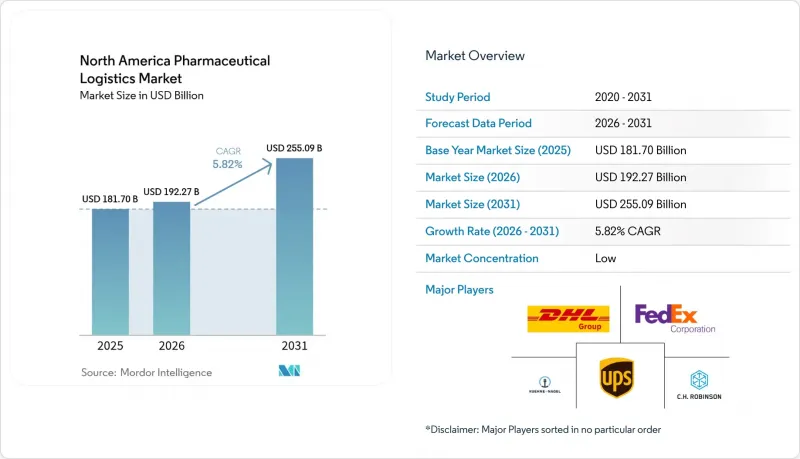
據 Mordor Intelligence 稱,2025 年北美醫藥物流市場價值為 1817 億美元,預計到 2031 年將達到 2550.9 億美元,而 2026 年為 1922.7 億美元,預測期(2026-2031 年)複合年成長率為 5.82%。
本報告按服務類型(運輸、倉儲、附加價值服務及其他)、營運模式(低溫運輸物流、非低溫運輸物流)、產品類型(處方藥、成藥、生技藥品/生物相似藥及其他)和國家/地區(美國、加拿大、墨西哥)對市場進行細分。市場預測以美元(USD)為單位。
北美醫藥物流市場趨勢與洞察
需要超低溫配送基礎設施的細胞和基因療法臨床試驗正在迅速增加。
先進療法臨床試驗的快速擴張推動了對能夠在低至-196 度C的低溫下穩定保存細胞材料的儲存解決方案的投資。位於安大略省漢密爾頓的OmniaBio公司佔地12萬平方英尺的設施目前是加拿大最大的同類設施,這表明該地區處理此類療法的能力正在不斷增強。美國FDA針對CRISPR技術產品推出的新型平台技術認定,使得必須符合嚴格的監管鏈法規的運輸量不斷增加,從而簡化了檢驗程序並縮短了審查週期。能夠提供檢驗的低溫運輸車輛、冗餘電源備份和即時溫度偏差警報的物流供應商,在贏得合約方面具有強大的優勢。製造商與第三方物流公司之間的合作關係也不斷擴大,將處理能力整合到靠近研究叢集的多租戶園區也日益成為一種趨勢。這些趨勢使北美醫藥物流市場成為支持精準醫療發展的重要基石。
美國專科藥房通路中直接面向病患的銷售模式的興起
製造商正在建立自己的入口網站,將昂貴的藥品直接送到患者家中,從而省去仲介業者,提高患者的用藥依從性。直接面向患者的醫療物流領域遠端醫療發展,遠距醫療預計在2024年占美國門診就診量的18%以上。採用溫控包裝的末端配送公司正在將配送範圍擴展到農村地區,而基於區塊鏈的審計追蹤系統則用於記錄藥品儲存歷史,以符合《藥品安全追蹤法案》(DSCSA)的要求。零售連鎖店正在維修診所,以支持依賴即時藥品配送的分散式臨床試驗。大都會圈附近的自動化微型倉配中心正在進一步縮短前置作業時間。隨著這些措施的成熟,它們正在為北美藥品物流市場帶來持續的收入來源。
長期司機短缺限制了國內道路運輸準時運輸的能力。
根據美國卡車運輸協會 (ATA) 估計,到 2030 年,司機缺口可能達到 16 萬人,這將對時間要求嚴格的醫療貨物運輸路線帶來巨大壓力。目前,製造工廠已報告勞動力短缺 20.6%,而 2024 年 12 月的運輸成本飆升是自 2022 年 4 月以來的最大漲幅。司機離職率上升導致準時交貨率下降,迫使托運人使用高價空運並儲備緩衝庫存。潛在的移民限制可能會進一步加劇勞動力短缺。這些壓力推高了營運成本,並為原本蓬勃發展的北美醫藥物流市場蒙上了一層陰影。
細分市場分析
至2025年,運輸環節將佔北美醫藥物流市場71.35%的佔有率。這反映出空運、陸運和多模態服務在跨越廣袤地域的及時配送中發揮核心作用。美國、加拿大和墨西哥之間的國內卡車運輸路線連接超過1.6兆美元的貿易額。波音公司預測,在電子商務和包括藥品在內的高價值商品的推動下,航空貨運量將以每年4.1%的速度成長。
儘管倉儲物流領域規模相對較小,但隨著製造商為關鍵藥品和先進療法儲備庫存,預計該領域將以5.6%至6.38%的複合年成長率成長,因為這些藥品和療法需要受控環境。機器人揀選系統和自動化冷庫縮短了訂單週期並提高了準確性,而通過ISO認證的無塵室則支援二次包裝和套件組裝。人手不足正在加速對自動化領域的投資,而諸如最終階段客製化和法規遵從支持等附加價值服務正在使北美醫藥物流行業的供應商脫穎而出。
其他好處:
- Excel格式的市場預測(ME)表
- 3個月的分析師支持
目錄
第1章:引言
- 研究假設和市場定義
- 調查範圍
第2章:調查方法
第3章執行摘要
第4章 市場狀況
- 市場概覽
- 市場促進因素
- 細胞和基因療法臨床試驗的激增,對超低溫物流基礎設施提出了更高的要求。
- 美國專科藥房通路中直接面向病患(DtP)模式的興起
- 美國和墨西哥之間近岸灌裝和加工設施的擴張,正在形成跨境低溫運輸流動。
- 加拿大對生技藥品生產的優惠待遇正在提振對符合GMP標準的倉庫的需求。
- 美國《2024 年國防安全戰略法案》(DCSSA) 里程碑要求擴大即時物聯網溫度監控的範圍。
- 永續性措施使可重複使用的被動式托運人能夠大幅減少航空貨運的碳足跡。
- 市場限制因素
- 長期司機短缺限制了國內準時運輸的能力。
- 在低於-70°C的溫度下,使用乾冰和液態氮進行治療的成本很高。
- 墨西哥低溫運輸法規的碎片化增加了運輸過程中的風險。
- 邊境堵塞影響了跨境貨車運輸的準時率。
- 價值供應鏈分析
- 監管和技術展望
- 波特五力模型
第5章 市場規模與成長預測
- 按服務類型
- 運輸
- 公路貨運
- 航空貨運
- 海上運輸
- 鐵路貨運
- 倉庫/存儲
- 附加價值服務及其他
- 運輸
- 按營運模式
- 低溫運輸物流
- 非低溫運輸物流
- 依產品類型
- 處方藥
- 成藥
- 生技藥品和生物相似藥
- 疫苗和血液製品
- 臨床試驗材料
- 細胞和基因治療
- 醫療設備及診斷設備
- 動物用藥品
- 其他
- 國家
- 美國
- 加拿大
- 墨西哥
第6章 競爭情勢
- 市場集中度
- 策略趨勢
- 市佔率分析
- 公司簡介
- DHL Group
- United Parcel Service, Inc.
- FedEx
- Kuehne+Nagel International AG
- DSV(DB Schenker)
- CEVA Logistics
- Lineage Logistics
- Expeditors International
- XPO Logistics
- Americold Logistics
- AIT Worldwide Logistics
- Ryder Supply Chain Solutions
- Yusen Logistics(NYK line)
- Nippon Express
- SEKO Logistics
- Schneider
- CH Robinson
- Penske Logistics
- GEODIS*
第7章 市場機會與未來展望
According to Mordor Intelligence, the North America pharmaceutical logistics market size was valued at USD 181.70 billion in 2025 and estimated to grow from USD 192.27 billion in 2026 to reach USD 255.09 billion by 2031, at a CAGR of 5.82% during the forecast period (2026-2031).
This report Segments by Service Type (Transportation, Warehousing & Storage and Value-Added Services and Others), by Mode of Operation (Cold-Chain Logistics and Non-Cold-Chain Logistics), by Product Type (Prescription Drugs, OTC Drugs, Biologics & Biosimilars, and More), by Country (United States, Canada and Mexico). The Market Forecasts are Provided in Terms of Value (USD).
North America Pharmaceutical Logistics Market Trends and Insights
Surge in Cell & Gene Therapy Clinical Trials Requiring Ultra-Cold Distribution Infrastructure
Advanced therapy trials are scaling rapidly, prompting investment in storage solutions that keep cellular material stable at temperatures as low as -196 °C. OmniaBio's 120,000 square-foot facility in Hamilton, Ontario, now the largest of its kind in Canada, signals growing regional capacity for these therapies. The U.S. FDA's new Platform Technology Designation for CRISPR-based products simplifies validation steps and shortens review cycles, thus raising shipment volumes that must meet stringent chain-of-custody rules. Logistics providers able to offer validated cryogenic fleets, redundant power back-ups and real-time excursion alerts are well placed to win contracts. Partnerships between manufacturers and 3PLs are also expanding to embed capacity in multi-tenant campuses near research clusters. These dynamics elevate the North America pharmaceutical logistics market as a critical enabler of precision medicine scale-up.
Rise of Direct-to-Patient Models in U.S. Specialty Pharmacy Channel
Manufacturers are building proprietary portals that send high-value drugs directly to patient homes, trimming intermediaries and improving adherence. The direct-to-patient healthcare logistics segment is growing alongside telehealth, which handled over 18% of U.S. outpatient visits in 2024. Last-mile couriers equipped with temperature-verified packaging extend reach to rural areas while blockchain audit trails document custody events for DSCSA compliance. Retail chains are retrofitting clinics to support decentralized clinical trials that rely on just-in-time drug delivery. Automated micro-fulfilment centers near metropolitan zones shorten lead times further. As these practices mature they contribute to recurring revenue streams within the North America pharmaceutical logistics market.
Chronic Driver Shortages Limiting Domestic Road Capacity for Time-Critical Shipments
The American Trucking Associations estimate the shortfall could reach 160,000 drivers by 2030, straining time-definite lanes for healthcare cargo. Manufacturing plants already cite labour gaps at 20.6%, and higher transportation prices in December 2024 marked the steepest rise since April 2022. Driver turnover erodes on-time performance, pushing shippers to use premium air options or build buffer inventories. Potential immigration restrictions could tighten labour pools further. These pressures inflate operating costs and temper the otherwise strong outlook for the North America pharmaceutical logistics market.
Other drivers and restraints analyzed in the detailed report include:
- Expansion of U.S.-Mexico Near-Shore Fill-Finish Facilities Creating Cross-Border Cold-Chain Flows
- Canada's Biologics Manufacturing Incentives Boosting Demand for GMP Warehousing
- High Cost of Dry-Ice & Liquid-Nitrogen Compliance for <=-70 °C Modalities
For complete list of drivers and restraints, kindly check the Table Of Contents.
Segment Analysis
Transportation captured 71.35% of the North America pharmaceutical logistics market share in 2025, reflecting the centrality of air, road and multimodal services for timely deliveries across a vast region. Domestic truck routes connect more than USD 1.6 trillion in U.S.-Canada-Mexico trade, while Boeing forecasts 4.1% annual expansion in air-cargo traffic driven by e-commerce and high-value goods, including medicines.
Warehousing and storage, though smaller, is set to grow at.5 6.38% CAGR as manufacturers create inventory buffers for critical drugs and as advanced therapies demand controlled environments. Robotic picking systems and automated cold rooms shorten order cycles and raise accuracy, while ISO-certified clean rooms support secondary packaging and kitting. Labour scarcity accelerates capital investment in automation, and value-added services such as late-stage customisation and regulatory support differentiate providers within the North America pharmaceutical logistics industry.
Complete Report Scope:
- By Service Type
- Transportation
- Road Freight
- Air Freight
- Sea Freight
- Rail Freight
- Warehousing & Storage
- Value-added Services and Others
- Transportation
- By Mode of Operation
- Cold-Chain Logistics
- Non-Cold-Chain Logistics
- By Product Type
- Prescription Drugs
- OTC Drugs
- Biologics & Biosimilars
- Vaccines & Blood Products
- Clinical Trail Materials
- Cell & Gene Therapies
- Medical Devices & Diagnostics
- Veterinary Medicine
- Others
- By Country
- United States
- Canada
- Mexico
List of Companies Covered in this Report:
- DHL Group
- United Parcel Service, Inc.
- FedEx
- Kuehne + Nagel International AG
- DSV (DB Schenker)
- CEVA Logistics
- Lineage Logistics
- Expeditors International
- XPO Logistics
- Americold Logistics
- AIT Worldwide Logistics
- Ryder Supply Chain Solutions
- Yusen Logistics (NYK line)
- Nippon Express
- SEKO Logistics
- Schneider
- C.H. Robinson
- Penske Logistics
- GEODIS*
Additional Benefits:
- The market estimate (ME) sheet in Excel format
- 3 months of analyst support
TABLE OF CONTENTS
1 Introduction
- 1.1 Study Assumptions & Market Definition
- 1.2 Scope of the Study
2 Research Methodology
3 Executive Summary
4 Market Landscape
- 4.1 Market Overview
- 4.2 Market Drivers
- 4.2.1 Surge in Cell- & Gene-Therapy Clinical Trials Requiring Ultra-Cold Distribution Infrastructure
- 4.2.2 Rise of Direct-to-Patient (DtP) Models in U.S. Specialty Pharmacy Channel
- 4.2.3 Expansion of U.S.-Mexico Near-shore Fill-Finish Facilities Creating Cross-Border Cold-Chain Flows
- 4.2.4 Canada's Biologics Manufacturing Incentives Boosting Demand for GMP Warehousing
- 4.2.5 Growing Adoption of Real-Time IoT Temperature-Monitoring Mandated by U.S. DSCSA 2024 Milestone
- 4.2.6 Sustainability Push for Re-Usable Passive Shippers to Slash Airfreight Carbon Footprint
- 4.3 Market Restraints
- 4.3.1 Chronic Driver Shortages Limiting Domestic Road Capacity for Time-Critical Shipments
- 4.3.2 High Cost of Dry-Ice & Liquid-Nitrogen Compliance for <=-70 °C Modalities
- 4.3.3 Fragmented Mexican Cold-Chain Regulations Elevating In-Transit Risk
- 4.3.4 Border Congestion Impacting On-Time Performance of Cross-Border Truckloads
- 4.4 Value / Supply-Chain Analysis
- 4.5 Regulatory & Technological Outlook
- 4.6 Porter's Five Forces
- 4.6.1 Bargaining Power of Buyers
- 4.6.2 Bargaining Power of Suppliers
- 4.6.3 Threat of Substitutes
- 4.6.4 Threat of New Entrants
- 4.6.5 Competitive Rivalry
5 Market Size & Growth Forecasts (Value, USD Billion)
- 5.1 By Service Type
- 5.1.1 Transportation
- 5.1.1.1 Road Freight
- 5.1.1.2 Air Freight
- 5.1.1.3 Sea Freight
- 5.1.1.4 Rail Freight
- 5.1.2 Warehousing & Storage
- 5.1.3 Value-added Services and Others
- 5.1.1 Transportation
- 5.2 By Mode of Operation
- 5.2.1 Cold-Chain Logistics
- 5.2.2 Non-Cold-Chain Logistics
- 5.3 By Product Type
- 5.3.1 Prescription Drugs
- 5.3.2 OTC Drugs
- 5.3.3 Biologics & Biosimilars
- 5.3.4 Vaccines & Blood Products
- 5.3.5 Clinical Trail Materials
- 5.3.6 Cell & Gene Therapies
- 5.3.7 Medical Devices & Diagnostics
- 5.3.8 Veterinary Medicine
- 5.3.9 Others
- 5.4 By Country
- 5.4.1 United States
- 5.4.2 Canada
- 5.4.3 Mexico
6 Competitive Landscape
- 6.1 Market Concentration
- 6.2 Strategic Moves
- 6.3 Market Share Analysis
- 6.4 Company Profiles {(includes Global level Overview, Market level overview, Core Segments, Financials as available, Strategic Information, Market Rank/Share for key companies, Products & Services, and Recent Developments)}
- 6.4.1 DHL Group
- 6.4.2 United Parcel Service, Inc.
- 6.4.3 FedEx
- 6.4.4 Kuehne + Nagel International AG
- 6.4.5 DSV (DB Schenker)
- 6.4.6 CEVA Logistics
- 6.4.7 Lineage Logistics
- 6.4.8 Expeditors International
- 6.4.9 XPO Logistics
- 6.4.10 Americold Logistics
- 6.4.11 AIT Worldwide Logistics
- 6.4.12 Ryder Supply Chain Solutions
- 6.4.13 Yusen Logistics (NYK line)
- 6.4.14 Nippon Express
- 6.4.15 SEKO Logistics
- 6.4.16 Schneider
- 6.4.17 C.H. Robinson
- 6.4.18 Penske Logistics
- 6.4.19 GEODIS*
7 Market Opportunities & Future Outlook

 英國醫藥物流:市場佔有率分析、產業趨勢與統計、成長預測(2026-2031)生物製藥物流:市場佔有率分析、產業趨勢與統計、成長預測(2026-2031)亞太地區醫藥物流:市場佔有率分析、產業趨勢與統計及成長預測(2026-2031)歐洲醫藥物流:市場佔有率分析、產業趨勢與統計及成長預測(2026-2031)
 醫藥物流市場分析及至2035年的預測:依類型、產品、服務、技術、組件、應用、設備、運輸方式及階段
 醫藥物流市場:按類型、產品類型、組件、運輸方式和最終用戶分類-2026-2032年全球市場預測生物製藥物流市場:2026-2032年全球市場預測(依產品類型、服務類型、運輸方式、溫度需求及最終用戶分類)中國醫藥物流:市場佔有率分析、產業趨勢與統計及成長預測(2026-2031)印度醫藥物流:市場佔有率分析、產業趨勢與統計及成長預測(2026-2031)德國醫藥物流:市場佔有率分析、產業趨勢與統計及成長預測(2026-2031)