


 |
市場調查報告書
商品編碼
2119700
英國醫藥物流:市場佔有率分析、產業趨勢與統計、成長預測(2026-2031)United Kingdom Pharmaceutical Logistics - Market Share Analysis, Industry Trends & Statistics, Growth Forecasts (2026 - 2031) |
||||||

※ 本網頁內容可能與最新版本有所差異。詳細情況請與我們聯繫。
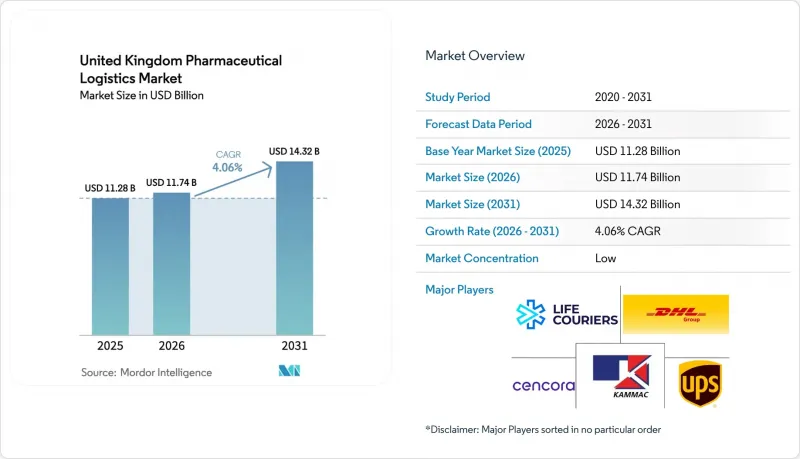
根據 Mordor Intelligence 預測,英國醫藥物流市場規模將從 2025 年的 112.8 億美元成長到 2026 年的 117.4 億美元,到 2031 年將達到 143.2 億美元,2026 年至 2031 年的複合年成長率為 4.06%。
本報告依服務類型(運輸、倉儲、附加價值服務及其他)、營運模式(冷鏈物流、非冷鏈物流)及產品類型(處方藥、成藥、生技藥品及生物相似藥、疫苗及血製品、臨床試驗材料等)分類。市場預測以美元計價。
英國醫藥物流市場趨勢與洞察
線上藥局的擴張和電子商務的成長
英國英國醫療服務體系 (NHS) 與 Uber 和皇家郵政的合作標誌著醫療服務正朝著直接送藥上門的方向系統性轉變,從而實現處方即時追蹤,並通過電子檢驗減少處方箋錯誤。人工智慧驅動的需求預測如今已成為庫存補貨週期的基礎,減少了庫存緩衝,並釋放了倉庫空間用於存放更高價值的生技藥品。這些數位化工作流程提高了資料安全要求,迫使承運商整合安全 API 和雙因素認證來處理病患資料。受監管藥品和溫度敏感型生技藥品增加了「最後一公里」配送的複雜性,因為它們必須在送貨上門時同時滿足安全性和藥品分銷管理 (GDP) 的要求。因此,物聯網賦能的保險箱和帶有時間戳的配送檢驗工具的應用日益普及,使得數位化原生物流供應商成為希望拓展居家照護的 NHS 信託機構的理想合作夥伴。
MHRA嚴格遵守GDP規定
英國脫歐終止了歐盟GDP證書的自動核准,並強制要求所有進口貨物提交英國合規文件,迫使承運商維修其系統。從「平行分銷通知」過渡到「平行輸入進口許可證」需要升級倉庫管理系統的資料收集能力,這將在短期內增加成本,但會進一步增強擁有成熟品管系統的大型企業的競爭優勢。英國藥品和保健產品監管署(MHRA)關於即時生產(POCM)的指導意見使情況更加複雜。檢驗公司必須增加經過驗證的無塵室運輸規程,才能在嚴格的穩定性容差範圍內,將新鮮配製的單劑量藥品從醫院檢查室直接運送到病人床邊。合規支出也蔓延到員工培訓領域,承運商在其GDP課程中增加了網路安全和資料完整性模組,以滿足電子儲存歷史記錄的要求。
符合GDP規定的司機短缺
英國脫歐後的移民限制導致重型貨車司機勞動力短缺。此外,取得GDP認證需要額外6至12個月的培訓,這進一步拖慢了招募進度。 2024年,認證司機的薪資溢價年增14%,給營運低利潤冷藏車的中小型運輸公司帶來了壓力。當地藥局反映,在高峰期無法滿足配送需求,迫使英國國民醫療服務體系(NHS)信託機構使用多點整合服務,延長了前置作業時間。儘管政府已推出學徒計畫津貼,但由於資格認證過程漫長,該計畫的使用率仍然很低。未來,半自動駕駛卡車的試點計畫或許能夠緩解這種依賴,但監管障礙可能會使商業部署推遲到預測期之後。
細分市場分析
2025年,運輸業將維持在英國醫藥物流市場60.55%的佔有率,為英國醫藥物流市場貢獻68.3億美元。公路貨運憑藉其覆蓋1250多個NHS醫院和社區藥房配送中心的地理優勢,佔據主導地位,從而實現了關鍵藥物的當日補貨。該細分市場利用GPS定位技術,透過將運輸狀態資料直接傳輸到NHS電子處方箋服務平台,提高了透明度。附加價值服務雖然規模較小,但正以4.78%的複合年成長率成長,尤其是在NHS數位化政策的推動下,客戶越來越希望在同一份合約中獲得庫存最佳化分析、重新貼標和退貨管理等功能。
技術投資持續變革服務型經濟。人工智慧驅動的航線最佳化已將平均飛行距離縮短了8%,抵消了燃油成本的波動。航空貨運雖然價值佔比不到8%,但對於從美國進口先進治療藥物(ATMP)以及快速部署疫苗至關重要,然而區域機場的跑道使用限制制約了運輸量的成長。倉儲業,尤其是溫控倉儲,正經歷個位數成長,這得益於無菌生產擴張帶來的對檢驗的潔淨儲存設施日益成長的需求。運輸和附加價值服務向平台模式的整合表明,競爭格局正在發生變化,承運商不僅依靠里程,也依靠數據來創造收入。
其他好處:
- Excel格式的市場預測(ME)表
- 3個月的分析師支持
目錄
第1章:引言
- 研究假設和市場定義
- 調查範圍
第2章:調查方法
第3章執行摘要
第4章 市場狀況
- 市場概覽
- 市場促進因素
- 線上藥局的擴張和電子商務的成長
- MHRA嚴格遵守GDP法規
- 英國國家醫療服務體系(NHS)在個人化醫療方面所做的努力
- 英國脫歐引發國內物流投資
- ATMP臨床試驗(超低溫冷鏈)數量增加
- 英國國民醫療服務體系(NHS)藥局宅配服務擴展
- 市場限制因素
- 符合GDP標準的駕駛人短缺
- 能源和燃料成本飆升
- 區域機場接收藥品貨物的能力有限。
- 利用物聯網的冷鏈面臨的網路安全風險
- 價值供應鏈分析
- 監理情勢
- 技術展望
- 波特五力模型
- 英國第三方物流市場分析
- 地緣政治因素與疫情對市場的影響
第5章 市場規模與成長預測
- 按服務類型
- 運輸
- 公路貨運
- 空運
- 海上運輸
- 鐵路貨運
- 倉庫/存儲
- 附加價值服務及其他
- 運輸
- 透過操作模式
- 冷鏈物流
- 非冷鏈物流
- 依產品類型
- 處方藥
- 非處方藥
- 生物製劑和生物相似藥
- 疫苗和血液製品
- 臨床試驗材料
- 細胞和基因治療
- 醫療設備及診斷設備
- 動物用藥品
- 其他
第6章 競爭情勢
- 市場集中度
- 策略趨勢
- 市佔率分析
- 公司簡介
- DHL Supply Chain
- Life Couriers UK(Formerly Vision Logistics)
- Kammac
- Cencora, Inc.
- UPS
- Movianto
- Cool Cargo
- Yusen Logistics
- Circle Express UK
- DFS Worldwide
- CDL Logistics Group
- HANNON PharmaLink(HPL)
- Cavalier Logistics UK Limited
- LF&E Temperature Controlled Logistics
- Jan de Rijk Logistics
- WH Bowker Limited
- SEKO Logistics
- Kuehne Nagel
- Pulleyn Transport Ltd
- DSV
第7章 市場機會與未來展望
第8章附錄
- 宏觀經濟指標(按行業分類的GDP)
- 經濟統計-運輸和倉儲部門的貢獻
- 外貿統計-依商品和國家分類的進出口狀況
According to Mordor Intelligence, the United Kingdom pharmaceutical logistics market size is expected to grow from USD 11.28 billion in 2025 to USD 11.74 billion in 2026 and is forecast to reach USD 14.32 billion by 2031 at 4.06% CAGR over 2026-2031.
This report is Segmented by Service Type (Transportation, Warehousing & Storage, Value-Added Services and Others), Mode of Operation (Cold-Chain Logistics, Non-Cold-Chain Logistics), Product Type (Prescription Drugs, OTC Drugs, Biologics & Biosimilars, Vaccines & Blood Products, Clinical Trial Materials, and More). The Market Forecasts are Provided in Terms of Value (USD).
United Kingdom Pharmaceutical Logistics Market Trends and Insights
Growing Online Pharmacy and E-commerce Growth
NHS partnerships with Uber and Royal Mail illustrate a systemic pivot toward direct-to-patient delivery, enabling real-time prescription tracking and cutting dispensing errors through electronic verification. AI-assisted demand forecasting now underpins stock-replenishment cycles, shrinking inventory buffers and freeing warehouse space for higher-value biologics. These digital workflows elevate data-security requirements, pushing carriers to integrate secure APIs and two-factor authentication for patient data interchange. Last-mile complexity is rising because controlled drugs and temperature-sensitive biologics must meet both security and GDP parameters during doorstep hand-off. The result is growing uptake of IoT-enabled lockboxes and time-stamped delivery validation tools, making digitally native logistics providers attractive partners for NHS trusts pursuing home-care expansion.
Strict MHRA GDP Compliance
Brexit has ended automatic recognition of EU GDP certificates, obliging every inbound shipment to demonstrate UK compliance documentation and triggering systems retrofits among carriers. Transition from Parallel Distribution Notices to Parallel Import Licences requires data-capture upgrades across warehouse management systems, adding near-term cost but sharpening competitive advantages for large operators with mature quality-management frameworks. MHRA's point-of-care manufacturing guidance furthers complexity; logistics firms must add validated clean-room transfer protocols to carry freshly compounded personalized doses directly from hospital labs to bedside within narrow stability windows. Compliance spend is cascading into workforce training, with carriers expanding GDP curricula to include cyber-security and data-integrity modules that address electronic chain-of-custody mandates.
Talent Shortage of GDP-Compliant Drivers
Immigration curbs post-Brexit reduced the heavy-goods-vehicle workforce pool, and GDP qualifications add an extra training layer of 6-12 months, delaying talent replenishment. Salary premiums for certified drivers rose 14% year-over-year in 2024, squeezing smaller carriers that operate thin margin refrigerated fleets. Rural pharmacies report missed delivery windows during seasonal peaks, compelling NHS trusts to engage multi-stop consolidation services that lengthen lead times. While apprenticeship grants have been introduced, uptake remains modest due to long qualification pathways. Over time, semi-autonomous truck pilots could mitigate dependency, yet regulatory hurdles push commercial deployment beyond the forecast horizon.
Other drivers and restraints analyzed in the detailed report include:
- NHS Personalised-Medicine Initiatives
- Brexit-Driven Domestic Logistics Investment
- Rising Energy & Fuel Costs
For complete list of drivers and restraints, kindly check the Table Of Contents.
Segment Analysis
Transportation maintained 60.55% share of the UK pharmaceutical logistics market in 2025, translating to a UK pharmaceutical logistics market size contribution of USD 6.83 billion. Road freight leads due to its geographic reach across 1,250+ NHS hospital and community-pharmacy delivery points, allowing same-day replenishment cycles for critical medicines. The sub-segment leverages GPS-enabled telematics that feed shipment-status data directly into NHS Electronic Prescription Service dashboards, heightening transparency. Value-added services, albeit smaller, are rising at a 4.78% CAGR as clients seek inventory optimization analytics, relabeling, and returns-management functions within one contract, notably under NHS digitalization mandates.
Technology investments continue to reshape service-type economics. AI-driven route-optimization trims average empty mileage by 8%, offsetting fuel-cost volatility. Air freight, though <8% of value, is pivotal for ATMP imports from the United States and rapid vaccine deployment, but runway curfews at regional airports constrain uplift. Warehousing, particularly temperature-controlled space, experiences single-digit growth as sterile-manufacturing expansion pads demand for validated clean-storage chambers. The convergence of transportation and value-added services into platform models signals an evolving competitive dynamic where carriers monetize data as much as miles traveled.
Complete Report Scope:
- By Service Type
- Transportation
- Road Freight
- Air Freight
- Sea Freight
- Rail Freight
- Warehousing and Storage
- Value-added Services and Others
- Transportation
- By Mode of Operation
- Cold-Chain Logistics
- Non-Cold-Chain Logistics
- By Product Type
- Prescription Drugs
- OTC Drugs
- Biologics and Biosimilars
- Vaccines and Blood Products
- Clinical Trail Materials
- Cell and Gene Therapies
- Medical Devices and Diagnostics
- Veterinary Medicine
- Others
List of Companies Covered in this Report:
- DHL Supply Chain
- Life Couriers UK (Formerly Vision Logistics)
- Kammac
- Cencora, Inc.
- UPS
- Movianto
- Cool Cargo
- Yusen Logistics
- Circle Express UK
- DFS Worldwide
- CDL Logistics Group
- HANNON PharmaLink (HPL)
- Cavalier Logistics UK Limited
- LF&E Temperature Controlled Logistics
- Jan de Rijk Logistics
- W.H. Bowker Limited
- SEKO Logistics
- Kuehne Nagel
- Pulleyn Transport Ltd
- DSV
Additional Benefits:
- The market estimate (ME) sheet in Excel format
- 3 months of analyst support
TABLE OF CONTENTS
1 Introduction
- 1.1 Study Assumptions and Market Definition
- 1.2 Scope of the Study
2 Research Methodology
3 Executive Summary
4 Market Landscape
- 4.1 Market Overview
- 4.2 Market Drivers
- 4.2.1 Growing online pharmacy and e-commerce growth
- 4.2.2 Strict MHRA GDP compliance
- 4.2.3 NHS personalised-medicine initiatives
- 4.2.4 Brexit-driven domestic logistics investment
- 4.2.5 Growth in ATMP clinical trials (ultra-cold chain)
- 4.2.6 Expansion of NHS pharmacy home-delivery services
- 4.3 Market Restraints
- 4.3.1 Talent shortage of GDP-compliant drivers
- 4.3.2 Rising energy and fuel costs
- 4.3.3 Limited capacity at regional airports for pharma cargo
- 4.3.4 Cyber-security risks in IoT-enabled cold chain
- 4.4 Value / Supply-Chain Analysis
- 4.5 Regulatory Landscape
- 4.6 Technological Outlook
- 4.7 Porter's Five Forces
- 4.7.1 Threat of New Entrants
- 4.7.2 Bargaining Power of Buyers
- 4.7.3 Bargaining Power of Suppliers
- 4.7.4 Threat of Substitute Products
- 4.7.5 Intensity of Competitive Rivalry
- 4.8 Insights into 3PL Market in United Kingdom
- 4.9 Impact of Geopolitics and Pandemic on the Market
5 Market Size and Growth Forecasts (Value)
- 5.1 By Service Type
- 5.1.1 Transportation
- 5.1.1.1 Road Freight
- 5.1.1.2 Air Freight
- 5.1.1.3 Sea Freight
- 5.1.1.4 Rail Freight
- 5.1.2 Warehousing and Storage
- 5.1.3 Value-added Services and Others
- 5.1.1 Transportation
- 5.2 By Mode of Operation
- 5.2.1 Cold-Chain Logistics
- 5.2.2 Non-Cold-Chain Logistics
- 5.3 By Product Type
- 5.3.1 Prescription Drugs
- 5.3.2 OTC Drugs
- 5.3.3 Biologics and Biosimilars
- 5.3.4 Vaccines and Blood Products
- 5.3.5 Clinical Trail Materials
- 5.3.6 Cell and Gene Therapies
- 5.3.7 Medical Devices and Diagnostics
- 5.3.8 Veterinary Medicine
- 5.3.9 Others
6 Competitive Landscape
- 6.1 Market Concentration
- 6.2 Strategic Moves
- 6.3 Market Share Analysis
- 6.4 Company Profiles (includes Global level Overview, Market level overview, Core Segments, Financials as available, Strategic Information, Market Rank/Share for key companies, Products and Services, and Recent Developments)
- 6.4.1 DHL Supply Chain
- 6.4.2 Life Couriers UK (Formerly Vision Logistics)
- 6.4.3 Kammac
- 6.4.4 Cencora, Inc.
- 6.4.5 UPS
- 6.4.6 Movianto
- 6.4.7 Cool Cargo
- 6.4.8 Yusen Logistics
- 6.4.9 Circle Express UK
- 6.4.10 DFS Worldwide
- 6.4.11 CDL Logistics Group
- 6.4.12 HANNON PharmaLink (HPL)
- 6.4.13 Cavalier Logistics UK Limited
- 6.4.14 LF&E Temperature Controlled Logistics
- 6.4.15 Jan de Rijk Logistics
- 6.4.16 W.H. Bowker Limited
- 6.4.17 SEKO Logistics
- 6.4.18 Kuehne Nagel
- 6.4.19 Pulleyn Transport Ltd
- 6.4.20 DSV
7 Market Opportunities and Future Outlook
- 7.1 White-space and Unmet-need Assessment
8 Appendix
- 8.1 Macroeconomic Indicators (GDP Distribution by Activity)
- 8.2 Economic Statistics-Transport and Storage Sector Contribution
- 8.3 External Trade Statistics-Exports and Imports by Product and Country

 生物製藥物流:市場佔有率分析、產業趨勢與統計、成長預測(2026-2031)亞太地區醫藥物流:市場佔有率分析、產業趨勢與統計及成長預測(2026-2031)北美醫藥物流:市場佔有率分析、產業趨勢與統計及成長預測(2026-2031)歐洲醫藥物流:市場佔有率分析、產業趨勢與統計及成長預測(2026-2031)
 醫藥物流市場分析及至2035年的預測:依類型、產品、服務、技術、組件、應用、設備、運輸方式及階段
 醫藥物流市場:按類型、產品類型、組件、運輸方式和最終用戶分類-2026-2032年全球市場預測生物製藥物流市場:2026-2032年全球市場預測(依產品類型、服務類型、運輸方式、溫度需求及最終用戶分類)中國醫藥物流:市場佔有率分析、產業趨勢與統計及成長預測(2026-2031)印度醫藥物流:市場佔有率分析、產業趨勢與統計及成長預測(2026-2031)德國醫藥物流:市場佔有率分析、產業趨勢與統計及成長預測(2026-2031)