


 |
市場調查報告書
商品編碼
2115814
亞太地區醫藥物流:市場佔有率分析、產業趨勢與統計及成長預測(2026-2031)Asia-Pacific Pharmaceutical Logistics - Market Share Analysis, Industry Trends & Statistics, Growth Forecasts (2026 - 2031) |
||||||

※ 本網頁內容可能與最新版本有所差異。詳細情況請與我們聯繫。
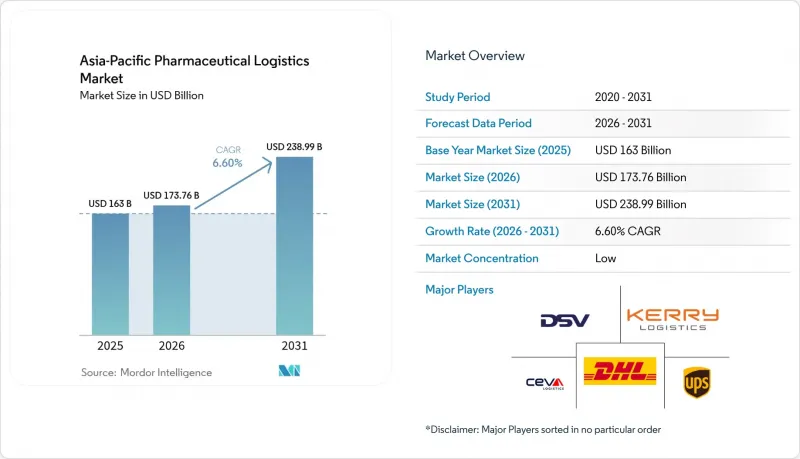
據 Mordor Intelligence 稱,亞太地區的醫藥物流市場在 2025 年的價值為 1,630 億美元,預計到 2031 年將達到 2389.9 億美元,而 2026 年為 1737.6 億美元,預測期(2026-2031 年)的複合年成長率為 60%。
本報告依服務類型(運輸、倉儲、附加價值服務及其他)、營運模式(低溫運輸物流、非低溫運輸物流)、產品類型(處方藥、成藥、臨床試驗用藥等)及地區(中國、印度、日本、韓國等)分類。市場預測以美元計價。
亞太地區醫藥物流市場趨勢及洞察。
生物製藥和疫苗產量增加
亞太地區生物製藥需求的不斷成長正在重塑整個醫藥物流市場的基礎設施需求。這是因為製造商正在運作模組化工廠,這些工廠可以在多個疫苗項目之間切換。賽諾菲在新加坡投資5.95億美元建設的Modulus工廠清楚地表明了該地區擴大產能的必要性,以及配套的端到端低溫物流對於維持關鍵品質特性的重要性。三星生物製劑計劃於2025年在其第五家工廠新增18萬升產能,而BioN-Tech已選擇新加坡為其區域mRNA中心。這兩家公司都在推動對專用儲存和即時監控網路的需求。這些投資正在提高亞太地區醫藥物流市場在溫度控制、文件記錄和安全方面的標準。
區域製藥製造中心的擴張
中印兩國的持續整合正促使製造業向專用產業園區分散,進而推動物流走廊的重新設計。在中國,集中採購已擴展至500種藥品,這要求物流供應商在維持服務水準和降低單位成本的同時,處理大規模的貨運量。印度的目標是到2047年實現3500億美元的藥品出口額,這將導致成品藥和原料藥(API)的運輸量增加,而這些藥品必須高效地運輸到港口和機場。韓國新建的生物製藥廠和專業胜肽生產設施凸顯了製造業活動的擴張。這些趨勢正在推動亞太地區醫藥物流市場對統一的品管流程、簡化的海關程序和多模態的需求。
低溫運輸基礎設施高成本
專用儲藏室、經過驗證的冷藏貨櫃和多溫區倉庫需要大量資金投入,這對小規模企業來說是一個挑戰。雖然基於人工智慧的需求預測可以減少產能浪費,但初始投資的絕對金額仍然很高,這減緩了新興市場網路的擴張。檢驗防凍箱性能的本地試點計畫突顯了其性能優勢,但也揭示了提高裝載容量的挑戰,阻礙了其廣泛應用。擴大可重複使用保溫包裝材料的使用有助於解決廢棄物問題,但這需要對清潔和逆向物流回收系統進行投資。
細分市場分析
預計到2025年,運輸服務將佔亞太地區醫藥物流市場收入的62.45%,凸顯了該地區對連接人口密集的製造群與醫院、藥房和出口門戶的多模態物流網路的嚴重依賴。由於公路運輸具有靈活的調度和「最後一公里」的配送優勢,因此在國內物流中佔據主導地位。另一方面,航空網路則在嚴格的溫控條件下運輸對時間要求較高的生物製藥產品。隨著製造商將週轉較慢的產品轉移到低碳路線,海運量增加,而鐵路則提供了沿著中歐軸線的替代路線。目前,一個整合了GPS、物聯網和區塊鏈工具的數位化控制塔正在協調不同運輸方式之間的轉換,從而提高整個亞太地區醫藥物流市場的透明度和合規性。
附加價值服務正以4.55%的複合年成長率快速成長,其中包括庫存最佳化、法規文件準備和品質保證。藥品托運商需要符合GDP認證的倉庫,該倉庫需在同一設施內配備溫控常溫區、冷藏區和冷凍區,並需要二次包裝和貼標服務。即時溫度監控系統、自動化揀貨系統和預測性補貨演算法正在提升服務期望。因此,物流供應商越來越傾向於提供涵蓋運輸、倉儲和合規的端到端契約,而亞太地區的藥品物流市場正朝著一體化供應鏈協調的方向發展。
其他好處:
- Excel格式的市場預測(ME)表
- 3個月的分析師支持
目錄
第1章:引言
- 研究假設和市場定義
- 調查範圍
第2章:調查方法
第3章執行摘要
第4章 市場狀況
- 市場概覽
- 市場促進因素
- 生物製藥和疫苗銷售量成長
- 該地區藥品製造地的擴張
- 藥品電子商務分銷的成長
- 國家基本藥物中心改革(中國、印度)
- 東協的GDP法規正在加速低溫運輸升級。
- 利用人工智慧進行路線最佳化,降低浪費率
- 市場限制因素
- 低溫運輸基礎設施成本高昂
- 應對涉及多個國家的複雜法規
- 二線城市生物製藥領域訓練有素的人員短缺
- 監測航空貨運航線的碳排放
- 價值供應鏈分析
- 監理情勢
- 技術展望
- 波特五力模型
- 新冠疫情與地緣政治事件的影響
第5章 市場規模與成長預測
- 按服務類型
- 運輸
- 公路貨運
- 空運
- 海上運輸
- 鐵路貨運
- 倉庫/存儲
- 附加價值服務及其他
- 運輸
- 透過操作模式
- 低溫運輸物流
- 非低溫運輸物流
- 依產品類型
- 處方藥
- 非處方藥
- 生物製劑和生物相似藥
- 疫苗和血液製品
- 臨床試驗樣本
- 細胞和基因治療
- 醫療設備及診斷設備
- 動物用藥品
- 其他
- 國家
- 中國
- 印度
- 日本
- 韓國
- 新加坡
- 澳洲
- 印尼
- 泰國
- 越南
- 其他亞太國家
第6章 競爭情勢
- 市場集中度
- 策略趨勢
- 市佔率分析
- 公司簡介
- DHL
- Kuehne+Nagel
- DSV
- UPS
- CEVA Logistics
- Kerry Logistics
- Sinotrans
- Yusen Logistics
- Nippon Express
- Toll Group
- SF Express
- Linfox
- Geodis
- Biocair
- NAF Pharma
- SEKO Logistics
- AIT Worldwide Logistics
- Clinigen Group PLC
- Nichirei Logistics Group Inc
- LX Pantos
第7章 市場機會與未來展望
According to Mordor Intelligence, the Asia-Pacific pharmaceutical logistics market size was valued at USD 163 billion in 2025 and estimated to grow from USD 173.76 billion in 2026 to reach USD 238.99 billion by 2031, at a CAGR of 6.60% during the forecast period (2026-2031).
This report is Segmented by Service Type (Transportation, Warehousing & Storage, Value-Added Services and Others), Mode of Operation (Cold-Chain Logistics, Non-Cold-Chain Logistics), Product Type (Prescription Drugs, OTC Drugs, Clinical Trial Materials, and More), and Geography (China, India, Japan, South Korea, and More). The Market Forecasts are Provided in Terms of Value (USD).
Asia-Pacific Pharmaceutical Logistics Market Trends and Insights
Rising biologics and vaccine volumes
Demand for biologics reshapes infrastructure requirements across the Asia Pacific pharmaceutical logistics market as manufacturers commission modular plants capable of switching among multiple vaccine programs. Sanofi's USD 595 million Modulus facility in Singapore illustrates the region's capacity build-up and the consequent need for end-to-end cryogenic logistics capable of maintaining critical quality attributes.Samsung Biologics added 180,000 L of capacity at its fifth plant in 2025, while BioNTech chose Singapore for a regional mRNA hub, both exerting upward pressure on specialized storage and real-time monitoring networks. Such investments raise the baseline for temperature assurance, documentation, and security in the Asia Pacific pharmaceutical logistics market.
Expansion of regional pharma manufacturing hubs
Continued consolidation in China and India spreads manufacturing volumes across purpose-built industrial zones, prompting a redesign of distribution corridors. China's centralized procurement now covers 500 medicines, pushing logistics providers to handle larger shipment lots at lower per-unit prices while ensuring service levels. India, targeting USD 350 billion in pharmaceutical exports by 2047, increases finished-dose and API throughput that must move efficiently to ports and airports. New biologics plants in South Korea and specialized peptide facilities underline the breadth of manufacturing activity. These developments heighten demand for harmonized quality processes, customs facilitation, and multimodal connectivity in the Asia Pacific pharmaceutical logistics market.
High cold-chain infrastructure cost
Specialized storage rooms, validated reefers, and multi-temperature warehouses require significant capital, challenging smaller operators. Although AI-based forecasting lowers capacity wastage, the absolute upfront spend remains high, slowing network roll-out in emerging markets. Rural pilots that tested freeze-preventive boxes underscored performance benefits yet revealed payload weight penalties that limited wide uptake. Higher adoption of reusable thermal packaging addresses waste but necessitates investment in cleaning and reverse logistics circuits.
Other drivers and restraints analyzed in the detailed report include:
- Growth of e-commerce pharma distribution
- National essential-drug hub reforms (China, India)
- Complex multi-country regulatory compliance
For complete list of drivers and restraints, kindly check the Table Of Contents.
Segment Analysis
Transportation services represented 62.45% of the Asia Pacific pharmaceutical logistics market revenue in 2025, underscoring the region's heavy reliance on multimodal distribution networks that link dense manufacturing clusters with hospitals, pharmacies, and export gateways. Road freight captured the bulk of domestic flows thanks to flexible scheduling and last-mile reach, while air networks handled time-critical biologics under active temperature control. Sea freight volumes grew as manufacturers shifted slower-moving products to lower-carbon lanes, and rail connections provided an alternate corridor along the China-Europe axis. Digital control towers integrating GPS, IoT, and blockchain tools now orchestrate modal transfers, enhancing visibility and regulatory compliance across the Asia Pacific pharmaceutical logistics market.
Value-added services expanded to a 4.55% CAGR and included inventory optimization, regulatory documentation, and quality assurance. Pharmaceutical shippers require GDP-certified warehousing that offers controlled ambient, refrigerated, and frozen zones within single facilities, as well as secondary packaging and labeling services. Real-time temperature dashboards, automated picking systems, and predictive replenishment algorithms elevate service expectations. As a result, logistics providers increasingly pursue end-to-end contracts that bundle transport, storage, and compliance, moving the Asia Pacific pharmaceutical logistics market toward integrated supply-chain orchestration.
Complete Report Scope:
- By Service Type
- Transportation
- Road Freight
- Air Freight
- Sea Freight
- Rail Freight
- Warehousing & Storage
- Value-added Services and Others
- Transportation
- By Mode of Operation
- Cold-Chain Logistics
- Non-Cold-Chain Logistics
- By Product Type
- Prescription Drugs
- OTC Drugs
- Biologics & Biosimilars
- Vaccines & Blood Products
- Clinical Trail Materials
- Cell & Gene Therapies
- Medical Devices & Diagnostics
- Veterinary Medicine
- Others
- By Country
- China
- India
- Japan
- South Korea
- Singapore
- Australia
- Indonesia
- Thailand
- Vietnam
- Rest of Asia Pacific
List of Companies Covered in this Report:
- DHL
- Kuehne + Nagel
- DSV
- UPS
- CEVA Logistics
- Kerry Logistics
- Sinotrans
- Yusen Logistics
- Nippon Express
- Toll Group
- SF Express
- Linfox
- Geodis
- Biocair
- NAF Pharma
- SEKO Logistics
- AIT Worldwide Logistics
- Clinigen Group PLC
- Nichirei Logistics Group Inc
- LX Pantos
Additional Benefits:
- The market estimate (ME) sheet in Excel format
- 3 months of analyst support
TABLE OF CONTENTS
1 Introduction
- 1.1 Study Assumptions & Market Definition
- 1.2 Scope of the Study
2 Research Methodology
3 Executive Summary
4 Market Landscape
- 4.1 Market Overview
- 4.2 Market Drivers
- 4.2.1 Rising biologics & vaccine volumes
- 4.2.2 Expansion of regional pharma manufacturing hubs
- 4.2.3 Growth of e-commerce pharma distribution
- 4.2.4 National Essential-Drugs hub reforms (China, India)
- 4.2.5 ASEAN GDP enforcement accelerating cold-chain upgrades
- 4.2.6 AI-enabled route-optimization lowering spoilage rates
- 4.3 Market Restraints
- 4.3.1 High cold-chain infrastructure cost
- 4.3.2 Complex multi-country regulatory compliance
- 4.3.3 Scarcity of biologics-trained staff in Tier-2 cities
- 4.3.4 Carbon-emissions scrutiny on air freight corridors
- 4.4 Value / Supply-Chain Analysis
- 4.5 Regulatory Landscape
- 4.6 Technological Outlook
- 4.7 Porter's Five Forces
- 4.7.1 Bargaining Power of Suppliers
- 4.7.2 Bargaining Power of Buyers
- 4.7.3 Threat of New Entrants
- 4.7.4 Threat of Substitutes
- 4.7.5 Intensity of Competitive Rivalry
- 4.8 Impact of COVID-19 and Geo-Political Events
5 Market Size & Growth Forecasts (Value)
- 5.1 By Service Type
- 5.1.1 Transportation
- 5.1.1.1 Road Freight
- 5.1.1.2 Air Freight
- 5.1.1.3 Sea Freight
- 5.1.1.4 Rail Freight
- 5.1.2 Warehousing & Storage
- 5.1.3 Value-added Services and Others
- 5.1.1 Transportation
- 5.2 By Mode of Operation
- 5.2.1 Cold-Chain Logistics
- 5.2.2 Non-Cold-Chain Logistics
- 5.3 By Product Type
- 5.3.1 Prescription Drugs
- 5.3.2 OTC Drugs
- 5.3.3 Biologics & Biosimilars
- 5.3.4 Vaccines & Blood Products
- 5.3.5 Clinical Trail Materials
- 5.3.6 Cell & Gene Therapies
- 5.3.7 Medical Devices & Diagnostics
- 5.3.8 Veterinary Medicine
- 5.3.9 Others
- 5.4 By Country
- 5.4.1 China
- 5.4.2 India
- 5.4.3 Japan
- 5.4.4 South Korea
- 5.4.5 Singapore
- 5.4.6 Australia
- 5.4.7 Indonesia
- 5.4.8 Thailand
- 5.4.9 Vietnam
- 5.4.10 Rest of Asia Pacific
6 Competitive Landscape
- 6.1 Market Concentration
- 6.2 Strategic Moves
- 6.3 Market Share Analysis
- 6.4 Company Profiles {(includes Global level Overview, Market level overview, Core Segments, Financials as available, Strategic Information, Market Rank/Share, Products & Services, Recent Developments)}
- 6.4.1 DHL
- 6.4.2 Kuehne + Nagel
- 6.4.3 DSV
- 6.4.4 UPS
- 6.4.5 CEVA Logistics
- 6.4.6 Kerry Logistics
- 6.4.7 Sinotrans
- 6.4.8 Yusen Logistics
- 6.4.9 Nippon Express
- 6.4.10 Toll Group
- 6.4.11 SF Express
- 6.4.12 Linfox
- 6.4.13 Geodis
- 6.4.14 Biocair
- 6.4.15 NAF Pharma
- 6.4.16 SEKO Logistics
- 6.4.17 AIT Worldwide Logistics
- 6.4.18 Clinigen Group PLC
- 6.4.19 Nichirei Logistics Group Inc
- 6.4.20 LX Pantos
7 Market Opportunities & Future Outlook
- 7.1 White-Space & Unmet-Need Assessment

 2026-2030年全球醫學流市場
 英國醫藥物流:市場佔有率分析、產業趨勢與統計、成長預測(2026-2031)生物製藥物流:市場佔有率分析、產業趨勢與統計、成長預測(2026-2031)北美醫藥物流:市場佔有率分析、產業趨勢與統計及成長預測(2026-2031)歐洲醫藥物流:市場佔有率分析、產業趨勢與統計及成長預測(2026-2031)
 醫藥物流市場分析及至2035年的預測:依類型、產品、服務、技術、組件、應用、設備、運輸方式及階段
 生物製藥物流市場:2026-2032年全球市場預測(依產品類型、服務類型、運輸方式、溫度需求及最終用戶分類)中國醫藥物流:市場佔有率分析、產業趨勢與統計及成長預測(2026-2031)
 全球醫藥物流市場:依服務類型、類型、產品類型、最終用戶和地區分類
 醫藥物流市場規模、佔有率及成長分析:依運輸方式、服務類型、物流類型、產品類型、最終用戶、應用及地區分類-2026-2033年產業預測