


 |
市場調查報告書
商品編碼
2124358
英國第三方物流(3PL):市場佔有率分析、產業趨勢與統計數據以及成長預測 (2026-2031)United Kingdom Third Party Logistics (3PL) - Market Share Analysis, Industry Trends & Statistics, Growth Forecasts (2026 - 2031) |
||||||

※ 本網頁內容可能與最新版本有所差異。詳細情況請與我們聯繫。
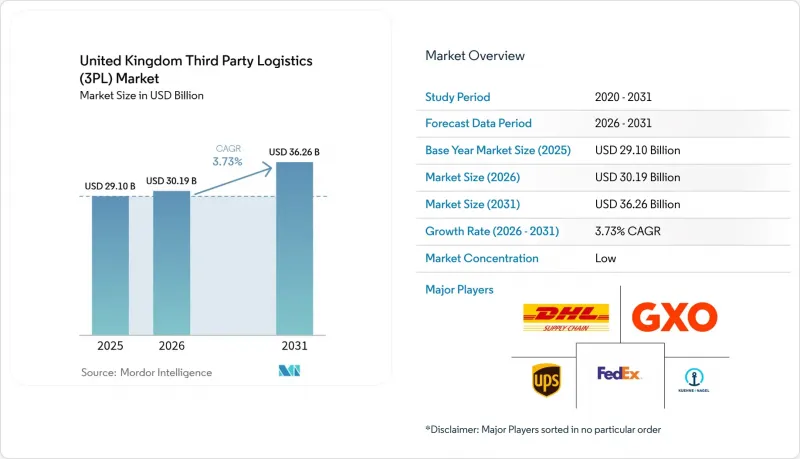
根據 Mordor Intelligence 預測,英國第三方物流(3PL) 市場規模將從 2025 年的 291 億美元成長到 2026 年的 301.9 億美元,然後在 2031 年達到 362.6 億美元,2026 年至 2031 年的複合年成長率為 3.73%。
本報告按服務(國內運輸管理、國際運輸管理及其他)、最終用戶(汽車、能源與公共產業、製造業、生命科學與醫療保健及其他)、物流模式(輕資產、重資產、混合模式)和地區(英格蘭、蘇格蘭及其他)進行細分。市場預測以美元計價。
英國第三方物流(3PL) 市場的趨勢與洞察
電子商務小包裹數量正在爆炸式成長。
如今,英國線上零售佔所有購物的30%。訂單頻率的快速成長迫使第三方物流公司(3PL)在都市區擴展其微型倉配中心,亞馬遜的「Project Juniper」網路就是一個典型的例子,該網路將配送時間縮短至短短幾小時。 DPD集團英國公司已在米爾頓凱恩斯完成了超過2500次自主「最後一公里」配送,這表明機器人技術能夠滿足商業性服務等級協定(SLA)的要求。倫敦Portal Way沿線聚集的260個「暗廚房」則反映了快速商務模式如何重塑倉儲需求。隨著零售商傾向於全通路履約,那些將B2B物流與直接面對消費者配送結合的企業正在獲得更高的合約價值和更長的合約期限。
政府為貨運提供脫碳獎勵
政府已累計2.54億美元用於零排放重型車輛(HGV)試點項目,並設定了2040年逐步淘汰新型柴油卡車的最後期限。先行者將在競標中獲得優勢。 HIVED公司已訂購11輛配備600千瓦時電池的梅賽德斯-奔馳eActros電動中程貨車,擴大了其全電動中程配送車隊,這些車輛續航里程可達310英里。此外,該公司還投資2,096萬美元維修了38個卡車休息站,安裝了大容量充電樁並改善了駕駛員設施,從而降低了電動卡車運輸的續航里程顧慮。冷鏈運輸每年排放1,410萬噸二氧化碳當量,因此溫控運輸的電氣化已成為監管重點。 ISO 14001認證正逐漸成為公共部門競標的必要條件,這將獎勵那些早期投資永續資產的第三方物流(3PL)公司。
司機和倉庫工人短缺
英國正面臨5萬名大型貨車(HGV)司機的缺口,目前供應量僅32萬,而需求量為37萬,限制了英國第三方物流(3PL)市場的擴張速度。司機的平均年齡為51歲,其中55%的司機年齡在50至65歲之間,顯示人才流失問題日益嚴重。人事費用人事費用佔3PL營運支出的40%以上,自2024年初19%的公司報告勞動力短缺以來,勞動成本已大幅上漲。一項旨在提升就業吸引力的2096萬美元基金用於改造38個卡車停靠站,但倫敦和曼徹斯特的高昂住宅阻礙了新員工的招募。隨著英國脫歐後歐盟工人離開歐盟,倉儲人手不足問題進一步加劇,迫使3PL公司轉向使用機器人和人工智慧進行貨位分配。
細分市場分析
到2025年,英國國內運輸管理將佔英國第三方物流市場規模的41.45%,這反映了英國獨特的以公路為中心的貨運模式。國際運輸管理對於跨境貿易仍然至關重要,但由於海關程序帶來的波動性,利潤率受到擠壓。隨著電子商務公司將人工揀貨、包裝、退貨和套件組裝等作業外包,增值倉儲和物流領域正以7.01%的複合年成長率成長。自動化倉庫系統、溫控倉庫和一體化海關區域正在將倉庫從成本中心轉變為盈利場所。儘管政府1,168億美元的公路和鐵路發展投資正在擴大多式聯運的機會,但由於都市區消費叢集集中在主要公路沿線,第三方物流(3PL)仍將在2031年之前繼續主導英國道路運輸市場佔有率。鐵路和沿海運輸業者正在進入可再生能源項目這一細分市場,這些項目需要運輸超大貨物,它們扮演的是補充角色,而不是取代卡車運輸。
企業對倉儲的日益依賴重塑了合約結構。客戶要求採用與訂單商品數量掛鉤的可變成本定價模式,這與機器人揀選的可擴展性完美契合。隨著對溫度敏感的食品和藥品流通量的增加,冷鏈設施的價格也水漲船高。自動化降低了勞動力需求,營運商正將人員重新分配到更高附加價值的任務,例如組裝和品質控制。將預測分析融入庫存管理的第三方物流公司正逐漸成為首選供應商,推動產業整合的趨勢。
其他好處
- Excel格式的市場預測(ME)表
- 3個月的分析師支持
目錄
第1章:引言
- 研究假設和市場定義
- 調查範圍
第2章:調查方法
第3章執行摘要
第4章 市場狀況
- 市場概覽
- 市場促進因素
- 電子商務小包裹數量正在爆炸式成長。
- 政府為貨運提供脫碳獎勵
- 倉庫自動化與機器人實施
- 英國脫歐後,整合近岸外包和清關功能的第三方物流服務的需求增加。
- 基於訂閱的D2C模式需要微型倉配
- 有關產品安全的法律法規正在促進安全物流的發展。
- 市場限制因素
- 促進要素和倉庫工人短缺
- 與英國脫歐相關的海關摩擦與行政程序
- 大型貨車(HGV)充電設施以及車輛電氣化對電網容量的限制。
- 物流地產稅負增加(2026年起重新評估後)
- 價值供應鏈分析
- 監理情勢
- 技術展望
- 波特五力模型
- 倉儲市場趨勢
- 來自 CEP、最後一公里和冷鏈的需求
- 電子商務趨勢
- 新冠疫情的影響及疫情後重建
第5章 市場規模與成長預測
- 按服務
- 國內運輸管理(DTM)
- 路
- 鐵路
- 航空
- 水路
- 國際運輸管理(ITM)
- 路
- 鐵路
- 航空
- 水路
- 加值倉儲與物流 (VAWD)
- 國內運輸管理(DTM)
- 最終用戶
- 車
- 能源與公共產業
- 製造業
- 生命科學與醫療保健
- 技術電子
- 電子商務
- 消費品和日常消費品(FMCG)
- 飲食
- 其他
- 透過物流模型
- 輕資產(管理類型)
- 資產密集型(公司車輛和倉庫)
- 混合
- 英國各地區
- 英格蘭
- 蘇格蘭
- 威爾斯
- 北愛爾蘭
第6章 競爭情勢
- 市場集中度
- 策略趨勢
- 市佔率分析
- 公司簡介
- DHL Group
- Kuehne+Nagel
- GXO Logistics
- FedEx
- United Parcel Service, Inc.
- DSV
- CEVA Logistics
- Yusen Logistics
- Rhenus Logistics
- Eddie Stobart Logistics
- Xpediator
- Bibby Distribution
- Torque Logistics
- Pointbid Logistics
- XPO Logistics
- Culina Group
- Geodis
- Parcel Hub
- Evri(原名 Hermes)
- Walker Logistics
第7章 市場機會與未來展望
According to Mordor Intelligence, the United Kingdom third party logistics market size is expected to grow from USD 29.10 billion in 2025 to USD 30.19 billion in 2026 and is forecast to reach USD 36.26 billion by 2031 at 3.73% CAGR over 2026-2031.
This report is Segmented by Service (Domestic Transportation Management, International Transportation Management, and More), by End User (Automotive, Energy & Utilities, Manufacturing, Life Sciences & Healthcare, and More), by Logistics Model (Asset-Light, Asset-Heavy, Hybrid), and by Region (England, Scotland, and More). The Market Forecasts are Provided in Terms of Value (USD).
United Kingdom Third Party Logistics (3PL) Market Trends and Insights
Explosive E-commerce Parcel Volumes
Online retail now represents 30% of all U.K. shopping. Rapid ordering frequencies compel 3PLs to enlarge urban micro-fulfillment footprints, evidenced by Amazon's Project Juniper network that cuts delivery windows to hours. DPD Group UK has already completed more than 2,500 autonomous last-mile deliveries in Milton Keynes, proving robotics can meet commercial service-level agreements. London's Portal Way hosts 260 dark kitchens that illustrate how quick-commerce models reshape warehousing demand. As retailers favor omnichannel fulfillment, operators that marry B2B distribution with direct-to-consumer parcel flows secure higher contract values and longer tenures.
Government Decarbonization Incentives for Freight
The government has earmarked USD 254 million for zero-emission HGV trials and set a 2040 deadline for phasing out new diesel trucks. Early movers gain bidding advantages; HIVED expanded its fully electric middle-mile fleet by ordering 11 Mercedes-Benz eActros units with 600 kWh batteries capable of 310-mile ranges. A further USD 20.96 million upgrade of 38 truck stops introduces high-capacity chargers and improved driver amenities, lowering range-anxiety barriers for electric haulage. Cold-chain transport emits 14.1 MtCO2e annually, making temperature-controlled electrification a regulatory priority. ISO 14001 certification is becoming table stakes in public-sector tenders, thereby rewarding 3PLs that invest early in sustainable assets.
Driver & Warehouse-Labor Shortage
The country is short 50,000 HGV drivers, with supply at 320,000 against demand for 370,000, limiting the expansion pace of the United Kingdom's third-party logistics market. The average driver age is 51, and 55% are within 50-65, signaling worsening attrition. Labor costs absorb more than 40% of 3PL operating spend and rose sharply after 19% of firms reported vacancies in early 2024. A USD 20.96 million fund to modernize 38 truck stops aims to improve job attractiveness, yet high housing costs in London and Manchester deter recruits. Warehouse labor gaps compound the issue as EU workers depart post-Brexit, pushing 3PLs toward robots and AI-driven slotting.
Other drivers and restraints analyzed in the detailed report include:
- Warehouse Automation & Robotics Adoption
- Post-Brexit Near-Shoring & Customs-Integrated 3PL Demand
- Brexit-Related Customs Friction & Paperwork
For complete list of drivers and restraints, kindly check the Table Of Contents.
Segment Analysis
The United Kingdom's third-party logistics market size attributable to Domestic Transportation Management stood at 41.45% share in 2025, mirroring the island nation's road-centric freight patterns. International Transportation Management remains critical for cross-border trade but wrestles with customs-driven volatility that depresses margins. Value-Added Warehousing & Distribution is accelerating at 7.01% CAGR as e-commerce clients outsource high-touch pick-pack, returns, and kitting tasks. Automated storage systems, climate-controlled chambers, and integrated customs areas turn warehouses into revenue-rich nodes rather than cost centers. Government road and rail upgrades worth USD 116.8 billion unlock intermodal plays, but the United Kingdom's third-party logistics market share for roads stays dominant through 2031 because urban consumption clusters hug motorway spines. Rail and short-sea players niche into renewable-energy projects requiring oversized-cargo moves, complementing rather than displacing trucking.
Growing enterprise reliance on warehousing has re-shaped contract structures. Clients demand variable-cost pricing tied to order lines, which suits the scalable nature of robotic picking. Cold-chain facilities earn premiums as climate-sensitive food and pharmaceutical flows expand. As automation compresses labor needs, operators redeploy headcount into value-added configuration and quality-check tasks. 3PLs that layer predictive analytics on inventory get preferred-supplier status, reinforcing consolidation trends.
Complete Report Scope:
- By Service
- Domestic Transportation Management (DTM)
- Roadways
- Railways
- Airways
- Waterways
- International Transportation Management (ITM)
- Roadways
- Railways
- Airways
- Waterways
- Value-Added Warehousing & Distribution (VAWD)
- Domestic Transportation Management (DTM)
- By End User
- Automotive
- Energy & Utilities
- Manufacturing
- Life Sciences & Healthcare
- Technology & Electronics
- E-commerce
- Consumer Goods & FMCG
- Food & Beverages
- Others
- By Logistics Model
- Asset-Light (Management-Based)
- Asset-Heavy (Own Fleet & Warehouses)
- Hybrid
- By UK Region
- England
- Scotland
- Wales
- Northern Ireland
List of Companies Covered in this Report:
- DHL Group
- Kuehne + Nagel
- GXO Logistics
- FedEx
- United Parcel Service, Inc.
- DSV
- CEVA Logistics
- Yusen Logistics
- Rhenus Logistics
- Eddie Stobart Logistics
- Xpediator
- Bibby Distribution
- Torque Logistics
- Pointbid Logistics
- XPO Logistics
- Culina Group
- Geodis
- Parcel Hub
- Evri (Formerly Hermes)
- Walker Logistics
Additional Benefits:
- The market estimate (ME) sheet in Excel format
- 3 months of analyst support
TABLE OF CONTENTS
1 Introduction
- 1.1 Study Assumptions & Market Definition
- 1.2 Scope of the Study
2 Research Methodology
3 Executive Summary
4 Market Landscape
- 4.1 Market Overview
- 4.2 Market Drivers
- 4.2.1 Explosive e-commerce parcel volumes
- 4.2.2 Government decarbonisation incentives for freight
- 4.2.3 Warehouse automation & robotics adoption
- 4.2.4 Post-Brexit near-shoring & customs-integrated 3PL demand
- 4.2.5 Subscription D2C models requiring micro-fulfilment
- 4.2.6 Product-security legislation boosting secure logistics
- 4.3 Market Restraints
- 4.3.1 Driver & warehouse-labour shortage
- 4.3.2 Brexit-related customs friction & paperwork
- 4.3.3 HGV-charging & grid-capacity limits for fleet electrification
- 4.3.4 Logistics-property tax rise (post-2026 revaluation)
- 4.4 Value / Supply-Chain Analysis
- 4.5 Regulatory Landscape
- 4.6 Technological Outlook
- 4.7 Porter's Five Forces
- 4.7.1 Threat of New Entrants
- 4.7.2 Bargaining Power of Buyers
- 4.7.3 Bargaining Power of Suppliers
- 4.7.4 Threat of Substitutes
- 4.7.5 Competitive Rivalry
- 4.8 Warehousing Market Trends
- 4.9 Demand from CEP, Last-mile, Cold-chain
- 4.10 Ecommerce Insights
- 4.11 Impact of COVID-19 & Post-pandemic Reset
5 Market Size & Growth Forecasts (Value)
- 5.1 By Service
- 5.1.1 Domestic Transportation Management (DTM)
- 5.1.1.1 Roadways
- 5.1.1.2 Railways
- 5.1.1.3 Airways
- 5.1.1.4 Waterways
- 5.1.2 International Transportation Management (ITM)
- 5.1.2.1 Roadways
- 5.1.2.2 Railways
- 5.1.2.3 Airways
- 5.1.2.4 Waterways
- 5.1.3 Value-Added Warehousing & Distribution (VAWD)
- 5.1.1 Domestic Transportation Management (DTM)
- 5.2 By End User
- 5.2.1 Automotive
- 5.2.2 Energy & Utilities
- 5.2.3 Manufacturing
- 5.2.4 Life Sciences & Healthcare
- 5.2.5 Technology & Electronics
- 5.2.6 E-commerce
- 5.2.7 Consumer Goods & FMCG
- 5.2.8 Food & Beverages
- 5.2.9 Others
- 5.3 By Logistics Model
- 5.3.1 Asset-Light (Management-Based)
- 5.3.2 Asset-Heavy (Own Fleet & Warehouses)
- 5.3.3 Hybrid
- 5.4 By UK Region
- 5.4.1 England
- 5.4.2 Scotland
- 5.4.3 Wales
- 5.4.4 Northern Ireland
6 Competitive Landscape
- 6.1 Market Concentration
- 6.2 Strategic Moves
- 6.3 Market Share Analysis
- 6.4 Company Profiles (includes Global level Overview, Market level overview, Core Segments, Financials as available, Strategic Information, Market Rank/Share for key companies, Products & Services, and Recent Developments)
- 6.4.1 DHL Group
- 6.4.2 Kuehne + Nagel
- 6.4.3 GXO Logistics
- 6.4.4 FedEx
- 6.4.5 United Parcel Service, Inc.
- 6.4.6 DSV
- 6.4.7 CEVA Logistics
- 6.4.8 Yusen Logistics
- 6.4.9 Rhenus Logistics
- 6.4.10 Eddie Stobart Logistics
- 6.4.11 Xpediator
- 6.4.12 Bibby Distribution
- 6.4.13 Torque Logistics
- 6.4.14 Pointbid Logistics
- 6.4.15 XPO Logistics
- 6.4.16 Culina Group
- 6.4.17 Geodis
- 6.4.18 Parcel Hub
- 6.4.19 Evri (Formerly Hermes)
- 6.4.20 Walker Logistics
7 Market Opportunities & Future Outlook

 第三方物流(3PL) 市場:依服務類型、運輸方式、最終用戶和地區分類
 美國零售第三方物流:市場佔有率分析、行業趨勢和統計數據、成長預測(2026-2031 年)零售第三方物流:市場佔有率分析、產業趨勢與統計、成長預測(2026-2031)印度第三方物流:市場佔有率分析、產業趨勢與統計及成長預測(2026-2031)德國第三方物流(3PL):市場佔有率分析、產業趨勢與統計及成長預測 (2026-2031)法國第三方物流(3PL):市場佔有率分析、產業趨勢與統計及成長預測 (2026-2031)
 LLM精細化服務市場規模、佔有率、成長及全球產業分析、區域趨勢及2026年至2034年預測
 第三方化學品分銷市場:全球市場預測,2026-2032年第三方物流軟體市場:全球市場預測,2026-2032年第三方物流市場-2026-2032年全球市場預測