


 |
市場調查報告書
商品編碼
2114956
印度第三方物流:市場佔有率分析、產業趨勢與統計及成長預測(2026-2031)India 3PL - Market Share Analysis, Industry Trends & Statistics, Growth Forecasts (2026 - 2031) |
||||||

※ 本網頁內容可能與最新版本有所差異。詳細情況請與我們聯繫。
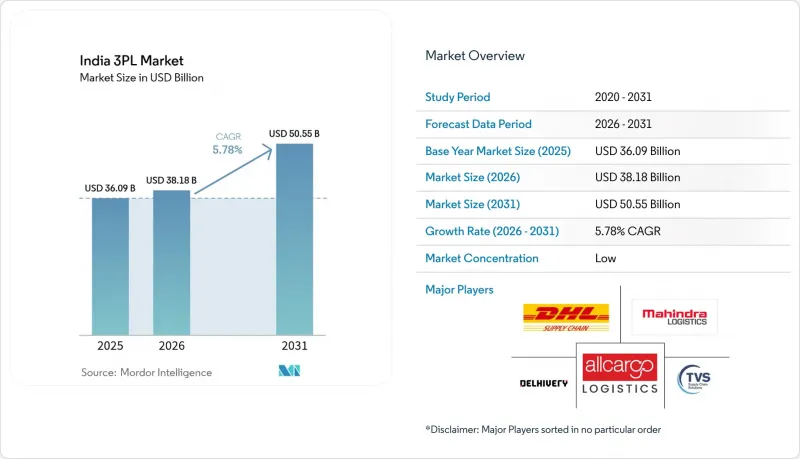
據 Mordor Intelligence 稱,印度第三方物流市場預計到 2026 年價值 381.8 億美元,高於 2025 年的 360.9 億美元,預計到 2031 年將達到 505.5 億美元。
預計從 2026 年到 2031 年,其複合年成長率將達到 5.78%。
本報告按服務類型(例如,國內運輸管理、國際運輸管理)、最終用戶(例如,公共產業、能源和公用事業、製造業)、物流模式(輕資產、重資產、混合模式)以及地區(印度北部、印度南部、印度西部、印度東部、印度中部)進行細分。市場預測以美元計價。
印度第三方物流市場的趨勢與洞察
電子商務訂單激增。
網路購物的快速發展已將貨物運輸模式從大批量托盤式B2B貨運轉變為數百萬件需要精準「最後一公里」配送的B2C小包裹。如今,快運平台承諾兩小時內送達,迫使第三方物流公司部署微型倉配中心和人工智慧分類機以縮短配送週期。像Delhivery這樣的供應商正在整合「暗店」(dark store)以提高網路密度並實現當日送達。 ONDC的開放式網路整合了在地化專家,即使是小規模經銷商也能即時連接全國配送網路。預計快遞小包裹年吞吐量將實現兩位數成長,能夠兼顧都市區配送速度和覆蓋農村地區的強大配送網路的營運商將佔據大部分市場佔有率。
政府促進基礎建設發展(Ghati Shakti、DFC)
一個統一的數位入口網站現已支援44個部會協作,並在同一張地圖上集中管理專案核准和貨物運輸路線。已建成的東部和西部專用貨運走廊縮短了古吉拉突邦港口至北部消費中心的出口貨物運輸時間,提高了鐵路貨運的獲利能力和可靠性。根據「國家基礎設施管道」計劃,超過6,020億美元的公共投資正在為多模態園區購買土地,這些園區將連接公路、鐵路和沿海航運,形成連續的走廊。對於印度的第三方物流(3PL)市場而言,這些走廊將降低直接營運成本,並促進運輸方式的轉變,從而緩解道路擁塞。
分散的貨車運輸能力和低能見度
公路貨運仍依賴數百萬輛未配備遠端資訊處理或路線最佳化系統的個體貨車車主。小規模車隊的這種主導地位削弱了服務的可靠性,增加了車輛的空轉里程,並限制了托運人所期望的即時更新。頻繁的路邊檢查加劇了車輛的停留時間,尤其是在基礎設施不完善的東行車道上。儘管數位化貨運交易平台正在湧現,但其普及程度仍參差不齊,印度第三方物流市場的資訊透明度仍存在差距。
細分市場分析
至2025年,國內運輸管理將佔印度第三方物流市場55.40%的佔有率。這反映出印度經濟對城際貨運道路運輸的持續依賴。然而,燃油價格波動和司機短缺正給利潤率帶來壓力,迫使現有業者採用路線最佳化演算法和繼電器卡車運輸模式。加值倉儲和物流服務以6.84%的複合年成長率成長,在所有服務中位居榜首,這主要得益於全通路零售商對延遲客製化、套件組裝和溫控倉儲需求的不斷成長。專用貨運走廊正將更多散裝貨物集中到鐵路運輸,迫使僅依賴道路運輸的業者在幹線路段上合作。這種轉變清晰地顯示了市場日益成長的多模態特性。
自動化倉庫系統和「貨到人」機器人已成為新倉庫的標配,而基於雲端的倉庫管理系統 (WMS) 則使第三方物流(3PL) 服務商能夠即時整合多個客戶的庫存狀態。印度擴大出口的願望推動了國際運輸的發展。像 Delhivery 和 Team Global Logistics 這樣的合作項目使得印度能夠向 120 個國家提供拼箱 (LCL) 運輸服務。沿海路線目前仍屬於小眾領域,但在「薩加爾馬拉計畫」的推動下,其重要性日益凸顯;空運則負責運輸藥品和電子產品等對時間要求較高的貨物。由於客戶重視承包可視性,因此,能夠將這些運輸方式整合到單一控制平台中的服務商正在印度的第三方物流市場中獲得長期合約和交叉銷售的機會。
其他好處:
- Excel格式的市場預測(ME)表
- 3個月的分析師支持
目錄
第1章:引言
- 研究假設和市場定義
- 調查範圍
第2章:調查方法
第3章執行摘要
第4章 市場狀況
- 市場概覽
- 市場促進因素
- 電子商務訂單激增。
- 政府促進基礎建設發展(Ghati Shakti、DFC)
- 快速消費品和零售業對整合解決方案的需求
- 中小微型企業向多客戶自動化倉庫(ONDC)遷移
- 托運人提出的永續性要求
- D2C和快速交易在二、三線城市盛行。
- 市場限制因素
- 卡車運輸能力分散且缺乏透明度
- 燃油成本、通行費和合規成本不斷上漲
- 倉儲自動化領域人員短缺
- 資料本地化導致IT成本上升
- 價值供應鏈分析
- 監理情勢
- 技術展望
- 倉儲和履約趨勢
- 來自 CEP 和最後一公里配送的需求
- 電子商務的影響
- 波特五力模型
第5章 市場規模與成長預測
- 按服務
- 國內運輸管理(DTM)
- 路
- 鐵路
- 空中航線
- 水路
- 國際運輸管理(ITM)
- 路
- 鐵路
- 空中航線
- 水路
- 加值倉儲與物流 (VAWD)
- 國內運輸管理(DTM)
- 最終用戶
- 車
- 能源公用事業
- 製造業
- 生命科學與醫療保健
- 技術與電子
- 電子商務
- 消費品和快速消費品
- 食品/飲料
- 其他
- 物流模型
- 輕資產
- 資產密集型
- 混合
- 按地區
- 印度北部
- 德里首都區
- 旁遮普邦
- 哈里亞納邦
- 其他
- 南印度
- 卡納塔克邦
- 泰米爾納德邦
- 特倫甘納邦
- 其他
- 西印度群島
- 馬哈拉斯特拉邦
- 古吉拉突邦
- 其他
- 東印度
- 西孟加拉邦
- 奧里薩邦
- 其他
- 印度中部
- 中央邦
- 恰蒂斯加爾邦
- 印度北部
第6章 競爭情勢
- 市場集中度
- 策略趨勢與發展
- 市佔率分析
- 公司簡介
- Allcargo Logistics Ltd.
- DHL Group
- Mahindra Logistics Ltd.
- TVS Supply Chain Solutions Ltd.
- Delhivery Ltd.
- Transworld
- FedEx
- Safexpress Pvt. Ltd.
- Kuehne+Nagel India Pvt. Ltd.
- DSV India
- TCI Supply Chain Solutions
- CJ Darcl Logistics Ltd.
- XpressBees Solutions Pvt. Ltd.
- DTDC Express Ltd.
- Nitco Logistics Pvt. Ltd.
- Future Supply Chain Solutions Ltd.
- Snowman Logistics
- Shadowfax Pvt. Ltd.
- Om Logistics Ltd.
- KD Logistics
第7章 市場機會與未來展望
According to Mordor Intelligence, India 3PL market size in 2026 is estimated at USD 38.18 billion, growing from 2025 value of USD 36.09 billion with 2031 projections showing USD 50.55 billion, growing at 5.78% CAGR over 2026-2031.
This report is Segmented by Service (Domestic Transportation Management, International Transportation Management, and More), by End User (Automotive, Energy and Utilities, Manufacturing, and More), by Logistics Model (Asset-Light, Asset-Heavy, Hybrid) and by Region (North India, South India, West India, East India, Central India). The Market Forecasts are Provided in Terms of Value (USD).
India 3PL Market Trends and Insights
E-commerce order-volume surge
Rapid growth in online shopping has shifted freight from bulk B2B pallets to millions of B2C parcels that demand precise last-mile execution. Quick-commerce platforms now promise two-hour delivery windows, compelling 3PLs to install micro-fulfillment nodes and AI-enabled sorters that compress cycle times. Providers such as Delhivery are pooling dark stores to boost network density for same-day reach. ONDC's open network integrates hyperlocal specialists, giving smaller sellers instant access to nationwide delivery rails. Annual express-parcel movements are on course for double-digit expansion, and the provider that balances urban speed with rural reach will capture an outsized wallet share.
Government infrastructure push (Gati Shakti, DFCs)
A unified digital portal now synchronizes 44 ministries, enabling project approvals and cargo routing to converge on a single map. The completed Eastern and Western Dedicated Freight Corridors have already trimmed transit times for export consignments leaving Gujarat ports for northern consumption centers, lifting rail freight revenue and reliability. Over USD 602 billion in planned public investment under the National Infrastructure Pipeline is unlocking land for multimodal parks that knit road, rail, and coastal shipping into continuous corridors. For the India third-party logistics market, these corridors lower direct operating costs and encourage modal shifts that dilute road congestion.
Fragmented trucking capacity & low visibility
Road freight still leans on millions of single-truck owners who operate without telematics or route optimization. The dominance of such micro-fleets erodes service reliability, inflates empty-haul mileage, and limits the real-time updates shippers expect. Multiple roadside inspections exacerbate dwell times, particularly on east-bound lanes where infrastructure lags. Although digital freight exchanges are emerging, adoption remains uneven, keeping the visibility gap wide for the India third-party logistics market.
Other drivers and restraints analyzed in the detailed report include:
- FMCG & retail demand for integrated solutions
- MSME shift to multi-client automated warehouses (ONDC)
- Rising fuel, toll, and compliance costs
For complete list of drivers and restraints, kindly check the Table Of Contents.
Segment Analysis
Domestic transportation management generated 55.40% of India's third-party logistics market in 2025, reflecting the economy's continued road dependence for inter-city cargo. Fuel volatility and driver scarcity, however, are pressuring margins, pushing incumbents toward route optimization algorithms and relay trucking concepts. Value-added warehousing & distribution is growing at a 6.84% CAGR, the fastest among all services, as omnichannel retailers demand deferred customization, kitting, and temperature-controlled storage. Dedicated freight corridors funnel more bulk product to rail, nudging road-only operators to partner for line-haul legs, a shift that exemplifies the market's multimodal evolution.
Automated storage and retrieval systems and goods-to-person robots are now standard in new builds, and cloud WMS lets 3PLs integrate inventory views across multiple clients in real time. International transportation rides on India's export ambitions; alliances like Delhivery-Team Global Logistics offer LCL connectivity to 120 countries. Coastal shipping remains niche but gains relevance under Sagarmala, while airfreight addresses time-critical pharma and electronics consignments. As customers prize turnkey visibility, providers that knit these modes into one control-tower dashboard are winning longer contracts and cross-selling opportunities in the India third-party logistics market.
Complete Report Scope:
- By Service
- Domestic Transportation Management (DTM)
- Roadways
- Railways
- Airways
- Waterways
- International Transportation Management (ITM)
- Roadways
- Railways
- Airways
- Waterways
- Value-Added Warehousing & Distribution (VAWD)
- Domestic Transportation Management (DTM)
- By End User
- Automotive
- Energy & Utilities
- Manufacturing
- Life Sciences & Healthcare
- Technology & Electronics
- E-commerce
- Consumer Goods & FMCG
- Food & Beverages
- Others
- By Logistics Model
- Asset-Light
- Asset-Heavy
- Hybrid
- By Region (Value)
- North India
- Delhi-NCR
- Punjab
- Haryana
- Others
- South India
- Karnataka
- Tamil Nadu
- Telangana
- Others
- West India
- Maharashtra
- Gujarat
- Others
- East India
- West Bengal
- Odisha
- Others
- Central India
- Madhya Pradesh
- Chhattisgarh
- North India
List of Companies Covered in this Report:
- Allcargo Logistics Ltd.
- DHL Group
- Mahindra Logistics Ltd.
- TVS Supply Chain Solutions Ltd.
- Delhivery Ltd.
- Transworld
- FedEx
- Safexpress Pvt. Ltd.
- Kuehne + Nagel India Pvt. Ltd.
- DSV India
- TCI Supply Chain Solutions
- CJ Darcl Logistics Ltd.
- XpressBees Solutions Pvt. Ltd.
- DTDC Express Ltd.
- Nitco Logistics Pvt. Ltd.
- Future Supply Chain Solutions Ltd.
- Snowman Logistics
- Shadowfax Pvt. Ltd.
- Om Logistics Ltd.
- KD Logistics
Additional Benefits:
- The market estimate (ME) sheet in Excel format
- 3 months of analyst support
TABLE OF CONTENTS
1 Introduction
- 1.1 Study Assumptions & Market Definition
- 1.2 Scope of the Study
2 Research Methodology
3 Executive Summary
4 Market Landscape
- 4.1 Market Overview
- 4.2 Market Drivers
- 4.2.1 E-commerce order-volume surge
- 4.2.2 Government infrastructure push (Gati Shakti, DFCs)
- 4.2.3 FMCG & retail demand for integrated solutions
- 4.2.4 MSME shift to multi-client automated warehouses (ONDC)
- 4.2.5 Sustainability mandates from shippers
- 4.2.6 D2C & quick-commerce penetration in Tier-2/3 cities
- 4.3 Market Restraints
- 4.3.1 Fragmented trucking capacity & low visibility
- 4.3.2 Rising fuel, toll and compliance costs
- 4.3.3 Warehouse-automation talent crunch
- 4.3.4 Data-localisation driven IT-cost inflation
- 4.4 Value / Supply-Chain Analysis
- 4.5 Regulatory Landscape
- 4.6 Technological Outlook
- 4.7 Warehousing & Fulfilment Trends
- 4.8 Demand from CEP & Last-mile Delivery
- 4.9 E-commerce Influence
- 4.10 Porter's Five Forces
- 4.10.1 Threat of New Entrants
- 4.10.2 Bargaining Power of Suppliers
- 4.10.3 Bargaining Power of Buyers
- 4.10.4 Threat of Substitutes
- 4.10.5 Competitive Rivalry
5 Market Size & Growth Forecasts
- 5.1 By Service
- 5.1.1 Domestic Transportation Management (DTM)
- 5.1.1.1 Roadways
- 5.1.1.2 Railways
- 5.1.1.3 Airways
- 5.1.1.4 Waterways
- 5.1.2 International Transportation Management (ITM)
- 5.1.2.1 Roadways
- 5.1.2.2 Railways
- 5.1.2.3 Airways
- 5.1.2.4 Waterways
- 5.1.3 Value-Added Warehousing & Distribution (VAWD)
- 5.1.1 Domestic Transportation Management (DTM)
- 5.2 By End User
- 5.2.1 Automotive
- 5.2.2 Energy & Utilities
- 5.2.3 Manufacturing
- 5.2.4 Life Sciences & Healthcare
- 5.2.5 Technology & Electronics
- 5.2.6 E-commerce
- 5.2.7 Consumer Goods & FMCG
- 5.2.8 Food & Beverages
- 5.2.9 Others
- 5.3 By Logistics Model
- 5.3.1 Asset-Light
- 5.3.2 Asset-Heavy
- 5.3.3 Hybrid
- 5.4 By Region (Value)
- 5.4.1 North India
- 5.4.1.1 Delhi-NCR
- 5.4.1.2 Punjab
- 5.4.1.3 Haryana
- 5.4.1.4 Others
- 5.4.2 South India
- 5.4.2.1 Karnataka
- 5.4.2.2 Tamil Nadu
- 5.4.2.3 Telangana
- 5.4.2.4 Others
- 5.4.3 West India
- 5.4.3.1 Maharashtra
- 5.4.3.2 Gujarat
- 5.4.3.3 Others
- 5.4.4 East India
- 5.4.4.1 West Bengal
- 5.4.4.2 Odisha
- 5.4.4.3 Others
- 5.4.5 Central India
- 5.4.5.1 Madhya Pradesh
- 5.4.5.2 Chhattisgarh
- 5.4.1 North India
6 Competitive Landscape
- 6.1 Market Concentration
- 6.2 Strategic Moves & Developments
- 6.3 Market Share Analysis
- 6.4 Company Profiles (includes Global level Overview, Market level overview, Core Segments, Financials as available, Strategic Information, Market Rank/Share for key companies, Products & Services, and Recent Developments)
- 6.4.1 Allcargo Logistics Ltd.
- 6.4.2 DHL Group
- 6.4.3 Mahindra Logistics Ltd.
- 6.4.4 TVS Supply Chain Solutions Ltd.
- 6.4.5 Delhivery Ltd.
- 6.4.6 Transworld
- 6.4.7 FedEx
- 6.4.8 Safexpress Pvt. Ltd.
- 6.4.9 Kuehne + Nagel India Pvt. Ltd.
- 6.4.10 DSV India
- 6.4.11 TCI Supply Chain Solutions
- 6.4.12 CJ Darcl Logistics Ltd.
- 6.4.13 XpressBees Solutions Pvt. Ltd.
- 6.4.14 DTDC Express Ltd.
- 6.4.15 Nitco Logistics Pvt. Ltd.
- 6.4.16 Future Supply Chain Solutions Ltd.
- 6.4.17 Snowman Logistics
- 6.4.18 Shadowfax Pvt. Ltd.
- 6.4.19 Om Logistics Ltd.
- 6.4.20 KD Logistics
7 Market Opportunities & Future Outlook

 第三方物流(3PL) 市場:依服務類型、運輸方式、最終用戶和地區分類
 美國零售第三方物流:市場佔有率分析、行業趨勢和統計數據、成長預測(2026-2031 年)零售第三方物流:市場佔有率分析、產業趨勢與統計、成長預測(2026-2031)英國第三方物流(3PL):市場佔有率分析、產業趨勢與統計數據以及成長預測 (2026-2031)德國第三方物流(3PL):市場佔有率分析、產業趨勢與統計及成長預測 (2026-2031)法國第三方物流(3PL):市場佔有率分析、產業趨勢與統計及成長預測 (2026-2031)
 LLM精細化服務市場規模、佔有率、成長及全球產業分析、區域趨勢及2026年至2034年預測
 第三方化學品分銷市場:全球市場預測,2026-2032年第三方物流軟體市場:全球市場預測,2026-2032年第三方物流市場-2026-2032年全球市場預測