


 |
市場調查報告書
商品編碼
2114848
德國第三方物流(3PL):市場佔有率分析、產業趨勢與統計及成長預測 (2026-2031)Germany Third-Party Logistics (3PL) - Market Share Analysis, Industry Trends & Statistics, Growth Forecasts (2026 - 2031) |
||||||

※ 本網頁內容可能與最新版本有所差異。詳細情況請與我們聯繫。
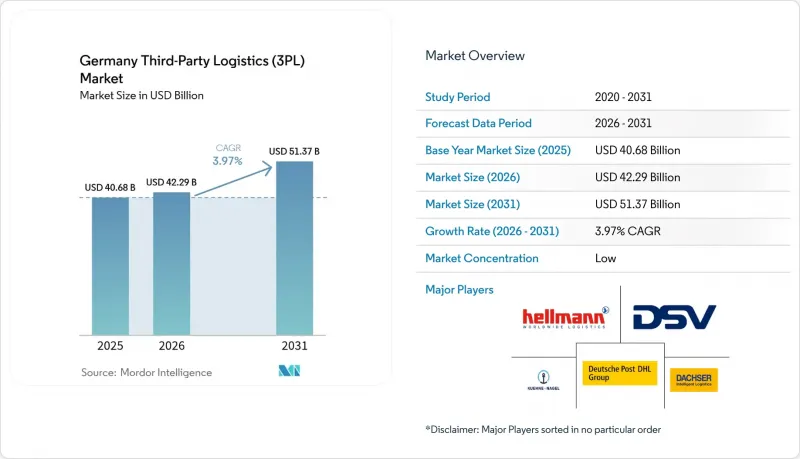
據 Mordor Intelligence 稱,2025 年德國第三方物流(3PL) 市場價值為 406.8 億美元,預計到 2031 年將達到 513.7 億美元,而 2026 年為 422.9 億美元,預測期(2026-2031 年)的複合年成長率為 3.97%。
本報告按服務類型(國內運輸管理、國際運輸管理及其他)、最終用戶(汽車、能源和公共產業、製造業及其他)、物流模式(輕資產、重資產、混合模式)以及所在州(北萊茵-威斯特法倫州、巴伐利亞州及其他)進行分類。市場預測以美元計價。
德國第三方物流(3PL) 市場的趨勢與洞察
電子商務小包裹量激增至疫情前水準。
隨著消費者將偏好購買轉向線上,小包裹需求持續超過2019年的基準值。智慧型手機支付佔所有交易的57%,迫使履約網路適應更小、更快的配送需求。德國平均1.44天的配送時間和94.39%的首次送達成功率鞏固了其作為理想物流樞紐的地位。 DHL每天處理670萬個國內小包裹,並力爭實現電子商務銷售額5%以上的年成長率,這表明現有運營商正在將資源從日漸衰落的郵政服務轉移到小包裹物流。隨著小包裹集中到郊區和農村地區,最後一公里配送能力的可擴展性仍然是一項決定性的競爭優勢。
透過全通路零售促進庫存多元化
為了兌現隔天送達的承諾,零售商現在正將庫存分散到多個微型倉配中心。 REWE斥資2.75億美元興建的馬格德堡中心便是這項轉型的典型代表。該中心佔地49,500平方公尺,自動化程度達50%,每日處理小包裹量高達286,000件。雖然分散式配送中心縮短了前置作業時間,但也增加了計畫的複雜性,迫使零售商將庫存視覺化和分配業務外包。資產規模較小的第三方物流(3PL) 服務商正日益受到青睞,他們將共用設施與先進的倉庫管理系統 (WMS) 和分析功能相結合,使零售商能夠在無需擁有倉庫的情況下靈活調整處理能力。
卡車駕駛人結構性短缺(超過8萬個職缺)
由於25歲以下的司機佔比不到3%,且司機流失率高於新增招聘率,運輸業者正面臨運能短缺的困境。配送路線延誤和運費飆升導致每年高達110億美元的經濟損失。歐盟以外司機面臨的監管障礙以及生活方式方面的顧慮阻礙了新司機的加入,迫使第三方物流公司提高工資並加大對員工保留福利的投入。大型業者正透過自動駕駛場內牽引車和路線最佳化來緩解這一影響,但小規模公司則面臨利潤率下降和被市場淘汰的風險。
細分市場分析
預計到2025年,國內運輸管理將佔德國第三方物流市場收入的38.45%,凸顯了德國第三方物流市場的規模。德國擁有13,000公里的高速公路網路和密集的產業叢集,為其發展提供了有力支撐。常規的貨物整合和整車運輸為歐盟內部的出口生產和供應鏈提供了支持。同時,隨著零售商庫存多元化和製造商對後續服務的需求不斷成長,「增值倉儲和物流」預計將以每年6.55%的速度成長至2031年。這種轉變導致德國第三方物流市場中基於設施的服務佔有率不斷增加,供應商維修其設施,以實施穿梭車系統、語音引導揀貨、溫控區等技術。
自動化和即時視覺化正在重新定義服務邊界。像Rhenus這樣的承運商重新設計了其樞紐物流流程,使網路運輸時間縮短了34%,這表明IT驅動的路線規劃可以在不增加車輛數量的情況下提高運輸能力。客戶對與運輸相關的倉儲營運的需求日益成長,並期望獲得包含單一發票的端到端解決方案。因此,第三方物流公司正在將貨物整合、交叉轉運和最後一公里配送整合到統一的合約中,模糊了傳統運輸和倉儲之間的界限。
其他福利
- Excel格式的市場預測(ME)表
- 3個月的分析師支持
目錄
第1章:引言
- 研究假設和市場定義
- 調查範圍
第2章:調查方法
第3章執行摘要
第4章 市場狀況
- 市場概覽
- 市場促進因素
- 電子商務小包裹量激增至疫情前水準。
- 透過全通路零售促進庫存多元化
- 英國脫歐後,由於路線變化,跨境B2C交易量增加。
- 德國最低工資提高 12 歐元後,自動化投資報酬率提升。
- 透過與環境、社會及公司治理(ESG)掛鉤的融資方式,促進環保型倉庫維修。
- 由於德國聯邦國防軍的重新武裝計劃,國防後勤成本增加。
- 市場限制因素
- 卡車駕駛人結構性短缺(超過8萬個職缺)
- 高昂的電費限制了低溫運輸產能的擴張。
- 更嚴格的周日貨車運營禁令使路網規劃更加複雜。
- 由於外包業務轉移到中東歐地區,國內第三方物流樞紐的處理量下降。
- 價值供應鏈分析
- 監理情勢
- 技術展望
- 波特五力模型
- 地緣政治與疫情的影響
第5章 市場規模與成長預測
- 按服務
- 國內運輸管理(DTM)
- 路
- 鐵路
- 航空
- 水路
- 國際運輸管理(ITM)
- 路
- 鐵路
- 航空
- 水路
- 加值倉儲與物流 (VAWD)
- 國內運輸管理(DTM)
- 最終用戶
- 車
- 能源與公共產業
- 製造業
- 生命科學與醫療保健
- 技術與電子
- 電子商務
- 消費品和日常消費品(FMCG)
- 飲食
- 其他
- 物流模型
- 輕資產(託管)
- 資產密集型企業(公司擁有車輛和倉庫)
- 混合型
- 德國各州
- 北萊茵-威斯特法倫州
- 巴伐利亞
- 巴登-符騰堡州
- 其他州
第6章 競爭情勢
- 市場集中度
- 策略趨勢
- 市佔率分析
- 公司簡介
- DHL Group
- Dachser
- Kuehne+Nagel
- DSV
- Hellmann Worldwide Logistics
- FIEGE Logistics
- Rhenus Logistics
- UPS Supply Chain Solutions Inc.
- FedEx
- HAVI Logistics
- Honold Logistik
- APL Logistics
- Geodis
- Arvato
- BLG Logistics Group
- Rohlig Logistics
- Seifert Logistics Group
- Bollore Logistics
- ID Logistics Group
- Scan Global Logistics
第7章 市場機會與未來展望
According to Mordor Intelligence, the Germany third-Party logistics market size was valued at USD 40.68 billion in 2025 and estimated to grow from USD 42.29 billion in 2026 to reach USD 51.37 billion by 2031, at a CAGR of 3.97% during the forecast period (2026-2031).
This report is Segmented by Service (Domestic Transportation Management, International Transportation Management, and More), by End User (Automotive, Energy & Utilities, Manufacturing, and More), by Logistics Model (Asset-Light, Asset-Heavy, Hybrid), and by States (North Rhine-Westphalia, Bavaria, and More). The Market Forecasts are Provided in Terms of Value (USD).
Germany Third-Party Logistics (3PL) Market Trends and Insights
E-commerce Parcel Volumes Surge Beyond Pre-Pandemic Baseline
Parcel demand continues to outpace 2019 benchmarks as consumers shift more discretionary purchases online. Smartphones drive 57% of checkouts, forcing fulfillment networks to accommodate smaller, faster deliveries. Germany's average 1.44-day transit time and 94.39% first-attempt delivery success entrench the country as a preferred distribution base. DHL processes 6.7 million domestic parcels daily and targets over 5% annual e-commerce revenue growth, illustrating how incumbent operators redirect resources from declining mail toward parcel logistics. Scalability in last-mile capacity remains a decisive competitive lever as parcel density spreads across suburban and rural zones.
Omnichannel Retail Drives Inventory Decentralization
Retailers now split stock across multiple micro-fulfillment locations to meet next-day commitments. REWE's USD 275 million Magdeburg center embodies this pivot, operating 49,500 m2 with 50% automation and throughput of 286,000 daily packages. Distributed nodes shorten lead times but multiply planning complexity, pushing merchants to outsource visibility and allocation tasks. Asset-Light 3PLs gain traction by layering advanced WMS and analytics over shared facilities, enabling retailers to flex capacity without owning warehouses.
Structural Truck-Driver Shortage (More than 80,000 Vacancies)
With fewer than 3% of drivers under 25, retirements outpace recruits, leaving fleets short of capacity. Annual economic drag hits USD 11 billion as routes are deferred or priced higher. Regulatory hurdles for non-EU drivers and lifestyle concerns depress new entries, forcing 3PLs to increase wages and invest in retention amenities. Larger operators buffer the impact with autonomous yard tractors and optimized routing, whereas small firms face margin compression and the risk of exit.
Other drivers and restraints analyzed in the detailed report include:
- Rising Cross-Border B2C Flows Post-Brexit Rerouting
- Automation ROI Improves with USD 13.2 Minimum Wage
- High Electricity Tariffs Limit Cold-Chain Capacity Expansion
For complete list of drivers and restraints, kindly check the Table Of Contents.
Segment Analysis
Domestic Transportation Management contributed 38.45% to 2025 revenue, underlining the Germany third-party logistics market size derived from the country's 13,000-km Autobahn grid and dense industrial clusters. Regular groupage and full-truckload moves support export production and intra-EU supply chains. Meanwhile, Value-Added Warehousing & Distribution is projected to grow 6.55% annually through 2031 as retailers decentralize inventory and manufacturers demand postponement services. This shift raises the Germany third-party logistics market share of facility-based offerings, encouraging providers to retrofit space with shuttle systems, voice-directed picking, and temperature-controlled zones.
Automation and real-time visibility reshape service boundaries. Carriers such as Rhenus trimmed network transit times by 34% after redesigning hub flows, proving that IT-enabled routing can unlock capacity without expanding fleets. Clients increasingly request transport-related warehousing, expecting single-invoice, end-to-end solutions. Consequently, 3PLs bundle consolidation, cross-dock, and final-mile under unified contracts, blurring the lines between legacy transport and storage segments.
Complete Report Scope:
- By Service
- Domestic Transportation Management (DTM)
- Roadways
- Railways
- Airways
- Waterways
- International Transportation Management (ITM)
- Roadways
- Railways
- Airways
- Waterways
- Value-Added Warehousing & Distribution (VAWD)
- Domestic Transportation Management (DTM)
- By End User
- Automotive
- Energy & Utilities
- Manufacturing
- Life Sciences & Healthcare
- Technology & Electronics
- E-commerce
- Consumer Goods & FMCG
- Food & Beverages
- Others
- By Logistics Model
- Asset-Light (Management-Based)
- Asset-Heavy (Own Fleet & Warehouses)
- Hybrid
- By States - Germany (Value)
- North Rhine-Westphalia
- Bavaria (Bayern)
- Baden-Wurttemberg
- Rest of States
List of Companies Covered in this Report:
- DHL Group
- Dachser
- Kuehne + Nagel
- DSV
- Hellmann Worldwide Logistics
- FIEGE Logistics
- Rhenus Logistics
- UPS Supply Chain Solutions Inc.
- FedEx
- HAVI Logistics
- Honold Logistik
- APL Logistics
- Geodis
- Arvato
- BLG Logistics Group
- Rohlig Logistics
- Seifert Logistics Group
- Bollore Logistics
- ID Logistics Group
- Scan Global Logistics
Additional Benefits:
- The market estimate (ME) sheet in Excel format
- 3 months of analyst support
TABLE OF CONTENTS
1 Introduction
- 1.1 Study Assumptions & Market Definition
- 1.2 Scope of the Study
2 Research Methodology
3 Executive Summary
4 Market Landscape
- 4.1 Market Overview
- 4.2 Market Drivers
- 4.2.1 E-commerce parcel volumes surge beyond pre-pandemic baseline
- 4.2.2 Omnichannel retail drives inventory decentralisation
- 4.2.3 Rising cross-border B2C flows post-Brexit rerouting
- 4.2.4 Automation ROI improves with Germany's EUR 12 minimum wage hikes
- 4.2.5 ESG-linked loans incentivise green warehousing retrofits
- 4.2.6 Bundeswehr re-armament programme lifts defence-logistics spend
- 4.3 Market Restraints
- 4.3.1 Structural truck-driver shortage (>80 000 vacancies)
- 4.3.2 High electricity tariffs limit cold-chain capacity expansion
- 4.3.3 Strict Sunday truck-ban complicates network planning
- 4.3.4 Near-shoring to CEE shifts volumes out of domestic 3PL hubs
- 4.4 Value / Supply-Chain Analysis
- 4.5 Regulatory Landscape
- 4.6 Technological Outlook
- 4.7 Porter's Five Forces
- 4.7.1 Threat of New Entrants
- 4.7.2 Bargaining Power of Suppliers
- 4.7.3 Bargaining Power of Buyers
- 4.7.4 Threat of Substitutes
- 4.7.5 Industry Rivalry
- 4.8 Impact of Geopolitics & Pandemic
5 Market Size & Growth Forecasts (Value)
- 5.1 By Service
- 5.1.1 Domestic Transportation Management (DTM)
- 5.1.1.1 Roadways
- 5.1.1.2 Railways
- 5.1.1.3 Airways
- 5.1.1.4 Waterways
- 5.1.2 International Transportation Management (ITM)
- 5.1.2.1 Roadways
- 5.1.2.2 Railways
- 5.1.2.3 Airways
- 5.1.2.4 Waterways
- 5.1.3 Value-Added Warehousing & Distribution (VAWD)
- 5.1.1 Domestic Transportation Management (DTM)
- 5.2 By End User
- 5.2.1 Automotive
- 5.2.2 Energy & Utilities
- 5.2.3 Manufacturing
- 5.2.4 Life Sciences & Healthcare
- 5.2.5 Technology & Electronics
- 5.2.6 E-commerce
- 5.2.7 Consumer Goods & FMCG
- 5.2.8 Food & Beverages
- 5.2.9 Others
- 5.3 By Logistics Model
- 5.3.1 Asset-Light (Management-Based)
- 5.3.2 Asset-Heavy (Own Fleet & Warehouses)
- 5.3.3 Hybrid
- 5.4 By States - Germany (Value)
- 5.4.1 North Rhine-Westphalia
- 5.4.2 Bavaria (Bayern)
- 5.4.3 Baden-Wurttemberg
- 5.4.4 Rest of States
6 Competitive Landscape
- 6.1 Market Concentration
- 6.2 Strategic Moves
- 6.3 Market Share Analysis
- 6.4 Company Profiles (includes Global level Overview, Market level overview, Core Segments, Financials as available, Strategic Information, Market Rank/Share for key companies, Products & Services, and Recent Developments)
- 6.4.1 DHL Group
- 6.4.2 Dachser
- 6.4.3 Kuehne + Nagel
- 6.4.4 DSV
- 6.4.5 Hellmann Worldwide Logistics
- 6.4.6 FIEGE Logistics
- 6.4.7 Rhenus Logistics
- 6.4.8 UPS Supply Chain Solutions Inc.
- 6.4.9 FedEx
- 6.4.10 HAVI Logistics
- 6.4.11 Honold Logistik
- 6.4.12 APL Logistics
- 6.4.13 Geodis
- 6.4.14 Arvato
- 6.4.15 BLG Logistics Group
- 6.4.16 Rohlig Logistics
- 6.4.17 Seifert Logistics Group
- 6.4.18 Bollore Logistics
- 6.4.19 ID Logistics Group
- 6.4.20 Scan Global Logistics
7 Market Opportunities & Future Outlook

 第三方物流(3PL) 市場:依服務類型、運輸方式、最終用戶和地區分類
 美國零售第三方物流:市場佔有率分析、行業趨勢和統計數據、成長預測(2026-2031 年)零售第三方物流:市場佔有率分析、產業趨勢與統計、成長預測(2026-2031)英國第三方物流(3PL):市場佔有率分析、產業趨勢與統計數據以及成長預測 (2026-2031)印度第三方物流:市場佔有率分析、產業趨勢與統計及成長預測(2026-2031)法國第三方物流(3PL):市場佔有率分析、產業趨勢與統計及成長預測 (2026-2031)
 LLM精細化服務市場規模、佔有率、成長及全球產業分析、區域趨勢及2026年至2034年預測
 第三方化學品分銷市場:全球市場預測,2026-2032年第三方物流軟體市場:全球市場預測,2026-2032年第三方物流市場-2026-2032年全球市場預測