


 |
市場調查報告書
商品編碼
2114948
法國第三方物流(3PL):市場佔有率分析、產業趨勢與統計及成長預測 (2026-2031)France Third-Party Logistics (3PL) - Market Share Analysis, Industry Trends & Statistics, Growth Forecasts (2026 - 2031) |
||||||

※ 本網頁內容可能與最新版本有所差異。詳細情況請與我們聯繫。
根據 Mordor Intelligence 預測,法國第三方物流(3PL) 市場規模預計將從 2025 年的 295.7 億美元成長到 2026 年的 308.2 億美元,然後在 2031 年達到 379.1 億美元,2026 年至 2031 年的複合年成長率為 4.23%。
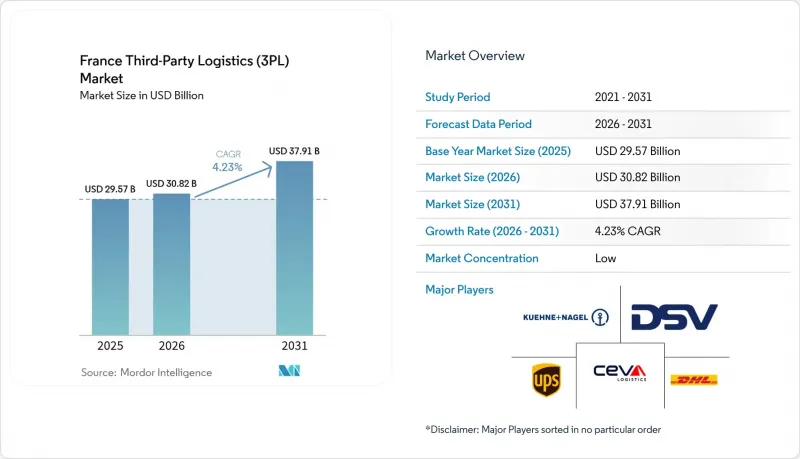
本報告按服務(國內運輸管理(公路、鐵路、航空、水路及其他)、最終用戶(汽車、能源和公共產業、製造業、生命科學和醫療保健、技術和電子及其他)物流模式(輕資產、重資產和混合模式)進行細分。市場預測以美元計價。
法國第三方物流(3PL) 市場的趨勢與洞察
電子商務履約需求激增
法國零售業向線上市場的快速轉型給「最後一公里」運輸能力帶來了巨大壓力,迫使第三方物流公司重新設計其城市網路,以電動貨車、微型配送中心和宅配櫃為核心,而非僅僅追求速度。目前,70%的法國網購消費者傾向於選擇低排放的配送方式,這迫使物流供應商在永續性和服務成本之間尋求平衡。預計到2030年,二手經濟的興起將使市場規模達到140億歐元,這推動了對逆向物流和品質控制需求的成長,促使零售商從基礎運輸服務轉向增值倉儲解決方案。雖然時尚品類的線上滲透率仍然最高,但食品雜貨和家居用品品類正在縮小差距,進一步提升了對溫控城市設施的需求。這些變化共同解釋了為什麼在法國第三方物流市場中,倉儲和物流服務的成長速度超過了核心的卡車運輸。
擴大歐盟內部跨境貿易
英國脫歐後,法國已成為歐洲大陸貿易流量的核心。連接北部製造業帶與地中海沿岸港口的多模態投資為此提供了強大支撐。將於2025年9月生效的強制性ELO數位信封系統將實現滾裝貨物(RoRo)海關單證流程的自動化,從而縮短等待時間,並促進中小型第三方物流營運商拓展國際航線。一條源自印度-中東-歐洲舉措的新運輸走廊將指定法國港口為進入歐洲大陸的首站,這將推動長途貨運代理和清關服務的需求。 2025-2026年政府戰略文件包括為智慧邊境技術和A1及A16高速公路沿線的低碳卡車停車場提供資金。隨著近岸外包的興起,托運人對位於加萊和里爾的綜合倉庫的需求日益成長,這些倉庫能夠在24小時內服務於法國國內市場和比荷盧經濟聯盟市場。
司機短缺和人事費用飆升
全美範圍內,卡車駕駛人空缺超過5萬個,儘管需求回升,但運輸能力仍受限。倉儲業也面臨類似的壓力,72%的業者表示招募困難,85%的業者表示留住員工困難。這種財務壓力也反映在破產申請的數量上,光是2024年第一季就有486家物流公司進入破產程序。這是自2008-2009年金融危機以來前所未有的水準。燃油價格波動和定價權有限進一步擠壓了本已微薄的利潤空間,尤其是對於那些缺乏自動化所需資金的中小型企業而言。雖然這些壓力正在加速機器人技術的應用,但除非輔以整合和路線最佳化軟體,否則資產密集型車隊的投資回收期預計仍將很長。
細分市場分析
2025年,「國內運輸管理」細分市場在法國第三方物流市場佔有率中佔42.65%,這得益於法國完善的高速公路網路和消費者對公路貨運的持續偏好。然而,該細分市場的中個位數成長率低於「增值倉儲物流」細分市場,後者6.85%的複合年成長率反映了SKU數量的增加、全通路訂單的成長以及交貨時間的縮短。國際運輸管理仍然容易受到地緣政治不確定性的影響,但預計從2026年起,由於ELO海關配額以及西班牙和義大利之間新的鐵路連接,其運輸量將有所成長。
法國第三方物流(3PL) 產業正從簡單的運輸服務轉向一體化的生命週期管理。零售商要求提供諸如倉庫內套件組裝、個人化客製化和退貨分類等服務,進一步將 3PL 融入下游客戶體驗。這種多層次的服務為額外收費提供了基礎,並強化了長期契約,從而緩解了純幹線運輸利潤率面臨的壓力。同時,政府補貼正重新運作鐵路運輸,也惠及多式聯運的貨運量。 MEDLOG 的巴黎樞紐計劃在 2027 年實現年吞吐量 100 萬標準箱,這將有助於實現減排目標並改善區域運輸能力平衡。
其他福利
- Excel格式的市場預測(ME)表
- 3個月的分析師支持
目錄
第1章:引言
- 研究假設和市場定義
- 調查範圍
第2章:調查方法
第3章執行摘要
第4章 市場狀況
- 市場概覽
- 市場促進因素
- 電子商務履約需求激增
- 歐盟內部跨境貿易的擴張
- 法國製造業外包趨勢
- 醫藥和食品領域低溫運輸的擴展
- 利用5G技術的倉庫自動化試點項目
- 鐵路貨運的振興將促進多式聯運第三方物流的發展。
- 市場限制因素
- 促進要素短缺和人事費用上升
- 遵守嚴格的碳排放法規的成本
- 都市區高密度區域實施貨車交通管制
- 英國脫歐後加萊港和英吉利海峽港口的變化
- 價值供應鏈分析
- 監理情勢
- 技術展望
- 波特五力模型
- 倉儲業的整體趨勢
- 來自 CEP、最後一公里和低溫運輸的需求
- 對電子商務業務的洞察
第5章 市場規模與成長預測
- 按服務
- 國內運輸管理(DTM)
- 路
- 鐵路
- 航空旅行
- 水路
- 國際運輸管理(ITM)
- 路
- 鐵路
- 空中航線
- 水路
- 加值倉儲和物流(VAWD)
- 國內運輸管理(DTM)
- 最終用戶
- 車
- 能源與公共產業
- 製造業
- 生命科學與醫療保健
- 技術與電子
- 電子商務
- 消費品和快速消費品
- 飲食
- 其他
- 物流模型
- 輕資產(託管)
- 資產密集型(公司車輛和倉庫)
- 混合
第6章 競爭情勢
- 市場集中度
- 策略趨勢
- 市佔率分析
- 公司簡介
- Bansard International
- SEKO Logistics
- DSV
- DHL Group
- GEFCO
- GEODIS
- ID Logistics
- Dimotrans Group
- Schneider
- XPO Logistics
- Kuehne+Nagel
- CEVA Logistics
- FM Logistic
- DACHSER France
- Rhenus Logistics
- United Parcel Service, Inc.
- Nippon Express
- Groupe CAT
- Dimotrans Group
- STEF
第7章 市場機會與未來展望
According to Mordor Intelligence, the France third-Party logistics market size is expected to grow from USD 29.57 billion in 2025 to USD 30.82 billion in 2026 and is forecast to reach USD 37.91 billion by 2031 at 4.23% CAGR over 2026-2031.
This report is Segmented by Service (Domestic Transportation Management (Roadways, Railways, Airways, Waterways), and More), End User (Automotive, Energy & Utilities, Manufacturing, Life Sciences & Healthcare, Technology & Electronics, and More), Logistics Model (Asset-Light, Asset-Heavy, Hybrid). The Market Forecasts are Provided in Terms of Value (USD).
France Third-Party Logistics (3PL) Market Trends and Insights
Surge in E-commerce Fulfillment Demand
France's rapid online retail migration is stretching last-mile capacity, prompting 3PLs to redesign city-center networks around electric vans, micro-hubs, and parcel lockers rather than pure speed. Seventy percent of French online shoppers now prefer low-emission delivery options, pushing providers to balance sustainability and service costs. The resale economy's climb toward a €14 billion valuation by 2030 intensifies reverse logistics and inspection needs, steering retailers toward value-added warehouse solutions instead of basic transport. Fashion continues to post the deepest online penetration, yet grocery and homeware categories are closing the gap, further lifting demand for temperature-controlled urban facilities. Together, these shifts explain why warehousing and distribution services outpace core trucking within the France third-party logistics market.
Growing Intra-EU Cross-Border Trade
Post-Brexit rerouting places France at the center of mainland trade flows, supported by multimodal investments that connect Northern manufacturing belts to Mediterranean ports. The mandatory ELO digital envelope, effective September 2025, automates customs paperwork for roll-on/roll-off freight, trimming wait times and encouraging smaller 3PLs to add international lanes. New corridors stemming from the India-Middle East-Europe initiative will designate French ports as the first continental landing points, raising long-haul forwarding and customs brokerage demand. Government strategy papers for 2025-2026 earmark funding for smart-border technology and low-carbon truck parking along the A1 and A16 highways. As near-shoring expands, shippers increasingly request integrated warehousing in Calais and Lille that can service both domestic and Benelux markets within 24 hours.
Driver Shortage & Mounting Labor Costs
Unfilled truck positions surpass 50,000 nationwide, constraining capacity even as demand rebounds. Warehouses feel parallel stress, with 72% of operators citing recruitment difficulties and 85% flagging retention challenges. The financial strain shows in insolvency filings-486 logistics firms entered administration during Q1 2024 alone, a level unseen since the 2008-2009 crisis. Fuel volatility and limited pricing power compress already thin margins, especially for smaller operators that lack automation capital. These pressures invite accelerated robotics adoption, but payback periods remain lengthy for asset-heavy fleets unless complemented by densification and route-optimization software.
Other drivers and restraints analyzed in the detailed report include:
- Outsourcing Focus of French Manufacturers
- Expansion of Cold-Chain in Pharma & Food
- Stringent Carbon-Emissions Compliance Costs
For complete list of drivers and restraints, kindly check the Table Of Contents.
Segment Analysis
Domestic Transportation Management contributed 42.65% of France third-party logistics market share in 2025, buoyed by dense motorway coverage and sustained road-freight preference. Yet the segment's mid-single-digit growth is eclipsed by Value-Added Warehousing & Distribution, whose 6.85% CAGR echoes rising SKU counts, omnichannel order profiles, and shrinking delivery windows. International Transportation Management remains vulnerable to geopolitical uncertainty, though the ELO customs envelope and fresh rail links to Spain and Italy are expected to lift volumes from 2026 onward.
The France third-party logistics industry is shifting from transactional trucking to integrated lifecycle stewardship. Retailers request kitting, personalization, and returns grading inside warehouses, embedding 3PLs deeper into the downstream customer experience. This service layering underpins incremental fees and fortifies long-term contracts, offsetting margin squeezes in pure line-haul. Meanwhile, intermodal volumes benefit as government subsidies rekindle rail; MEDLOG's Paris hub plans to process one million TEUs per year by 2027, supporting emission-cutting objectives and enhancing regional capacity balance.
Complete Report Scope:
- By Service
- Domestic Transportation Management (DTM)
- Roadways
- Railways
- Airways
- Waterways
- International Transportation Management (ITM)
- Roadways
- Railways
- Airways
- Waterways
- Value-Added Warehousing & Distribution (VAWD)
- Domestic Transportation Management (DTM)
- By End User
- Automotive
- Energy & Utilities
- Manufacturing
- Life Sciences & Healthcare
- Technology & Electronics
- E-commerce
- Consumer Goods & FMCG
- Food & Beverages
- Others
- By Logistics Model
- Asset-Light (Management-Based)
- Asset-Heavy (Own Fleet & Warehouses)
- Hybrid
List of Companies Covered in this Report:
- Bansard International
- SEKO Logistics
- DSV
- DHL Group
- GEFCO
- GEODIS
- ID Logistics
- Dimotrans Group
- Schneider
- XPO Logistics
- Kuehne + Nagel
- CEVA Logistics
- FM Logistic
- DACHSER France
- Rhenus Logistics
- United Parcel Service, Inc.
- Nippon Express
- Groupe CAT
- Dimotrans Group
- STEF
Additional Benefits:
- The market estimate (ME) sheet in Excel format
- 3 months of analyst support
TABLE OF CONTENTS
1 Introduction
- 1.1 Study Assumptions & Market Definition
- 1.2 Scope of the Study
2 Research Methodology
3 Executive Summary
4 Market Landscape
- 4.1 Market Overview
- 4.2 Market Drivers
- 4.2.1 Surge in e-commerce fulfilment demand
- 4.2.2 Growing intra-EU cross-border trade
- 4.2.3 Outsourcing focus of French manufacturers
- 4.2.4 Expansion of cold-chain in pharma & food
- 4.2.5 5G-enabled warehouse automation pilots
- 4.2.6 Rail-freight revitalisation boosting intermodal 3PL
- 4.3 Market Restraints
- 4.3.1 Driver shortage & mounting labour costs
- 4.3.2 Stringent carbon-emissions compliance costs
- 4.3.3 Urban consolidation-zone truck restrictions
- 4.3.4 Post-Brexit volatility at Calais & Channel ports
- 4.4 Value/Supply-Chain Analysis
- 4.5 Regulatory Landscape
- 4.6 Technological Outlook
- 4.7 Porter's Five Forces
- 4.7.1 Bargaining Power of Suppliers
- 4.7.2 Bargaining Power of Buyers
- 4.7.3 Threat of New Entrants
- 4.7.4 Threat of Substitutes
- 4.7.5 Competitive Rivalry
- 4.8 General Trends in Warehousing
- 4.9 Demand from CEP, Last-mile, Cold-chain
- 4.10 Insights on e-Commerce Business
5 Market Size & Growth Forecasts (Value)
- 5.1 By Service
- 5.1.1 Domestic Transportation Management (DTM)
- 5.1.1.1 Roadways
- 5.1.1.2 Railways
- 5.1.1.3 Airways
- 5.1.1.4 Waterways
- 5.1.2 International Transportation Management (ITM)
- 5.1.2.1 Roadways
- 5.1.2.2 Railways
- 5.1.2.3 Airways
- 5.1.2.4 Waterways
- 5.1.3 Value-Added Warehousing & Distribution (VAWD)
- 5.1.1 Domestic Transportation Management (DTM)
- 5.2 By End User
- 5.2.1 Automotive
- 5.2.2 Energy & Utilities
- 5.2.3 Manufacturing
- 5.2.4 Life Sciences & Healthcare
- 5.2.5 Technology & Electronics
- 5.2.6 E-commerce
- 5.2.7 Consumer Goods & FMCG
- 5.2.8 Food & Beverages
- 5.2.9 Others
- 5.3 By Logistics Model
- 5.3.1 Asset-Light (Management-Based)
- 5.3.2 Asset-Heavy (Own Fleet & Warehouses)
- 5.3.3 Hybrid
6 Competitive Landscape
- 6.1 Market Concentration
- 6.2 Strategic Moves
- 6.3 Market Share Analysis
- 6.4 Company Profiles (includes Global level Overview, Market level overview, Core Segments, Financials as available, Strategic Information, Market Rank/Share for key companies, Products & Services, and Recent Developments)
- 6.4.1 Bansard International
- 6.4.2 SEKO Logistics
- 6.4.3 DSV
- 6.4.4 DHL Group
- 6.4.5 GEFCO
- 6.4.6 GEODIS
- 6.4.7 ID Logistics
- 6.4.8 Dimotrans Group
- 6.4.9 Schneider
- 6.4.10 XPO Logistics
- 6.4.11 Kuehne + Nagel
- 6.4.12 CEVA Logistics
- 6.4.13 FM Logistic
- 6.4.14 DACHSER France
- 6.4.15 Rhenus Logistics
- 6.4.16 United Parcel Service, Inc.
- 6.4.17 Nippon Express
- 6.4.18 Groupe CAT
- 6.4.19 Dimotrans Group
- 6.4.20 STEF
7 Market Opportunities & Future Outlook
- 7.1 White-space & Unmet-Need Assessment

 第三方物流(3PL) 市場:依服務類型、運輸方式、最終用戶和地區分類
 美國零售第三方物流:市場佔有率分析、行業趨勢和統計數據、成長預測(2026-2031 年)零售第三方物流:市場佔有率分析、產業趨勢與統計、成長預測(2026-2031)英國第三方物流(3PL):市場佔有率分析、產業趨勢與統計數據以及成長預測 (2026-2031)印度第三方物流:市場佔有率分析、產業趨勢與統計及成長預測(2026-2031)德國第三方物流(3PL):市場佔有率分析、產業趨勢與統計及成長預測 (2026-2031)
 LLM精細化服務市場規模、佔有率、成長及全球產業分析、區域趨勢及2026年至2034年預測
 第三方化學品分銷市場:全球市場預測,2026-2032年第三方物流軟體市場:全球市場預測,2026-2032年第三方物流市場-2026-2032年全球市場預測